Key Highlights
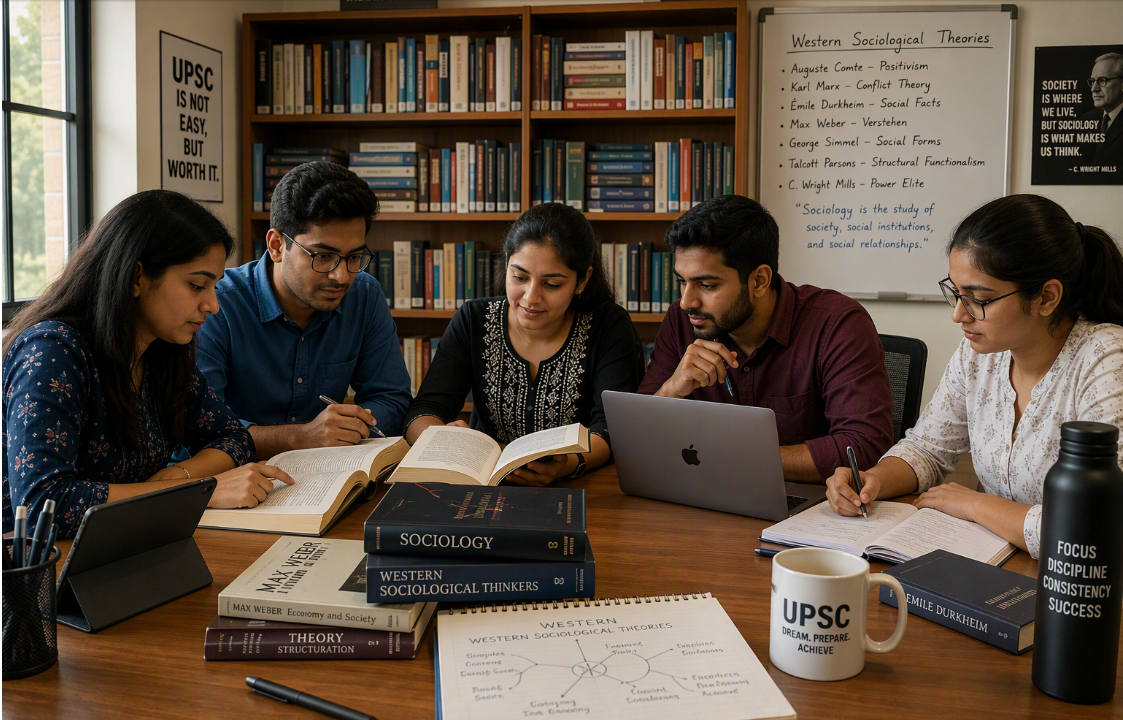
- Karl Marx, Max Weber, and Emile Durkheim are seen as the main names in western sociology for UPSC Sociology.
- These sociological thinkers help you read the syllabus through theory, not just facts.
- Karl Marx tells us about class struggle. Max Weber explains social action. Emile Durkheim tells us about social order.
- People like Robert Merton, Talcott Parsons, and George Herbert Mead are also important for you now.
- A good answer for UPSC sociology should link western sociology to examples from Indian society.
- Smart note-making and answer writing will help you use these thinkers well to get a good score.
Table of Contents
Introduction
If you want to get ready for UPSC Sociology, you should not think of western sociology as just another chapter. It is the base of the whole subject. Every big sociological theory helps you look at things like religion, inequality, family, politics, and social change in a better way. This is why western thinkers are a very important part of upsc sociology. When you know their ideas well, your answers can be more clear, direct, and easy for the examiner to read and give marks to.
Understanding the Role of Western Thinkers in UPSC Sociology
Western sociological thinkers are not just names from the sociology syllabus. You see their ideas again and again in many topics. When you read about social movements, politics, religion, or how people are split by class, these sociological thinkers help you understand why society is the way it is.
For UPSC sociology, this is very important. Good answers need clear ideas. They do not just depend on what people feel or say. Karl Marx matters a lot in this subject. He helps you look at class conflict and understand why there is inequality. In the next sections, you will find out why these thinkers matter. You will also learn where they are in the syllabus. You will see how to use them when you write your answers for UPSC sociology.
Why Western Sociological Thinkers Matter for UPSC Aspirants
To do well in upsc sociology, you need more than just short notes of each chapter. You should know the language that is used in sociology. Sociological thinkers are important for this. They give you ideas, simple words, and help you see how things connect. This will make your answers feel better than a normal General Studies answer.
Think of these ideas as tools you can use. Karl Marx can help you talk about class struggle, poverty, and work. With Emile Durkheim, you can talk about social order, how people feel close to each other, and how religion works in society. Max Weber helps you see things like bureaucracy, status groups, and why the people do social action. You can use all three—Karl Marx, Emile Durkheim, and Max Weber—for Paper I and also when you need to write about Indian society in Paper II.
This is why people who are new to this should not read the thinkers chapter by itself. When you read a theory, try to use it for indian society topics. Ask yourself simple questions. For example, what does Marx say about economic structures? What does Weber say about status? What does Durkheim say about the way people stick together? This practice can help you remember things better. It can also help you answer questions well.
Relevance of Western Thinkers in UPSC Syllabus
The sociology syllabus puts western thinkers in the front. They shape what people learn in this subject. In Paper I, you read about both old and new theorists. You should know their main ideas in a clear way. This is not just something extra to read. It is part of the main topics for upsc sociology.
Past question patterns usually focus on the big ideas from these thinkers. They do not often ask for small facts about their life. Most of the time, you get questions on topics like conflict theory, social action, bureaucracy, anomie, or manifest functions. So, you need to know these big ideas of each thinker and how people use them. Do not only learn what they mean; try to understand how they are used in different ways.
The best way to read the syllabus is to link each part to a sociological theory. For example, you can connect stratification to Marx and Weber. When reading about religion, think of Durkheim and Weber. Social order goes with Parsons and Durkheim. If you study in this way, it will be easier to understand and check the previous year question trends. This method helps you remember each sociological theory and how they link to the syllabus.
Integrating Western Theories in Answer Writing
Good answer writing in upsc sociology means you need to use sociological theory when you talk about any topic. If you just write about things like poverty, religion, or caste and do not bring in any theory, your answer will only talk about facts. A good answer looks deeper by using theory and gives more thought on the topic. The person who checks your paper will give you more marks for this.
You do not need to use many names in your answer. It is better to pick one thinker and talk about one or two ideas that match the question. For example, you can use Marx when you talk about class conflict. Pick Durkheim if you want to explain a social fact. Use Weber if you talk about status groups or how people act in groups, or even when speaking about bureaucracy. After you pick the idea, make sure you link it back to what the question asks.
A simple method can help:
- Begin with the idea and name the person who came up with it.
- Link this idea to the question’s problem.
- If possible, give an example from indian society.
- End by comparing it with something else or saying what problem is still there if that works.
Classical Western Sociologists: Foundations for UPSC Preparation
Any short look at western thinkers for UPSC Sociology starts with Karl Marx, Emile Durkheim, and Max Weber. These three are at the heart of this field. A lot of later talks in sociology start with what they said. Their work helps build the ideas in conflict theory and functionalism. Also, what they said helps us see how people understand society.
Each one lets you see society in a different way. Marx talks about class struggle and tells you how people act inside economic structures. Durkheim shows how group life stays together and explains what a social fact is. Weber looks at meaning, authority, and how people work in big groups, like government offices. All of them help you get ready to read more, and the next three sections go over each thinker in a simple way.
Karl Marx – Core Ideas and Conflict Theory
Karl Marx is an important name you need to know for upsc sociology. He talks about power, work, and why people do not always have the same things in life. In his conflict theory, he says class struggles shape the way people live. Because of this, we can use his ideas to see why there is poverty, how people work, how factories grow, and when people are taken advantage of.
For your exam, try to think of Marx as more than someone who talks about what is wrong with capitalism. He lets you see the world in a full way with his idea called historical materialism. In this idea, the way people work and make things shapes the state, what people believe, and many big groups in society. This is why he is still an important name among western sociological thinkers, mostly for the things he says about the mode of production and historical materialism.
Focus on these core ideas:
- Historical materialism is the idea that history changes because of real things like work, money, and who owns what. People’s lives and the way they think are shaped by how they make and share things.
- A mode of production means the way people make goods and get what they need. This can change over time and helps show how societies are built.
- Class struggle is about the fight between different groups who do not have the same amount of money or power. This fight shapes how the world is and causes change.
- The theory of alienation says when people do not feel connected to their work or what they make, they feel alone or unhappy. This happens when people feel like the work they do is not really their own.
When you use Marx’s ideas, you can see how social change comes about when people do not agree about money and work. His ideas show that class conflict is very important.
Emile Durkheim – Functionalism and Social Solidarity
Emile Durkheim is important to know if you want to see how society can keep order. While Marx spoke about conflict, Durkheim focused more on how the way people work together. He cared a lot about making things stable, and thought there is a strong moral part to how life in a group works. That is why the work of emile durkheim is often linked to functionalism and the way people see social solidarity.
One important thing that Emile Durkheim gave to sociology is the idea of a social fact. He said that social facts are outside of the person, and these can shape how people act. He also spoke about the division of labor. Durkheim used this to show how people move from mechanical solidarity to organic solidarity. This change happens when the society gets bigger and more complex.
For UPSC, Durkheim is very helpful when you write about religion, social cohesion, and the theory of suicide. He said that suicide rates are not just about one person. They are social and you can study and understand them. The theory of suicide lets you talk about this topic in a more sociological way. This makes it simple to use his work in today’s answers.
Max Weber – Interpretive Sociology and Modern Bureaucracy
Max Weber is not like many western thinkers. He did not think society is only about money or economics. In his view, called interpretive sociology, he looks at social action and what people feel or think when they act. This is why Max Weber’s ideas matter for UPSC answers. His way of thinking adds more depth.
He saw inequality as not just about class. Weber talked about status groups to show that honor and respect matter in social stratification. His work on authority, bureaucracy, and rationalization helps you get a clear way to look at modern institutions. This is helpful when you talk about governance and see how things work today.
Another big idea is the protestant ethic and the spirit of capitalism. Weber said that values and ways of thinking have a role in economic development. This helps you see how people’s culture and daily ideas can bring social change. The way he explains it will add both balance and depth to your answer.
Essential Concepts Introduced by Western Thinkers
UPSC questions often focus on key concepts. The questions are not only about the names of thinkers. So, you need to read western sociology and look at ideas like class conflict, social structure, authority, solidarity, and rationalization. These ideas come up a lot. They help shape what we know about sociological theory.
When you know the ideas well, it is easier to look at them again. You can put each idea with the person who made it. You can use these ideas for many answers about social change, inequality, religion, or large groups. The next parts talk about the main ideas you see a lot in UPSC questions.
Social Structure and Class Analysis
Social structure is a basic idea in Sociology. It talks about the roles, places, and links people have in society and how all these work together. Many western thinkers used the idea of social structure to explain how power and jobs are set in society. They say that classes and patterns are something that show up often in the society.
Karl Marx talks about class when he looks at how society runs. He says the mode of production is strongly linked to class conflict. Marx thinks that how people make things and own them shapes the social structure. So, inequality does not just happen by chance or by mistake. It comes from the way production and ownership are put together from the start.
Keywords used: karl marx, mode of production, class conflict, social structure
When you write answers for UPSC, class analysis helps a lot. You should use it when you talk about social stratification, labor, poverty, and social change. To connect these ideas to Indian society, talk about economic structures and how land and farms are split up. Using these points lets you go beyond just explaining things. You can make a clear point about why things happen in a society.
Division of Labor and Collective Consciousness
Among Durkheim’s main thoughts, the idea of division of labour and collective consciousness are very important. He talked about these ideas to show how people stay connected in a society, even if they all do different jobs. This is a simple point. You can use it when you write UPSC answers about modern social life.
Emile Durkheim said that in simple societies, people stay together because they are much alike. In large or complex societies, people feel a link to each other because they need one another to get by. This change helps build togetherness. Emile Durkheim also shared that social cohesion comes from a collective way of thinking. People get their shared moral beliefs from the group, not from each person alone.
These ideas matter a lot. They help us see that social order does not just show up by itself. People make it through norms, institutions, and what is called social fact. When you get a question about social order, religion, or education, these ideas can help you answer. You can also use them to talk about what happens in a place if the rules or ways people do things get weak. It helps when you need to explain how society changes.
Power, Authority, and Rationalization
Max Weber showed us power and authority in a clear way. He said power is not just about using force. It can also come from what people feel is right and fair. There are set rules and ways to run things that keep power in place. If you know this, it is easier to give good answers about the modern state and its rules or groups. Using Max Weber’s ideas can help make your points strong.
Weber’s idea of making things more logical is very useful. He said that people in today’s world now use calculation, rules, and look for efficiency more than before. This change shapes both office life and what we do every day. It gives a clear way to see why many things around us work well, even if they feel less personal.
Key Weber-based points to remember:
- Power can be seen in groups of people and in big organizations.
- Authority is there when people think it should be in charge.
- Rationalization helps rules and systems grow and become used.
- A bureaucracy is linked to legal rules and formal authority.
These ideas often come up in UPSC questions. Sometimes you see them in a clear way, but other times they can be more hidden.
Karl Marx: UPSC-Relevant Contributions and Applications
Karl Marx is still important now. Many UPSC topics look at the problem of inequality, labor, poverty, industrialization, and social change. His ideas help you know how economic structures affect the way people or groups act with each other. These ideas also make it clear why there are conflicts in society and how people feel and think about these problems.
For your preparation, focus on class struggle, historical materialism, and the theory of alienation. These are not just big words. They help you understand what is happening in the world. You can see their effect in jobs today and in Indian problems in society. The next sections will show you how to use Marx’s way of thinking when you answer questions.
Historical Materialism and Social Change
You need to know about the concept of historical materialism for UPSC. Marx said that the things people need to live, like money and work, shape how we make our groups, what we believe, and how we act in politics. In simple words, how people earn and use money makes all other parts of society change. The idea of historical materialism gives a strong way to explain social change.
The main idea here is about the mode of production. This means the way people make things and set up work. It is true that people change this at different times. When big problems come up in the way people work, they start to fight. This makes the social order change. Marx says the mode of production connects the economy and how history moves ahead.
For those who want to crack the exam, this can be a big help. It gives you a clear way to answer. You do not have to write unclear answers about change. You can talk about how economic structures bring tension, class division, and change in society. This is why Karl Marx is one of the most important western thinkers for UPSC.
Class Struggle and Theories of Labor
A quick look at the theories of Marx shows how important class struggle and labor are. Marx said that people in a society are in different groups, and their interests often do not go together. This class conflict is always there. It is how work and owning things happen, so it comes back in many times and places.
Marx’s theory of alienation helps us look at this topic in a better way. He said workers can feel apart from what they make. They feel cut off from how they work and from what they can do as people. This idea helps when we talk about jobs in factories, work that is not safe, and people who are not being treated in a fair way.
For UPSC, it is simple to use these ideas. You will find questions about things like class struggle, inequality, labor movements, poverty, and industrialization. When you talk about class struggle and alienation, these topics are easier to understand. With these points, you can show that labor issues are not only about money. They are also about people, power, and class relations.
Application of Marx’s Ideas in Indian Context
Marx’s ideas can help you think about indian society in a clear way. They let you see the problems that farmers have and the way people get used for their work. You also get to know how colonial rule made the indian economy worse. This kind of theory is good for answer writing about these topics.
A good answer about poverty or peasant struggles should not talk only about laws and plans. You can use Marx’s ideas to look at how money moves in the country. It also helps you see who owns things and how people in each group fight for their share. A.R. Desai also studied these problems. He used a Marxist way by talking about economic structures, class conflict, peasant movements, and the rules made by the state in India.
You can use Marx in Indian context through:
- We look at how the economy worked differently after colonial rule. There was a big change in economic structures because of this.
- We talk about how people had to work hard for not much pay, and how there was a lot of unfairness in farming. A few people owned most of the land, while many others had very little.
- We explain how, during colonial rule, new economic structures made people fight each other for money and power. This fight is called class conflict.
This way of writing will help your Paper II answers be better and more clear. It will also make your answers look smart and strong.
Emile Durkheim: Functionality of Society in UPSC Answers
Emile Durkheim helps you to see a basic question in sociology. He asks: What keeps society together? He talks about emile durkheim, division of labour, theory of suicide, and social fact. You can use these ideas to talk about how people in groups stay together, follow norms, and make rules. With Durkheim’s work, it is simple to know more about what people do, what brings order, and what keeps everyone working together.
Durkheim is often talked about in upsc sociology. He gives help with theory questions. He also talks about things like religion, education, stress, and social order. The next parts will show his main ideas in a way that is easy for you to use in exams.
Division of Labor and Types of Solidarity
Durkheim said that division of labour tells us how people stay together when their group or society gets bigger and more complex. In a simple place, everyone does the same kind of work. People feel close because they share the same daily life. But as the society becomes bigger and busier, people start to do different jobs. These new jobs are more special, and people need each other to get all the work done. This is how division of labour helps us see that people can still be connected as things change over time.
This split between mechanical and organic solidarity is a key idea in functionalism. It shows the way people stay together changes over time. Durkheim says that the order in society comes from the way people need each other. This still happens even if life and jobs get very different and new.
This idea is helpful for many UPSC answers. You can use it when you talk about social order, social change, and how new groups work now. It is also a part of his bigger work about rules and laws. When there is not a lot of unity, or people do not follow the same rules, there can be changes in how people behave. This can also affect things like suicide rates in society.
Understanding Social Facts
One good idea in upsc sociology is the social fact. Emile Durkheim said that some social things are out of the person, but these things can shape how people act in a big way. This will help you give answers that are not just about personal reasons.
Social fact is important because it helps make Sociology its own field. Durkheim said that things like rules, ways of doing things, and groups can be looked at by using science. If you want to learn about family, school, religion, or why people break rules, the idea of social fact gives you a way to study all these things. It lets you see what is really going on in their lives.
Remember social facts through these points:
- They are not based on what one person wants.
- They help people do things in a certain way.
- They are about how people act with others, not just by themselves.
- They can be checked using facts and tests.
This idea is very common. A lot of western thinkers have talked about it. It is still important when you write answers in exams.
Durkheim’s Influence on Contemporary Sociological Studies
Durkheim still has a big effect on the way people see modern sociology. He gave us clear ideas to help understand social order, how people fit in, and institutions. A lot of what he said about social order is still key, especially when we see fast change, stress, or things fall apart in society. That is why people still read and talk about his ideas in classes and tests.
His work is very helpful when people talk about indian sociology. You can use his ideas to talk about things like religion, education, how people work with each other, and what happens when things in a group start to break down. He talks about rules and laws in his theory. This is useful when a group starts to lose balance.
For UPSC, you will find Durkheim useful in practice. He helps show how different institutions work. He also makes it clear why people need rules and values to help them. With his ideas, you can talk about how shared beliefs bring people together. These beliefs help in our group life. The way he sees things, which is called functionalism, is a good way to look at social order. Functionalism helps explain how people stay together and what keeps things working well over time.
Max Weber: Comparative Approach for Sociology Optional
Max Weber is important because he helps us see sociology in a new way. He talks about things like social action, values, authority, rationalization, and bureaucracy. With max weber, you do not get just one answer that is only about money or how things are set up. You get a fuller view since he brings more detail and meaning to the way we look at people and society in this field.
His way of looking at things makes it easier to understand topics in Sociology optional. With the spirit of capitalism and the protestant ethic, Weber shows that what people think can help shape how the economy grows. The next parts will talk about his ideas, so you can use them for answer writing and for going over what you have learned.
Types of Authority and Bureaucratic Structures
Weber’s work on authority matters a lot in upsc sociology. He did not just talk about power. He looked at how people feel about different kinds of authority and sorted them by what they think is right. This makes his ideas easy to use and good for your exam answers.
Weber’s ideas about the way offices work matter a lot. He showed how the way people work today connects to rationalization and legal rules of power. That is why jobs now use written rules, they have different levels of power, and use people’s skills. Weber is helpful for more than just Sociology. People talk about him when they speak to how we govern and run groups or places too.
Keep these three authority types ready:
- Traditional authority
- Charismatic authority
- Legal-rational authority
These ideas help us see how the way the government and big groups work affects our lives today. They also show why weber’s concept is still very important when people want answers that come from theory.
Sociology of Religion and Verstehen
Weber’s look at religion and society matters because he shows how ideas connect with both social life and money matters. In The Protestant Ethic, he explains that religious beliefs helped to shape the spirit of capitalism. Before this, most people thought economic development was just about money or things you own. Weber made people see that the Protestant ethic played a big part in how the spirit of capitalism grew.
Weber’s idea called verstehen is as important as his other thoughts. He said the study of people and groups should try to see what these actions mean to them. This way of thinking puts the focus on real people and what goes on in their heads. It does not just ask what is going on in the world, but also thinks about why people feel and act as they do.
For the UPSC exam, this helps you write answers that have more details. You can use verstehen when you talk about social action, religion, and status groups. Weber’s way is not like what most other western thinkers do. He puts ideas, motives, and places or rules together to look at how they match up.
Impact of Weber’s Methodology on UPSC Questions
If you look at the previous year, you can see how the questions test both the method and the idea at the same time. This is where Weber becomes very important. He talks about social action and explains why people do things in certain ways. Weber also talks about how we read these actions and compare them with other actions. This can help you when you need to explain something, not just give a simple meaning.
Get ready for UPSC sociology by learning about Weber with a method. Do not try to remember just a few points. Instead, ask yourself if the question is about meaning, legitimacy, religion, bureaucracy, or inequality. This will help you see if you need to write about Weber in your answer. It is a good way to get better at UPSC sociology.
A quick revision table can help:
| Weberian area | What to recall for UPSC |
|---|---|
| Social action | Meaning-oriented behavior and subjective understanding |
| Verstehen | Interpretive method to understand human action |
| Authority | Traditional, charismatic, and legal-rational authority |
| Bureaucracy | Rule-based administration linked to rationalization |
| Religion | Protestant Ethic and the spirit of capitalism |
| Stratification | Class with status groups and power dimensions |
Modern Western Sociologists: Expanding the UPSC Scope
After you read about classical thinkers, the UPSC also wants you to know about some big names from more recent times. Robert Merton, Talcott Parsons, and George Herbert Mead each add new ideas and take the old thoughts further. They help you think about new topics and answer many types of questions on these new themes.
Parsons talks about structural functionalism. Merton helps make theories work in day-to-day life. Mead explains symbolic interactionism so you can understand it well. All three help you know more about the social system, what it means to go against rules, who people are, and how they act with others. The next three sections show why these people are important. You will read why you should add them in your notes and read about them again.
Talcott Parsons – Structural Functionalism and Social Systems
Talcott Parsons is a well-known modern thinker. He wanted to show how the parts of society work together. His idea, structural functionalism, says that society is made of many parts. These parts connect to help keep things steady and in balance. Because of this, you can use talcott parsons when talking about what keeps big groups together and why they do not change much over time.
A main point in Parsons’ work is the social system. He says that each part of society connects with the others. This connection helps people keep social order. Because of this, people often talk about his ideas when they talk about norms, roles, and institutions. The way all these things come together is what helps the whole society work well.
For UPSC, Parsons is a good choice if you want to show how old places are different from modern ones. His pattern variables help you see how indian society has changed with time and with what is happening in the world now. So, his ideas might feel a bit far from real life, but they can help you write good and clear answers. This can make answer writing simple and helpful for you.
Robert K. Merton – Middle-Range Theories and Anomie
Robert Merton is known to be easier for students to use in upsc sociology exams, and many like him because of this. He did not keep using big theory. He worked with range theories. These range theories talk about ideas that you can test in many places. This helps make his work good to use in practice.
Merton made the study of society better by adding ideas like manifest functions and latent functions. He also created strain theory to explain why people do certain things when what they want and how to get it do not match up. This helps people look at social problems in a clear way and not just judge them.
Key Merton ideas to prepare are:
- Range theories are ideas that help us see the link between big changes in society and the small things we do every day. These theories are there to show what happens between people and groups. Most of the time, they help us know why things in a group or place work how they do.
- Manifest functions are the main things that any system or action is meant to do. In school, the main job is to teach kids facts and thinking skills. A manifest function is clear, easy to spot, and people know about it.
- Latent functions are things that happen because of a system or action, but people do not always plan or think about them right away. A good example is children making friends at school. That is nice, but it is not the main thing schools want.
- Strain theory and anomie look into what can happen when people feel pushed out or find they cannot reach their own goals in life. Strain theory explains that everyone wants good things, and feel pressure if they cannot get these things the right way. Anomie is about the time when rules are not clear, and people feel lost or confused. Both words give reasons for problems in groups or why some could break rules.
We can use range theories, manifest functions, and strain theory to read groups and see how things work or fall apart, whether the ways are new or old.
His ideas can help you when you want answers about what is wrong, what you should do, goals, how people go wrong, and stress in today’s life.
George Herbert Mead – Symbolic Interactionism and Self
George Herbert Mead sees things in a new way. He does not study just big groups or systems. He looks at how people act each day and how the self grows. This makes symbolic interactionism work well with big ideas in the syllabus, too.
Mead says that who we are comes from being around other people. We learn about ourselves by knowing what they think of us. Because of this, his ideas can be used when you talk about things like socialization, identity, education, and family. His work also shows how people change the way they act when they use symbols or respond to things near them.
For UPSC, Mead is key when you talk about youth culture and social media. His ideas help you see how young people make their own identity now. Mead is not like other people who look at the social system, but he gives balance to your study. He lets you see the small and personal parts of life in society.
Frequently Asked Concepts from Western Thinkers in UPSC
Previous year papers show that UPSC likes to ask about key concepts. They may use different words each time, but you still get many questions on ideas from conflict theory, functionalism, and interpretive sociology. So, it is a good idea to read these key concepts again. Also, make sure you review the thinkers.
You should be ready with ideas that work for many topics like class, authority, solidarity, social action, anomie, and social mobility. When you know how to link these topics and use them in your answers, you feel more sure about your replies. The next parts will talk about the main ideas you will see a lot.
Conflict, Functionalist, and Interpretive Approaches
One good way to get ready for upsc sociology is to put thinkers into groups by the way they see things. This helps you look at their ideas quickly when you take the test. Most of the questions in the paper are about conflict theory, functionalism, and interpretive sociology.
Conflict theory lets you see how people use power, how they fight each other, and how some take advantage of others. Functionalism helps you know how things stay in line, how people work together, and how rules keep society going. Interpretive sociology is about what things mean, why people act the way they do, and how those actions happen. When you get a big question, these ideas help you to talk about social order and conflict theory before giving the full answer.
Use this quick comparison:
- Conflict theory is connected to Marx. It is also about class conflict.
- Functionalism is connected to Durkheim and Parsons.
- Interpretive sociology is linked with Weber. It looks at social action.
- Application: You should choose the approach that fits what the question wants.
This method saves time and improves structure.
Comparative Analysis of Western and Indian Perspectives
A good answer often looks at both western sociology and indian sociology. You do not need to treat them as two things that are far apart. You can use ideas from western sociology to understand indian society in a better way. After this, add the thoughts that come from indian thinkers and use real-life examples to give proof.
The material here shows a clear way to write for Paper II. Use Weber’s idea of status groups when you talk about the caste system. When you write about Sanskritization, use Merton’s idea of reference groups. Use Marx’s ideas if you write about agrarian class structure, colonial rule, or peasant struggles. This is how theory helps you in Paper II.
You can build comparisons through:
- Weber talks about caste by showing how it creates a system based on status. This helps people see where they are in the social chain.
- Merton speaks about Sanskritization with the idea of reference groups. He shows how people use these groups when they want to change their spot in the social ladder.
- Yogendra Singh talks about the modernization of Indian tradition. He connects this idea to big talks about change in society.
This cross-linking can help you make your sociology answers more clear and strong. It keeps your points focused on what the exam asks for.
Most Common UPSC Questions Related to Western Thinkers
Yes, previous year papers often ask about western thinkers. The words in the questions may not always be the same. You might get a question about one thinker. There can also be questions that ask you to compare one thinker’s ideas to another. Sometimes, you will need to use a key idea in your mains answer. So, it is good to focus on the main ideas when you get ready for your exams.
A good way to get ready for upsc sociology is to read year papers. You should sort the questions by thinker and by theme. Do not look only for simple questions like “Discuss Marx.” You need to find questions where talking about a thinker will make your answer better, even if the name is not in the question. This is a smart tip for people who are studying upsc sociology.
Common question areas include:
- Class struggle happens when people in different social groups try to get more power or money. Social stratification is about how people are put into higher or lower groups in society.
- The division of labour is when people do different jobs at work or in life. This helps groups feel connected and work well together.
- Bureaucracy is a system with rules that groups or companies follow. Authority is who gets to tell other people what to do.
- Religion can change how people think. The spirit of capitalism is about some beliefs that make people work hard and save money.
- Identity formation means how people figure out who they are. Social media is now important in this process.
You can see these themes come up over and over in many ways.
Effective Note-Making Strategies for Western Thinkers
The best way to make notes for upsc sociology is to keep your thinker notes short. You should try to link these notes so you can use them in answer writing. If you make your notes too long, it takes more time to read them again. If you do not link your notes, it is hard to use them when you want to write answers.
A good system will have topic lists, short papers about ideas, and mind maps. You can add a part with examples like social media, caste, religion, or labor. The next parts tell you how to make notes that stay small but help you get ready for exams.
Building Concise and Relevant Sociology Notes
The best notes do not have to be long summaries of books. They should help you with the sociology syllabus and with answer writing. For each thinker, write down the main definition, the key concepts, and where you can use these ideas when you take the exam.
One good way to get ready is to make a fact sheet that is just one page for each thinker. To do this, start with the name. Next, write their main idea in one line. After that, list 3 to 5 big concepts from them. Then, add 2 or 3 ways you can use their ideas. This way, you have all the main points together. It will also make it much easier and faster to look over your notes before the exam.
Your note sheet should include:
- The main idea is that class struggle and social change are very important parts.
- Class struggle is when groups of people fight over what they feel they need or want. Over time, these fights can bring a lot of change to society.
- Social change talks about how the world and people in it get better or sometimes different as time goes on.
- You can use class struggle and social change to talk about why things shift, how people get rights, or why one group might have more power than the other.
This way will help you save time. It also helps you remember the idea when you feel stressed.
Topic-Wise Listing and Mind Maps for UPSC Preparation
If you want a list of western thinkers by topic for upsc sociology, you should look at your syllabus first. Go through every unit one by one. See which thinker fits with each topic. After this, look at past year papers. This helps you see which thinker is linked with which topic in the exam. Doing this will make your list more helpful for upsc sociology.
Mind maps are good because they help you see how each part of the topic is linked. You can make one part for stratification, one for religion, one for social order, and one for deviance. Under each part, write the person and the idea that goes with it. This way, it becomes easy to read before a test and you will remember the most important points.
A simple topic-wise listing can include:
- Stratification: Marx, Weber
- Religion: Durkheim, Weber
- Social order: Durkheim, Parsons
- Deviance: Merton
This way can help you turn all of your random reading into a plan that will get you ready.
Techniques to Connect Western Thinkers Across Papers I & II
One good way to do well in the sociology optional is to link Paper I with Paper II. The western sociological thinkers help you learn the theories. Indian society gives you real-life examples. If you use ideas from both when you write answers, they will look good and feel complete.
The material here shows that this way of doing things works. When you talk about Sanskritization, you can use Merton’s ideas about reference groups. To talk about the caste system, you should use Weber’s work on status groups. If you talk about class, land fights, or change during colonial years, use Marx’s ideas. When you want to talk about how things change or stay the same in society, use Durkheim’s idea of division of labor.
Build these cross-paper links:
- Weber talks about caste in society. He shows how people are placed in a line of status levels.
- Merton is known for his work on Sanskritization. He explains how people use reference groups to help them know where they stand.
- Marx looked more at problems in farming. He showed how economic structures in any society shape how people live.
This habit can help people remember things better. It can also help them give good answers for all parts of the syllabus.
Conclusion
To sum up, if you want to do well in UPSC, you need to know the main ideas of key Western thinkers in sociology. It is very important to read and learn the work of Karl Marx, Emile Durkheim, and Max Weber. The theories from these people make up the core of the subject. These ideas help you think in a better way and give you good points to write in your exam answers.
When you use these concepts in your answer writing, you show that you understand the big ideas and how they fit into both the past and now. Making good notes will help you remember and use this subject well. If you want to take your UPSC preparation to a higher level, feel free to get in touch for your free talk with our team of experts.
Who are the most important western thinkers every UPSC Sociology student must know?
The main western thinkers you should read for UPSC Sociology are karl marx, max weber, emile durkheim, robert merton, and talcott parsons. karl marx, max weber, and emile durkheim give you the basic ideas for this subject. robert merton and talcott parsons help you understand more about why people do not always follow rules, different roles in society, the social system, and how we look at how everything works together in society.
How can I quickly summarize Marx, Durkheim, and Weber for the exam?
Karl Marx talks about class struggle. A good word to use for this is “inequality.” You can look at how people in a workplace get paid in different ways with this idea.
Durkheim is known for the idea of social fact. A good word to use here is “norm.” You can use this idea to see how people act at school.
Weber is known for the spirit of capitalism. A good word to use here is “work ethic.” This helps you look at why people work hard for money at their jobs.
Are there any recent UPSC questions focused specifically on western sociological thinkers?
In the previous year and also in recent UPSC sociology exams, you can see that the questions about western sociology and sociological thinkers are both direct and indirect. Many times, the exam question does not give the name of the thinker. But the main ideas like bureaucracy, class, solidarity, and anomie show up often. So, it is good to read year papers by each theme and not only by each thinker.
Frequently Asked Questions
Who are the most important western thinkers every UPSC Sociology student must know?
The main western thinkers you should read for UPSC Sociology are karl marx, max weber, emile durkheim, robert merton, and talcott parsons. karl marx, max weber, and emile durkheim give you the basic ideas for this subject. robert merton and talcott parsons help you understand more about why people do not always follow rules, different roles in society, the social system, and how we look at how everything works together in society.
How can I quickly summarize Marx, Durkheim, and Weber for the exam?
- Karl Marx talks about class struggle. A good word to use for this is “inequality.” You can look at how people in a workplace get paid in different ways with this idea.
- Durkheim is known for the idea of social fact. A good word to use here is “norm.” You can use this idea to see how people act at school.
- Weber is known for the spirit of capitalism. A good word to use here is “work ethic.” This helps you look at why people work hard for money at their jobs.
Are there any recent UPSC questions focused specifically on western sociological thinkers?
In the previous year and also in recent UPSC sociology exams, you can see that the questions about western sociology and sociological thinkers are both direct and indirect. Many times, the exam question does not give the name of the thinker. But the main ideas like bureaucracy, class, solidarity, and anomie show up often. So, it is good to read year papers by each theme and not only by each thinker.