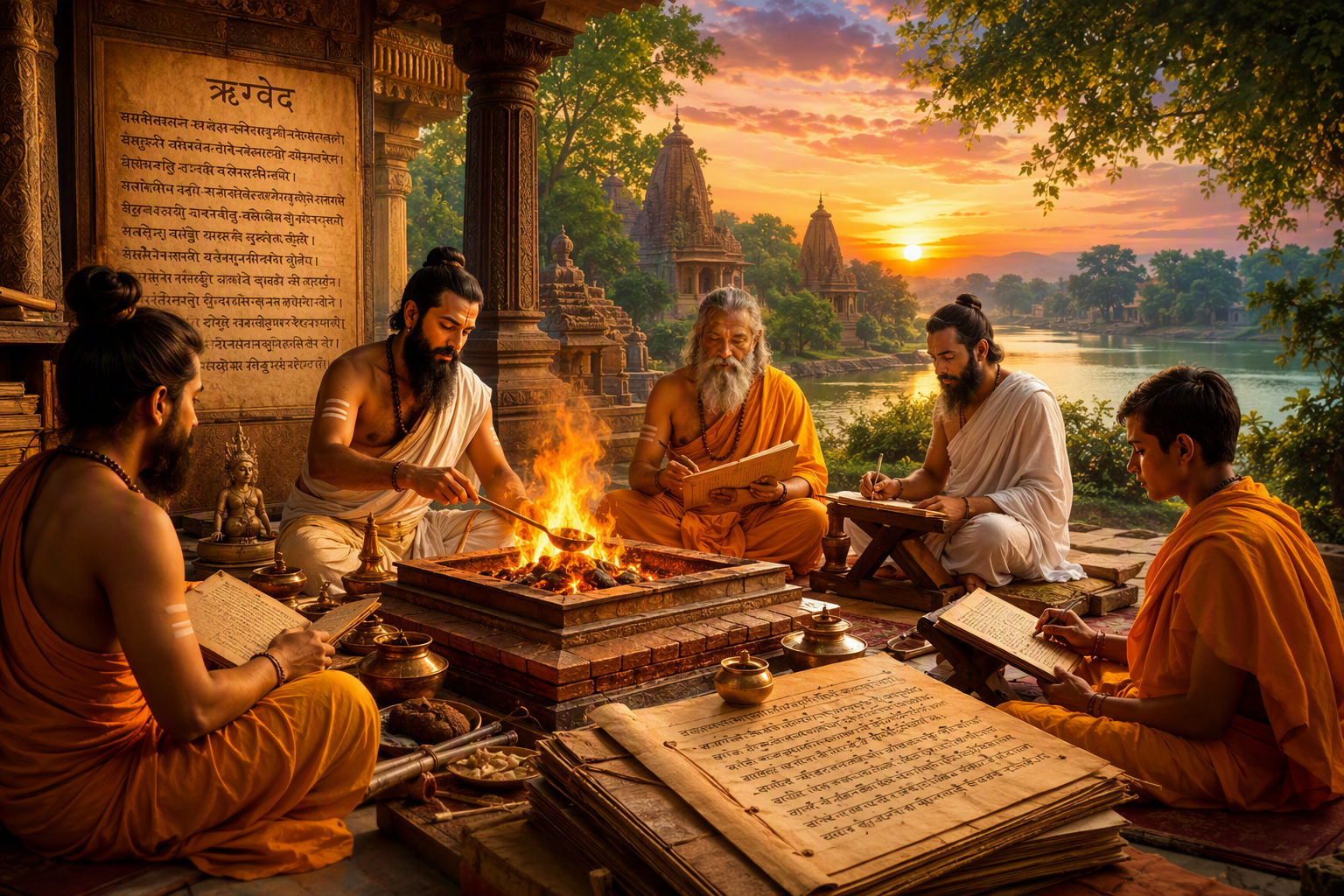
Key Highlights
- The vedic period is a main point in UPSC ancient history. It can help you get to know early Indian civilization in an easy way.
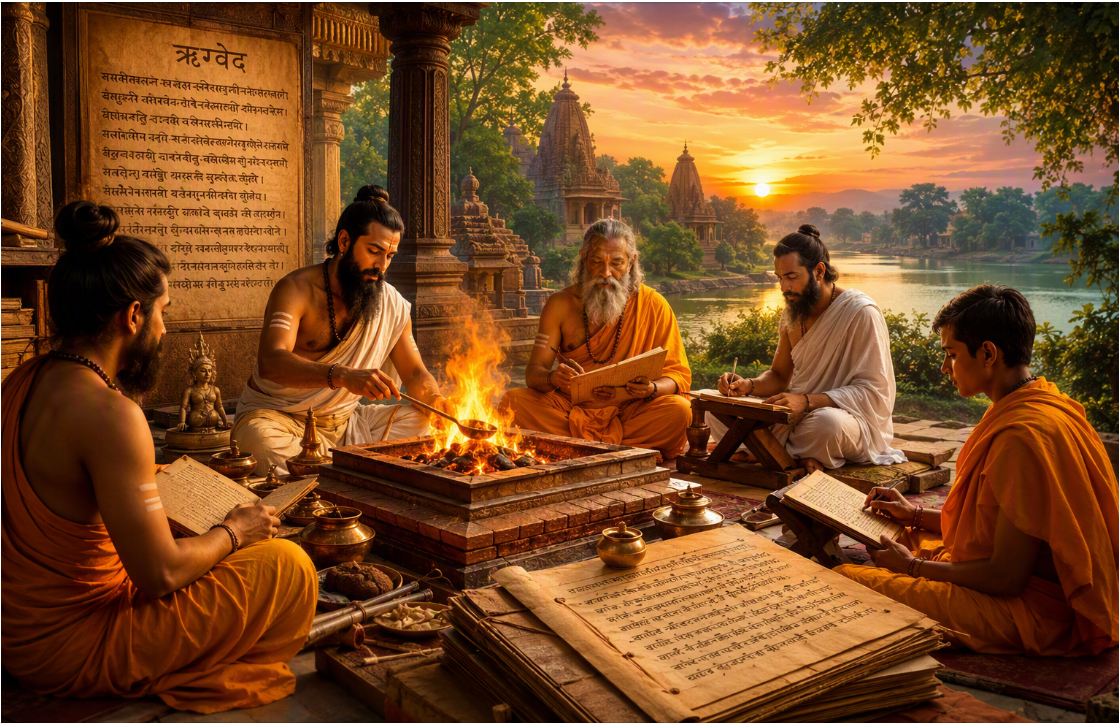
- The Rigveda is the oldest veda. It helps you see how vedic society grew, what their religion was, and how they lived each day.
- Early vedic aryans lived by keeping cattle, farming, and doing a small amount of trade.
- In the UPSC exam, you will get questions about vedic texts, some important deities, and the social structure of the vedic period.
- You need to read about both the early and later parts of the vedic civilization. This will make it easy to remember what you read.
- Using previous year papers will help you practice questions about the vedic period and make things more clear.
Table of Contents
Introduction
The vedic period is a key time in Indian history. This is something you need to know if you want to do well in the UPSC exam. The vedic period was from around 1500 BCE to 500 BCE. This was the time when early vedic civilization started to grow in the Indian subcontinent. People wrote the Vedas in this period. A lot of new social and religious ideas came up, and many things that shaped Indian civilization started in the vedic period.
If you understand this time of ancient history, it will help you go over the topics and answer exam questions more easily.
Overview of the Vedic Period for UPSC Aspirants
For people who are getting ready for UPSC, the vedic age is a very key topic in ancient India. There can be many types of questions from this topic. You may find questions asking for facts, questions that make you compare, or ones where you have to say what you think. The most important things you need to read are about the vedic people and how they came to be important. You should also read about the composition of the Vedas, how social life changed in that time, and what new things came up in the economy and the government.
In simple words, the UPSC syllabus has many topics about vedic civilization. You will get to read about its literature. There are also topics on the religion, the social hierarchy, and what village life was like. You will see how political groups worked in that time. It also talks about how vedic civilization changed from the early days to later times. If you sort these topics well, it is easier to revise indian history.
Importance of the Vedic Age in the UPSC Syllabus
The vedic period is an important part of indian history. It links things like literature, society, economy, and religion in one topic. There are not many subjects in indian history that do all of this. That is why the vedic period comes up so often in previous year papers. When you do your regular study for the exam, you will also see a lot of questions about the vedic period.
A big reason the rigvedic period is so important is because of the Rigveda. The Rigveda is the main text you read to know about this time. It helps you see how life was with herds of animals, tribes, gods, and rivers. You can learn how people started to form groups and work together, too. UPSC wants you to join the vedic age with the big changes that came after the indus valley civilization. This helps you know how things went ahead from the indus valley to the new ways that came in the vedic age.
The UPSC exams often have questions on what Aryan means as a speech group. They also ask about key vedic texts, the religion that people had in early times, and ideas like Dharma and Rita. If you take time to study these topics, the vedic period can help you score more marks. So, make sure you read well about the vedic period and practice questions on it.
Scope and Coverage of Vedic Period UPSC Notes
Good Vedic Period UPSC notes should be short, clear, and easy to read. It is best not to add facts that feel out of place. What you need is a clear structure for your notes. Your notes should show how early vedic aryans lived. There should be facts from vedic texts. The notes should also tell how early vedic society changed over time in indian civilization. These things will help you get what is important about the vedic period, vedic society, early vedic aryans, vedic texts, early vedic society, and indian civilization.
Your notes should talk about the main points from the syllabus. Write in a clear and short way. Focus on:
- The main Vedic texts are the Rigveda, Samaveda, Yajurveda, and Atharvaveda. The Rigveda has songs to many gods. The Samaveda is full of songs used in rituals. The Yajurveda tells how to do ceremonies. The Atharvaveda has spells and simple prayers for people to use every day.
- In Vedic society, many things shaped the way people lived. A lot of the economy was about farming and taking care of cattle. Families were big and close, with all members staying together and helping one another. Worship was a big part of life. People would pray and give items to the gods so they could get good things in life.
- As time passed, Vedic society started with small tribes. Chiefs were the leaders in those early days. After some time, social hierarchy began to grow. There was now a clear system where some groups had more power and more respect than others.
It is just as important to keep separate headings for religion, polity, and literature. This will help you get ready to answer both simple and mixed questions about the vedic period. If someone asks you to sum up the UPSC syllabus topics on the vedic period, these three note blocks usually work well.
Key Phases of the Vedic Period: Early and Later Vedic Age
The early vedic period and the later vedic period are two main parts you need to know for the UPSC exam. This way of splitting the vedic period helps you see how the period changed with time. At first, the vedic civilization started with people who moved around with their animals. Later, they built homes and started to form different groups in their society.
For exam preparation, you need to know the main differences in economy, polity, religion, and social structure. The early vedic people mostly lived in tribes. They kept animals. Later, people began to settle in deeper ways. There were new changes at this time, too. You will read about one of them as “painted grey ware” in many texts. The next parts make it easy to see how things shifted for the vedic people.
Features and Social Structure of the Early Vedic Period
The rigvedic period lets you see how early vedic society was. At this time, vedic people lived mostly by keeping cattle and farming crops. They built their social life around tribes. The rules were not strict yet. Those rules came later. So, you should not mix the later rules with how things were during this early vedic society.
For UPSC PYQs, you will see most questions about social structure come from these areas:
- The varna system began to show up little by little.
- The vedic people were herders and farmers.
- There were some ideas like Rita. This was the main moral law that helped keep things in order.
Another good thing to do is to compare. UPSC often puts vedic society and indus valley people or indus valley civilization side by side. They do this to see how well you know the time order and culture of these groups. So, when you read about early vedic society, look at what is inside that group. At the same time, try to link it with other parts of ancient history and the indus valley civilization.
Significant Developments during the Later Vedic Period
As you move into the later vedic age, you notice that life gets more organized and has more layers. People start to live in a way that is more settled. Political changes are easy to see and to follow during this time. The social hierarchy gets even stronger in the later vedic age. That is why UPSC asks you to study both the early and later vedic age together, not just one of them.
Some main changes are usually made at this time.
- There were bigger social gaps, and the groups of people were easier to see.
- There was more talk about rituals in vedic religion.
- Later vedic literature started to talk about more things than just the first hymns.
For UPSC, you can spot the main difference right away. At first, there is a tribal feel to it and the people live simple lives. Many of them are herders. As time goes by, you see more order in the way people live. Rituals become more common and planned. Politics also gets more clear and set. If you use these three points to make your answer, it will be much easier for you to handle questions that ask you to compare.
Essential Vedic Texts and Literature
Vedic texts are the heart of this topic. They are the main literary sources for this part of Indian history. Most questions about Indian history begin with early vedic literature. From there, you learn about society, religion, and ideas. If you do not have a good understanding of vedic literature from text, then the whole topic does not feel connected.
Start with the Rigveda because it is the oldest veda. After that, read the other vedas and later works. UPSC PYQs about vedic society often ask what is in these texts, how vedic religion grew, and what ideas are in each text.
Analyzing the Rigveda, Samaveda, Yajurveda, and Atharvaveda
The four Vedas are the main books you need to read for Vedic study in the UPSC exam. The Rig Veda is the oldest and is very important. It helps you know more about the rigvedic aryans. The other Vedas show how people did rituals, used chants, and did magic in those times. A lot of questions will ask about the composition of the Vedas with simple identification.
A simple way to revise them is through comparison:
| Veda | Key focus for UPSC |
|---|---|
| Rigveda | Oldest veda; contains hymns of the Rigveda and gives details about early society, rivers, and deities |
| Samaveda | Known for melodies and sacred chants |
| Yajurveda | Contains ritual formulas and mantras used in yajna |
| Atharvaveda | Includes magical charms, spells, and speculative hymns |
Here are some examples of old UPSC questions about the vedic age. These ask things like which Veda talks about magic spells. They also ask what the word Aryan means. You may also need to know which river is named the most in old writings. These questions help tie the text to the history of indian society. They also check if you can remember facts about the vedic age.
Importance of Brahmanas, Aranyakas, and Upanishads for UPSC
Besides the four Vedas, the later additions to vedic literature are important for UPSC too. The Brahmanas say how people should do rituals. The Aranyakas go deeper and make you think more about things. The Upanishads ask big questions about life and our world. These parts help you see the growth of vedic literature in indian history.
For smart revision, remember these points:
- The Brahmanas are tied to talking about how and why rituals are done.
- The Aranyakas move more toward thinking and looking into deeper thoughts.
- The Upanishads focus on asking big questions in life. They also be about important talks and ideas.
UPSC PYQs sometimes mix these texts with facts. For example, the talk between Nachiketa and Yama is in the Kathopanishad. The line “Satyameva Jayate” comes from the Mundaka Upanishad. You may see names like the Aitareya Upanishad in some questions with options. So, it is good to know where each text is from.
Political and Economic Life in the Vedic Age
Political and economic life in the vedic age matters for UPSC. This is because it shows how the groups and the way people lived all linked together. The king was the main person to rule. There were groups and meetings where people talked and made choices. People living in the village made sure all of the society stayed strong. Learning this helps you get a good idea of how life was in the vedic age, both for leaders and for people working to live every day.
At this time, people took part in many economic activities. They did things like keeping cattle, farming, and trade by using the barter system. Questions about the barter system and these activities come up a lot. Sacrificial rituals also had a strong link with political life. So, this part is very important for people to know.
The parts below break down these themes into clear and simple points.
Political Organization, Kingship, and Assemblies
The political setup in the rigvedic period was not just about having a single leader. It was linked closely to tribes and groups of people who lived together. The social unit played a big part at this time. A king was there, but he did not have all the power. He worked with many groups and followed the old rules that people knew already.
When you revise polity, focus on:
- Kingship is important for the people, but it is not the only thing that matters.
- Assemblies help people and tribes make choices together.
- Having a social unit and helping out is key if you want to keep things in order.
UPSC does not always say if a question is history optional in the basic books. But you will see topics about Aryans and the vedic period in other areas. The vedic period comes up when you read about things like rules in society, language, and people who move from places such as central asia. You have to know that the thought of Dharma was about the conception of obligations for people in their society and for those who were in charge.
Economic Activities and Village Life
Economic life in vedic civilization was based on cattle and farming. People kept cows and other animals, which were seen as very valuable. Farming was important because it let people stay in one spot. The village was the center where people made and grew things. This had a big effect on social life during that time. People traded goods and services with the barter system. This means they swapped things instead of using money. The barter system shows trade was a part of vedic civilization before money became used a lot.
For revision, keep these areas together:
- The main part of economic life was looking after cattle and working on farms.
- The village was made by using the idea called grama.
- People used the barter system to trade and did some early trade, too.
If you want to practice Vedic Period multiple-choice questions for UPSC, it is better to use topic-wise practice sets. You will find practice on economic life, rivers, texts, and social structure. This is helpful, as most questions ask about one main fact from a big area. At times, things like Rita, which is about the functioning of the universe, can also come up in questions on social structure or economic life.
Socio-Religious Aspects of the Vedic Period
The social and religious life in vedic society is important for UPSC. It helps you see how people lived, prayed, and took care of their families and society. In this part, you find out how social hierarchy was a big part of life and what people believed day by day.
People often ask about the religion of early vedic aryans. They want to know things like what kind of sacrifices there were, who the important deities were, and how the social groups changed as time went by. The vedic religion is closely tied to the old texts. This means you can understand their beliefs if you read those works. To make this easy, let’s look at these topics in a simple way.
Caste System, Family, and Role of Women
The UPSC often has questions on how the social structure of vedic people changed with time. In the early vedic period, the social groups were not strict. But as the vedic period went on, the varna system began to show up more. The social hierarchy slowly became fixed and easy to see. This change is a common topic in questions about the vedic period.
The most asked topics related to society include:
- The varna system began to take shape and became stronger as time went on.
- Family life was the most important part of society.
- A lot of old writings talk about the position of women.
One big thing to know is that there have been women with knowledge in this tradition. For example, Lopamudra was called a Brahmavadini. She wrote some hymns in the Vedas. This is important because the UPSC may ask about the role of women. They use examples like this and not only talk about social distinctions.
Religion, Beliefs, and Rituals Practiced
The early vedic aryans based their religion on showing respect to the forces of nature. They did this by doing yajnas, which are special kinds of rituals. The religion of early vedic aryans is a main topic for UPSC, so you need to keep this point in mind. The vedic religion did not use images like other Indian beliefs that you read about later.
Keep your path to the prelims simple. Stay focused on facts.
- The vedic texts talk about many important deities like Agni, Indra, Surya, Varuna, Mitra, Rudra, and Vishnu.
- You need to remember that sacrificial rituals were the main religious practices at that time.
- Make sure to go over Rita again, as it is the fundamental moral law that keeps the cosmic order in place.
When you see Vedic Period questions in UPSC Prelims, do not choose answers that feel too strong or too much. Link each point to where it really came from. For example, if you read a question about early Vedic worship, think that most people at that time used to worship nature and did yajna. This is the best way to answer because most of the questions are about the real cultural developments and what people believed in during that time.
Frequently Asked Vedic Period UPSC PYQ Themes
Previous year papers show that some Vedic themes come up again and again. If you look at these patterns closely, you can get ready in a better way. This helps make your study plan clear and not random. You get to practice for both prelims recall and answer writing practice.
In Indian history, the vedic civilization is linked to topics like key texts, rivers, gods, different social groups, and big ideas like Dharma and Rita. The vedic age questions are not only about dates. They check if you understand the facts, can compare things, and read the main points well.
Recurring Topics in Vedic Period UPSC PYQs
If you look at previous year papers, you will see that the questions are asked in a special way. The UPSC likes to give questions with facts from a text and ones that ask to show the difference between things. So, when it comes to the vedic period, the questions are not random at all. They come again and again from a small group of important topics in the vedic period.
The recurring topics include:
- Vedic texts are from the early vedic period. These texts talk about old stories, rules for people, and songs. Each text has a set of ideas and lessons.
- The vedic period was a time when people had strong faith in gods. People would pray to main gods. They also used special steps to make sacrifices for their gods.
- In the early vedic period, people lived together in small groups. Life was simple and all work was shared based on family and gender. Some would work on the land, while other people looked after their animals. This shaped life and work in their society during the vedic period.
Another thing that comes up often in ancient history is when you need to compare topics. The exam might ask you to look at vedic society or vedic civilization next to the indus valley or indus valley civilization. You can also get questions about words like Aryan, or about rivers like Sindhu and Saraswati. Sometimes there are questions about ideas in later text, too. If you know vedic society as groups, then questions about vedic civilization are also not hard to answer.
Types of Questions: Multiple Choice, Assertion-Reason & More
The UPSC Prelims can have questions about the vedic period in many forms. You may get direct MCQs. Sometimes, you will get statements or assertion-reason questions. This is why you need to know both facts and the background about the vedic period. You also need to practice how to remove wrong options to find the best answer. Try to read and practice about the vedic period while thinking about all these points. Do not treat them as different things.
You can practice well through:
- You can find topic-wise MCQs on vedic texts, religion, and rivers.
- Take time to look at assertion-reason questions on Dharma, Rita, and ways people worship.
- Check out previous year papers. This helps you see the kind of questions they ask and where you might get tricked.
- Do written practice. Try to write facts in short and clear ways.
This mix can help you because one fact can come up in different ways. For example, a question about Atharvaveda can show up as a text-based question. A question about early Vedic religion can be where you need to pick out the wrong choices. When you practice both MCQs and written answers, your memory gets better. You feel more ready for the exams.
Practicing Vedic Period UPSC MCQs and PYQs
A good way to get ready for this topic is to solve MCQs as soon as you finish each short round of revision. You can first start with text topics. After this, read about social features, economy, religion, and political life. This practice step by step will help you to see all the areas you may feel unsure about. It also keeps you from mixing up facts that sound close to each other.
Previous year papers focus again and again on the main ideas of vedic society. So, you should practice them often. Try not to keep them for the end. Make them a main part of your study plan.
If you want topic-wise UPSC prelims questions on Vedic culture, look for compilations about ancient history and Vedic culture from trusted preparation sites and PYQ collections. You can use these questions with answer writing practice to help you remember the topics in a short time. This way, you get better at finding the correct answers for prelims. At the same time, you improve your writing for main exams. It will not feel too much or hard when you do your practice and revise later.
Tips for Solving Vedic Period UPSC MCQs Effectively
When you answer MCQs about the vedic period, do not just choose an option because it has a word that you know. The UPSC often gives options that seem the same. You need to match the word with where it comes from and what it means in that text. This is the best way to handle ancient history questions about the vedic period.
A practical method is to:
- Go through your one-page notes before you start with the MCQs.
- Underline key things like text names, rivers, and gods. This will help you find the answers faster.
- Use the rule of taking out answers when one does not match what you know.
You should do answer writing practice while you work on objective questions too. Take topics like Rigveda, Rita, or early Vedic religion. Write two or three lines about each. This helps you remember them better. For UPSC Prelims, the best way is to stay calm. You have to read each option with care. Try to spot the right answer. Practice PYQ-type questions many times.
Conclusion
To sum up, knowing about the Vedic Period is very important if you want to do well in the UPSC exam. When you understand the top features, key points, and also the social and religious parts of the Vedic Period, you can build a strong study plan. This will make it easier for you to know the topics and get ready for all types of questions. If you keep using practice questions from past years (PYQs) and MCQs, you will feel more sure and get better results. If you want help that matches your UPSC needs, you can ask for a free talk. A good start with the Vedic Period can help you reach your goals!
What is the difference between Early and Later Vedic Period for UPSC?
The early vedic period was a time when people lived in small tribes. They were close to animals and there was not much social order. The later vedic period was not the same. People started living in bigger groups. They settled down at one place. It was during this time that rules about who was higher or lower in society became clear. There were also many new rituals. When you read about the vedic period for UPSC or if you study indian history, it is good to know this difference. It helps you see how the vedic civilization changed after the time of the indus valley.
How can I prepare Vedic Period UPSC notes for last-minute revision?
For last-minute UPSC preparation, it is good to make one-page notes on vedic texts, vedic society, religion, parts of polity, and how the economy worked. A small table that shows the difference between the early and later phase of the vedic period will help you as well. If you group short topics together in ancient history, you can go over the vedic period more quickly. You will be able to remember more facts with less mix-up.
Where can I practice topic-wise Vedic Period UPSC PYQs?
You can practice Indian history by using Ancient History compilations. These usually have previous year papers sorted by topic. Look for sets about the vedic age or Vedic culture. It is good to start your revision with the Rig Veda. Then read about religion, people in society, and the rivers from that time. After this, practice more with full topic sets. This way, you will remember more about ancient history.