Key Highlights
- The indian monsoon is about monsoon winds. There is a clear seasonal reversal in the way the winds move.
- The summer monsoon, to be exact the southwest monsoon, gives India most of its annual rainfall.
- The process works because there is differential heating. The land has low pressure, and wind belts shift.
- The indian ocean, arabian sea, and bay of bengal are important. They add moisture to the system.
- How well the monsoon works affects farming, water supply, food security, and the income of people living in the countryside.
- For UPSC, you need to know about the types, causes, how it can change, and its effects on different regions.
Table of Contents
Introduction
The indian monsoon is a big weather system in the country. It shapes the monsoon season and helps with farming. It also fills rivers and reservoirs. This system changes daily life for people in the indian subcontinent. Most of the annual rainfall comes in a short time. Because of this, even a small change in when it starts or how strong it is can make a big difference. If you want to know more about India’s climate, economy, and geography, you should learn about the indian monsoon first.
Defining the Indian Monsoon
The term monsoon comes from the Arabic word “mawsim.” This means season. In simple words, monsoon winds are seasonal winds that change direction when the season changes. That is why the monsoon is not only about rain. It is a much bigger system in the air.
Across the Indian subcontinent, this change has a big effect on the monsoon season. In summer, winds move from the sea to the land. They also bring moisture with them. But in winter, winds go from land to sea and they are dry. This seasonal reversal shows how the indian monsoon works and helps us understand it.
Characteristics and Seasonal Patterns
The Indian monsoon is all about seasonal winds. These winds change direction between summer and winter. The summer monsoon brings most of the rain to India. In winter, the winds are dry for most parts of the country. This change gives India a unique pattern of weather.
During the wet months, monsoon rainfall starts with a sharp rain and thunder or lightning. This rain often shows up fast. The air cools down a lot right after these first showers. Many places get heavy rainfall at this time, but not every spot gets the same amount.
Monsoon patterns change from place to place in India. The west coast and northeast get a lot of rain. But some other parts inside the country and to the west do not get much rain. In summer, India gets the southwest monsoon. Later in the year, the northeast monsoon comes as the main retreating monsoon.
Distinct Types of Monsoon in India
India gets two big monsoons. Each comes at a different time and affects its own part of the country. The southwest monsoon is strong during the rainy season. It gives most of the rain to India. The northeast monsoon comes after that. It matters most for the southeast coast.
You can think of the system like this:
- The southwest monsoon starts in June and ends in September. It brings rain to many places.
- The northeast monsoon is active from October to December. It hits Tamil Nadu harder than other areas.
- The winter monsoon is another name people use for the dry wind that blows from the northeast.
- The retreating monsoon is the time when the southwest monsoon slowly leaves.
- During the last phase, the southeast coast gets much rain.
The most important thing here is location. Many places in India get rain mainly from the southwest monsoon. But Tamil Nadu and nearby places get most of the rain from the retreating monsoon. This is why it is good to know about both types of monsoon in India. It will help if you are studying geography or getting ready for the UPSC exam.
Mechanism of the Indian Monsoon
The Indian monsoon works because of differential heating between land and sea. In summer, land in Asia gets hot faster than the nearby ocean. This makes low pressure build up over the land. The pressure over the ocean is still higher, so air moves from there toward the land.
This movement gets stronger due to the change in wind direction during different seasons. The bigger monsoon circulation also has a role in this. The trade winds cross the equator. They turn because of Earth’s rotation. These winds come into India full of moisture.
After this, things like pressure systems, upper-air flow, and the ITCZ show how the process works in detail.
Atmospheric Circulation and Wind Pattern
A good way to know about the monsoon is to look at it like a big air movement system. In summer, the land in Asia gets very warm. This makes a strong pressure difference between the land and the indian ocean around it. Air will go from places with high pressure to places with low pressure.
These winds come from the trade winds in the southern hemisphere. When they move past the equator, the winds get turned and change into southwest monsoon winds. Some people say this process is like a big sea breeze. The air moves from cooler parts of the ocean to hot land areas.
Keywords added: monsoon winds, trade winds, southern hemisphere, southwest monsoon, sea breeze, trade winds of the southern hemisphere, southwest monsoon winds.
When the monsoon winds get to India, they break into parts over the Arabian Sea and Bay of Bengal. The way these winds move, how much moisture they have, and how strong they be, all play a part. These things work together to decide where the rain comes first, where it gets heavy, and when there may be breaks in the rain during this time.
Role of Inter-Tropical Convergence Zone (ITCZ)
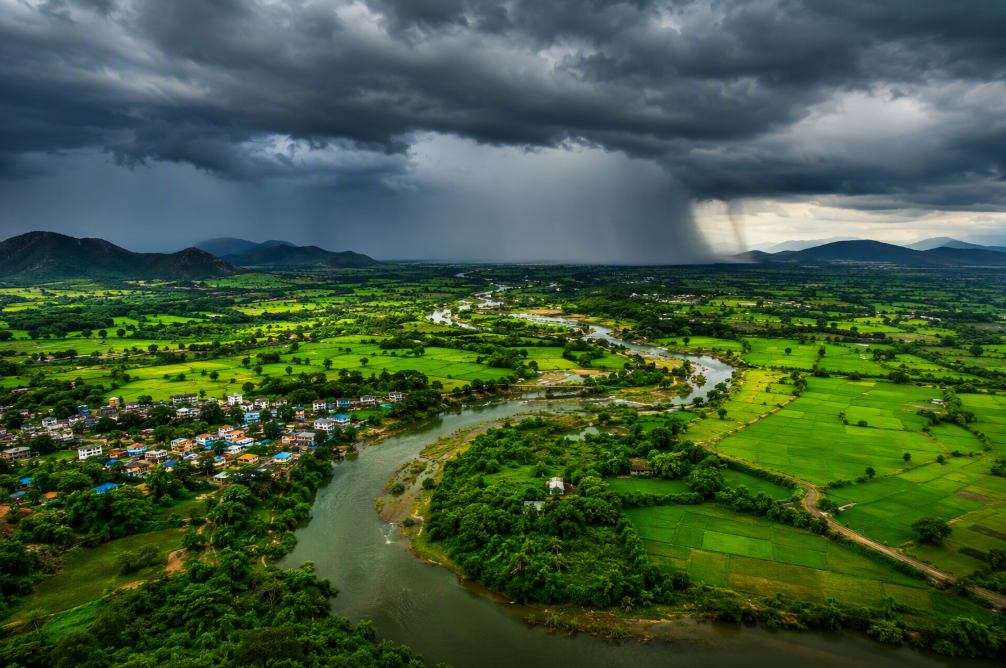
The inter-tropical convergence zone (ITCZ) plays a big part in shaping India’s weather, especially during the monsoon season. It is the area where trade winds from the north and south meet. This meeting makes a low pressure zone, which pulls in wet winds from the Indian Ocean. These winds move up and cool off, bringing heavy rainfall to the Indian subcontinent.
The way the tropical convergence zone shifts during the year has a huge effect on how rain is spread. This, in turn, affects farmers and every other part of weather conditions during these months.
Theories Explaining the Monsoon Mechanism
The monsoon happens in a complex way, so there is more than one theory to explain it. The older idea was about thermal changes. It focused on how land and sea heat up in different ways. This difference is called differential heating. Because of it, low pressure forms over the land during the summer. This makes the winds blow from outside toward the land.
Later thoughts brought in upper-air actions, the jet stream, and how walls like the Himalayas and the Tibetan Plateau shape the indian monsoon. The coriolis effect helps too, since it pulls winds to one side after they pass over the equator. All these things together help us know what makes the indian monsoon happen.
Thermal Concept and Pressure Systems
The idea linked to Halley is that land and water do not warm up or cool down in the same way. In winter, the land in Asia gets cold quicker than the sea near it. This leads to high pressure on land and low pressure over the sea. Because of this, winds move from the land to the sea.
In summer, land heats up fast. This makes low pressure. At the same time, ocean stays cooler and holds higher pressure. The difference in pressure brings wet winds into India. Differential heating is the main way monsoons begin.
But this idea by itself cannot explain everything. It does not tell us why the rain can start or stop very fast. It also does not explain why there can be long gaps, or why the rain pattern changes. That is why later ideas talked about more things. They added the tibetan plateau, moving pressure systems, and changes in the upper-air. These all help us to understand the monsoon better.
Jet Stream and Dynamic Theory
The dynamic theory does not just look at heating on the ground. It pays attention to the way air moves high up. The jet stream is key here. In winter, the subtropical jet stream changes because of the big Tibetan area. Where it goes helps shape weather in South Asia.
In the summer, the Tibetan Plateau gets a lot of heat. This strong heating makes the air move in the middle part of the sky. It helps form the tropical easterly jet, which goes over to Peninsular India. This flow high above supports the monsoon. It also helps move a lot of air in from the ocean.
The idea is easy to understand. The Indian monsoon does not move only by surface pressure. It changes because of upper winds, heat from different places, and the shape of the land. These parts affect the monsoon trough. They also make moisture move faster. This is why the Indian monsoon acts like a changing system in the air.
Factors Affecting Spatial and Temporal Variability
Monsoon rainfall does not fall the same way everywhere in India. Some areas get a lot of rain, and other places get only a small amount or have rain that is not steady. This happens because of things like the height and shape of the land, how far a place is from the sea, which way the wind is blowing, and the way rain-carrying clouds move.
Time is important too. Changes in the timing can be seen when the rains come late, feel weak, stop for a while, end early, or arrive as heavy downpours. In some years, there can even be extreme rainfall events followed by dry periods during the same season. To figure out why this happens, you need to look at the land, the faces of places around, and bigger things that happen between the ocean and air.
Influence of Topography and Geography
Topography plays a big part in how monsoon rain changes from place to place. When moist winds from the Arabian Sea reach the western ghats, they have to go up. On the windward side, there is a lot of rain. On the leeward side, there is much less rain.
The bay of bengal part acts in a different way. It goes toward the east of India and the northeast. Then, it is helped along by both the hills and plains. The Himalayan mountains stop it from going farther north. This makes the air go up and drop its water as rain over the foothills, valleys, and places nearby.
Geography also helps set how rain falls across the indian peninsula and northern plains. Coastal areas get early rain and it is often heavy. The places in the middle may wait for rain that comes later. Rajasthan does not get much rain because the winds move alongside the Aravalli hills. Also, the Winds do not rise up enough there to make good rainfall.
Impact of Global Phenomena (El Niño, Indian Ocean Dipole)
Global ocean-atmosphere events can make the Indian monsoon stronger or weaker. El Nino happens when the water in the Pacific Ocean gets warmer. Many times, El Nino is connected to weaker monsoon in India. But, this is not always true. Every weak Indian monsoon does not mean that El Nino is there.
The indian ocean dipole can change how the monsoon works in India. It shows the difference in water temperature between the west and east parts of the indian ocean. When the west indian ocean is warmer, it is called a positive phase. A positive phase can help make the monsoon stronger in India.
Key links to remember are:
- El Niño usually means a weaker monsoon flow.
- La Niña is often found with a stronger monsoon.
- A positive Indian Ocean Dipole can help bring rain to India.
- When people talk about climate change, they look at more uncertainty and rain that does not follow a clear pattern.
Regional Variations and Major River Basins
Regional differences are a big part of India’s monsoon climate. The west coast, northeast, northern plains, and dry inside areas do not get rain in the same way. Their monsoon rainfall changes with how the branches move, the land, and where the rain comes from.
These differences affect the big river basins. The gangetic plains rely a lot on rivers that get water from the rainy season. Other basins act in a different way when there are changes in the season or heavy rain. If you look at what happens in the mountains, near the coast, and with rain in each basin, you will see how the rainy season works in real life.
Monsoon Behavior in Himalayan and Coastal Zones
The Himalayan region is big when it comes to how the monsoon works. The mountains stand in the way and stop the winds. This makes the moist air go up. Because of this, there is heavy rain over foothill areas. You can also see a lot of rain in the northeast and some places in the northern plains.
In the coastal zones, monsoon rains show up in different ways. The west coast gets the main hit from the arabian sea branch. Because of this, weather conditions on the west coast get wet fast when monsoon rains begin. The western ghats help push air up. This makes heavy rainfall in many places.
Variability can still cause trouble. If depressions move, one place can get a lot of rain again and again, while another place stays dry. In mountain areas, this can make landslides more likely. In coastal areas, too much rain may bring floods, break down transport, and put stress on homes and local infrastructure.
Recent Changes in Rainfall Over Major River Basins
Recent monsoon behavior shows that rain does not fall the same everywhere, even in one season. In July 2026, India saw less rain overall. But some areas in the east and northeast had more rain and heavy showers. Because of this, river basins are not reacting in the same way.
In simple terms, rivers in eastern India and the northeast got more rain than other places. At the same time, the whole country did not get the usual amount of annual rainfall for that time.
| Region/Basin-linked area | July 2026 rainfall picture |
|---|---|
| India as a whole | About 222.4 mm against normal 275.7 mm, nearly 19% below normal |
| East and Northeast India | About 330.9 mm against normal 513.2 mm |
| Bihar and nearby basin zones | Heavy to very heavy rain at times, with flood risk in some places |
| Central India connections | Rainfall distribution remained uneven, shaped by monsoon systems and extreme rainfall events |
Prediction and Forecasting of Monsoon
Monsoon prediction matters because it tells us when the rains will start and how they will spread. This helps with farming, water use, and being ready for disasters. Experts look at pressure systems, how air moves up high, what the ocean is doing, and how rain falls to make a forecast for the monsoon season.
In India, the india meteorological department takes the main role. It keeps track of when the monsoon starts, moves forward, gets active, and ends in different areas. Forecasting does not depend on just one sign. It uses several things from the air and sea. This is why it is important to know about the criteria and models used in India.
Criteria for Onset and Withdrawal
The india meteorological department says the southwest monsoon starts when rain-carrying winds and good weather conditions move in. A well-known place to check this is Kerala. The southwest monsoon usually gets there in early june. After that, it moves over the rest of the country step by step.
Withdrawal does not follow the same path. When the sun seems to move to the south, the monsoon trough in northern India gets weaker. The winds lose their power. The sky above is more clear. After this, the southwest monsoon starts to leave the northern plains and then goes toward the south.
A simple way to remember the sequence is:
- The onset of the monsoon happens first over the Andaman-Nicobar Islands in the middle of May.
- Kerala gets the monsoon in the early June.
- By mid-July, most of India has the monsoon.
- The withdrawal starts from northern India at the beginning of October.
Monsoon Prediction Models Used in India
India takes a wide approach and does not stick to just one rule. They use prediction models to look at how the air moves, where the pressure zones are, and how the winds act high up in the sky. This helps them know when the weather will start, how it will spread, and when it will be strong or weak.
The india meteorological department looks at signals from the ocean, too. It checks things like sea surface temperature patterns and what is happening in the Pacific and indian ocean. The department also watches ocean currents like the Somali Current. These things can make the monsoon flow stronger or weaker.
In short, good prediction models link the land, the sea, and the sky. They look at the weather conditions, changes in the air, and big climate signals like ENSO and the Indian Ocean Dipole. This way of looking at things helps India with farm planning, flood readiness, and taking care of water. The Indian Ocean and weather conditions play a big part in this.
Impact of Monsoon on Agriculture and Society
The monsoon impacts farming because most Indian farms rely on rain. A big part of the annual rainfall comes during one main time. Crop success depends on when the rain falls and how it spreads through the season.
The monsoon is important for more than farms. Food security, water supply, and people’s jobs all depend on it. A good monsoon helps people earn, keep production steady, and have a good year. But when the rain is weak or comes at the wrong time, it can be hard for communities, markets, and the systems people rely on.
Agricultural Productivity and Food Security
The indian monsoon is called the backbone of farming for a good reason. A lot of people depend on farm work, and many fields still need monsoon rains, not steady water from canals. When monsoon rains come at the right time, farmers can plant sooner and crops grow better.
The wet season is very important for kharif crops. Good rain keeps the soil wet. It fills up reservoirs and adds to the groundwater. This helps different parts of the country with their crop choices. Food stays safe, too, in areas where farming depends on rain.
Trouble can start when there is not enough rain, or if rain comes late. Sometimes, the rain does not fall evenly, either. Because of this, crops can fail. Farmers may have to plant seeds later than usual. Fields that already have crops can also have dry periods.
But, too much rain at one time can hurt farms, too. Flooding can happen. Soil can be washed away. So, whether there is too little or too much rain, farms and people in the country can face hard times.
Societal, Economic, and Environmental Implications
Monsoon changes do not just impact farming. The effect on money can be seen in rural income, the food people have, rising prices, and how much water is there. When there is not enough rain, people can feel drought-like hardships. When there is too much rain, the loss from floods can be very bad.
There are also big effects on the environment. Extreme rainfall events can wash away soil, cause landslides, and hurt places where people live. In the monsoon season, health risks can also go up, especially when there is a lot of water and drains do not work well.
Important impacts include:
- Crop loss happens when there is drought or when too much water floods the farms.
- Roads, bridges, and local things in the area can get damage.
- When water does not move, there is more risk for sickness and disease.
- There is rising worry about climate change. Rain does not come the same as before.
UPSC Insights: Key Concepts and Common Mistakes
For UPSC, the Indian monsoon is more than a geography topic. It links the study of climate, farming, the economy, disasters, and even current news. This is why understanding the Indian monsoon can help you write clear answers for both ideas and practice-based questions.
Many students lose marks as they confuse causes, branches, and times when things change with the seasons. A lot of them also miss out on the most important ideas, such as the ITCZ, jet streams, ENSO, or the Tibetan Plateau. If you understand the basics, and if how you shape your answers is strong, you will find this topic easier in the exam.
Essential Points for UPSC Preparation and Exam Strategy
A good exam plan starts with the right order. Begin by knowing what the monsoon is. Then learn about how it works. Next, read the theories. After that, look at the different branches, changes, effects, and how to predict it. Doing it in this order helps you write clear answers, so you do not get confused. In upsc, being clear is more important than talking about too many things.
You need to link facts with recent events. Use what is happening with the monsoon, rainfall, and new updates from IMD. This helps your answer be more clear and fair.
Keep these points in mind:
- Learn the main ideas about ITCZ, differential heating, jet streams, ENSO, and IOD.
- Do not mix up the southwest monsoon with the retreating or northeast monsoon.
- Do not write about only the thermal theory. Add dynamic factors too.
- Keep in mind that there are regional differences in the weather. Think about the Western Ghats, northeast India, and Tamil Nadu.
- Do not miss common mistakes that people make about the start, end, and spread of rainfall.
Conclusion
To sum up, it’s important to know about the indian monsoon. This is not just to understand how complex it is, but also because it has a big effect on farming, people, and the environment. The many things that change the monsoon, like how air moves in the sky and big world events, have a huge effect on lives in India. If you are getting ready for the UPSC exam, knowing about these ideas and the mistakes people often make will help you plan how to read better. When you read more about how the monsoon works, you will see its place in our world and how people live. Try to find out more, because the world of the indian monsoon is waiting for you.