Key Highlights
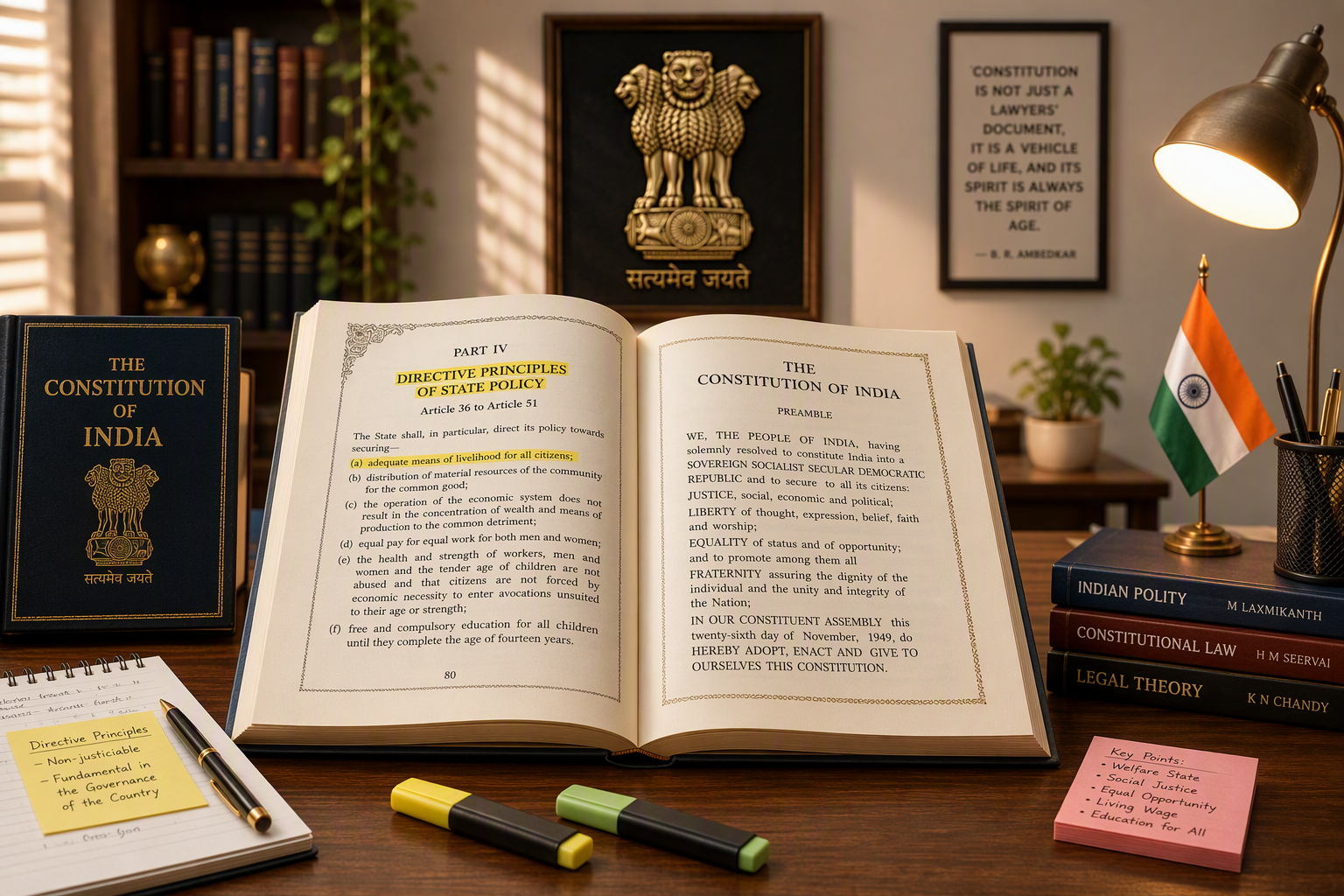
- The directive principles of state policy are found in Part IV of the Constitution of India.
- The directive principles in Part IV cover Articles 36 to 51. These help guide the state in the governance of the country.
- These principles are not enforceable in court, but they are still a big part of state actions.
- The idea for directive principles of state policy mostly came from the Irish Constitution.
- Experts usually put directive principles into three groups: Socialist, Gandhian, and Liberal-Intellectual.
- For UPSC exams, learning about directive principles of state policy is key. They connect welfare goals, changes to the Constitution, and good governance of the country.
Table of Contents
Introduction
If you are getting ready for UPSC and want to do well in polity, you cannot overlook directive principles of state policy. These principles are in Part IV of the Constitution. They are like simple rules or suggestions to help make laws and run the state in a way that is good for everyone. The directive principles are not meant to be taken to court, but they are still very important for making laws, running offices, and doing things for the people.
When you know why these principles exist, read their articles, and how they are put into groups, the directive principles of state policy get easy to read, remember, and write about in your answers.
Historical Background and Meaning of DPSP
To understand the history behind the principles of state policy, you need to know why the creators of the Constitution wanted these social and economic goals in the law. They put the directive principles of state policy in Part IV of the Constitution. This way, the State would try to create justice and work for the welfare of the people. Part IV of the Constitution shows how important these goals are for our country.
In the Constituent Assembly, these ideas were shaped by the Irish Constitution and other global thoughts. The goal was simple. These ideas would guide public policy, even if courts could not enforce them right away.
DPSP Meaning and Its Genesis in the Indian Constitution
The Directive Principles of State Policy are an important part of the Indian Constitution. These principles of state policy help guide how the country is run. They came from the idea of social justice and economic welfare. The people who set up the Indian Constitution looked at the Irish Constitution while making them. The Constituent Assembly talked a lot to shape these directive principles.
The directive principles do not just sit in the Indian Constitution. They give a way to improve the welfare of the people through things like public health and education. These ideals show that the state wants to build a just society and a welfare state where everyone can do well. The directive principles of state policy make sure the governance of the country is fair to all.
DPSP Borrowed From Foreign Constitutions
The directive principles of state policy did not come about on their own. The main source was the Irish Constitution. This is especially true for the way it looked at social policy. Because of this, the Constitution of India set goals for the state. But these goals are not directly enforceable by law.
There is a clear connection to the Spanish Constitution. The idea first started in the Spanish constitutional tradition before it came into the Irish system. Later, when India took ideas from other places, it changed them to fit what Indian people needed. It did not just copy them word for word.
This borrowing was done for a real reason. The framers wanted a tool in the constitution to help shape the new nation, cut down gaps between people, and make life better for everyone. That is why directive principles of state policy became one of the most important and well-thought-out ideas borrowed for Indian Polity. The principles of state policy were meant to guide both the state and its leaders when making laws and taking action. So, the directive principles play a big role in Indian Polity.
Influence of Global Constitutional Practices on DPSP
Global constitutional thinking influenced the DPSP in many ways. The Irish Constitution helped shape the structure. But the ideas about welfare, justice, and responsible government were also important. The Constituent Assembly knew that a modern republic should have social goals as well as legal rights.
You can see the global influence in the rules that are tied to international law and treaty obligations. These rules show that the way people see governance of the country is not just about what happens inside the country. It is also about how to act peacefully with other nations and how to follow legal norms.
So, DPSP shows what is important to India and follows ideas from around the world. It brings together the need for welfare, peace, and the duty of institutions. That is why these principles are still important when you want to see how the State should act when things change.
Constitutional Framework of Directive Principles (DPSP Article)
The base for each DPSP article is in Part IV of the Constitution of India. This part of the Constitution sets out what the State should think about when making state policy. It talks about how to improve public welfare and bring about social change. Part IV of the Constitution gives a way for the State to follow, even when the courts cannot make it follow these rules directly.
For UPSC, it is good to know the location and the reason for these provisions. The next few parts will tell you where these are found and why they were added. You will also read how these are not the same as rights you can make the state enforce.
Location and Wording of DPSP Article 36 to Article 51
DPSP is in Part IV of the Constitution of India. You will find it from Article 36 to Article 51. These articles tell us about the State. They also show why the directive principles are important. They give goals that are about the good of people. Some ideas touch justice, village groups, public health, the environment, and peace with the world. So, Part IV of the Constitution of India talks a lot about these important aims.
An easy way to remember the spread is to put the articles into groups based on their topic. You do not have to remember each one alone. This will make it easy for you to go over them again for prelims and mains.
| Article Range | Broad Focus |
|---|---|
| Article 36 | Definition of State |
| Article 37 | Application of directive principles; fundamental in governance but non-justiciable |
| Articles 38-39 | Social order, welfare, livelihood, equal pay, reduced inequality |
| Articles 39A-43B | Free legal aid, work, education, humane conditions of work, living wage, cooperative societies |
| Articles 44-51 | Uniform civil code, early childhood care, weaker sections, public health, environment, judiciary, international law |
The Objective Behind Inclusion of DPSPs in the Constitution
The directive principles of state policy were added to help bring social and money justice for everyone. These principles of state policy help the government make rules and plans for the welfare of the people. The government must look at things like education, healthcare, and fair pay. The directive principles of state are an important plan to make a welfare state. They help balance the rights that people have (called fundamental rights) with the jobs that the state needs to do. The main goal of these directive principles of state policy is to build a good social order. It should be in line with the values written in the constitution of india so that our country becomes a just society for all.
Distinction Between Fundamental Rights and DPSP
Students often confuse Fundamental Rights with directive principles of state policy. The best way to tell them apart is to ask if you can use the court of law to make them happen. Fundamental Rights can be enforced in the court of law. But directive principles of state policy, or DPSP, cannot be forced through the court. They are non-justiciable.
There is also a difference in what they focus on. Fundamental Rights keep people’s freedom safe from anything the state might do. On the other hand, DPSP tells the State to work for the good of people. It wants the State to bring welfare and equality for all. One wants to protect freedom, and the other wants to help bring social and economic change.
- Fundamental Rights can be taken up in a court of law, but the directive principles of state policy are not.
- A person can get Fundamental Rights through the court of law, but you can’t enforce the directive principles of state policy in this way.
- The Fundamental Rights are there for each person’s freedom, while the directive principles of state policy are about doing good for all people.
- The two work well together. This balance between fundamental rights and directive principles is now a main part of the basic structure.
Classification of Directive Principles of State Policy
The Constitution does not officially split directive principles into groups. But most people who study this topic use a helpful way to put them in order. This makes it easier to see all the goals in Part IV. These can be about things like helping workers, village self-government, or making sure there is peace in the world.
This way of sorting things helps when you get ready for exams. It shows the way groups of people and areas of policy are linked together through one main idea. That idea is social justice. Now, let’s look at these three big groups.
Socialist Principles and Their Relevance for UPSC
Socialist principles aim to cut down on inequality and help with economic welfare. These articles tell the State to work towards making sure people have jobs, share resources fairly, get equal pay, have public help when needed, and live better lives. The main goal is to get social justice by using planned public action.
For UPSC, these ideas are important. A lot of welfare laws and plans are linked to them. They also help you see how the Constitution and the way we govern are connected in the mains answers.
- Article 38 tries to help people by making life better and cutting down on gaps between rich and poor.
- Article 39 is there to help people earn money, get equal pay, and stop too much wealth going to just a few.
- Article 42 wants to see people have humane conditions of work. It also talks about help for mothers.
- Article 43 says everyone should get a living wage, and the Minimum Wages Act helps turn this goal into practice.
Gandhian Principles for Social Harmony
Gandhian principles show Gandhi’s idea of building self-reliant communities. He believed people should live by strong moral values. These ideas focus on village panchayats, cottage industries, helping weaker groups, and making life better for all. They have a close link with rural areas and the way local people run things.
Article 40 says the State should set up village panchayats as small groups that run themselves. Later, this idea turned into the panchayati raj system. Article 43 asks the State to help cottage industries grow, mainly for people or groups working together in rural areas.
These principles also help keep weak groups safe. Article 46 makes sure that the educational and money needs of weaker sections get support. This includes people in Scheduled Castes and Scheduled Tribes. Gandhian principles work together to make local democracy strong. They also help with social harmony and development at the ground level.
Liberal-Intellectual Principles Promoting Progress
Liberal ideas focus on change, setting up strong systems, and helping the country grow over time. These ideas include things like a uniform civil code, better schooling, taking care of the environment, having courts that are free from outside pressure, and friendly ties with other countries. These write-ups show that Part IV is not just about money matters.
Article 45 talks about early childhood care and education. Article 50 says that there should be a clear line between the judiciary and the executive in public services. Article 49 is about protecting monuments and objects of national importance. All these help make the constitution stronger and support growth for the country.
This group links to economic democracy in an indirect way. Better groups, clear laws, and good learning support help things get better. When these things are strong, rights and duties can grow together with public welfare. This helps build a stable democracy.
Key Features of DPSP for UPSC Preparation
When you read about directive principles of state for UPSC preparation, you should look at their main features. Do not just try to remember all the article numbers. These directive principles in Part IV of the Constitution are wide in scope. They are made for the well-being of the people. The idea is for these principles to help guide how the country is run over the years. Part IV of the Constitution plays a big part in the governance of the country.
Their importance is seen in the way courts, lawmakers, and the government read them alongside rights and main values in a constitution. The next parts explain why these rules are not enforceable in court, how they help guide policy, and the main things people say against them. Everything is explained in a simple way.
Non-Justiciable Nature and Its Significance
One of the most important things about DPSP is that it is non-justiciable. This means the court of law cannot make sure these rules are followed. Article 37 says very clearly that no court can make the government do these things. So, unlike fundamental rights, you cannot go to the court of law if a directive is not done.
This approach was chosen because the people who wrote the rules saw that many goals would need money, work, and plans that stretch over a long time. State governments and the Union had to be able to change how they act based on what they have and what is most important at the time. This gave them more room to get things done when things change.
- The DPSP lets governments choose when and how to put things into practice.
- It does not make every social and money-related goal something the courts must do right away.
- The DPSP may not be forced by law, but it still puts a moral and political job on the State.
Guiding Role in Governance and Lawmaking
Directive principles are there to help with the governance of the country. They lay out goals in the Constitution that the government and lawmakers need to follow. These are not just simple statements. The directive principles show what kind of social order the State should create. They help shape laws and make sure leaders do their work keeping these goals in mind.
You can see this in the suitable legislation and welfare steps that were put in place after India became independent. Laws about wages, education, labor protection, legal aid, the environment, and rural jobs all show that the welfare of the people is a top rule in the constitution. This is when DPSP starts to work in practice.
Their role can also be seen in how courts read the law. Courts do not make DPSP rules directly happen. But they use these ideas to read laws and rights in a more caring and wide way. This is why DPSP is still very important in the work of the government and in plans for the people every day.
Criticism and Challenges Associated with DPSP
Even though they are important, DPSP has had a lot of blame. The main problem is that there is no way to force these ideas to happen. The courts cannot make the government act. So, there is a chance the leaders may wait a long time or pick out only the things that help them in politics. Because of this, the promise of social justice does not always work well in real life.
Another thing that can be hard is that some things are not clear and how things are put together. A lot of the rules are wide, and you will see the same ideas in many different articles. This can make people confused about what they mean and how to use them. Some orders, like the uniform civil code, are still talked about even after many years.
There are some real world limits too. We have few resources, and there is not always quick action from leaders. Many people do not know enough about these issues. The rules on public health, labor welfare, and things of national importance are good. But even with that, turning these big ideas into real changes is still a big job in the constitution.
Amendments and Changes Relating to DPSP (DPSP Amendment)
The principles of state policy in India have not stayed the same since 1950. The Constitution of India has changed many times with important amendments. These changes have helped the directive principles of state policy to better address new social needs. This shows that the directive principles of state policy can change and grow with the times.
For UPSC, you should know about the 42nd amendment act and 86th amendment act well. These two changes show that welfare priorities in the country have changed with time. It is important to get a clear idea of how these amendments came in and why they matter now.
Major DPSP Amendments and Their Implications
Several changes were made in constitutional amendment laws, which helped make DPSP stronger and different in what it covered. These changes were planned to give more details for social welfare and make these goals match how modern government works. For the UPSC exam, you should know about the 42nd, 44th, 86th, and 97th constitutional amendments.
The 42nd Amendment Act put new welfare-focused rules into the law. The 86th Amendment Act made changes in the way education works. It moved elementary education into fundamental rights with Article 21A. It also made changes to Article 45.
| Amendment | Key DPSP Impact |
|---|---|
| 42nd Amendment Act, 1976 | Added Article 39A, 43A, 48A; strengthened child welfare, free legal aid, worker participation, and environment |
| 44th Amendment Act, 1978 | Added Article 38(2) to reduce inequalities among individuals, groups, and regions |
| 86th Amendment Act, 2002 | Made elementary education a Fundamental Right under Article 21A; shifted Article 45 to early childhood care |
| 97th Amendment Act, 2011 | Added Article 43B on cooperative societies and professional management of cooperative societies |
Recent Developments and Evolving Significance of DPSP
Recent changes show that DPSP still shapes how the government works, even though you can’t force it by law. Every big DPSP amendment makes welfare, who joins in, and changes in public groups reach more people.
Take free legal aid and changes in cooperative societies as examples. Free legal aid shows how the constitution wants everyone to have the same chance at justice. In the same way, Article 43B supports the voluntary formation, strong professional management of cooperative societies, and the idea that people control them by voting. This shows that DSSP now talks about new kinds of social and economic groups too.
Its growing importance comes from how it can change. DPSP still helps shape social justice, public welfare, and which way policy should go. No matter if the topic is education, the environment, workers, or local groups, these rules still guide how the State responds to what people need.
Conclusion
To sum up, knowing the Directive Principles of State Policy (DPSP) matters a lot for people who want to take the UPSC exam and for anyone who wants to know more about Indian governance. The principles of state policy give a base to guide the state in making rules that help with social justice and economic welfare. When you look at the history, the meaning in the constitution, and how these directive principles are sorted, you will see how they help build a nation that moves ahead. Even though the directive principles may not be something you can challenge in court, there is no doubt they do shape how the government works. For those getting ready for UPSC, knowing the directive principles of state policy well can add to your learning and help you answer questions on this topic in a good way. If you feel that you need help with your study plan or want support, feel free to get in touch for a free consultation today!
Frequently Asked Questions
Why are DPSPs non-enforceable by law?
DPSPs are non-justiciable. This is because Article 37 of the Constitution of India says you cannot ask a court of law to enforce them. The people who wrote the constitution wanted directive principles of state to help guide state policy. They also wanted the government to have freedom to use resources and set priorities when working towards welfare goals.
How do DPSPs impact Indian governance and society?
Directive principles of state policy help shape the governance of the country. They point lawmakers and the government toward social justice and the welfare of the people. These principles of state policy inspire lawmakers to make suitable legislation on things like education, labor, legal aid, health, and the environment. All this helps the State work toward a fairer and kinder place for everyone.
How should UPSC aspirants study DPSP for maximum scoring?
To do well in UPSC, you need to study Part IV of the Constitution. This part covers the DPSP, including the article range, groups, and any changes made to it. Make sure to look at how Part IV of the Constitution is different from Fundamental Rights. Remember the most important points and common complaints about DPSP. You should also learn how big laws and welfare steps connect to what the Constitution asks for in Part IV. This will help you later when you need to remember things for both the prelims and mains exams.