Key Highlights
- Geography in upsc prelims gives marks to those who show clear thinking and connect ideas from textbooks with current affairs.
- Your geography syllabus should start with physical geography. After that, read about indian geography, oceanography, and human topics.
- The most important topics are plate tectonics, indian monsoon, ocean currents, soils, rivers, and natural resources.
- NCERT books help you get a strong foundation before you read notes and practice with previous year papers.
- A simple way to revise, practice with maps, and break topics into parts makes it easier to remember key topics.
- Going over current affairs again and again helps you answer geography-based questions in upsc prelims with good accuracy.
Table of Contents
Introduction
Geography is very helpful for upsc prelims. This is because it brings together ideas, maps, and real events. You do not just read about physical geography. You also link it to the geography of india, the climate, rivers, resources, and disasters. This makes the subject feel close to real life. It also helps you score more marks.
When your basics are clear, you can answer many questions with more ease. This guide is here to show you the best topics. That way, your practice can stay on track and be strong.
Understanding the Importance of Geography in UPSC Prelims
Geography is important in upsc prelims. It is always included in general studies. The subject is linked to environment, agriculture, and disasters in the civil services examination. When your ideas about geography are clear, you can score well. It makes geography a safe subject to get marks in civil services.
It also links with current affairs, so it stays useful in every upsc exam. If you cover the geography syllabus, you get better at accuracy and cutting out wrong answers. That is why geography matters when you want to score well in upsc prelims.
Weightage of Geography in Prelims Examination
People who want to do well in upsc prelims often want to know how to pick which geography subjects to read first. The answer is simple. Start with the main topics that give you good marks in the geography syllabus. Begin with physical geography. This helps you get a strong base. Then move to Indian geography, as it helps with questions that use maps. Topics like human and economic geography are useful too. These help you answer applied questions in the general studies paper.
A quick read of year papers and previous year papers shows that UPSC asks many questions about ideas and what is happening now. Topics like climate, rivers, landforms, soils, monsoon, and resources come up a lot. So, you have to start with the basics and then practice how to use them.
| Geography Area | Priority in Preparation |
|---|---|
| Physical Geography | Highest, because it supports many conceptual questions |
| Indian Geography | Very high, due to maps, rivers, climate, and resources |
| Oceanography | High, especially with currents, tides, and marine topics |
| Human and Economic Geography | Moderate but important for applied understanding |
Syllabus Overview for Geography
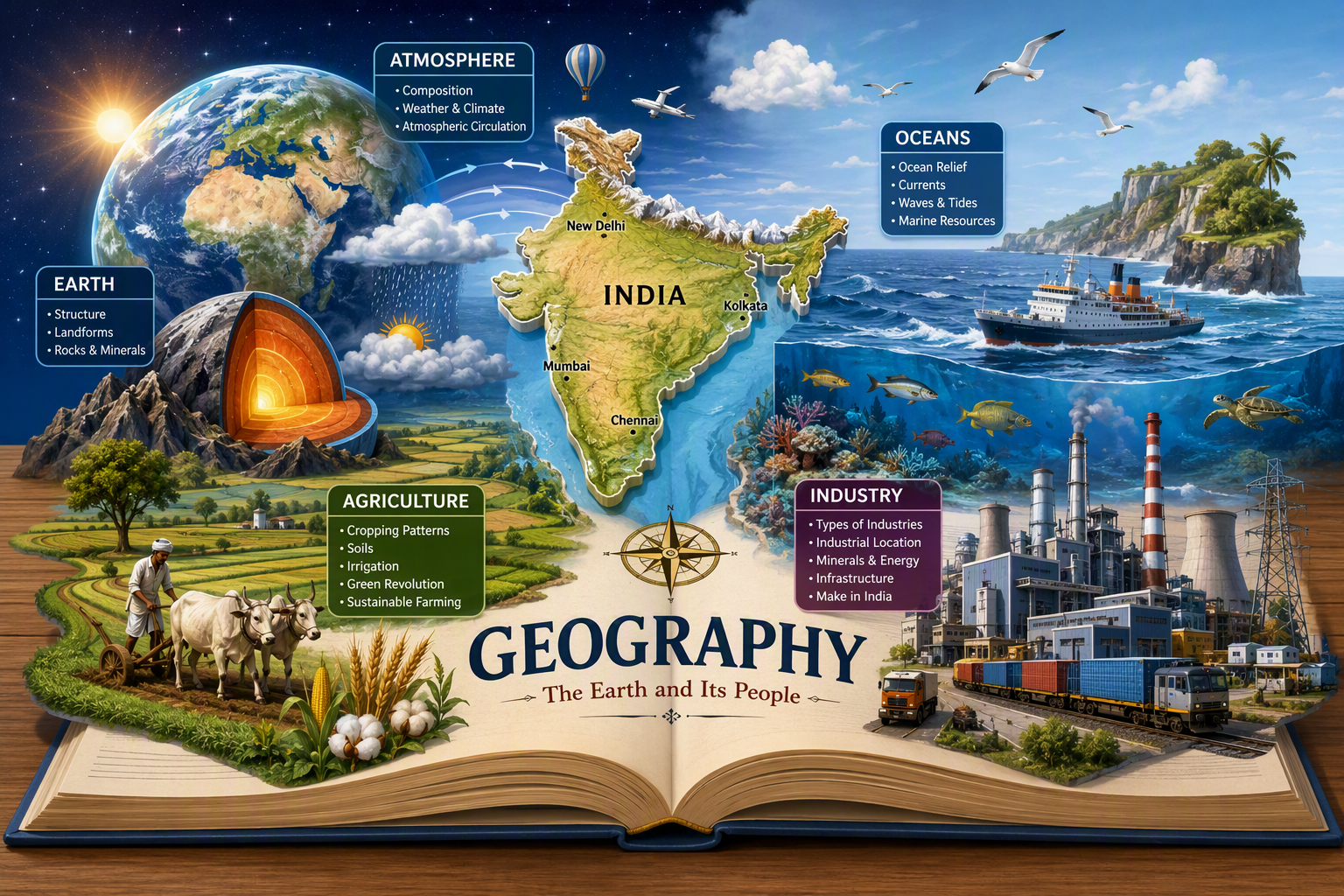
If you need a quick look at the upsc syllabus for geography, break it into four parts. The first part is physical geography. This includes the earth, landforms, climate, and oceans. The second part is indian geography. It covers things like physiography, rivers, climate, soils, and resources.
The third part, called economic geography, is about learning the different industries, minerals, transport, and farming. The fourth part, which is human geography, covers subjects like population, people moving from one place to another, types of settlements, and cities getting bigger. Both economic geography and human geography topics show up as facts to remember and also linked to news or current events.
Key areas to track are:
- Physical geography covers things like the shape of the earth, how rocks break down, and the air around us.
- Indian geography talks about rivers, the monsoon, and different soils.
- Economic geography looks at minerals, energy sources, and places where people make things.
- Human geography includes the rise in population, people moving from place to place, and cities growing.
Physical Geography – Core Topics to Focus
Physical geography is the place where many people who want to learn begin. It helps you build a strong base for the topics you will study later. In the upsc syllabus, this part tells you how the earth works, how landforms come to be, and why climate systems act the way they do.
The most important topics in geography for upsc prelims are earth structure, plate tectonics, volcanism, earthquakes, weathering, and mountain ranges. If you understand these well, the other parts of geography will be easier to follow and remember.
Origin and Structure of the Earth
Start by learning the basics of earth structure. This will help for many questions in upsc prelims. You need to know about the crust, mantle, and core. You should also understand the difference between continental and oceanic crust. The way density changes, along with the inner layers, often helps explain big geographical concepts.
Another important area is the proof used to understand what is inside the earth. Seismic waves play a big role. P-waves, S-waves, and surface waves show us about shadow zones and how things are arranged inside the planet. These basics look easy, but they give us strong conceptual clarity.
Once you have done that, connect the earth’s structure with rock types and bigger physical features. Igneous, sedimentary, and metamorphic rocks, plus the rock cycle, all link straight to plate tectonics and continental drift. That is why you should keep coming back to this topic for revision.
Plate Tectonics and Types of Landforms
Plate tectonics is one of the most important topics in upsc prelims. It shows how the surface of the Earth moves. You should study continental drift theory, sea-floor spreading, convection currents, and paleomagnetism. These are linked ideas. It is better to read them together and not as separate facts.
Start with learning about landforms. UPSC wants you to know how forces from inside and outside Earth change the planet. You should look at how fold mountains, block mountains, and volcanic mountains are made. Also, you need to know how big physical features are spread out in different places.
Mountain ranges are simple to study if you link them to how the plates move under the earth. Many tests want you to know the process, not only facts from memory. Ask, what type of plate movement makes a fold mountain? Also, how is that not the same as a volcanic landform? This practice helps you remember and do well.
Volcanism and Earthquakes
Volcanism and earthquakes keep coming up in upsc prelims. These topics join together ideas, maps, and disasters. You need to know earthquakes happen from tectonic activity. They show up most near plate boundaries. Where they happen is just as important as why they happen.
Volcanism is best learned by looking at the kinds of volcanoes and how they form. You should know about shield volcanoes and composite volcanoes. Each type connects to the type of magma, how it erupts, and the physical features you see around it. If you link all this together, you can answer questions that need thinking and understanding. You might not have to just memorize facts one by one.
A good way to go over this part is to see how earthquakes, volcanoes, tsunamis, and plate movement all link together. If you think of them as parts of one big system, it is easier to learn the topic. This is also helpful if current affairs bring a new event into the geography section of the exam.
Weathering, Erosion, and Depositional Features
Weathering, erosion, and depositional features are important in UPSC preparation. These topics help us know how geographical features change over time. Weathering makes rock break down right where it is. Erosion moves the broken pieces. Deposition creates new forms on the land. These are simple ideas, but UPSC likes to test them in ways that are not obvious.
You need to know the three main types of weathering and how big things like rivers, wind, and glaciers help move and shape the land. Each one makes its own kind of land features. This is where learning about how things work can help the most.
Focus on these micro areas:
- There is mechanical, chemical, and biological weathering.
- Erosion and depositional features can come from rivers, wind, and glaciers.
- Mass movement changes the shape of the land and helps landform evolution.
If you know the agent and what feature it makes, you will feel more sure when you answer questions about physical geography.
Climatology – Fundamental Concepts
Climatology is an important topic in the upsc syllabus. It helps with geography and general studies as well. You do not look at the atmosphere or winds alone. You also learn how weather, rain, and heat affect life and the economy.
Key micro topics cover the atmosphere composition, heat balance, pressure belts, planetary winds, jet streams, monsoon mechanism, cyclones, El Niño, la nina, and climate change. Build this section with care. If you do that, many applied questions become much easier.
Structure and Composition of the Atmosphere
You need to understand the atmosphere well for physical geography and the upsc exam. Begin by learning about what it’s made of and how it is built. Know the main gases in it. Also, look at how the layers are set up from top to bottom. These basic ideas are easy to get. But they help you learn later topics like temperature, pressure, and rainfall.
Next, link the atmosphere with solar radiation and heat balance. The heat budget of the Earth shows why some places get warmer than others. It helps understand how energy moves in the system. This idea is key to knowing where winds come from, their patterns, the climate in different areas, and how the seasons change.
You should also make sure to connect this part with climate change. After you learn how the atmosphere works in the usual way, it gets easier to see what happens when there is a change in balance. This point makes the topic important not just for studying in the usual way but also for staying ready for geography questions that are about current events.
Temperature and Pressure Belts
Temperature and pressure belts are simple topics that be very useful in the geography syllabus. They help you know the way air moves around the globe. You also learn about trade winds, westerlies, and monsoon systems from this. If you do not study this part, other topics can feel out of place or not make sense later.
The heat budget of the Earth shows why temperature is not the same everywhere. These changes in heat make differences in pressure. These pressure differences make the air move in the atmosphere. When you see how these steps go together, it is easier to study this topic again.
Keep your notes focused on:
- The way temperature spreads and the things that affect it
- Main pressure belts and where they are in latitude
- How the heat budget, pressure gradient, and movement of air are all connected
This topic can help you learn about physical features too. The way climate works changes things like plants, water, and what the land looks like in different places all over the world.
Winds, Monsoons, and Cyclones
Winds, monsoon, and cyclones are some of the most important topics for geography in upsc prelims. They get asked because they bring together what you read in books and what is happening now. You need to learn about planetary winds, local winds, jet streams, and how air moves above as one linked system.
For India, the indian monsoon is very important. You should look at how it works, the way the wind changes during seasons, and what controls the rain. You also need to know about western disturbances, the retreating monsoon, and areas where cyclones happen a lot. These places are often in news stories because they connect with farming and weather changes.
Revise these points well:
- The main winds on Earth are called trade winds and westerlies.
- The Indian monsoon has its own steps and pattern during the year.
- There are two types of big storms, tropical cyclones and temperate cyclones.
- El Niño and la nina change how much it rains and also affect the Indian monsoon.
This is one of the best ways to get in touch with current affairs.
Precipitation and Climatic Types in India
Precipitation is about more than rain. In upsc preparation, you get to see why different places have changes in farming, forests, and water to use. Learn the main kinds of rain and link them to the seasons in India.
India has different weather because of the monsoon, western disturbances, relief features, and changes from one area to another. Because of these, the country sees many types of climates. These differences in climate affect natural vegetation, how crops are grown, and where people live. This is why the topic is important for all of us.
You need to keep climate change in mind when you change this section. If rainfall changes, it can affect forests, farming, and can cause dry or wet conditions. So this topic is important for geography, nature, and current affairs at the same time.
Oceanography – Essential Topics for UPSC Prelims
Oceanography is a small topic in upsc prelims. It gives steady results for students every year. Things like ocean currents, tides, salinity, and ocean relief come up a lot. These are important because they link to climate, marine resources, and world geography.
You should look at the indian ocean, coral reefs, and how sea life is spread out. These topics matter more when you use maps and think about environmental issues. The subtopics below show the most useful parts of oceanography for going over again.
Ocean Relief Features and Submarine Landforms
Ocean relief is simple, but it is needed for upsc preparation. Begin with the continental shelf, the continental slope, and the abyssal plains. These make up the main parts of the ocean floor. You see them often in questions that test ideas and concepts.
First, you need to know the basics. Then, go to submarine landforms. The sea floor is not the same as what you see on land. Marine topography changes the way resources and the ocean work. Think of it as layers under the water. This can help you see how the topic fits together.
This part is about physical features and where resources are found. The continental shelf is good for fishing and finding things offshore. Ocean relief is not just something shown on a map. It is also tied to economic and environmental geography.
Ocean Currents and Tides
Ocean currents and tides are top oceanography topics in the upsc exam. Ocean currents change climate, help fishing, and affect ship travel. Tides areimportant for coastlines and connect with the moon and sun. If you understand the basics, this chapter can help you score well.
You need to know about warm and cold currents, and the Coriolis effect. You should also learn what upwelling and downwelling are.
In the indian ocean, the currents are important. They change the climate in the area and affect sea life and activity.
It is good to look at tides as well. You should study spring tides and neap tides.
Revise these micro points:
- Warm and cold ocean currents can change the weather in many places. Warm ocean currents make the air feel hotter. Cold ocean currents can make the air feel cooler. The type of ocean current in a place can change how much rain there is or if the weather feels dry.
- Spring tides are high tides that happen about two times each month. They happen when the sun, the moon, and the earth are in a line. Neap tides, on the other hand, are lower high tides. They happen when the sun and moon are at a right angle with earth.
- There is a link between ocean currents and la nina. La nina is a weather event that makes the oceans cooler than normal near the equator. This can change rain and wind in many parts of the world. La nina is part of what makes big weather changes, along with other patterns.
These ideas also help you link oceanography and climate study in a real way.
Marine Resources and Their Distribution
Marine resources are a key topic in geography. They bring together the economy, the care for nature, and where things are found. The ocean gives us food, minerals, and other natural resources. In the UPSC syllabus, you should link how resources are spread out to the conditions in the ocean and the features of the sea floor.
The indian ocean matters a lot for India. India’s spot by the sea gives it both money and power. Things found in the ocean like polymetallic nodules and other marine deposits are important. You will see these things talked about when people speak about how we use resources and plan for the ocean.
A good answer or note about revision should show how marine resources connect to sustainable development. The way people use resources should not be looked at alone. It needs to work alongside efforts to conserve them, think about ocean acidification, and plan for nature to stay steady for a long time. That is why this topic is both important right now and will keep being important.
Indian Geography – High Priority Areas
Indian geography is very important for UPSC exams. It often comes up in prelims, and it helps a lot for upsc mains and the gs paper. You need to study maps, climate, rivers, soils, agriculture, and natural resources. When you learn this, it gives you a big advantage in many subjects.
A smart way to learn the geography of India is easy. You should begin with physiographic divisions and drainage. After that, look at the climate, vegetation, soils, and resources. This order will help you see the geography of India as one whole system, not as just a bunch of different topics.
Physiographic Divisions of India
Physiographic divisions are a key part of indian geography. In the upsc syllabus, you need to know about the Himalayas, Northern Plains, Peninsular Plateau, coastal plains, and islands. These are more than names on a map. They help us understand the climate, rivers, soils, and how people live in different parts of India.
The Himalayan parts should get more attention. You need to look at the Greater Himalaya, Lesser Himalaya, and Shivalik ranges. Study key passes and glaciers, too. Link them with where the rivers start and these land shapes. This will help you see how India’s land is set up.
Keep these areas ready:
- The main physiographic divisions of India have their own role in shaping the land. These include mountains, hills, plateaus, and plains.
- Mountain ranges like the Himalayas, Western Ghats, and Aravalli Range be important parts of India’s land. Their height and shape affect the weather and be home to many plants and animals.
- There are islands, passes, and plateaus in India, which have their own importance. These places help move people or goods, connect areas, and affect lives for many living there.
Keywords: mountain ranges, physiographic divisions
This chapter lets you understand other parts that come up later with little work.
Drainage System and River Basins
The drainage system is a key part of indian geography. You need to know about the Himalayan rivers. These are the Indus, Ganga, and Brahmaputra. You should also learn about the rivers that join them. Rivers in Peninsular India, like Godavari, Krishna, and Narmada, are also very important.
River basins be important in agriculture, transport, and in how water resources are used. They also affect floods. UPSC can ask about where rivers start, where they flow, their tributaries, and what is special about each basin. For your upsc preparation, include notes on river linking projects, reservoirs, and places that often have floods.
To do well when you read and revise, it helps to look at how the Himalayan and Peninsular river systems are different. Focus on where they start, the way they flow, and how their water changes in each season. This one way of looking at them can help you answer a lot of questions. It also helps you see more clearly how these rivers in India support both the economy and the lives of people.
Climate and Natural Vegetation Zones
India’s climate and its natural vegetation link to each other, so UPSC asks about them together. Start with the things that change climate. Then go on to the southwest monsoon, northeast monsoon, retreating monsoon, and western disturbances. These weather patterns show why different areas have their own kinds of natural vegetation.
Natural vegetation is shaped by how much rain there is, the temperature, and the land. This is why different climate areas matter. The types of forests and places with certain plants are not random. They come from weather changes over many years. When you see the link between these things, it gets much easier to review this chapter.
This topic is connected to forest conservation and environmental issues. If the rain falls differently or there is more pressure on forests, this changes how plants grow. So, when you read for upsc prelims, you need to think about the ecological part. It will help you with both basic and current questions.
Soils of India and Their Distribution
Soils in India matter a lot. They link right to farming, the weather, and how people use the land. If you study the geography of India, it is good to know about alluvial, black, red, laterite, and mountain soils. UPSC can ask where these soils are found, what they are like, or which crops grow well in them.
Soils form because of things like climate, the main rock in the area, and the shape of the land. This is why it helps to study them along with other geographical features, not just learn their meanings alone. Soils matter a lot for land use and how much we can grow, so they are key if you are getting ready for prelims or the upsc mains.
Focus on these areas:
- Alluvial soil is found in large areas of the plains. It covers much of the land in that these regions.
- There is black soil, red soil, laterite soil, and mountain soil. Each kind of soil be found in a different part of that region.
- Soil can be lost from wind and water. To stop this, people use conservation methods. These help keep the soil in place.
If you add your soil notes to a map, the time you use for revision gets shorter. You will also make fewer mistakes.
Economic & Human Geography for UPSC Prelims
Economic geography and human geography help you get ready by showing how people use space, land, resources, and the things we build. In indian geography, these ideas explain how we use farms, minerals, factories, why people move, and how cities grow. These topics may look less important. But they often help you answer real prelims questions.
For study material, it is good to start with NCERT books. These books help you build a strong foundation in geography of india. After that, you can use short geography notes, topic-wise study material, maps, and previous year papers. This mix works well for economic geography of india and other human development topics.
Agriculture Patterns and Major Crops
Agriculture plays a big part in economic geography. It ties together land, climate, soil, and laws. In upsc prelims, you need to read about crop seasons like Kharif, Rabi, and Zaid. You should also know the main pattern of how crops are spread across India.
Major crops and farm patterns must be read along with the places where they grow and the weather they need. This lets you know why some crops are common in some states. It also helps when UPSC asks about things like rain, heat, and the right soil for them.
You should also make short notes about irrigation methods, the different schemes for farming, MSP, and changes in farming rules. These topics often show how the old ideas in farming link with new things happening now. If you read this chapter a few times, it can be one of the best ways to connect geography with the part about the economy.
Mineral and Energy Resources in India
Mineral resources and energy resources are key parts of economic geography of india. In the upsc exam, these topics help you because they are about location, facts, and ideas at the same time. You need to know the main places where minerals and energy are found. Also, learn about how they are spread across different areas.
Coal, petroleum, natural gas, iron ore, bauxite, manganese, and atomic minerals are some of the main topics in geography. These are often asked in exams. The potential for renewable energy is important too. Now, questions about resources, development plans, and sustainability are being put together more often.
Keep your revision centered on:
- Coal is found in several places. Petroleum and natural gas are found in many areas too.
- Iron ore, bauxite, and manganese can be seen in certain belts. Atomic minerals are also found in a few regions.
- India holds great power to use renewable energy.
This chapter is easy if you read it with maps. Try to group resources by area and not just use random lists.
Population Distribution, Migration, and Urbanization
Population distribution, migration, and urbanization are key parts of human geography. In the upsc syllabus, these topics help you see how people live in different places and why they move. The main idea is to look at the patterns and reasons behind where people are, not just remember numbers.
Migration should be looked at by seeing what makes people leave a place and what makes them want to go somewhere new. Urbanization is tied to where people choose to live and how an area gets bigger. The demographic transition model gives a clear way to understand how people numbers change as time goes by.
You should feel good about knowing population growth trends. You should also understand different kinds of population pyramids and basic ideas from census data. These things help with both big ideas and numbers-based questions. If you go over them with charts and examples, it will be a lot easier to remember the chapter.
Industrial Locations and Key Economic Regions
Industrial locations matter because UPSC likes to ask why industries grow in certain areas. In economic geography, you need to know the factors that affect location. These include resources, transport, labor, and access to markets. These points help explain how big industrial regions form in India.
This chapter links to Indian geography by talking about transport and communication. The topic covers the main ports, national highways, inland waterways, railway zones, and the coastal states in India. All these play a part in the way industries grow and trade moves. So, this is about more than just factories. It shows how movement of people and things shapes Indian geography and business.
Revise these points together:
- There are many things that change where industries set up. A place that is easy to get to and has water, power, and other supplies makes it good for a factory or plant. The people, pay rates, and being close to customers can help, too. A building spot that has the right weather, flat land, and is not far from raw materials makes work go well and save time.
- The biggest spots for industry have strong roads, railways, and easy waterways to move things. These places often get good network connections. A company needs these links to send things out fast and bring in what it needs. This way, the system keeps going and lets the area grow.
- Ports open up the country to ships from far away. Trade routes make it simple for goods to move between places. International trade brings the world together. It helps sell local products and buy what is missing. A port or shipping line helps make it fast for goods to go out and come in, so these links let all people win.
When you put industries and their networks together, your notes will be easier to read and remember. This way, everything makes more sense.
Conclusion
To do well in the UPSC prelims, it is important to know geography. You should focus on key topics like physical geography, climatology, oceanography, and Indian geography. Studying human geography and economic geography is also needed, because these are big parts of the exam. Be sure to stay organized and cover each category. This will help you know more and feel confident on exam day. When you get ready for UPSC prelims, keep in mind that you must study and practice often. Good luck with your preparation!
Frequently Asked Questions
Which geography topics are repeated in UPSC prelims?
In upsc prelims, previous year papers show the same important topics from physical geography and indian geography again and again. You will see topics like plate tectonics, earthquakes, monsoon, ocean currents, rivers, soils, physiographic divisions, and themes about climate. Questions often come back in a new way. So, it is good to do concept-based revision instead of just remembering facts.
What is the best strategy to revise geography for UPSC prelims?
The best way to revise is to start with NCERT books for the geography syllabus. You should read short notes, look at maps, and practice by topics. For UPSC preparation, try to revise connected themes together. For example, climate and monsoon, or rivers and physiography. Also, practice previous year questions to help you remember for general studies.