Key Highlights
- In economics, you look at different types of goods by thinking about their use, if people own them, and the way they are made in the production process.
- You should know about private goods, public goods, club goods, and common goods as part of your basics for the UPSC exam.
- Goods can also be put into groups like final goods, intermediate goods, consumer goods, and capital goods.
- The law of demand helps explain how most goods work, but Giffen goods and Veblen goods do not always follow this rule.
- Some goods are there for personal use, while other goods are used for further production or to give economic value addition.
- You can use examples from India like street lighting, tea leaves, and machinery to make your revision about the different types of goods easier.
Table of Contents
Introduction
If you are getting ready for the UPSC exam, you need to know the types of goods. In economics, things are placed in these groups to show how they meet people’s wants and enter the market, and how they move through stages like making and using. Most of these things are called economic goods because they need scarce resources and you have to make a choice to get them. You should also see how these types connect to the law of demand, how income can change people’s choices, and what role public policy may play. When you know why we group goods in these ways, it is much easier to solve many questions, both old and new, that you may see.
Core Concepts of Goods in Economics
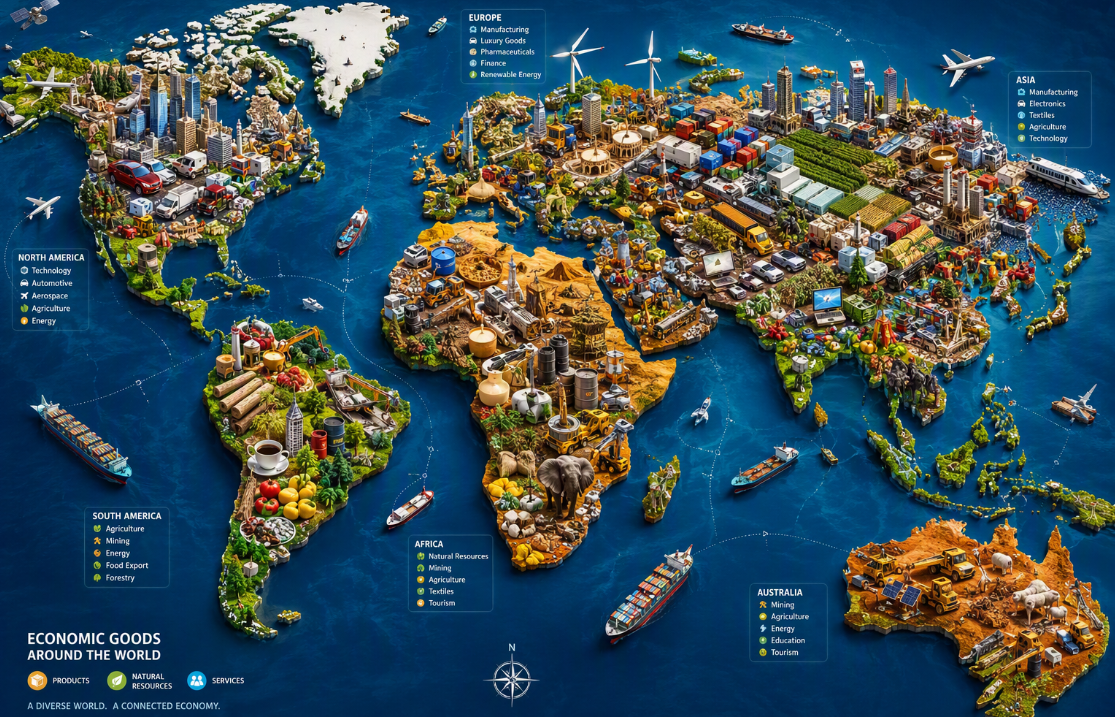
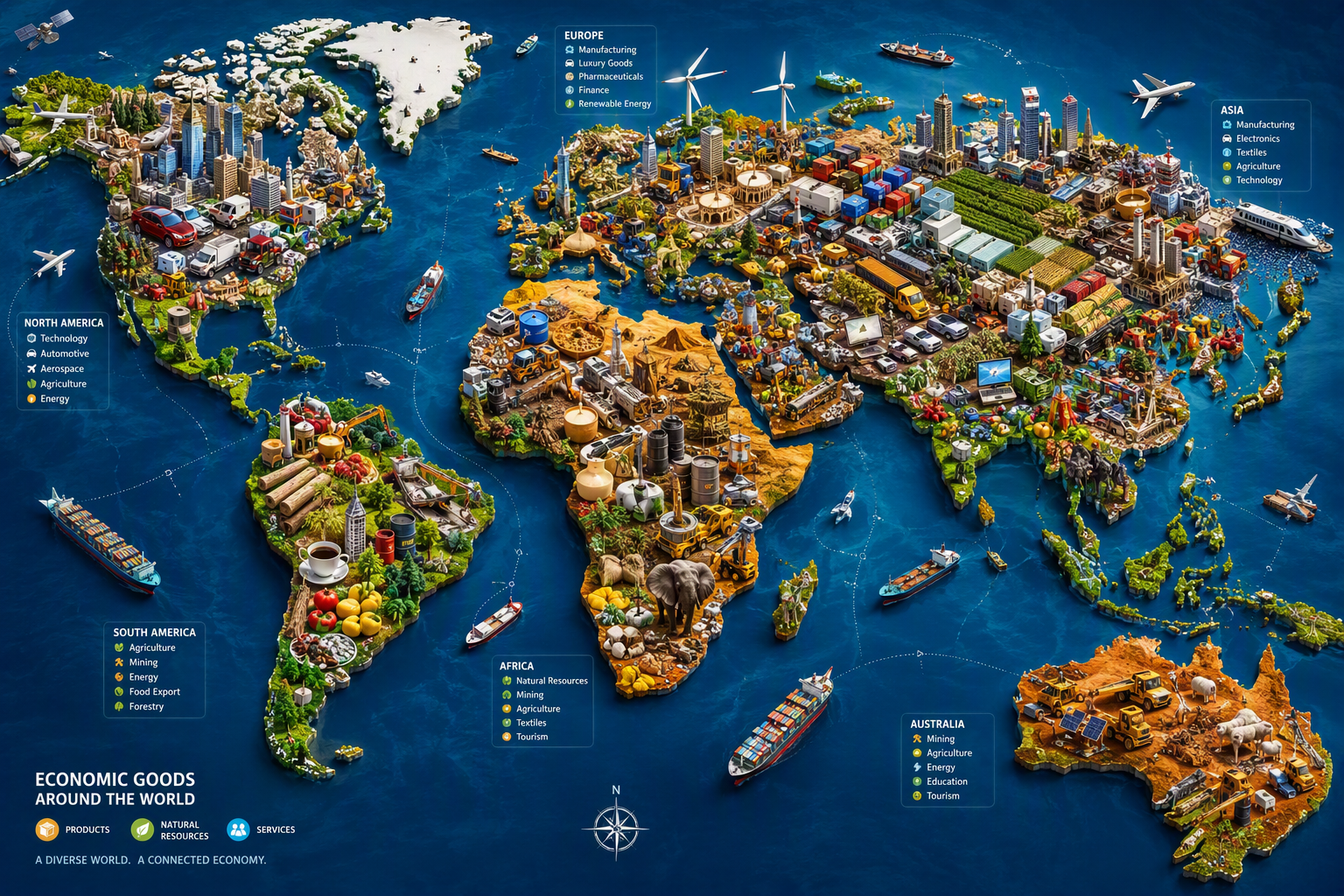
In economics, goods are things that people want. They are made by using resources. Goods become useful when people use them. Some goods are things you can touch. Others can be services.
To learn about the different types of goods, you have to look at where they are in the production process, how people use them, and if they are hard to find. This idea is helpful when you want to sort goods by how people use them in the end, who owns them, and how many people want them. The next two parts will explain this in an easy way.
Definitions and Basic Understanding of Goods
Goods are things people make to meet human wants. A business will use things like land, work, money, and planning to make these goods. These goods are what people get after all the work, and people feel happy when they use them.
Most of the things people talk about in economics are called economic goods. This is because people make them by using scarce resources, so they do not have enough of them for everyone. A car, a book, medical services, and even street lights all take resources to make or run. Since these resources are limited, using them for one thing means you cannot use them for something else.
That is where opportunity cost comes in. If people use steel, labor, or land for one thing, they can’t use the same things for another. This shows why economics looks more at economic goods instead of free goods. For UPSC, you should remember that there is a link between scarcity, choice, and human wants. This is a key idea.
Classification Criteria for Goods
Economics puts goods into different groups. This helps make analysis easier. The same thing can be put into a new group based on what it does in the production process. It can also be grouped in a new way if you look at its final use. That is why context is important in UPSC questions.
A good can be looked at in a few ways. First, see who uses it. It is also important to look at if it gives any economic value addition. You should know if people use it for direct consumption or for further production.
For example, think about a part that is sold to a factory. If it is used for further production, it is not the same as selling that same part as a spare part to a buyer for direct consumption. The value addition of the good can change based on how and by whom it is used.
Key classification criteria include:
- Use in the production process: A good can be an intermediate good or a final good.
- Purpose of purchase: A good can be bought for personal use or for business use.
- Nature of access: A good can be private, public, club, or common.
- Role in value addition: A good is used either for final use or for further transformation in the production process.
Primary Types of Goods in Economics for UPSC
A big part of learning UPSC economics is to know the four main types of goods. These types are based on rivalry and excludability. The four are private goods, public goods, club goods, and common goods. Each of them acts in a different way in the market and with policy.
This way of grouping things helps you see why there are free riders, why the government has to step in sometimes, and why shared things can get used too much. The idea also shows why private firms make some stuff but stay away from other things. Let’s look at these types side by side and with simple examples you can remember for your exam.
Private Goods vs Public Goods
Let’s start with private goods. These goods are excludable and rival. That means if you do not pay, you can be kept out. When one person uses the good, there will be less of it for other people. Food, clothing, cars, and televisions are all in this group. People buy these goods for personal use.
Now think about public goods. These are easy for people to use and no one can be kept out. A person’s use of them does not stop others from using them too. Street lighting and national defence are good examples. When there are free riders, private firms do not feel it will be good to make or provide these things.
Here is a quick text table for revision:
| Feature | Private goods | Public goods |
|---|---|---|
| Excludability | Yes | No |
| Rivalry | Yes | No |
| Payment link | Usually direct | Often not direct |
| Example | Food, tickets, cars | Street lighting, national defence |
| Law of demand relevance | Commonly applies in markets | Less direct due to public provision |
Club Goods and Common Goods
Not all goods can be put into just private goods or public goods. Club goods and common goods are in the middle. That is why people call them quasi-public goods. These kinds of goods matter for UPSC. They often ask questions about the small differences between public goods and club goods.
Club goods are things that people can be kept out of, but if you get in, many people can use it at the same time. Common resources are things you can’t stop people from using, but when one person uses it, there is less for others. A cable television or Netflix subscription is a club good because people have to pay to use it, but many people can watch them at once. A grazing meadow or fish stock is part of common resources because one person’s use means there is less left for others.
Keep these points in mind:
- Club goods let some people be kept out, so those who give the service can ask people to pay.
- Common goods get used too much because anyone can use them.
- People who do not pay but still use services, known as free riders, are a problem in public places and when things are shared.
- Street lighting is not a club good. It acts more like a public good.
Goods by Production Stage
One more way to group goods is by looking at where they are in the production process. Some goods get used up or change form before people buy them. Others are ready for final use. This is important because it helps stop confusion when we count national income.
You need to make a clear difference between an intermediate good and a final good. A capital good is also important. This is because it helps make other goods and services at different times. These types have a link with value addition and these help keep you from double counting. The next parts will show these with Indian examples.
Intermediate Goods Explained with Indian Examples
Intermediate goods are items that are partly made and used in the production process. People do not eat or use them as they are now. These goods are made to be changed more before they are ready for final consumption. So, they pass from one step of the production process to another for further transformation.
Think about raw materials, electronic parts, food ingredients, or building materials. Tea leaves that a tea company uses to make packaged tea are an intermediate good. A car part that goes into a vehicle is also an intermediate good. In each case, the item is used for further production.
The main idea here is about context. The same thing can be an intermediate good or a final use item. For example, a car part sent to a factory is an intermediate good. But if that car part is sold straight to a person as a spare, then it is for final use. This is why the UPSC asks questions that need careful reading.
Final Goods: Consumer and Capital Goods
A final good is a product that does not need more work before you can use it. It is ready for you to buy for direct consumption or to use as an investment. People count it only one time when they measure national income. This helps make sure national income is counted right.
Consumer goods are items that people buy for their own use. Food, clothes, and appliances are easy examples. Some of these consumer goods last for a long period, like furniture and cars. These are called durable goods because they stay in good condition for a relatively long period. Other items, like toothpaste or food, get used up quickly. People buy all these things for personal use, and these buyers are called ultimate consumers.
Capital goods are a type of final good. The difference is that firms buy them, not households. Things like machines, trucks, office buildings, and tools are all capital goods. They help with future output and help to add value for the economy. This is why it is so important to know how final good, consumer goods, and capital goods work when we talk about value addition and national income, especially for UPSC theory.
Nature of Consumption – Economic and Free Goods
Goods can also be sorted by how scarce they are. This is a basic idea in the study of economics. Some goods use up scarce resources. They have a price or you have to give up something for them. Other goods are easy to find and be everywhere.
There are two types of things here: economic goods and free goods. The main difference is about how hard it is to get them and what you give up to get them. It is not only about how useful they are. If you get this, many things in economics will be easier to learn. The next two parts show why most economists talk more about economic goods and not so much about free goods.
What are Economic Goods?
Economic goods are things made by using scarce resources. Since these resources are not much, the goods that come from them are also not many. This is why economic goods are important in the study of economics, which looks at how people make choices when there are not enough resources.
Cars, books, bikes, medical services, and street lights are all examples of economic goods. The production process for these things needs people, work, and other resources. When we use time and resources to make any of these, we cannot use those same things for something else. This loss is called the opportunity cost of production and consumption.
Because there are not enough of these goods, prices are important. The law of demand is true for them. When price goes up, demand decreases. This is why economic goods are such a big part of market study, welfare plans, and what the country does. For UPSC, always link economic goods with things like being scarce, the cost, and how people use few resources.
What are Free Goods?
Free goods are things you can get for free. There is no limit to how much you can get of them. These goods have zero opportunity cost, so you do not lose out on anything else when you use them. People do not use up any scarce resources to make them. So, when you use free goods, you do not have to choose between this or some other thing because there is enough for everyone.
Common examples are air, sea water, and sunshine. These things help us with our human wants. But they are not traded like economic goods in the market. Their supply is not limited like other things. People do not pay money just to have these in their daily life.
This is also why economics does not look at them much. The subject is mostly about how people use scarce resources to meet unlimited wants. Free goods are not the main focus because they have zero opportunity cost. This means if the goods are easily available and there is no loss, they are not about having to choose one thing over another. For exams, remember: free goods, even if useful, do not count as economic goods because of their zero opportunity cost.
Goods Based on Income and Demand Relationship
When people have more or less money, the way they buy things can change. Because of that, experts put items into groups like normal goods, inferior good, and luxury goods. They also talk about some items that act in a special way, like veblen goods and giffen goods. These kinds of goods don’t always follow the usual rules.
The main idea here is income elasticity of demand. This tells us how demand will change when people’s income goes up or down. This topic is very important for UPSC exams because it links what you read in books to real life. You get to see how income affects what households buy, how poverty can change what people shop for, and how the things people choose to buy change over time. Let’s look at these topics one by one.
Normal Goods, Inferior Goods, and Luxury Goods
Normal goods are things that people buy more of when their income rises. These goods have a positive income elasticity of demand. For example, people often get more garments, furniture, and mobiles when they have more money. A special set of goods called luxury goods see their demand go up even more, as income rises. This means, when people earn more, they spend a lot more on these items.
An inferior good is one where people buy less of it when their income rises. This happens because, as people get more money, they look for better things. For example, they might stop buying cheaper generic brands, second-hand furniture, or small low-cost housing. So, when income rises, the demand for these goods goes down. This shows that incomes can change the way people buy different things.
For quick revision:
- Normal goods: When there is more income, people buy more of these things.
- Luxury goods: When income goes up, demand for these items goes up a lot. These goods have a strong positive income elasticity of demand.
- Inferior good: People buy less of these things when income rises.
- Demand for luxury goods often moves up and down more than the demand for normal goods.
Giffen Goods and Veblen Goods in the Indian Context
Most goods follow the law of demand. This means when the price goes up, the demand decreases. But there are some special cases. Giffen goods and Veblen goods do not follow this rule. These things are asked in UPSC to see if you know the exceptions and not just the rules.
Giffen goods are hard to find in real life. For these goods, people may buy more when the price goes up. This is seen in poor households. When low-cost foods like wheat, rice, potatoes, or bread cost more, some people still pick them. That is because they cannot pay for better choices. So, poor households might buy more giffen goods even as the price goes up.
Veblen goods are not like other goods. People buy these things to feel important or to show off. These items are seen as status symbols, so if the price goes up, more people may want them. Some good examples are high-end phones, fancy jewelry, old antiques, paintings, and designer clothing. In short, one type is bought when people have hard times, but Veblen goods are all about showing off to others.
Goods by Relationship with Other Goods
Goods can also be grouped by how people use them with other goods. Some goods are used with others, while some take the place of others. Knowing this can help people see why demand changes when prices or what people want change.
Economics points out demerit goods because using them can be bad for people and lead to market failure. So, this part connects how demand for things relates to public welfare. First, let’s talk about complementary goods and substitute goods with some simple examples that you can remember easily.
Complementary Goods and Substitute Goods with Examples
Complementary goods are items that people use together. When you get one, you often need the other too. For example, a car and petrol go hand in hand. The same is true for toothpaste and a toothbrush, or a pen and ink. The way these things work together is important, especially when the price of one goes up or down.
Substitute goods are other options you can choose. If the price of one goes up, people might start to buy the other one instead. For example, tea and coffee are substitute goods. Pepsi and Coca-Cola are, too. You can also have different public transport options that work as substitutes. When people change what they buy because of price, this is called the substitution effect.
Keep these examples handy:
- Complementary goods: A car and petrol go together.
- Complementary goods: Toothpaste and a toothbrush are used in the same way.
- Substitute goods: Tea and coffee are used instead of each other. Some people use tea leaves when they drink tea at home.
- Substitute goods: A person may pick one way to travel instead of another when using public transport.
Conclusion
In short, it is important to know about the many types of goods in economics, especially if you are getting ready for the UPSC exam. You can learn about private goods, public goods, and free goods. Each one is a big part of the way our economy works. When you understand these ideas, you build up your knowledge. You also get better prepared for tough exams like UPSC. The way we put goods into groups is not just something to read about in a book. It helps you see how people buy things and how markets work. If you want to know more about types of goods, like public goods or free goods, and boost your UPSC study, book a free talk with our team today!