Key Highlights
- This guide shows you the important topics in upsc economics. It is helpful for Prelims and Mains.
- You will get to know how the Indian economy is a part of general studies and the civil services exam.
- This covers things like economic growth, budgeting, banking, poverty, and economic reforms in an easy way.
- You will see what makes Prelims facts different from analysis in Mains.
- The blog has the names of trusted books, simple notes, and tools for revision.
- You will learn easy ways to prepare for upsc economics using the syllabus and previous year papers.
Table of Contents
Introduction
If you want to do well in the civil services exam, you need to pay attention to upsc economics. The subject is present in Prelims and Mains. It also connects with many current issues you read every day. If you understand the economics syllabus clearly, you will know what to study instead of guessing. This guide shows you how to break up the subject into small, easy parts. So you can focus on the key concepts, the main issues, and the topics that come up most often in the civil services exam.
Overview of Indian Economy for UPSC Aspirants
The indian economy is very important for the upsc civil services exam. It brings together both theory and current affairs. In general studies for the civil services exam, you need to know how growth, poverty, inclusion, banking, and budgeting shape India’s development. These topics help you see how the indian economy and current affairs are linked in the civil services exam.
The indian economy syllabus is not only about what words mean. You have to connect ideas with government rules, news stories, and important reports. This is why studying by looking at the syllabus is a good way to learn better. Now, let us find out why this topic is so important for the exam.
Importance of Understanding Indian Economy in UPSC Exam
Economy is a key topic in the civil services exam. You will see questions about it in both objective and descriptive forms. In general studies, the questions are there to see if you know how India grows, how the state helps in social development, and how the policies change daily life. This makes the upsc economics syllabus very useful for the civil services exam. It is also good for getting a high score.
The important topics you need to know are economic growth, development, poverty, inclusion, budgeting, banking, inflation, balance of payments, demographics, and social sector ideas. It is also important to read about public finance, national income, financial institutions, and sustainable development. These important topics help build your foundation.
Current affairs also plays a big part in shaping many questions. Things like MSMEs, Make in India, NITI Aayog, black money, and food security are often asked about in topics on the economy. When you link ideas with what is happening now, the subject gets easier and can be more useful to you.
Structure of Indian Economy Syllabus for UPSC
The upsc economy syllabus is spread over several stages. In Prelims, you will see economy in the Economic and Social Development section. In Mains, it is found in General Studies Paper III. There, you read about economic development and other important topics. The syllabus is also offered as an optional subject for those who want to study it more.
To read the economics syllabus in a clear way, you should break it into main areas.
- This includes growth, development, sustainable development, and human development.
- You will read about poverty, inclusion, demographics, and actions in the social sector.
- The text covers fiscal policy, the budget, public finance, and revenue receipts.
- It also looks at banking, inflation, foreign trade, current account, and the balance of payments.
This way, you can get the important topics and not feel lost. First, go over the basics. Then, look at applications. After that, try to link them with current affairs. When you know the framework, breaking down the full syllabus is much easier.
Detailed Indian Economy UPSC Syllabus Breakdown
Just reading all parts of the economics syllabus is not enough. You have to see which parts show up in Prelims. You should know which parts you need to look deeper into for Mains. Also, check where previous year papers say there is a focus. A topic-wise plan can help with all this.
For indian economy preparation, start by splitting your reading into concepts, policies, sectors, and trends. After that, connect these topics with upsc economics questions from earlier exams. This way, you get a clear look at what is most important. Now, let’s break the syllabus down into parts that stay focused on the exam.
Core Topics for UPSC Prelims – Indian Economy
Prelims tests how clear you are, not just if you have some idea. In upsc economics, the questions often come from basic ideas. They also ask about things that connect to government plans, reports, and names you hear in the news. You need to get the ideas right, so keep going over ncert books and one main place where you read these topics. Keep working at it, read often, and focus on being clear with what you know.
Focus strongly on these areas:
- Economic growth, development, poverty, and inclusion
- Inflation, banking, monetary policy, and financial markets
- Budget, taxation, public finance, and deficit-related terms
- Agriculture, food security, demographics, and international financial institutions
NCERT books give you a base to understand key ideas in the indian economy. These include terms like national income, exchange rate, consumer price index, and GDP. After you read about these topics, go back and read about new things that happen now, and solve practice questions. This is what you need to do if you want to know the important topics for the indian economy part of the UPSC exams.
Key Issues for UPSC Mains – Indian Economy
Mains is not just about writing the right meaning of words. In this part, you have to talk about things like trends, check how good ideas work, and tell what the effects are on economic development. You might also get questions on planning, mobilization of resources, jobs, inclusive growth, building roads or power, and food processing. A clear structure in your answers will help you do well.
A big section of General Studies Paper III talks about fiscal policy, monetary policy, and balance of payments. You will read about budgeting, land reforms, and how economic reforms change things. Agriculture is also given focus. This includes topics like irrigation, Minimum Support Price (MSP), buffer stocks, public distribution, and food security. You should know about infrastructure and the investment model too. These are key areas for General Studies Paper III.
What kind of questions come from Indian economics in the UPSC exams? In Mains, these are usually the type where you have to think deeper. You need to link a topic with government policies, how they work in real life, and what is going on now. It is not just about saying what something means.
Weightage and Trends in UPSC Exams
If you look at previous year papers, you will see that the economy is not just a side part. In general studies, you get direct concept questions. There are also questions on policy and issues. A good understanding of the economic survey and the budget can help you write better answers.
Here is a simple look at the trend, made from the shared material:
| Area | Likely Focus in Exam |
|---|---|
| Prelims GS economy | Concepts, schemes, inflation, banking, budget, poverty |
| Mains GS III | Growth, planning, inclusion, agriculture, infrastructure |
| Economics optional | Indian Economy 40-45, Micro and Macro 35-40, International Economics 15-20, Money Banking & Public Finance 10-15, Growth and Development 10, Statistics 7-10 |
This pattern gives an answer to another common question: what kind of questions do the UPSC exams ask from Indian economics? They can go from fact-based elimination in Prelims to asking you to write in detail about issues in Mains. By looking at trends, you will know which important topics you should focus on first.
UPSC Economics: Prelims vs Mains
Many people read economics in the same way, but the prelims and mains need you to read differently. Both these exams are part of the economics syllabus, but you must cover them with different detail and style. In prelims, you have to be quick, clear, and remember things well.
In the mains stage, upsc economics is more about analysis. You need to say what caused a thing, what followed, and what ideas came out of it. You have to write your answers in a clear form. The economy is part of general studies, so knowing how this is different could help you save time. Let us look at both of these next to each other.
Syllabus Differences between Prelims and Mains
The biggest difference is about how deep you need to go. In prelims, the economics syllabus is to make you aware of key words, schemes, signs, and basic ideas of policies. In mains, you have to go deeper, explain things, understand them well, and write about issues. So, the way you study for prelims and mains is not the same.
You can think of it this way:
- Prelims want to know what a idea is and where you can use it.
- Mains want to see why this thing is important and what effect it will have.
- In general studies for mains, you need to connect your answer with policy, development, and current affairs.
For example, the prelims can test things like inflation, national income, or tools used in banking in a direct, question-answer form. In the mains, you may need to write about how inflation can change growth. You may also have to talk about how fiscal choices change development, or how policy reforms can bring new outcomes. So, this is how the upsc economics syllabus for prelims is not the same as the syllabus for mains.
Typical Question Formats in UPSC Indian Economy Segment
In prelims, economics questions are all objective. You need to pick the right statement, match terms, or use a concept for a current issue. A lot of these economics questions may look easy at first. But, you have to be exact with your answers. This is the reason it is so important to read and practice the indian economy segment again and again.
In mains, the format is very different. The questions make you discuss, examine, look at, or judge topics like inclusive growth, public finance, economic reforms, food security, or balance of payments. Here, answer writing practice is a must. Just knowing the facts is not enough.
So, what kind of questions do you get from Indian economics in the UPSC exams? For Prelims, the questions focus on quick checks of your ideas and facts. For Mains, you need to give reasons, show examples, and connect the answer with policy. If you read and practice for both At the same time, you will get a much better hold of the subject.
Essential Indian Economy UPSC Notes Compilation
Good notes help you save time, even if you do not have an economics background. You do not need to collect a lot of study material. Make short notes on important economic terms, main trends, and key policy areas. This will help you go over everything quickly before both stages of the exam.
For upsc economics, you need notes that make it easy to understand ideas. Your notes should also keep up with new updates and show which parts are fixed and which parts can change. If you do this right, short notes can be your own revision book. The next sections will give you a simple plan so you can make these notes for each topic.
Macro-Economic Concepts Explained Simply
Start your notes with basic macro ideas. You will see these topics in many parts of the syllabus.
Write about national income, GDP, GNP, inflation, unemployment, fiscal policy, monetary policy, and exchange rate in simple words. For each term, you should write one definition, one use, and one example.
This way, the notes will be clear. You can read them any time and know what these topics mean.
National income accounting is helpful to see how a country’s output, income, and spending are tracked. It shows where the money in an economy comes from and where it goes.
Economic growth is about the rise in a country’s production or national income over time. But, development is not just about making more things. It also looks at how people’s lives get better, including their health, schooling, and living ways. Human development means improving how people feel, live, and work. Some ways to measure this include seeing how long people live, how much they learn, and the money they can spend.
There are also several ways to measure poverty. A common way is to look at how many people do not have enough money to eat or live well. A country can use other signs too, like if people cannot read or have no clean water.
Sustainable development is when a country tries to grow well today but also cares about people living in the future. It means using resources in a good way so that the earth, air, and water are not harmed for kids coming later.
All these ideas—economic growth, development, human development, poverty measures, sustainable development, and national income accounting—often connect with social development. They are used in talks about how to improve people’s lives and plan better policies for the future.
Yes, I can make short notes on the Indian economy for your UPSC prep. The best way is to keep every topic short. Try to link it with what is happening now in the country. Make sure you can read it quickly before practice exams or on the exam day.
Sectoral Analysis (Agriculture, Industry, Services) for UPSC
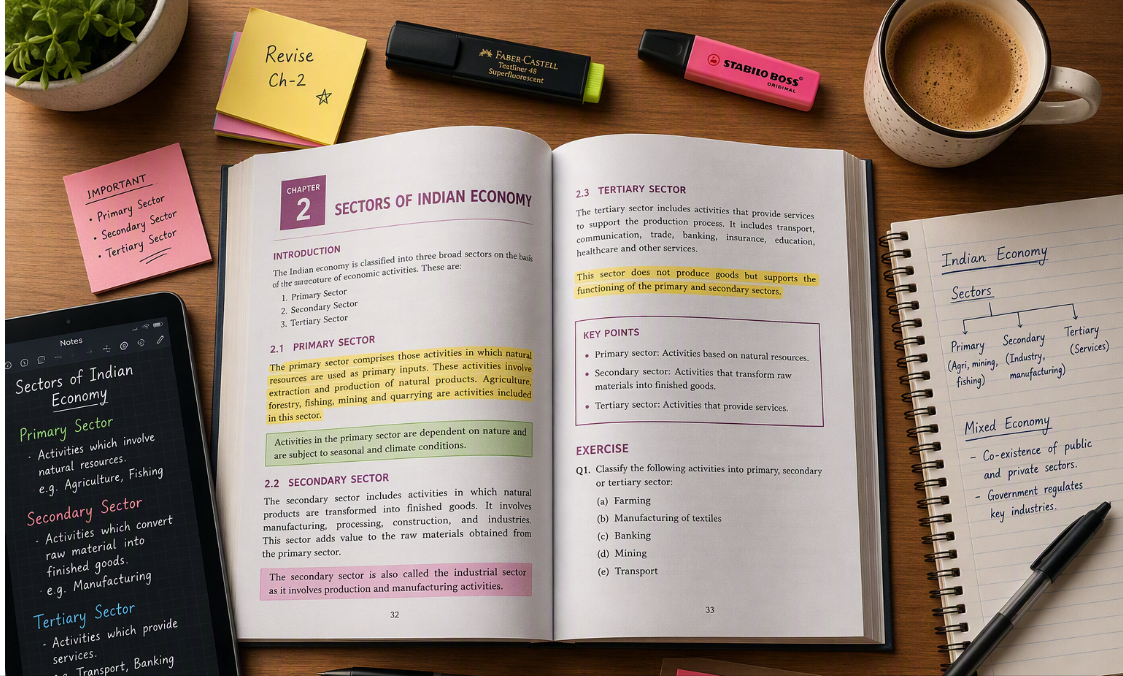
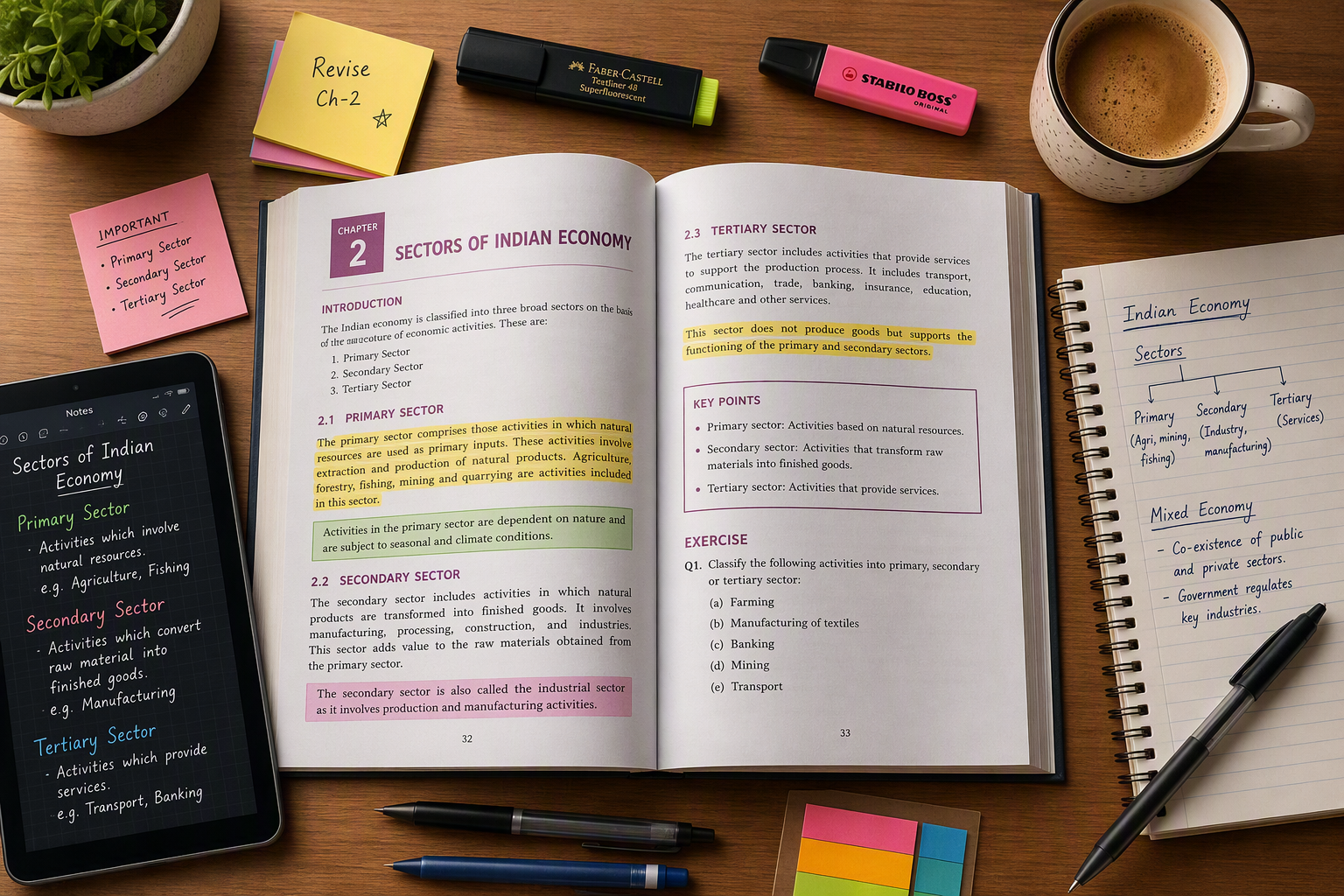
Sectoral notes can help you see how the economy works in real life. You can split your notes into three parts – agriculture, industry, and services. Then, write down the real issues each sector faces, the changes or reforms they have, and how each one helps with growth and jobs. This way, your study gets a clear path to follow.
Your topic-wise notes should include:
- Agriculture: the way crops are grown, how much water is used, MSP, buffer stocks, and food security
- Industry: rules for industry, how small or medium businesses (MSMEs) work, selling government stakes, and what the public sector and private sector do
- Services: about IT and ITES, tourism, services related to trade, and financial markets
- Linked areas: food processing, moving goods, infrastructure, and the investment model
Toppers deal with the economics part in the UPSC exam by making big topics simple. They break them into small notes based on different areas. They also add up latest examples as they study. This way, it helps them go over these notes fast at the time of Prelims. It also makes their answers better in the Mains by giving the answers clear points.
Indian Economic Policies and Recent Developments
Policy notes should not feel random. You need to track the areas that are in the syllabus and also in news right now. This means looking for government policies on inclusion, employment, agriculture, budgeting, social welfare, and infrastructure. You should try to see how these things impact people, and not just remember their names.
Important policy-linked themes are the economic reforms that started after liberalization, choices related to fiscal policy, planning, NITI Aayog, Make in India, and industrial corridors. These programs also impact economic development. It is important for you to see how such policies help with inclusive growth, resource mobilization, and jobs.
The best way to get ready for Indian economics in UPSC is to read about a policy and know its background. Start by reading and understanding the concept. After that, link it to something that has happened lately. In the end, write what the result or effect could be. This is the fastest way to help you get ready for both parts of the exam.
Must-Read Indian Economy UPSC Books
The right books about the Indian economy can help you feel less confused. You do not need a lot of sources if you understand the basics. You can start with ncert books. After that, you can go to a few good reference books. These should help explain the Indian economy in a way that is easy to use for exams.
Use these as your main study material. Add some government documents from the official website only when you need them. A good mix of the basics, practice points, and review help is enough. Now, let’s look at the most useful recommended textbooks and how to use them.
Top Recommended Textbooks for Indian Economy Preparation
If you want to know which books to read for Indian economics for UPSC, the material here tells you in a clear way. Start with ncert books from Classes X, XI, and XII. These books help you build strong ideas. After that, get one or two good reference books for a better understanding of the subject.
The most useful sources mentioned are:
- Indian Economy by Ramesh Singh
- The Indian Economy by Sanjeev Verma
- Mishra-Puri and Dutt-Sundaram are good for economics optional
- M. L. Jhingan, H.L. Bhatia, S.B. Gupta, and H.G. Mannur work well for more advanced topics
For the upsc civil services exam, you should pick books based on what you need for each part. For general studies, you need to know the ideas well and connect them with what is happening now. If you pick economics optional, you have to go deeper into the theory. The best way is to use a small list of books and read the important topics more than one time. This helps you get ready for the civil services exam in the best way.
Reference Materials and How to Use Them Effectively
Reference materials will help you only if you use them the right way. The economic survey, budgets, PIB, newspapers, ARC reports, and ministries have useful info. These are good to use, but they should go along with your main books and not take their place.
For UPSC economics, you do not need to read many books. Most people do well if they read one main book with some reference books. You should also read the economic survey to see trends. Go through previous year papers to know the question pattern. Look for current updates for use in answers. This helps keep your study material easy to handle.
A good way to study is this. First, read one main source to understand the ideas. Then, use one set of notes when you go over things again. After that, practice with previous year papers to test what you know. This way, you get all you need and do not feel scattered by using too many books or notes.
Indian Economy Preparation Strategies for UPSC Success
Many people find it hard to learn the economy. The main reason is that they read it without a study plan. A better way is to start with the basics. After that, look at the problems or issues in the subject. Then, focus on revision and testing. This way can help you, even if you do not have an economics background.
For upsc economics, you should practice answer writing, look at previous year papers, and keep up with what is happening now. You do not have to follow a hard or tricky routine. What helps is to stay steady, be clear, and read things many times. Here is how you can use this in a real way.
Study Plan for Beginners and Repeaters
A good study plan starts with building ideas and understanding. If you are new to this, read NCERTs and learn the basic words. If you are trying again, put more time on the parts you find hard, look at where you need to read again, and work on how well you write your answers. No matter which group you are in, you need to read economy for general studies and think about current affairs while doing so.
A practical plan looks like this:
- Start with the basics first. These basics are national income, inflation, banking, budget, and poverty.
- Look at important topics for each sector and cover them. These are agriculture, industry, services, and trade.
- Connect topics that do not change much with current affairs and the government steps or policies.
- Take tests and do short revisions each week to help you remember all the topics.
The best way to get ready for Indian economics in the UPSC is to use a step-by-step plan. First, learn the main idea of each topic. Then, try to see how this topic is shown in the news. After that, read and go over it again. Last, test what you know. This way works well even if you do not have an economics background.
How Toppers Prepare Indian Economy for UPSC
Toppers often do not read about the economy from too many places. They make a good base, write short notes, and read them many times. They use previous year papers to know what the exam wants. This helps them read less and save a lot of time.
For their main exams, toppers focus on answer writing practice. They practice explaining economic reforms, public finance, food security, and the balance of payments with a clear structure. When working on optional or advanced topics, they use simple economic terms, real-life examples, and the right data. They also add graphs in their optional answers when it makes sense.
Toppers in the UPSC exam handle the economics section in a clear way. They do not read lots of books. They choose one main book and stick to it. They keep up with new updates and go over their notes again and again. They also practice writing clearly for this part. This is how they get ready for the exam.
Creating and Using Topic-Wise Notes for Indian Economy UPSC
Topic-wise notes are very useful when you study upsc economics. They let you go over things fast and you feel less lost before the exam. You may read from some reference books, but for your last revision, you should use your own short notes. This helps you remember things better.
A simple note-making format is:
- Make one page for each topic. These pages will cover the meaning, some examples, a linked policy, and a problem people see right now.
- For important topics, split things that stay the same from things that can change.
- Add short facts from the study material, but only if they help you revise.
Yes, there are topic-wise notes for the Indian economy for UPSC on many websites. You can find material, reports, and short notes too. But the best notes will be the ones you make from a few good sources. These will fit your revision needs well and help you the most.
Conclusion
To sum up, doing well in the Indian Economy is important for all UPSC aspirants who want to do well in their exams. You need to know the details of the syllabus and plan how to study for it. A good understanding of economic ideas will help your preparation a lot. The Indian Economy is important not only for the exam, but also to help you get a better idea of what is happening in India and in the rest of the world. As you get ready for the exams, remember that you need to use the right resources, practice past papers, and keep up with what is happening now. If you need help, feel free to ask for it. Start preparing now and take the first step towards your UPSC goals!
Is it better to follow multiple sources or stick to one for Indian Economy UPSC?
Stick to one main source when you read for UPSC economics. Use a few reference books only when you need to fill gaps in your study. If you have too much study material, it can make you feel confused. For general studies, keep your source list short. This helps you go over important topics more often. You will remember them better before both Prelims and Mains
Where can I find downloadable PDFs or concise notes for Indian Economy UPSC?
You can use the government reports, summaries, and updates from the official website of the ministries. The economic survey and budget documents are also good study material. But for upsc economics, the best short notes are the ones you make yourself when you read and study
What are the most scoring topics in Indian Economy for UPSC?
The most scoring important topics in upsc economics are economic growth, inflation, budgeting, banking, poverty, inclusion, agriculture, and economic reforms. You should start with ncert books to make your basics strong. Then, read about current events and see how they connect with these topics. This way, you get the best results in both stages of the exam.