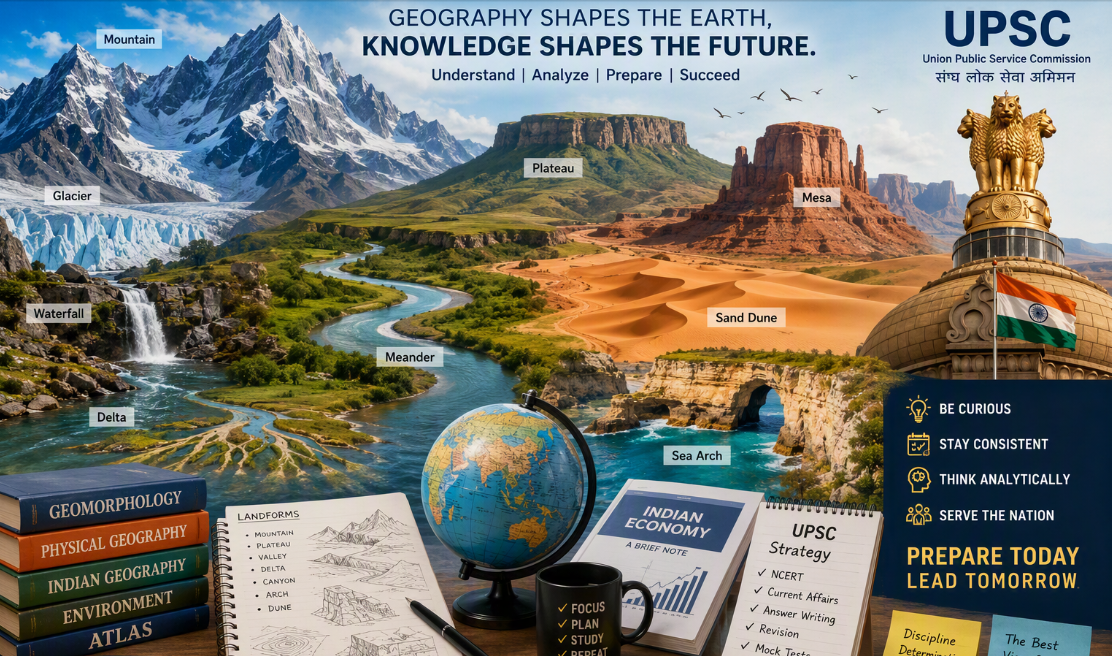
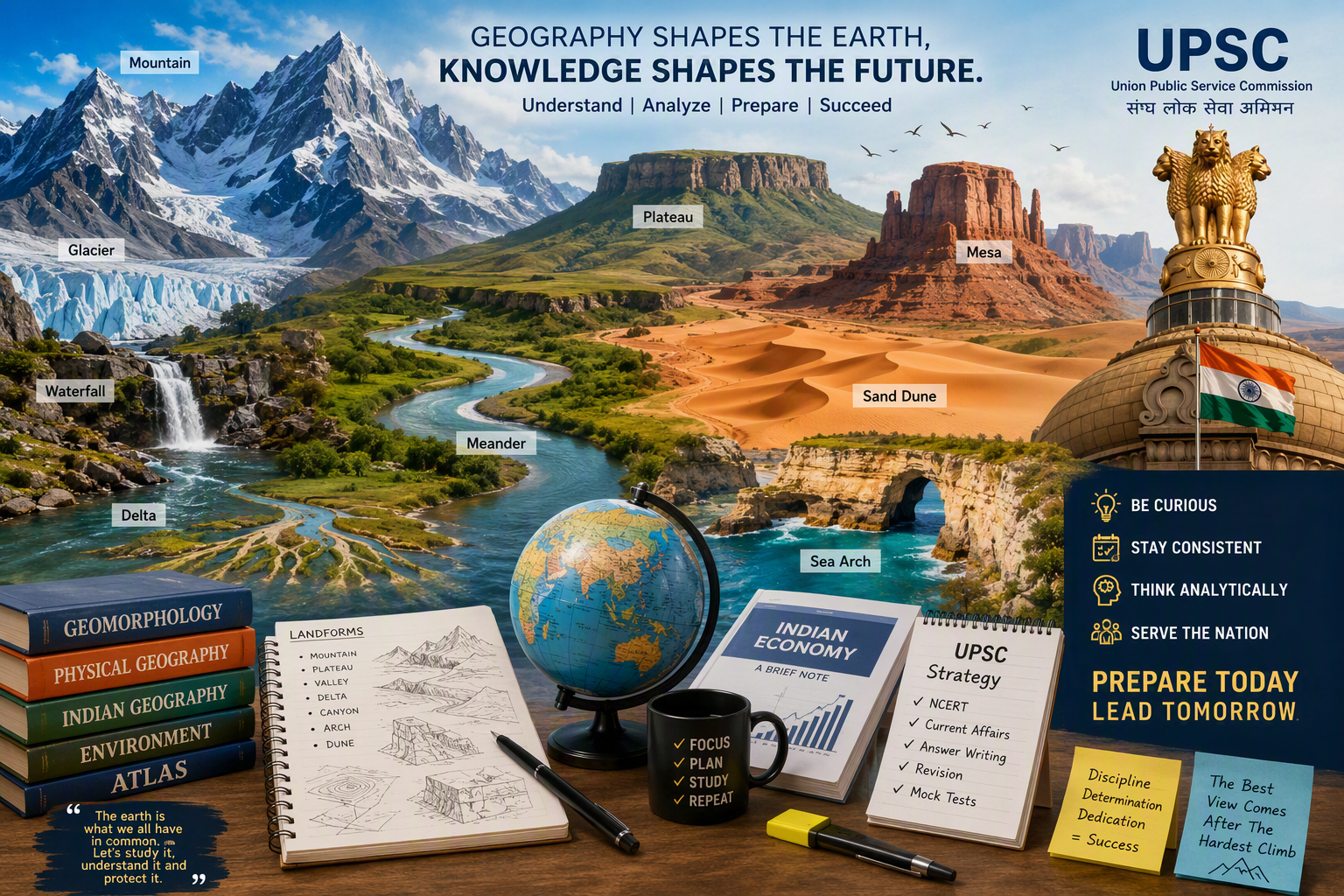
Key Highlights
- Geomorphology is an important area in physical geography. It comes in both General Studies and geography optional papers for upsc mains.
- You must be clear about plate tectonics, continental drift, landforms, and how land changes for better answer writing.
- Past trends show the questions are often about ideas and how they link with current affairs.
- A smart way to prepare is to connect geomorphology with disaster management, environmental issues, and regional planning.
- Use NCERTs, standard books, maps, and test series to make strong notes and practice for revision.
- You write better answers with diagrams, examples, and regular answer writing practice.
Table of Contents
Introduction
Geomorphology is a very useful part of geography when you study for civil services. It shows how the earth’s surface forms and changes. If you learn this well, many ideas in world geography will be easier to understand. It helps you know the concepts and also aids in writing your answers for exams. You can learn about things like mountains, rivers, earthquakes, and erosion from it. Geomorphology gives a clear way to read physical features. This is why it is asked in Prelims, Mains, and even in interview talks.
Overview of Geomorphology in the UPSC Syllabus
In the upsc syllabus, geomorphology is a big part of physical geography. It is important for General Studies in Prelims and for GS Paper 1 in upsc mains. It is also a key topic in geography optional Paper 1.
Key topics cover landform development, endogenic and exogenic forces, as well as the evolution of the earth. You also get plate tectonics, continental drift, isostasy, mountain building, volcanicity, earthquakes, and tsunamis. There is more about geomorphic cycles, erosion surfaces, slope development, channel morphology, and applied geomorphology. These areas help you build the base for deeper preparation.
Significance of Geomorphology for UPSC CSE
Geomorphology is an important part of civil services preparation. It helps you to know how the earth looks and acts on its surface. The topic is not just about ideas. It helps a lot with maps and answers to questions on the environment and disasters. Many parts of general studies use it.
You need to understand the way internal and external forces shape the earth. Internal forces are things like tectonic activity, volcanoes, and earthquakes. External forces are changes caused by weathering, erosion, and deposition. You should also get clear about slope development, landform evolution, and how rivers, wind, and glaciers change the land and make different landscapes.
This subject is more useful when you link it with what is needed in real exams. If you know the basic ideas well, you can talk about things like mountain building, tsunamis, drainage patterns, and erosion in a simple way. This will make your prep stronger. It will also help you feel more sure about your answers.
Structure of the Geomorphology Syllabus in UPSC Papers
The upsc syllabus lists geomorphology in geography optional Paper 1. It is part of physical geography. But its ideas come up in other parts too. In upsc mains, you may get questions about landforms, earthquakes, and physical features. These can show up in GS Paper 1 as well.
If you look closely, the way things are set up goes from basics to real uses. It starts with ideas that control how landforms get shaped, the earth’s structure, and some simple points about earth’s magnetic field. Then you get topics about plate tectonics, continental drift, isostasy, and the newest ways people think mountains come up. After that, there are chapters on things like volcanoes, earthquakes, tsunamis, how rocks and land wear away over time, and how rivers shape their paths.
The last layer matters most. In UPSC, there is applied geomorphology. It also connects with the environment and economic geology. So, do not read this unit as single facts by themselves. Learn it by moving from the idea, to how it happens, to how you use it in the exam.
Role of Geomorphology in GS and Geography Optional
In the gs paper, geomorphology helps you understand Indian and world geography topics like mountain ranges, rivers, earthquakes, and tsunamis. In geography optional, you study these ideas in more depth. This makes your base much stronger when you prepare for civil services.
That overlap helps you. When you study geography optional, you also make your GS Paper 1 better. It can help with essays and answers about issues like development, hazards, or problems with the environment. A strong base in physical setting will matter here. This lets you use your study time well.
For answer writing, keep your way simple. First, read and get the syllabus line by line. After that, use diagrams, maps, and short examples. Then, link what you read in theory with the current topics and also with previous year demand. If you do these steps well, geomorphology turns into a scoring area and does not feel hard.
Understanding the Basics: What is Geomorphology?
Geomorphology is a part of physical geography. It looks at what shapes the surface of our Earth. For UPSC, you need to know how things like mountains, plateaus, plains, valleys, slopes, and river channels come to be and how they change with time.
It also talks about the forces that cause these changes. This is the reason geomorphology is closely linked with world geography. It can help you talk about what you see on the earth’s surface in a clear way, instead of just learning things by heart.
Definition and Scope as per UPSC Standards
According to UPSC standards, geomorphology is about more than just knowing the names of landforms. It is the study of how landforms form and change over time. It includes looking at the earth’s crust, the inside of the earth, and the forces that change the surface all the time. In answer writing for upsc mains, this wide view of geomorphology is important.
This text is about the start and change of the earth’s crust, and what’s inside the earth. It talks about tectonic theories, how mountains build, earthquakes, volcanoes, and tsunamis. You will also read about changes in the shape of the land, erosion, how slopes form, and what river channels look like. The evolution of the earth is an important part of this topic.
You should look at the scope in two ways. One way is to know the ideas, where you learn the theories and the steps of things. The other way is practical, where physical geography is connected to the environment, dangers, and real-life examples. When you get this bigger picture, you will be able to write answers that are better and more complete.
Core Concepts in Geomorphology
There are a few key ideas that shape all of geomorphology. You should begin with the earth’s inside, crust development, and the forces that change the land’s shape. Then learn about continental drift and plate tectonics. These ideas help us know why big changes happen and where many landforms come from.
Now, let’s look at the main geomorphic processes. Weathering breaks down rocks. Erosion takes material away. Transportation moves it to new places, and deposition builds new shapes on the land. Rivers, wind, glaciers, and slopes all change the land in different ways. In physical geography, you need to know what results each one brings.
Finally, keep in mind that these ideas link to other things as well. For example, soil types and soil profile are tied to weathering and the parent material. Mountain building comes from tectonics. If you get your basics right, the hard-looking chapters start to make sense on their own.
Geomorphology and Its Relevance to Physical Geography
Geomorphology is a big part of physical geography. It helps us understand why the earth looks the way it does. Without geomorphology, we would see mountains, plains, river valleys, and all coastal forms as random things with no connection. The study helps make sense of all these land features and how they fit together.
You can see why plate tectonics is so important when you look at the evolution of the earth. It also helps you understand how the earth’s crust changes and why the land looks the way it does. Plate tectonics tells us how mountain systems form, why earthquakes happen, and where volcanic zones are found. After this, geomorphic processes show how rivers, glaciers, wind, and slopes can change these big features even more.
This is why the UPSC wants you to join chapters together, not study them one by one. Physical geography is a connected system. If you know about geomorphology, you will find it easier to understand things like climate, soils, rivers, and hazards. This also helps you plan better answers.
Deep Dive into the Geomorphology Syllabus
A look at the upsc syllabus shows that geomorphology covers a lot but can be handled. The main thing is to split it into smaller topics and read them one after the other. This helps in gs paper study and is useful for geography optional too.
You need to talk about theories, processes, landforms, and how to use them all at once. When you read the syllabus step by step, you do not read randomly. This way, you can link every topic with maps, diagrams, and previous year questions, and make it all fit together better.
Key Topics in Geomorphology for UPSC
The main ideas in geomorphology can be seen in the official syllabus. You do not have to guess what will come. Try to read the topics that show up again and again in general studies and when you get ready for your optional subject.
These key areas cover things like how a process works, important theories, and how you can use these ideas in real life. They fit well with talks about disaster management, problems in the environment, and bigger topics like different climatic regions and global climatic change.
- There are many things that play a role in how landforms take shape and change over time.
- The world is shaped by forces inside the Earth and those outside, such as earthquakes and volcanoes.
- The idea of continental drift, isostasy, and plate tectonics help explain how the land moves and changes.
- The shape of rivers, how slopes form, and ways land wears down all have effects on the land’s look.
- Weathering, erosion, and deposition can change the land. Soil erosion is one key thing people need to watch.
- We use what we know about geomorphology to help with the environment and learn what hazards could happen.
Once you cover these, it will be simpler for you to go over your work later. Your plan to get ready will feel more clear and tidy.
Important Subtopics and Their Weightage
Not every subtopic in upsc mains has to be read in the same way. There are some topics that will need you to have a better understanding of the ideas. Others can be improved with diagrams, examples, and case studies. A good and simple reading plan can help you save time.
In general, theories and the way things happen need the most focus the most. They help answer many questions. Topics about landforms come after that. The parts you can use in real life help give more meaning to what you learn. Even things like the soil profile and how it ties to the environment can help make your answers stronger when you need them.
| Subtopic | Relative priority for preparation |
|---|---|
| Plate tectonics, continental drift, isostasy | Very high; core concepts often support direct and indirect questions |
| Earthquakes, tsunamis, volcanicity | Very high; useful for both theory and applied answers |
| Weathering, erosion, mass wasting | High; repeated importance in physical geography |
| Geomorphic cycles, slope development, erosion surfaces | High; strong for conceptual upsc mains answers |
| Channel morphology and fluvial features | High; useful in landform and drainage-based discussions |
| Applied geomorphology, environment, hazards | Medium to high; adds relevance and value addition |
Mapping the Syllabus with Previous Year Trends
Yes, in past years, questions about geomorphology have come up in the UPSC exam. You can find these mostly in broad physical geography topics during Prelims. They also show up in an analytical way in upsc mains. That is the reason why mapping the syllabus from the first day is important when you plan to study for this exam.
Start by writing down each geomorphology keyword you see in the syllabus. After that, put the previous year questions under those main topics. You will see that UPSC goes back to the main areas, like tectonics, earthquakes, how landforms grow, slope processes, and applied parts, instead of pulling random questions from less known topics.
A good test series helps you spot patterns more quickly. It shows you the way one topic can show up in questions as facts, ideas, or in practical ways. When you set up the syllabus like this, you will find that going over notes is easier. Your answer writing also gets better and is more focused on the exam.
Fundamental Processes and Theories in Geomorphology
This area of geomorphology talks about how landforms get made, how they change, and why some get destroyed. If you know the main ideas and steps, the different topics make sense together. This will help you with answer writing and answer writing practice.
The most important parts are plate tectonics, continental drift, and how the land moves. Weathering, erosion, and slope processes also matter a lot. These ideas help us know why there are earthquakes, fold mountains, river valleys, and other visible features on the earth.
Endogenic and Exogenic Processes
Endogenic processes start deep inside the earth. They are things like changes to the crust, volcanic activity, earthquakes, and big movements in the plates of the earth. These processes help to create big land forms. They also change how the earth looks, but this happens slowly and over many years.
Exogenic processes act from outside the earth. Things like weathering, erosion, movement, and buildup of material happen because of rivers, wind, glaciers, and gravity. Endogenic forces make hills or valleys, but exogenic forces keep changing these shapes all the time. This balance between both is important in geomorphology.
For UPSC preparation, you need to use examples. Plate tectonics helps you understand how mountains form and where earthquakes happen. Soil erosion teaches you how outside forces change land and slopes. If you show the difference between these two well, your answers will be more analytical and not just simple descriptions.
Tectonic Movements and Their Impact
Tectonic movements are the shifts in the earth’s crust that shape land and surface form. These movements connect to the ideas in the continental drift theory and plate tectonics. People use these ideas to learn about many big features on the earth’s surface in geography.
One big result of this is the making of fold mountains. This gets done because of compressional pushes in the earth. Tectonic shifts also lead to things like faulting, earthquakes, earth rising up, earth going down, and volcanic blasts. These things do not just happen alone. They are all part of one large system where the earth’s surface keeps moving.
Get ready for your studies by focusing on how things change. Try to ask yourself, what does this tectonic movement make or change? It can make mountains, lead to earthquakes, change where water goes, or change the land over time. This way of asking questions helps you remember the idea and use it well when you answer questions.
Weathering, Erosion, and Mass Wasting Processes
Weathering breaks down rocks where they are. Erosion takes this material and moves it away from the place where it started. Mass wasting is when rocks and soil move downhill because of gravity. These three things are a big part of physical geography.
They help form slopes, valleys, channels, and cover on the ground. Weathering breaks down rock and gets it ready. Erosion moves this material to another place. Deposition puts it down, making new land shapes somewhere else. Mass wasting changes hills and can become a big problem in areas that are not stable. This is the place where geomorphology and disaster management fit well together.
For exams, you need to know process, result, and why it matters. A good example is soil erosion. Slope failures in hilly areas are another one. If you say how these things happen and why they are important, your answers will be more complete and helpful.
Landforms and Their Development
Landforms are what we see because of the way the earth’s surface changes over time. These changes happen because of different geomorphic processes. This topic in physical geography can help you score well, since you can easily see how each process leads to a clear result. The topic is also good when you read or study world geography.
When you learn about landforms, think about what rivers, wind, and glaciers do. These things shape drainage system patterns and the way slopes look. They also help form big physiographic regions. The ideas below will help you make sense of all that.
Fluvial Landforms
Fluvial landforms form when water moves over land. Rivers help shape the land because they wear away rock, move soil, and drop material in new places. So, rivers play a big part in making the land look the way it does. This is why river features are so important to learn about in physical geography for UPSC.
The syllabus talks about channel shape, and this is an important idea when you study rivers. It helps you see how river channels can be different in their shape and the way they act. Rivers do more than flow. Rivers shape valleys, slopes, flat plains where the river sometimes floods, and places where water leaves things behind as it moves. Over time, these river changes have a big effect on the drainage system.
You should link river work with other big geography ideas too. The way rivers move dirt affects soil types by moving and washing away soil. This also slowly changes how people live around rivers and changes local places in small ways. When you get how rivers work, it is easier to answer questions about land shapes and water flow.
Aeolian and Arid Landforms
Aeolian landforms are made by the wind. You often see them in dry places where there is not much plant life. Because of this, they are an important part of what we study in physical geography. The main things that shape these landforms are wind erosion, how the wind moves things, and where the wind puts them down.
These features are found in places where the weather is dry and there is a lot of loose sand or soil. In these climatic regions, wind can move the ground easily. The wind helps shape the land there. If you want to prepare for UPSC, it can be good to compare what wind does to what rivers or glaciers do. This can help you understand aeolian work better than studying it alone.
Keep your way of doing things focused on each step. Ask what the wind takes away, how it moves small pieces, and where it puts them down. This easy way helps you give better answers about the shape of the land in dry places like deserts. You will not get lost in too many names or details.
Glacial and Periglacial Landforms
Glacial landforms are made when ice moves over land. Periglacial landforms, on the other hand, form in cold places near glacial areas. Both glacial and periglacial landforms are a big part of physical geography. They show how the climate and earth processes work together to shape the land.
Glaciers change, move, and drop rocks and dirt in ways that are not like rivers or the wind. This makes glacial landforms good for comparing things when you want to get ready for tests or lessons. Periglacial landforms are important too. They show what the surface looks like in cold places and how slopes can change when the ground is almost frozen.
For UPSC, you do not have to use a scattered approach. Just focus on the agent, the process, and the result or relief. If you put glacial landforms and periglacial landforms in that order, it helps you remember better. Your answers will also become more structured this way.
Applied Geomorphology Topics for UPSC
Geomorphology is not just about ideas. The UPSC wants you to know the ways in which knowing about landforms can help in real life, too. It is important to see how this can work in things like disaster management, environmental issues, and planning. That is why this part is both useful and interesting.
Applied geomorphology links the field of physical geography with everyday challenges. It helps us see where there are dangers like landslides or places that often lose soil. You can use it to spot areas with water problems and make smarter choices for regional planning. The next parts will show you how to work with this style of problem-solving as you get ready.
Geomorphology in Environmental Management
Geomorphology helps people manage the environment. It shows how terrain, slopes, and what happens on the ground shape land use and damage to land. You can see this link very clearly in things like environmental issues, erosion, deforestation, and places where the land is fragile.
When you know about landforms and how they change, it gets easier to talk about conservation measures. Things like the slope of land, the way water drains, and how erosion happens can all change how the land is used and cared for. This is also the point where the work with soil conservation and how we manage plants starts to matter the most.
You can make your answers better if you link these ideas with bigger topics like social forestry and looking after the environment. The UPSC likes when you do this, because it shows that you can go from talking about how things work in nature to what people can do to handle them. At the same time, you do not lose the clear point you want to make.
Disaster Management and Geomorphic Hazards
Geomorphology is important in disaster management. A lot of natural hazards come from changes in the earth’s surface or when the ground is not stable. This is why people who are preparing for civil services need to know about geomorphic hazards. This is not just important for those who choose geography as their optional subject.
The syllabus covers earthquakes and tsunamis in the part about physical geography. In indian geography, you will read about landslides, floods, and droughts as current issues. These topics will start to make sense when you get the idea of things like terrain, how slopes move, where tectonic zones are, and how water moves.
In exam writing, you should not just list hazards. You need to explain them. Show how the land or natural features add to the risk. A slope is not always safe and can be a problem if it becomes unstable. A river may change where it flows. Movements in the earth can set off big events. This kind of explanation tells more about the process and will make your answers much better.
Geomorphological Mapping Techniques
Geomorphological mapping is about showing landforms, slopes, rivers, and surface features as pictures or maps. If you are preparing for UPSC, you do not need to be a technical expert. But you do need to use maps and simple pictures often and in a way that everyone can understand.
The guidance makes this clear. Mapping is key when you get ready for geography, both for Prelims and Mains. When you use maps by region and theme, you will get a better feel of the subject. It also helps your answer writing practice. A single map or sketch can turn an average answer into a good one.
Maps are useful tools you can use for learning, not just for showing results at the end. Use maps to look at river systems, where there are tectonic zones, mountain belts, and places where danger is high. This will help you remember things better, see things in space, and work faster during an exam.
Preparation Strategy for Geomorphology UPSC Notes
Good geomorphology preparation starts with simple and clear upsc notes. You do not need to read a lot of heavy books if your notes match the syllabus. Be sure to read them again and add diagrams. This will help with answer writing practice. It will also make it easier to remember what you read and do better in answer writing.
Start reading NCERTs first, as they make things clear. After that, read some well-known books. Be sure to go through the previous year analysis, and use maps and selected updates from the news. A good test series will help you change your reading into proper notes for the exam and plan your revision in a better way.
Best Books and Reference Materials
The best way is to start with basic sources. Then, go to the main book sources. NCERTs are very good and many people say they help with strong ideas. These books are easy, and they make things clear. After you read them, you can read other special books.
For working on geomorphology and other parts of geography, it is good to use a short list of trusted sources. Too many books can make you feel lost. Your upsc notes should come after you read a few key books more than one time. Practice with maps and questions to help remember what you read.
- NCERT Class 11 and 12 geography books
- Certificate Physical and Human Geography by G C Leong
- Physical Geography by Savindra Singh
- Human Geography by Majid Hussain
- Geography of India by Majid Hussain or D R Khullar for context
- A good atlas, plus a test series for answer improvement
These books cover test series, physical geography, and human geography topics that help you do well in exams. A good atlas can also help you with maps. A test series is helpful to check your answers and make them better. Make sure you read one at a time and practice as you go.
Using Topic-Wise Geomorphology UPSC Notes
Topic-wise notes work best when you make them in the same order as the syllabus. Do not put everything in one long notebook. Break your work into earth structure, theories, processes, landforms, hazards, and applied geomorphology. This way, it is easy to look back at your notes and get ready for upsc mains.
You can make notes by topic using NCERTs, books, your class material, and what you find from your own previous year question work. The collected sources also talk about full notes PDFs and geography notes sets. These can help, but the real use comes when you turn them into something you can read and use.
For answer writing, try to keep every note page short. Make it direct, too. Add one simple definition. Put in the key points. Draw a small diagram. Show one way to use the idea or topic. This way, your topic notes will be better. They will work better for you than just reading things again and again.
Building Personalized Study Resources
Personalized study resources are made by picking out what matters from the regular material. You filter this through your syllabus and what you find hard. This helps more than trying to read too many PDFs. You need notes you can look at quickly. These should also help you write good answers in your exams.
Start by making notes for each topic from NCERTs and main books. Then, add maps, short examples, and connect parts to the current topics when you can. Keep different pages for theories, landforms, and applied parts. This will help you with answer writing and make answer writing practice feel much easier.
A smart study system gives you previous year questions and shows your test mistakes. When you change your notes after every practice test, they get better over time. This is often more helpful than if you use only ready-made material.
Approaching Previous Year Questions on Geomorphology
Yes, previous year questions are one of the best ways to get ready for geomorphology in UPSC mains. They help you see what the UPSC asks. You can find out how well you need to know each topic. They also show you which parts need more of your time and practice. This helps for both Prelims and upsc mains.
Do not read questions in any random order. Try to group them by theme. Note the ideas that come up again and again. Practice answer writing for these groups. This way, your preparation will be much more focused.
Analysis of UPSC CSE Prelims & Mains Questions
In the UPSC CSE exam, you will see geomorphology in both prelims and mains. In prelims, you can get questions that check your basic ideas in physical geography. In mains, you need to write your answers well. You should link ideas and explain them in line with the syllabus. Good answer writing for this part is important.
The material says you should look at previous year questions closely after you know the syllabus. This will help you find the important topics. You can also see how UPSC sets the questions. In the past, themes like tectonics, earthquakes, erosion, landform development, and physical setting have been key topics.
Do not just read the question and move on. Take time to look at the topic, what is being asked, any diagrams you may need, and other smaller topics that go with it. Doing this one thing can help you remember better. It will make how you write more clear, and help you revise faster for both prelims and mains.
Commonly Asked Concepts and Themes
In exams, the questions you get in geomorphology are often from the main ideas, not from rare topics. If you look at the previous year patterns, you will see that there is focus on things like earth processes, plate movement, different land shapes, and how hazards happen and affect people.
For upsc mains, there are some themes in physical geography that are asked often. These are plate tectonics, continental drift, earthquakes, tsunamis, slope development, geomorphic cycles, and erosion. These are important not just for mains. In other objective exams, too, you will get questions about big ideas in physical geography. This includes topics about rivers, mountains, and how the earth moves. These ideas will help you know what to read and practice.
So, what should you expect? There will be questions where a concept needs to be explained, compared, or used in some way. Because of that, good answer writing needs to be clear. It’s not about trying to remember a lot of random facts. You should focus your time on themes that link the idea with what you can see happening.
Sample Model Answers for Geomorphology Questions
Model answers help because they show how to put an answer together, not just what to write. In geomorphology, a good answer will have a start with a meaning or an example to set the scene. Next, it will tell you how something works. A diagram or a map often comes after. At the end, it will show why this is important or how people use this information.
For answer writing practice, try to keep your model answers short and stick to the syllabus. If you get a question on plate tectonics, start by explaining the theory. Then talk about how it is important for mountain building and causes earthquakes. Finish by saying why it is important to help us understand the earth’s surface. If you write this clearly, that is enough.
You can make these model answers better by adding some short examples that are connected to real-life use. For example, you can talk about a risk or about regional development to make the ending stronger. The goal here is not to make your writing pretty. It should be clear, well-organized, and ready for the exam.
Integrating Geomorphology with Other UPSC Geography Topics
It is easier to understand geomorphology when you see it as a part of connected geography. It helps you in physical geography and world geography. It also helps you with topics like hazards and planning. When you study this way, you save time. Your answers will also get better.
You should connect landforms and processes with things like climatic changes, drainage, soils, vegetation, and regional planning. This makes each topic help the other. It will also help you when you go back to study before the exam, as everything will feel much easier to remember.
Linking Geomorphology with Climatology
Geomorphology and weather study go hand in hand. This is because the weather has a big effect on what happens on the earth’s surface. Rain, how hot or cold it is, and wind all help with how rocks break down, how the ground wears away, and how things get moved and end up in new places. Because of this, you can only truly understand many land shapes if you also think about the weather there.
This is important when we talk about Indian geography. The rainfall patterns and the way the mechanism of Indian monsoons work have an effect on how much water is in the rivers, how much the land gets worn away, how floods happen, and how steady the slopes are. Climatic changes can also change these things with time. Because of this, the land keeps changing and is never still.
When you answer these types of questions, try to show the two-way link between the two things. The climate shapes the way the land changes. At the same time, landforms can also change the weather in that area. This joined-up way of writing fits well in all analytical Mains answers.
Connections with Biogeography and Oceanography
Geomorphology and biogeography link together by the way soils, slopes, and plant life are set up. The type of weathering and the main rock or material below affect how soil develops. The shape of the land changes where habitats are and how the environment reacts to change. This is why we should not read these topics by themselves.
The link between this topic and oceanography is also important. Earth processes shape both coastal and marine areas. Ocean relief has its own meaning in this field. The syllabus covers the bottom topography of the Atlantic. It also talks about other ocean basins as key topics.
You can understand more about coral reefs and the coast when you see how ocean conditions change them. When you read about geomorphology with biogeography and oceanography, geography is more clear. It helps the subject feel like one idea instead of broken parts.
Geomorphology’s Role in Indian Physical Geography
In Indian geography, people need to know about geomorphology to understand the physical setting of the land. It helps us see how hills, rivers, and land change. You will not really know the country’s looks or places if you do not learn how landforms began and how they keep on changing. This helps us to know more about land shape, water flow, dangers in the area, and why one place is not like the other.
You can see this clearly in mountain ranges, river systems, plains, plateaus, and coastal zones. The way we look at physiographic regions comes from the shape of the land and the forces that act on it. The height and shape of land also play a big part in things like farming, where people live, how they move around, and regional development.
That is why geomorphology is useful not just for big ideas. It helps to show why some places get floods, landslides, or erosion. It also explains why the economy looks different in other places. In indian geography, it helps people see why we have certain land shapes and what they mean.
Tips for Effective Learning and Retention
You will remember geomorphology better if you study in an active way, not by just reading again and again. Try to use diagrams, maps, short notes, and practice answer writing often. These simple steps will help you keep ideas fresh in your mind. This way is a lot better than just reading notes over and over.
Also, do not use too many study resources at the same time. Go over the same materials again and again. A test series, along with looking at past year papers, and simple revision plans will help. This way, you will go from understanding things, to remembering them, and then to using them well in the exam. You will not waste any effort.
Mind Maps and Visual Learning Tools
Mind maps help a lot in geomorphology. This subject has many things that connect to each other. On one page, you can see how plate tectonics can make mountains, causes earthquakes, and start volcanic activity. This way of learning with pictures helps people remember things better and much faster.
You can make different maps for landform agents, tectonic theories, slope processes, and hazard links. The advice for preparation also points out that maps and diagrams are good tools. These are not just to help you remember things. They also help you with answer writing.
Try to make each visual easy to read. Use arrows, short labels, and focus on one main idea. If you go back and look at these mind maps often, you will remember things faster. Your answers will also have better structure when you take exams.
Answer Writing Techniques for Geomorphology
For upsc mains, it is good to write geomorphology answers in a clear way. Use a simple structure. Make your answers easy to read and add diagrams where you can. Begin with a short meaning or the main idea. After that, explain the topic in points or short paragraphs. Finish with why the topic matters, how people use it, or a main idea that links things together.
The advice given here is useful and easy to use. You can add subheadings, bullet points, maps, and flowcharts when they help. A well-made diagram can make things look clear and be good for your work. It helps people to see the idea right away. This works well for topics that have steps, like how erosion happens, what tectonics do, or how a landform forms.
A test series can help you get better at answer writing. It helps you work on your speed. It shows you what you need to put in your answers. You will also see when your answers are too long or too brief. By writing answers often, your work will get better. You will feel more ready for the exam.
Frequently Recommended Revision Methods
The best way to revise is to go over your notes in short and repeated sessions. You do not have to read all the topics at once. It is better to read one theme at a time, like theories, processes, fluvial forms, hazards, and applied parts. This will help you stay focused. It is also less tiring when you do it this way.
Another good way is to mix answer writing practice with your revision. After you go over a topic, try to write a 100- or 150-word answer without looking at your notes. This will show you fast what you remember and what you do not. You will also see where you need to work more. This answer writing practice helps you more than just reading your notes again and again.
You should also read using maps, previous year questions, and feedback from the test series. These things help you remember better and learn how to answer in the exam. For a subject like geomorphology, it is good to revise in a way that is visual, written, and done many times.
Conclusion
To sum up, learning geomorphology is very important if you want to clear the UPSC exam. It helps you learn more about physical geography and can make your exam preparation stronger. When you find the key topics and use good ways to study, you build a strong base for the exam. Try to connect geomorphology with other subjects too. This helps you see the bigger picture.
Make sure to read about both the ideas and the real-life uses of geomorphology. This will help you follow a balanced way to prepare. As you get ready for UPSC, do not feel shy to look for more resources or ask for advice. You could also get a free consultation for a study plan or extra support. You can do well in the UPSC exam if you stay focused and keep going!
Which are the most important geomorphology topics for UPSC?
The topics you need to focus on for geomorphology in upsc mains and gs paper are plate tectonics, continental drift, earthquakes, tsunamis, geomorphic cycles, weathering, erosion, channel morphology, slope development, and soil erosion. These are key parts of geomorphology. They also help you get ready for larger topics like physical and world geography.
Where can I find reliable geomorphology UPSC notes and resources?
You can build good UPSC notes by using NCERTs, Savindra Singh, G C Leong, Majid Hussain, and a good atlas. These books should be your main reference materials. To make your notes better, add feedback from test series, important current affairs, previous year questions, and practice answer writing often. This way, your notes will be more useful for you.
How to write high-scoring answers for geomorphology questions in UPSC?
To write strong answers in upsc mains, start with a clear definition. Then, explain the process using simple points. A neat diagram or map also helps. Do answer writing practice often. Use model answers when you practice. Try to link your answers with gs paper themes. This way, your answers will be clear. You can also get better marks in the exam. Remember to focus on good answer writing every day.