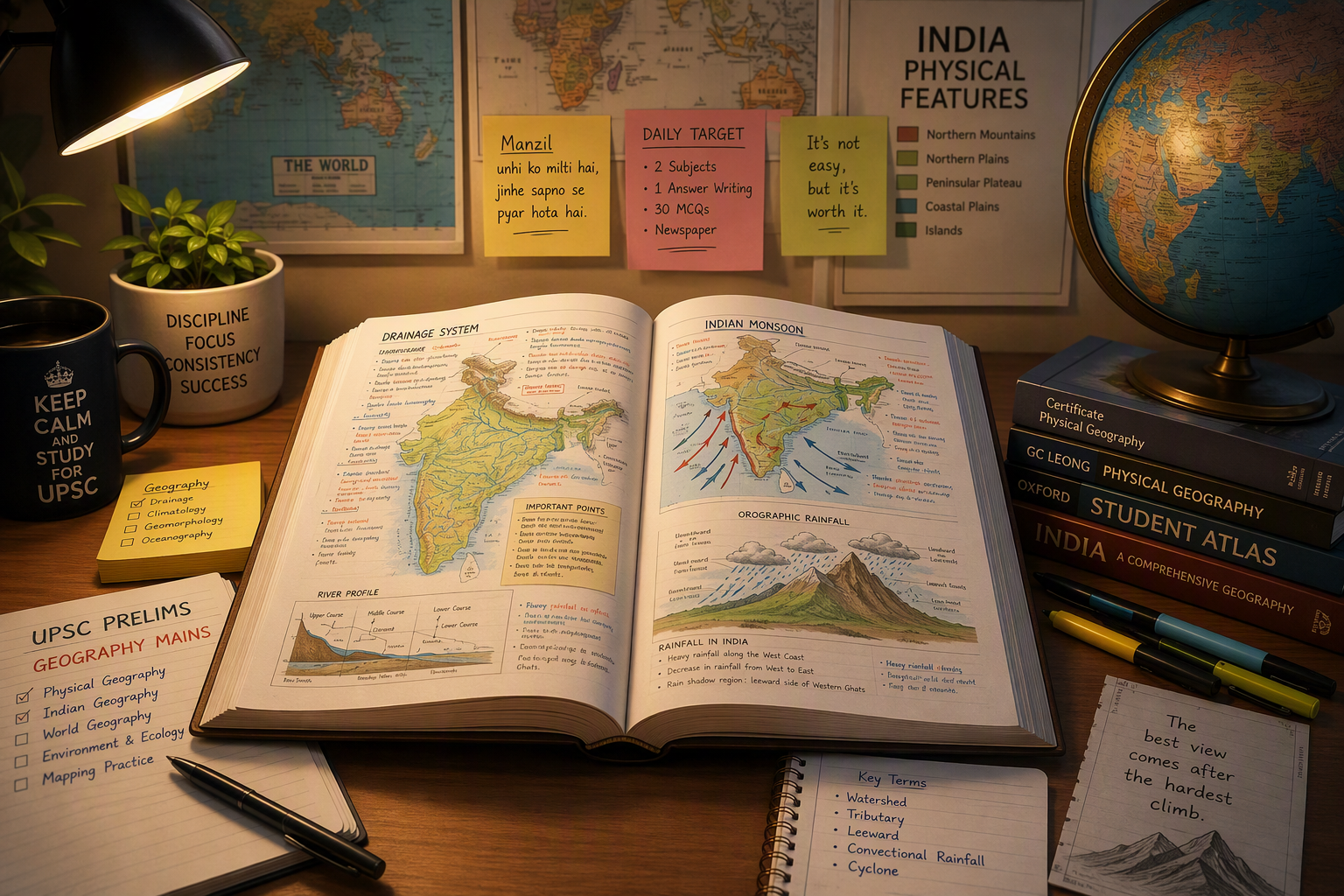
Key Highlights
- Climatology is one of the key topics you must read in the geography section of the UPSC CSE exam, for both the prelims and mains.
- Your geography notes should have all the main points about the atmosphere, solar radiation, winds, climatic regions, and the Indian monsoon.
- Good answer writing can help you get more marks. Try to use diagrams, flowcharts, and links to current affairs when you can.
- NCERT geography books and neat, expert notes will give you a strong base for effective UPSC preparation.
- Going through previous years’ papers and joining a test series will let you see patterns, help you revise faster, and get better at accuracy.
- A reliable download link for topic-wise notes will make your revision easy and help you stay more organized.
Table of Contents
Introduction
Climatology is a key part in the geography section of the UPSC CSE. It brings together the physical steps, weather, and everything that happens in India. This topic matters for both the prelims and the mains exams. If you feel that the topics are too much or hard to read, you can use some good geography notes. These notes can make it feel simple. This post gives you a plain guide for all the important topics. You will find the best way to read and make your answers. The tips help you get set for both papers.
UPSC Climatology Syllabus Overview
The entire syllabus in climatology teaches you from the very start. It gives you the basic ideas first. After that, you learn how to use what you know. You will see what makes up the air around us and how the atmosphere is built.
You read about solar radiation, how heat moves around, and how temperature changes. The text also shows you how air moves—this is called atmospheric circulation. It helps you understand how the weather can change on earth.
The syllabus will cover how the big winds called planetary winds blow, plus smaller winds like local winds and jet streams. It talks about different climatic regions in the world. In the course, you learn what happens to water in the air. There is a part on the types of clouds and different ways that rain falls. You read about acid rain too, as well as weather events like El Nino and La Nina.
Start by reading NCERT geography books first. After that, use short notes. This makes NCERT geography easy to read. These steps help you with UPSC prelims, mains exams, and answer writing. You should look at previous years’ papers and join a test series. This helps you know what topics matter the most.
If you want topic-wise climatology notes for effective UPSC preparation, use the main sources and write out all subtopics. Practice questions for practice every day. Make sure there is a clean download link too. This will boost your UPSC geography skills.
Essential Topics and Weightage in Climatology
If you want topic-wise climatology notes for UPSC geography preparation, it is good to organize the subject based on what is important for the UPSC exam. In the UPSC exam, some important topics come up again and again. You will see these in both the upsc prelims and mains exams. So you should focus on these important topics first.
| Topic | Relative trend in previous year questions |
|---|---|
| Atmosphere composition and structure | Foundational, asked directly and indirectly |
| Solar radiation and heat balance | High importance for concepts and application |
| Atmospheric circulation and weather systems | High for world geography understanding |
| Planetary winds, local winds, jet streams | Very important for mapping and explanation |
| Climatic regions of world | Moderate to high in regional distribution |
| El Nino, La Nina, clouds, rainfall | Strong link with answer writing and current events |
Use previous year questions and test series to practice answer writing. Start by spending most of your time on key topics. Once you feel good about those, read about linked areas like regional distribution and weather systems. This way, your answer writing will get better.
How to Approach Climatology for UPSC Geography
A good way to begin is to use simple sources first. You can read NCERT geography as your base. After this, read short geography notes from people who know the subject well. This will help you get clear on the basics for your UPSC optional paper.
You can follow this sequence:
- Read NCERT geography books to help you get clear ideas. Be sure to practice the last part of each chapter.
- Make short notes for each topic. Write points for the atmosphere, winds, rainfall, and climatic regions.
- Use a good download link. This can help you keep all your revision material in one folder.
- Practice answer writing. You can use diagrams, tables, and the right keywords to make your answers better.
- Join a test series. This will help you learn to answer fast and understand the exam well.
It is also important to link current affairs with steady concepts. For example, when you hear about a weather event in the news, you can connect it to things like jet streams, rainfall, El Nino, or monsoons. This practice helps to make your effective UPSC preparation better and more helpful.
Key Concepts in Climatology Every UPSC Aspirant Must Know
Climatology is easy to understand if you start with a few main ideas. The key topics you need to know are the major components of the atmosphere, solar radiation, heat balance, winds, pressure belts, rainfall, climatic regions, and the Indian monsoon. These topics are important in physical geography. They help you understand how things work and let you use what you know in practice.
In the UPSC exam, you often do not find these themes by themselves. They connect with things like world geography, current affairs, and answer writing. When you see the way they go together, it helps your effective UPSC preparation. It also makes the process easy to follow. The next parts will give you these ideas in short and simple notes you can use.
Structure and Composition of Earth’s Atmosphere
One key thing that every UPSC student should know in climatology is the structure of the atmosphere. You need to learn about the layers and the major components in it. This layer around the Earth helps to shape the weather and climate that we see.
We learn about the air around us by finding out what is in it and how it is formed. This helps you know why the temperature goes up or down, how atmospheric pressure works, and what causes many dynamic processes. In exams, this is important for topics like jet streams, circulation, and where temperature changes. If you do not get these basics first, the next chapters can feel confusing.
For effective UPSC preparation, try to keep your notes short and in layers. Start with one line for the structure. Then, write one line for the composition. After that, add one line about why it matters. When you start answer writing, this give you a good way to begin your answer. Then, you can go on to talk about things like weather systems, pressure, or new events from the news that relate to changes in the air.
Solar Radiation, Heat Budget, and Temperature Distribution
Another important topic is solar radiation and the way the Earth’s heat is balanced. These talk about how energy comes in, how it is taken up, sent back, and moved around. If you want to do well in upsc prelims or the mains, you should not skip this topic.
Temperature changes based on energy that comes in and how the atmosphere as a whole works. In physical geography, people often use terms like heat budget and adiabatic lapse rate when talking about this. Even if you feel the question is just asking for facts, the examiner wants you to explain how these things happen, not just give a short answer from memory.
Try to use notable examples in your answer writing. For example, you can talk about heat balance. You can link it to changes in temperature and big weather patterns. A small sketch showing energy coming in and going out can help your answer stand out. This is an easy way to go from just talking about ideas to getting more marks.
Atmospheric Pressure and Winds
Atmospheric pressure and winds play a big role in studying climate. They help people see how air moves in the sky. If you know about pressure differences, you can find out why the wind blows and how air gets around. This is useful to understand where weather systems come from and how the seasons shift during the year. Learning about these things will also help you know more about jet streams and how the climate changes over time.
For answer writing, these main points are helpful. They can show what causes something and what happens because of it. You should feel good with things like atmospheric pressure, the types of winds, and words like warm front and cold front. The next parts talk about the reasons and the big patterns in the world that you should know.
Factors Influencing Atmospheric Pressure
Atmospheric pressure changes because the Earth does not have the same conditions everywhere. You need to look at temperature, altitude, and big changes on the planet. These things can change how air moves. They make the pressure go up or down, and that changes the weather and the way the air moves around.
Temperature plays a clear part in the way air moves. Warmer air does not act the same as cooler air. The height above the ground, called altitude, matters too. This is because the pressure gets lower the higher you go. In climate studies, it is good to know about these changes. This helps people look at big trends in the world and also changes close by. That is why many feel talking about this topic helps with both basic ideas and real life questions.
When you write answers, do not just list the factors. You have to show how each factor links to the result. For example, connect atmospheric pressure to things like winds, how much rain an area gets, and the way every region feels the effects. This helps a lot when you talk about human geography and regional development, since the climate shapes where people live, what they choose to plant, and how they make plans in that area. You can use current affairs as examples, but do this only if they make the main idea easier to understand.
Types of Winds and Global Circulation Patterns
If someone asks you what the main things are to know about world climatology for UPSC geography, you can tell them this. Global circulation patterns show how air moves around the earth. They are key to seeing how climate systems in the world stay connected. This is a big topic in world geography, and it is also important when you read about the climate of India.
Focus your notes on these types of winds:
- Planetary winds are big wind patterns that move all around the earth.
- Local winds are winds that show up in one place and do not travel far.
- Jet streams are fast-moving air high up in the sky. These winds can change the weather a lot.
- Tropical cyclones are strong storms that spin and happen in warm areas of the world.
- Temperate cyclones are storm systems that show up in areas with medium temperatures. They often form near weather fronts.
When you write your answer, try to show how the parts fit together. Do not just list facts on their own. For example, link jet streams to the reason seasons change. Show how cyclones are part of bigger weather patterns. This keeps your answer clear and tidy. It helps with effective UPSC preparation, mainly when the question mixes world trends with what is going on in India.
World Climate Classification Systems
World climate classification systems help you sort this big topic into simple groups. You do not need to keep many details in your mind with no plan. With these systems, you can see that the different climatic regions are not alike. The temperature, the amount of moisture, and the main parts of climate systems all matter. This is important for anyone who studies world geography. It also helps to answer questions that ask you to compare one place to another.
When you write answers, using classification can help you organize your text. It lets you show the regional distribution in a way people can see clearly. You can link climatic regions with farming, where people live, and human geography. The next two sections will talk about the main systems and climatic regions that are important for India.
Köppen’s and Thornthwaite’s Climate Classification
Köppen’s and Thornthwaite’s ways to group climates help make sense of world geography. You do not have to study these ways in detail for UPSC. Just know how climates are sorted. Also, know how these groups of climates show different climatic regions in the world.
You only need an easy way to do the exam. You can use climate classification to see different zones. This will help you find patterns and connect them with environmental geography. If you get a question about latitude and the equator in climatology, show that where a place is on the Earth can change big climate patterns and how areas are not the same as each other.
Köppen’s system is good when you need to sort climate into big groups. Thornthwaite’s way helps a lot when you want to see how climate works in real life. When you do answer writing, try to put in small tables, maps, or diagrams to help. A style like NCERT geography is a good choice because it is clear and easy for people to read.
Climatic Regions of the World Relevant to India
Not all types of world climates are needed for UPSC. You should pay attention to the climatic regions that help you know Indian geography. It is good to put your time into tropical, subtropical, and monsoon-linked weather patterns. This way, your revision will be more useful and can help you save time.
The equator and latitude matter a lot in climatology. They help make large areas feel hot or cool. The way these factors work shapes the regional distribution of climate across the world. When you learn about this, you also see how world geography and India connect. This makes it easier to compare different regions. You do not have to look at each place alone.
When you write answers, try to link global climatic regions with Indian weather, farming, and environmental geography. This helps when you get questions where the examiner wants to see how you use what you know. A short talk about trends found in both the world and India can make your answer better. It also shows you understand more.
Indian Climatology Insights for UPSC Success
Indian climatology is important. You will see it many times in both easy and hard parts. In Indian geography, the climate links to farming, the way people live, water, and changes in seasons. This is why the indian monsoon and the climate systems that come with it are a big part of your learning.
For your exam, you might see questions about Indian climate, current affairs, and how the two connect with regional development. A strong answer should join ideas in theory with real-life examples from India. The next parts will talk about how the monsoon works. They also cover how things like latitude, the equator, and different physical features help shape the climate.
Monsoons: Mechanism, Variability, and Impact
Monsoons are important in Indian weather. You should know how they work, how they change, and what happens because of them. This is needed because the topic is found in geography, environment, farming, and current affairs. The dynamic Indian monsoon is not just about wind changing direction. It is a system that brings big social and money-related effects.
The way monsoons change is important when we talk about big things like the Indian Ocean Dipole and the link between the sea and the air that you read about in climatology. This is the point where world weather patterns and what happens in India come together. You often have to look at this connection when you get questions that ask you to think or break things down.
For answer writing, start with a simple plan. First, say how it works. Next, talk about what makes it change. Then, tell what happens because of it. If you can, give notable examples from recent current affairs that fit your answer. This keeps the answer clear and balanced. It also helps you talk about things like regional development, farming stress, or uneven rainfall without losing focus.
Role of Latitude, Equator, and Physical Geography in Indian Climate
The spot where India sits on the globe plays a big part in the way it gets heat from the sun, the weather it goes through, and how the different climatic regions are in the country. Latitude and the equator are not just things for a map. They really change the climate. This is very important if you are getting ready for the UPSC exam, as you need to know how latitude shapes climate in different parts of India.
Physical geography gives more detail and helps you see the big picture. The shape of the land, how far it goes, and the other things found in nature all change the way the climate turns out in Indian geography. These things are important. They change the plants that grow, the farming that people do, and the places where people make their homes. So, when you look at the climate, you can also see how it links to the other parts of geography.
In answer writing, you can start with the place or area. Then, talk about what is on the land or what controls it. Next, you can say what happens because of these things. After this, you can connect your answer to current affairs if it fits well. This helps people see why India has so many kinds of weather and why every season is not the same for all places.
Conclusion
To sum up, if you want to do well in geography for UPSC, you have to understand climatology. You should know about things like atmospheric pressure, wind, and how different climates are grouped. This is important because these topics can come up in many questions during the exam. You need to read about the world and also focus on India, like how the monsoon happens here. This can help you feel more ready for the test. Try to study and practice often to see good results.
If you want more help, you can talk to our experts for a free consultation. This can give you more support with climatology and make your UPSC preparation stronger.
What are the best sources for simplified UPSC climatology notes?
Begin your studies with NCERT textbooks. These books help you get clear ideas about each topic. They also help you know the basics well. Once you read them, you can move to geography notes made by experts. There are topic-wise notes with diagrams and flowcharts that make it easy to learn. There is a proper download link, so you can get the notes fast. All of these tools are a great resource for quick revision and effective UPSC preparation.
How do physical geography topics like solar eclipses relate to climatology?
In UPSC study, physical geography looks at the mysteries of the universe. These topics help you know where Earth is, how it moves, and what big changes can happen. Solar eclipses are not the main part of climatology. But if you learn about them, you can use this in your answer writing. They let you make strong points and give notable examples in your answers.
Are there any recommended strategies for efficient UPSC climatology preparation?
Yes. First, break down the entire syllabus into key topics. Read the basics from good books for each one. Make short notes while you read. Try to solve questions from previous years too. Add answer writing practice into your study plan. Join a good test series. This will help you get better at presentation, speed, and clarity. These steps keep your work focused and help you use your time well.