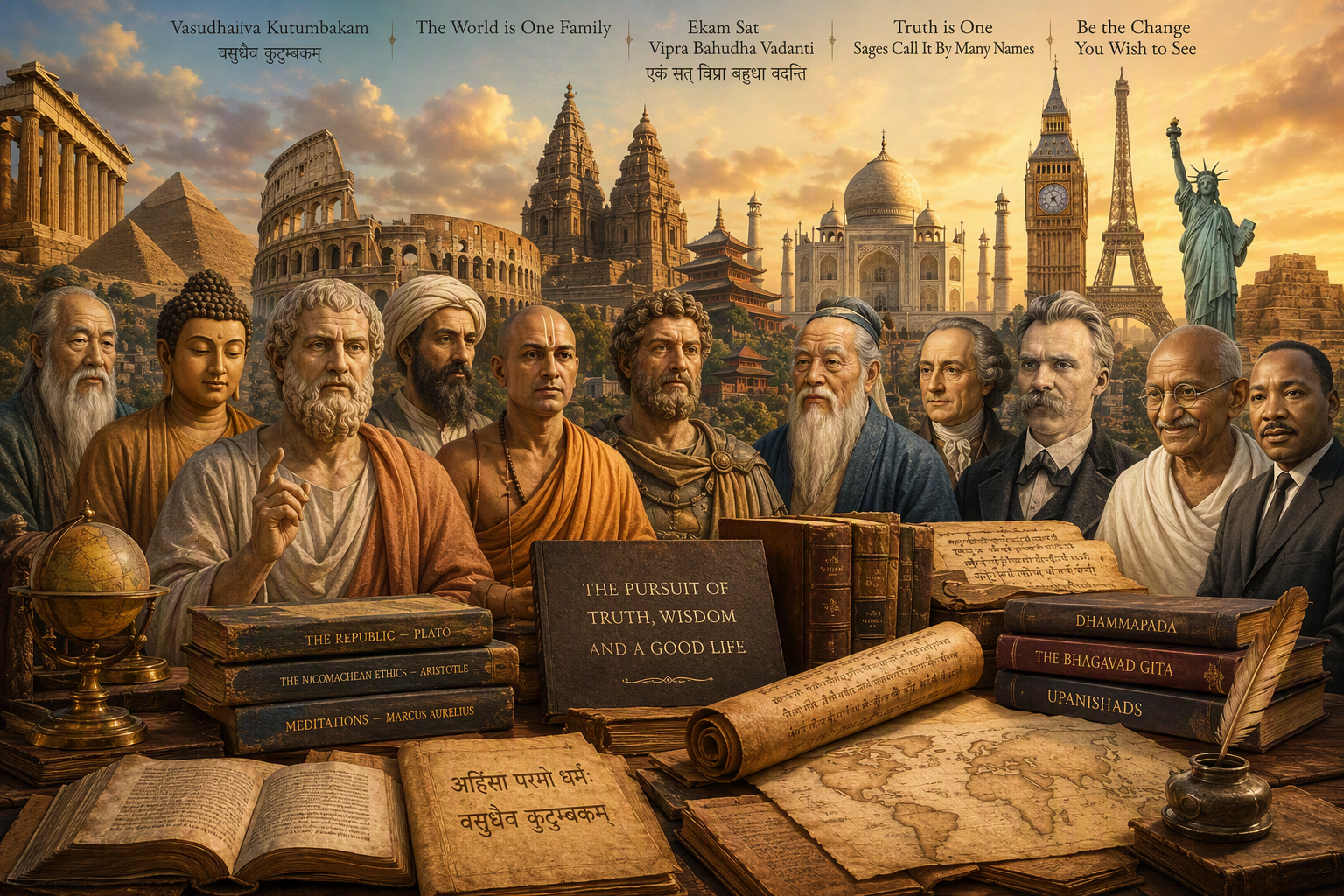
Key Highlights
- This blog shows how Mahatma Gandhi and Swami Vivekananda helped shape moral philosophy and human values.
- You will read how Indian thinkers connect ethics with the way of life and social justice.
- The blog also talks about western philosophy and big ideas about right and wrong, but in simple words.
- The article checks how Indian and global ethics match up, looking at duty, justice, and what is good.
- You will get to know how they have shaped modern society, how people live and work together, and also world ethics.
- This is a simple guide you can use later to make notes or put into a PDF.
Table of Contents
Introduction
Moral thinkers have always helped people ask a very simple question: what is the right way to live? Their ideas shape moral values, public life, and the way you live. In India and around the world, many people connect ethics with justice, truth, duty, and compassion. Thinkers like Swami Vivekananda and Mahatma Gandhi did not just give theories. They also showed people how to improve human life in a real way. To know more about what they gave to society, let’s start by looking at some important Indian moral thinkers.
Prominent Moral Thinkers from India
India gave the world many moral thinkers. They connected ethics to what people do every day, public duty, and spiritual insight. Their ideas had an impact on human life, the way people are governed, reform, and social harmony. In Indian society, people did not keep moral thinking apart from what they did in real life.
From Mahatma Gandhi to Swami Vivekananda, these important people helped shape what we think about truth, service, equality, and self-discipline. Some of them talked a lot about compassion. Others focused more on political philosophy. There were also those who worked on ideas about how people can grow inside. All together, they give us a strong base to understand ethics in our lives and in public. The next parts make their top ideas clear.
Mahatma Gandhi – Philosophy of Non-Violence and Truth
Mahatma Gandhi put ahimsa and truth at the heart of public life. He did not keep his vision of what is right and wrong just for people’s private lives. Gandhian philosophy taught us that it is important to use good ways to reach good goals. He said that people must stand against what is wrong, but not feel hate for others.
His ideas became clear when he was in South Africa. Later, these ideas helped lead India’s freedom movement. Through satyagraha, he showed the world that courage, discipline, and non-violence can fight against unfair systems. This way of thinking mattered not just in politics but also in social justice and the freedom movement. It taught many people about their civic responsibility.
Gandhi is still important today because he showed that you can use ideas about right and wrong in real life. He did not keep his ideas just for India. Many people in other countries also learned from him and used his work to create change. The civil rights movement is one big example of this. In short, Gandhi proved that telling the truth and not using violence can help many people act in a good and fair way.
Swami Vivekananda – Universal Ethics and Spiritual Humanism
Swami Vivekananda gave ethics a strong human feel and spiritual touch. He said that each person has inner strength and value. For Swami Vivekananda, being good was more than just about fear. It was to feel that all life is one and to live by a higher universal law.
His practical message showed in the work of the Ramakrishna Mission and Ramakrishna Math. Through the idea of shiva jnane jiva seva, he said that to serve human beings is to serve the divine. This made ethics a way of life for people. It was not just something you read about in a classroom.
His teachings can still guide you today:
- Work on who you are by learning new things, believing in yourself, and having self-control.
- Help people by doing social service, mostly for the poor and those left out.
- Mix your deep thoughts with action in the modern world.
Buddha – The Middle Path and Compassionate Ethics
Buddha gave people a way to live that is based on knowing about suffering, knowing yourself, and being kind to others. He did not say people should go to extremes, like hurting themselves or chasing after every wish. Instead, he talked about the middle path. This is a good way to live with clear mind and balance.
He started his teaching with the noble truths. These explain what suffering is and how people can get over it. The eightfold path gives real steps to help through right actions, clear thinking, and putting in the right effort. Because of this, ethics became a clear practice instead of just a good idea.
Buddha is important when we talk about global ethics. His kind way of living touched people not just in India, but all over the world. His message pushed many to practice a humane way of life. Even now, what he said helps us think about how to keep calm, act the right way, and live together in peace in our human life.
Chanakya – Ethics in Governance and Political Thought
Chanakya is known for linking morality with how a state should be run. His political philosophy, found in the Arthashastra, talked about how to govern, make laws, keep the economy strong, and keep things in order. He was not just a dreamer. He wanted to know what rulers should do to keep the state and the people safe.
During the rise of the Mauryan Empire, his ideas helped shape a real way to run things. He thought that rulers should have discipline, see ahead, and follow a clear code of conduct. He saw good rule as doing what is best for people, but also knowing the real limits they face.
Chanakya is still important today because people in charge still can face hard choices between what is right and what is needed. His ideas show that working in public office means you need to have good judgment, think smart about what can be done, and take responsibility for your actions. Because of this, the work and words of Chanakya are still a big part of how people talk about ethics and being a good leader.
Adi Shankaracharya – Advaita Vedanta and Unity of Morality
Adi Shankaracharya gave a strong base to Indian ethics with Advaita Vedanta. He said that there is one ultimate reality under all that we see as different. This changed how people think about what is good or right. If all life is part of one truth, then how we live should show that we are all one.
His teaching was not just about things we cannot see or touch. He helped people understand human values by telling them to let go of their ego and think about who they are deep down. For him, all of us are connected. We are not here to fight with others. We are all part of the same spiritual world. That is the core of his idea about what is good or bad.
For people today, Shankaracharya gives a way to find clear ethics in your own mind. He shows how knowing yourself goes with doing what is right. His thoughts are still important in hindu philosophy and in talking about how knowing yourself on the inside can help you do better in social life.
Rabindranath Tagore – Humanism and Cultural Ethics
Rabindranath Tagore brought warmth and new ideas to how we think about right and wrong. He spoke up for humanism, saying that people should care for each other. He wanted freedom in education and respect for every person’s culture, without being too focused on just one nation. For Tagore, being good had to do with being creative, having dignity, and knowing that people and nature are linked together.
His cultural ethics pushed people to go beyond strict groups. He said that education should help with human development. It should not only train people to do a job. This idea gave moral life a wider meaning because it connected learning with character, care, and being open to others.
Tagore wanted to see a nation of beautiful minds. Even today, this idea still matters for indian society. He told everyone that real progress is not just about money or things. It is about being kind and good. He showed that having strong values, living in peace with others, and having freedom can help every person and the whole society grow in the right way.
Dr. B.R. Ambedkar – Social Justice and Equality
Dr. B.R. Ambedkar made social justice and fairness the main focus in life. He stood against the unfair caste system. He said that people need liberty, equality, and friendship to have a true democracy. His values were about respect and rights for all.
In indian society, he changed things in a big way. He did not agree with ways of thinking that left some people out or treated them badly. Instead, he said that a fair society must help the weak and make sure everyone has a real chance. This made moral ideas part of laws and how things work in the country.
Ambedkar is important in the modern world because not all people get equal rights even now. He taught that being good is not only about how people act on their own. Ethics should look at unfair systems too, not just at what each person does. Today, his ideas still help people talk about democracy, fairness, and making rules that include everyone.
Thiruvalluvar – Tirukkural and Timeless Moral Principles
Thiruvalluvar is known for the Tirukkural. This is a text full of moral values and simple wisdom. The Tirukkural has short lines that give clear life advice. These lines talk about how we should act, how we live with others, and about our duties to people. The work is still important for all of us today.
The Tirukkural is powerful because it is clear. It shares simple and lasting ideas about honesty, control, duty, and kindness. In a few words, it serves as a helpful code of conduct for each person and those who lead. You do not have to know a lot about philosophy to get its lessons.
For ethics study, Thiruvalluvar is very helpful. His teachings are clear and easy to use in life. They make you think about things like being honest, staying disciplined, and treating people well. His work shows that moral philosophy can be short, easy to remember, and still help a lot with day-to-day choices.
Indian Moral Philosophers’ Key Concepts in Ethical Thought
Indian moral thought is built on a few strong ideas. These ideas come up often in what many thinkers say. For example, dharma, ahimsa, self-realization, and being responsible to others all play a big part. These ideas help shape ethics in hindu philosophy and in other Indian traditions.
These ideas matter because they link what is inside you to how you act around others. Indian thinkers did not see morality as a far-off idea. They often joined it with duty, care, and helping others. The next parts will look at these ideas, so you will see how they help lead people and their social life.
Dharma and Its Significance in Indian Philosophy
Dharma is a very important idea in Indian ethical thought. In hindu philosophy, it means doing your duty, acting in the right way, and keeping the moral order that helps life go on. Dharma is not just someone’s private belief. It guides what people do in the family, with others in society, and in public life too.
You can think of dharma as a code of conduct that guides people in what they do. It helps you choose what is right when you are in different roles or dealing with different things. This makes dharma very important in social life. Dharma also connects the idea of being disciplined with having a responsibility to others and respect for moral laws.
Dharma is important because it keeps things in balance. It does not focus only on rights or only on duties. It holds both what one does and what is good for all at the same time. If you are learning about ethics, dharma gives you a good way to see what it means to be responsible every day and in a group.
Ahimsa: The Principle of Non-Violence
Ahimsa means not hurting others. But it is more than just not using violence. It tells you to not be cruel, feel hate, or try to control anyone. This idea is important in many Indian ways of life. Mahatma Gandhi used it and made it even more well-known.
In public life, ahimsa asks us to show restraint. It shows us to talk things over and to have humane policy for people. It tells those who lead or make choices to keep in mind that human life should have dignity. The ultimate goal here is not to be weak. The goal is to have moral strength. You reach it by having self-control and showing empathy for others.
You can apply ahimsa in practical ways:
- Try to solve any fight by talking and convincing first before using force.
- Help and stand by people who are at risk. Be fair and gentle with them.
- Use power in a way that does not hurt or shame anyone. Do not seek payback.
The Role of Self-Realization in Morality
Self-realization is an important idea in Indian thought. It is about knowing who you really are, and not just living based on want, pride, or fear. Because of this, being moral is often seen as going with inner discipline and thinking about yourself.
In Advaita Vedanta, self-realization helps you see the ultimate reality. This kind of insight can shape how you act in life. If you feel your true self is tied to a bigger spiritual ground, you may not feel as selfish. The way you live starts to show more humility, restraint, and respect for people.
This idea goes well with spiritual humanism, which you can see in the teachings of Swami Vivekananda. Human values get stronger when people find respect inside themselves. So, in this way, being moral does not just mean to follow rules. It means to show what you feel and know on the inside.
Social Responsibility in Indian Ethical Traditions
In Indian thinking, being good in your own life is not kept apart from what you owe to others around you. A good way of life means you take care of others and act with social responsibility. Many thinkers in these traditions say that people should care for others. They put focus on helping the poor, those who feel left out, and people who are going through pain.
Many reformers and spiritual leaders put a strong focus on social service. In Indian society, people often check a person’s moral worth by looking at how he or she treats other human beings. Ethics can be seen in a person’s actions, not just what they believe.
Two recurring lessons stand out:
- Service, policy, and leadership should be led by human values.
- When people act for others, they should focus on including everyone, giving help, and treating all people with respect.
Influence of Indian Philosophers on Global Ethical Thought
Indian philosophers changed the world’s thinking about right and wrong. They talked about non-violence, being kind, and having good control over yourself. These ideas spread to other countries by what people did, by teaching, and by groups. gandhi ji and Buddhism are two well-known examples.
Their bigger impact is that they show how ethics can help people live together in peace. At the same time, they do not give up on being firm about what is right and wrong. These traditions started debates about peace, justice, and good behavior in many places around the world. The examples below show how Indian thought became a part of global ethics and stayed there for a long time.
Gandhi’s Global Impact on Civil Rights Movements
Gandhi ji’s way of not using violence to fight for rights spread to places outside India. When he was in South Africa and later in India, he proved that you can change things in politics with strong will. He showed people that you can stand up for what you want without causing harm.
This way of thinking had a big impact on the civil rights movement. People like martin luther king and nelson mandela looked to him for ideas about how to do the right thing while fighting for change. Gandhi’s work spread across the world because he showed people a clear and steady way to stand up to wrongs but also make sure everyone was treated with respect.
There are three ways that people see his impact around the world:
- He used non-violence as a real way to act in public.
- He brought together moral protest and social justice.
- He gave hope to leaders who later stood up against racial and political hardship.
Buddhism Spreading Compassion Ethics Worldwide
Buddhism took Indian moral thought to many places in Asia and other parts of the world. People liked it because it was clear, full of discipline, and showed compassion. It did not want people to follow blindly. Instead, Buddhism gave people a way of life that focused on being aware and living with good ethics.
The noble truths help people see why there is suffering in life. By following Buddhist practice, you learn to hold back, feel for others, and find balance inside yourself. This way, everyone can get close to caring for others. The noble truths are for all kinds of people, like everyday people, leaders, and whole communities.
Buddhism still has a big role in global ethics. It teaches people to be peaceful but not just stay out of things. There is a focus on taking care with what you think and do. This means ethics is both about you and how you treat others. In today’s world, this way can give good moral help that works.
Indian Philosophies in Modern Administrative Ethics
Indian ethical traditions still guide how people work in government today. They teach the importance of duty, being kind, and looking after the public. These teachings help officials know that the job is not just about power or control. It is also about being fair, showing care, and making good decisions for others.
You can see the role of these ideas in good governance and the welfare state. People like Gandhi, Buddha, Ambedkar, and Vivekananda help with moral ways to handle being left out, conflict, and giving services. Their talks guide ethical choices in public institutions.
For practical use, these traditions suggest:
- Administration must look after the dignity of every person, especially those who are weak or need help.
- A public office needs to work well for people and also be ready to take care of everyone in the society.
Major Moral Philosophers from Around the World
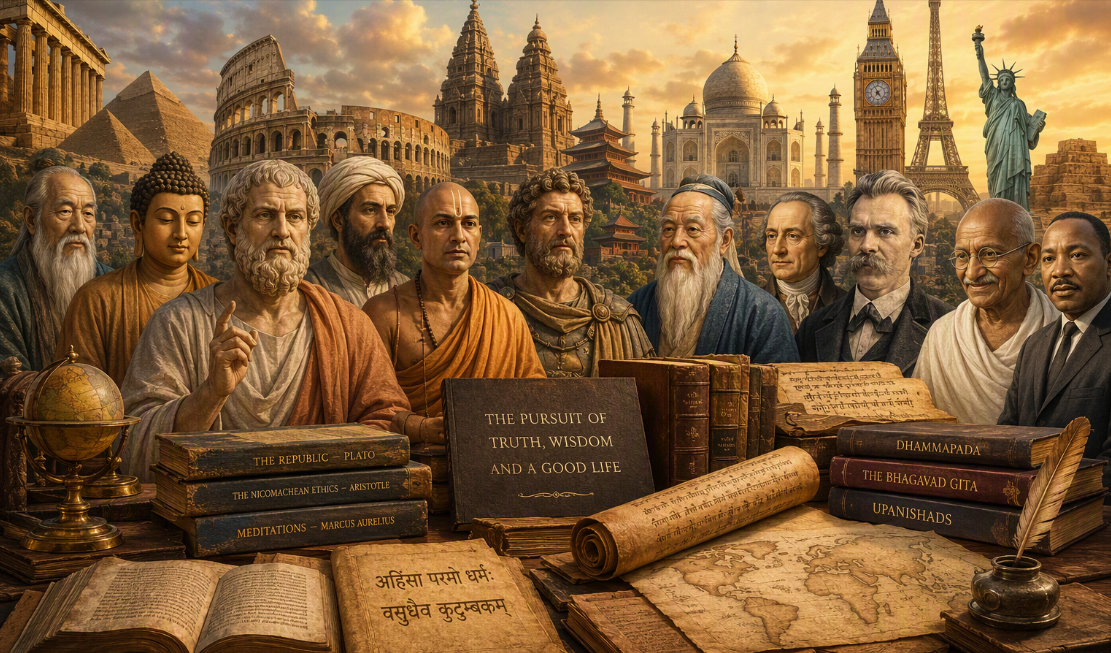
Moral philosophy grew as many important thinkers shared their ideas. In western philosophy and other ways of thinking, people asked questions like: What makes a good person? How can a group be fair? What makes life feel worth living? Their answers helped shape the rules we follow and the way people think about law and politics.
From Socrates to Confucius, these thinkers talked about things like virtue, duty, freedom, and order. They did not all use the same way to think about these things, but they all wanted to know about human nature and what it means to do the right thing. Now, let’s look at some of their main ideas, one at a time, in a way that’s simple and easy to use.
Socrates – Pursuit of Virtue and Self-Knowledge
Socrates is known for asking strong questions about truth, virtue, and the good life. He did not give simple answers. He talked with people to help them look close at what they believe. This way, self-knowledge became very important in moral philosophy.
For Socrates, being good was linked to knowing yourself. He thought that a person should not live without thinking about their actions. He always talked about how we must look at our life closely. This made doing the right thing feel personal and hard. He said human values like honesty, being brave, and being wise had to be part of your everyday life. It was not enough to just talk about these things. You had to show them in what you do.
His role in virtue ethics is still important today. He said that moral growth starts when you really ask yourself good questions. This is why Socrates is still a big part of how we learn ethics. He asks people to think clearly, live in a good way, and look for truth while staying humble.
Plato – Idealism and Justice
Plato helped shape moral philosophy by showing how ethics fits into a fair society. For him, justice was more than just laws. It was when each part of life does what it should, and everything works together as a whole.
Plato talks a lot about the best kind of state and smart leaders. He used political theory to show that people and the whole group should be led by reason. In this way, ethics and how we run things are linked closely.
People still read Plato today. He talked about how we cannot set apart moral questions from the way groups are built and how someone runs things. If a place wants to be fair, the people must work on both rules and what kind of people they are. What he wrote is still a big start point for most talks we have now about what is fair and how people lead.
Aristotle – Virtue Ethics and Golden Mean
Aristotle was clear when he talked about virtue ethics. In Nicomachean Ethics, he said that people build moral values through their habits and who they are as people. A good life does not happen because of one thing you do. It happens when you practice moral values again and again.
His well-known idea of the golden mean tells us to find balance. A good life sits between things that are too much and things that are too little. For example, courage is in the middle of being too bold and being afraid. This golden mean helps make ethics feel real and something that we can use in our everyday lives.
Two key ideas define Aristotle’s approach:
- A virtuous person gets better by learning, thinking, and doing things again and again.
- Making the right moral choice often needs balance, not just going to one side or the other.
Confucius – Harmony, Duty, and Social Ethics
Confucius based his ideas on harmony, duty, and good behavior in how people act with each other. He talked a lot about the family, respect, being moral as a leader, and having order in society. He said that things work well when the people do what they should with care and self-control.
His social ethics are not the same as a strict social contract model. They start with real, everyday ties between people, not just a formal deal. Still, the goal is the same. They both want a stable society, leaders you can rely on, and trust among people. In this way, moral leadership is very important.
His teachings remain useful today:
- Public leaders need to act with honesty. They need to set a good example for others.
- Social harmony gets stronger when people do their duty and show respect to each other.
Immanuel Kant – Categorical Imperative and Duty-Based Ethics
Immanuel Kant is one of the most important names in duty-based ethics. He said that morality should not be based on what happens after you act or on how you feel. Instead, what you do must follow principles that can stand as universal law. This idea is called his categorical imperative.
The main idea in Kant’s ethics is clear but tough. You should ask if the reason for what you do is something that everyone can agree with. If no, then what you do is not the right thing. This makes ethics strong and based on reason. It also helps keep things fair and steady for all people.
Kant’s ideas have had a big effect on modern ethics. He taught people to show respect for others and to act with strong values. He also said everyone should take responsibility in public life. Today, when we talk about rights, doing what is right, or moral duty, we often see people follow what he said. He told us that we should act based on good reasons, not just because it is easier or suits us at the time.
John Stuart Mill – Utilitarianism and Welfare Ethics
John Stuart Mill moved utilitarianism forward by asking which actions bring the greatest happiness of the greatest number. He did not leave out rights, but he looked at actions and rules by the good and well-being they bring.
His views on welfare and ethics started to matter a lot in talks about law, change, and rules for the public. Mill stood up for individual freedom. He showed that the good of all people should not always take away a person’s liberty. This balance made his ideas have a strong impact in the modern world.
Two features stand out in Mill’s thought:
- Moral action should help to make life better for all people.
- We should still see individual freedom as important, even when we focus on helping everyone.
Jean-Jacques Rousseau – Social Contract and Freedom
Jean-Jacques Rousseau was important in political philosophy. He talked a lot about freedom and how people come together in a group. In his social contract idea, he said that the government is only right when it listens to what people, as a whole, want. Those who have power must work for the community and not try to rule over it.
This brings a civic side to moral obligation. People are not just there to follow leaders. They are a part of a group that grows stronger because they join in and share a goal. Freedom is not the same as having no rules. It means living with rules that everyone has agreed to together.
Rousseau is still remembered because he connected ideas about equality, being a citizen, and fair rule. He had a big effect on later ideas about democracy. He said that leaders need to answer to the people. He also made people see that ethics is not just about rules, but also about everyone agreeing and sharing the work in making decisions.
Thomas Hobbes – Social Order and Moral Obligation
Thomas Hobbes tried to solve problems about disorder using his views on ethics. He thought people would fight and feel unsafe if they did not have a strong leader or government. Because of this, he created a strong idea known as social contract theory. Under this social contract, people agree to give up some rights so there can be order and safety for everyone.
For Hobbes, people need rules and someone in charge to avoid chaos. The most important thing is to keep things in order. Because of this, it’s smart to follow a strong government. He does not see things the same way as Rousseau, but his ideas have a big effect on others.
Hobbes is still important today when we talk about state power, law, and security. People still discuss the welfare state, authority, and public order. These talks often go back to what he asked: how can a society keep people safe from trouble while still making sure the rules are fair and real?
Jeremy Bentham – Utility and Law of Greatest Happiness
Jeremy Bentham said we should use utility as the base for rules of right and wrong. He thought the best way to judge what we do is to look at the pleasure or pain it brings. This is now called the law of greatest happiness. It is an important idea in welfare ethics.
Bentham’s way of thinking gave moral reasoning a clear public focus. He did not just follow tradition. He asked if a law really helps everyone feel better in the group. This made his ideas important for changes in laws and ways to shape social policies.
His main contribution can be summed up simply:
- The main way to check if institutions and choices are good is to see how useful they are.
- In public life, moral values need to match with things we can measure, like social welfare.
John Rawls – Justice as Fairness
John Rawls gave new life to political philosophy by talking about justice as fairness. He wanted people to think about what rules they would make if they did not know what place they would have in society later. This idea put fairness right in the middle of many moral and political talks.
His ideas had a big impact on how people today think about social justice and the welfare state. Rawls thought that it was not enough for institutions to just protect basic freedom. He said they should also help with unfair disadvantage. In this way, his work brings together ethics, public life, and equal respect for people.
A simple way to read Rawls is this:
- A fair society needs to care for the people who have the least.
- We should look at our systems and see if they treat everyone the same way when giving out chances.
Core Ethical Theories of Western Moral Philosophers
Western philosophy gave us major ideas about how people should act. Some of these are virtue ethics, utilitarianism, social contract thought, and deontology. Each one tries to answer a clear question. What makes an action right or wrong?
Some people think about character. Some look at results. Others feel that duty or agreement is more important. Knowing these ideas makes it easier to compare the way thinkers see things and how you can use their ideas for today’s problems. The next parts talk about each way. These help you understand them better.
Virtue Ethics Explained
Virtue ethics is not just about the rules you should follow. It also asks what kind of person you want to be. This way of thinking is linked to Aristotle, but it started even before him. In virtue ethics, the most important thing is your character. That is where good and bad actions come from.
A virtuous person builds good habits as time goes on. Virtue ethics does not just depend on strict moral laws. It also uses practical wisdom, balance, and judgment. The golden mean is key because it shows how people using virtue can stay away from bad extremes.
Its basic lessons are easy to grasp:
- Ethics is about shaping who we are. It is not only about following rules.
- A person with good conduct needs to have balance. It is also important to have discipline and make good choices.
Deontological vs. Consequentialist Ethics
Deontological ethics looks at actions based on duty and principle. Consequentialist ethics looks at actions based on what comes out of them. This is a clear split in moral philosophy. It also helps show why people can not agree, even if they both care about justice and welfare.
Immanuel Kant is known for his ideas about deontological ethics. He asks if what you do can be made into a universal law for everyone. John Stuart Mill is known for thinking about consequentialist ethics. He says the best thing is to pick what makes the most people happy.
Here is a simple comparison:
| Aspect | Deontological Ethics | Consequentialist Ethics |
|---|---|---|
| Main focus | Duty, rule, intention | |
| Key thinker | Immanuel Kant | |
| Moral test | Can this be a universal law? | |
| Main focus | Outcome, result, welfare | |
| Key thinker | John Stuart Mill | |
| Moral test | Does it produce greater good? |
The Relevance of the Social Contract
The social contract is an important idea in both politics and moral thinking. It talks about why people follow rules, listen to authority, and do their duties as citizens. At the heart of it, the social contract looks at how social order can be right or fair. This gives a reason for people to feel that rules and duties matter in both morals and government.
Thomas Hobbes said that there must be strong authority for people to live in peace and feel safe. Rousseau saw things another way. He thought that the power people have must show what all of them want together, called the general will. Both spoke about how what is right and wrong connects to how people live together, but they did not come to the same ideas.
The social contract is still very important today. We can see it in many talks about who can be a citizen, what rights we have, and what the state can do. A lot of Indian ways of thinking start with dharma or a sense of spiritual unity. In contrast, the social contract idea is more about making a political agreement first. This is a key difference between the two.
Utilitarianism and Its Modern Applications
Utilitarianism is about a simple idea. It asks, which action will give the most good to the most people? Jeremy Bentham started this idea. John Stuart Mill made it better. Today, people still use it when they make laws, plans, and big choices in the modern world.
It is easy to see why the welfare state can be popular. Many governments must decide what to do when they have only a small amount of resources. In times like this, using utilitarian thinking can help guide welfare state rules that try to give the most good to as many people as possible. You can see this a lot in talks about changes, services, and what is best for the whole group.
Its modern applications often appear in:
- Public policies are made to help many people do better in life.
- These choices look at the costs and good points for all people.
Comparative Insights: Indian and Western Ethical Philosophies
Indian and Western ethical philosophies look at some of the same questions. However, they each start from a different place when looking for answers. Both are about moral values, justice, duty, and how people act. This is why you can see many shared values between the two.
Indian society and western culture each have their own bases for how people should act. People in Indian society often link right and wrong with beliefs about the soul, staying disciplined, and living in peace with others. People from western culture usually talk more about rights, using logic, and thinking through rules. When you look at both, it is easier to see what global ethics is about.
Shared Values and Divergent Paths
Indian and Western thinkers have many of the same ideas about what is right and wrong. Both groups say that truthfulness, fairness, being strict with yourself, and caring about other people are important. These values are common because, for the most part, people in both groups feel the same way when they face problems, pain, or times when they must make a choice. This is how people everywhere start to think about morals.
But the paths people take are often not the same. In Indian thought, the topic of morality is usually linked to self-control, knowing more about your own spirit, and making sure there is social harmony. In Western ways, mainly in formal philosophy, ethics is mostly set up by talking about rights, clear thinking, or rules made by groups. These paths are not the same, but they are not totally opposite either.
This difference can be helpful. It helps you have more ways to talk about right and wrong. One group may focus on how you can change yourself. Another group may look at how you make rules feel fair. When you use both ways, you learn more about human values in what you do alone and in public with people.
Different Approaches to Duty and Justice
Duty and justice can be seen in both Indian and Western ways of thinking. But the way they talk about these ideas is not always the same. Immanuel Kant talks about duty as listening to a moral law that comes from reason. Gandhian philosophy connects duty with truth, not hurting others, and having control over yourself during times of social struggle.
Justice can show up in different ways. In the West, people might talk about it as rights, fairness, or the legal system. In India, the idea of justice is often about dharma, taking care of others, or ending suffering and leaving anyone out. The concern is the same in both, but the way people go about it is not.
You can see the distinction clearly:
- Kant talks about rules that are the same for everyone.
- Gandhian philosophy says that duty is linked to doing good things and treating people with care in public life.
Perspectives on the Role of Individual and Society
Another key thing to talk about is the person and the whole group of people in a place. A lot of thinkers in the West focus a lot on individual freedom. They also care about people’s rights and choices. You can see this idea in the work of Mill, Rousseau, and later thinkers who talk about politics. A single person is often seen as someone who stands alone and makes their own decisions about right and wrong.
Indian traditions often put the person within a bigger group of duty, people, and feeling of spirit. This does not remove personal worth. Instead, it asks that you look at freedom together with duty, service, and control. The self matters, but so does our way of depending on each other.
These different points of view can work well together. One looks out for freedom. The other helps build responsibility and social harmony. Today, the modern world often needs both kinds of thinking about right and wrong. A healthy society has to keep people’s dignity safe. At the same time, it should also support care, fairness, and work for everyone’s well-being.
Impact on Contemporary Global Ethics
The ideas from moral thinkers like Swami Vivekananda and Mahatma Gandhi still matter today. What they said about human values and social justice has a big impact on the world’s ethics. These teachings push people to work for equality and help human rights in many places. There is John Stuart Mill too, who talks about individual freedom. He also wants everyone to feel happy. We live in an world where many cultures meet and talk. Knowing about these ideas helps people feel closer and work well together. In the end, what these thinkers left us still affects how we talk about right and wrong today.
Application of Philosophers’ Teachings in Contemporary Ethics
Many people today feel the impact of philosophers’ teachings, especially when they face moral choices. The ideas in virtue ethics from Swami Vivekananda and Gandhi ji help people grow and care more about others in modern society. There are also the thoughts from western philosophy like John Stuart Mill’s focus on the greatest happiness. These ideas guide the welfare state to put human well-being first.
When these teachings are used in day-to-day life, they support social justice and hold up moral values. This helps make human life better for everyone. Using these lessons gives a strong path for good decisions. It works for people from different cultures and makes sure that the important values in society remain steady.
Guidelines for Public Administration and Governance
Bringing moral philosophy into public administration can make the way people are governed better. It helps raise good and ethical leaders. Gandhi and Tagore talk a lot about human values. They say leaders should focus on social justice and the welfare of the community. By using ideas from the social contract theory, officials are told to remember they have a duty to serve people. They must follow ethical rules. These rules help leaders be open and honest.
In modern society, these ideas build trust. People feel heard and there is room for open talk. A strong code of conduct grows out of these values. This code supports the idea of a welfare state. It helps create good governance. In the end, these steps set the stage for a better and fairer government.
Morality in Personal and Professional Life
Morality shapes both our personal and work life in a big way. It helps us make good choices in our daily talks and actions. Thinkers like Swami Vivekananda and Gandhi often talked about why human values matter so much for a life worth living. The lessons they shared push us to work for social harmony. They also ask us to live with honesty and to stand up for social justice.
At work, when you follow a code of conduct based in moral philosophy, you build better ties with others. You also help to keep a feel of respect in your workplace. Taking up virtues from different cultures and ways of thinking can help you deal with the tough parts of modern society. This, in the end, helps you grow as a person and become a more ethical leader.
Influence on Modern Laws and Human Rights
The work of mahatma gandhi and martin luther king jr has done a lot to shape the laws and human rights we have now. They believed in not using violence and stood for social justice. Today, you can still feel how strong their ideas are in the law and in how people talk about fairness. They both showed a way to value right and the welfare state.
Ideas from moral philosophy like the social contract and john rawls’ social contract theory push us to make laws that bring fairness and equal treatment for all people. Looking back at this history helps us in the present. It shows why our main freedoms and good rule for people are needed to build a real just society.
Conclusion
The ideas from moral thinkers and philosophers have been very important for building how people think about what is right or wrong. Great leaders like Swami Vivekananda and Mahatma Gandhi, and Western thinkers like Immanuel Kant, still shape the way people live today. Their teachings focus on social justice, individual freedom, and the right to have moral values. These thoughts help people make good choices and guide governments too. When we bring this wisdom into our own lives, we help make the world more peaceful. In the end, working towards a just society shows that people everywhere want human development and a better life for everyone.
Who are the most influential Indian and global moral thinkers for ethics exams?
Key Indian moral thinkers are Mahatma Gandhi and B.R. Ambedkar. At the same time, well-known global figures include Immanuel Kant and John Stuart Mill. These moral thinkers have big roles in shaping moral philosophy today. Their ideas are important, and people use them often when talking about ethical thinking and different frameworks in studies or exams.
How can the teachings of Gandhi, Vivekananda, and Confucius be applied today?
The teachings of Gandhi, Vivekananda, and Confucius are still helpful today. They tell us to practice non-violence, find out who we are, and be honest in how we lead. Their ideas help people be more kind, do the right thing, and care for others. By following these teachings, we can build a better and more peaceful society that fits with what the world values now.
What is the main difference between Indian and Western moral philosophies?
Indian and Western moral beliefs have different starting points. Indian philosophy puts focus on the group, spiritual development, and duty, or dharma. On the other hand, Western beliefs often put the person first, value logical thinking, and set up rules around personal freedom. Because of this, the way people look at what is right in different places can be very different.