Key Highlights
- The schedules of the Indian Constitution show the details of many constitutional provisions. This makes them easy to read and understand.
- They help to divide powers, keep tribal areas safe, and give rules for governance.
- You need to remember the ninth schedule, seventh schedule, and tenth schedule if you are preparing for the UPSC exam.
- The fourth schedule tells us about the rajya sabha seats and shows how seats are given out.
- The eighth schedule gives a list of official languages. Some later schedules give rules for panchayati raj and municipalities.
- All these schedules make it simple to read again about state legislatures, fundamental rights, and federal relations.
Table of Contents
Introduction
The schedules of the Indian Constitution are important to know for the UPSC exam. They help turn the Constitution of India into something you can use and understand in practice. These schedules share a lot about legislative details. You get information about Indian states, union territories, official languages, rajya sabha seats, tribal areas, and local bodies.
If you want to go over things faster and remember better for polity, it helps to know these schedules well. This way, you can link the articles, constitutional provisions, and major changes without feeling lost in the main text.
Overview of Schedules in the Indian Constitution
The schedules of the Indian Constitution are lists that are added to the Constitution of India. They help organize important constitutional provisions in a simple way. This makes sure that the main text does not get too full and hard to read.
When the Constitution was first made, there were 8 schedules. Over time, more were added, and now there are 12 because of some changes. The inclusion of schedules helps to organize many topics like land reforms, allocation of powers, official languages, panchayati raj, and how municipalities work. This set-up helps make things clear for people. It also makes it easier for you to look things up, follow, and change rules when needed.
Definition and Significance for UPSC Aspirants
The schedules of the indian constitution are simple lists. They give you the administrative and legislative details for certain articles. These lists do not take the place of the main constitutional provisions. They just make these things clear in an organized way.
For the UPSC exam, you need to know these schedules well. A lot of questions come from them. There are many direct and idea-based questions. They might ask about rajya sabha seats, official languages, tribal areas, anti-defection rules, or the responsibilities of panchayati raj institutions. A lot of these topics are also linked to federal relations, legislative authority, and even the basic or fundamental rights of people.
You may wonder what you need to focus on first. Start with the First, Fourth, Fifth, Sixth, Seventh, Ninth, Tenth, Eleventh, and Twelfth Schedules. These parts are very useful for both prelims and mains. They talk about the division of powers, judicial review, local bodies, and special provisions. In these Schedules, you get this information in a short and clear way.
Why Schedules Were Included in the Indian Constitution
The inclusion of schedules helped with a practical problem. The constitution of india needed to keep the main text clear and simple. It also needed some room for lists, tables, and groupings. Schedules did this by putting all the details away from the main text. This way, the main text could stay easy to read and follow.
This way made legal rules simpler and made constitutional provisions easier for people to use. The Constitution did not fill up articles with long lists. It put the technical things in schedules instead. That way, lawmakers, courts, and people in charge could look at clear material when they needed it.
Over the years, schedules have helped make changes feel more simple. For example, the ninth schedule was brought in with the First Amendment to help with land reforms and other laws like that. Even when there were questions about judicial review later on, the schedule system stayed helpful. This way of setting things up comes from the way laws were written after the Government of India Act.
Structure of the Indian Constitution: Parts, Articles, and Schedules
The Constitution of India is made up of three parts. These are called parts, articles, and schedules. The parts in the Indian Constitution show the big themes. The articles give the main text and hold the direct constitutional provisions.
Then there are the schedules of the indian constitution. These schedules help by giving extra details you need to know. They cover things like forms of oaths, allocation of seats, tribal administration, official languages, and legislative powers. When you see this layout in the indian constitution, it helps make your UPSC revision much easier to do.
Key Differences between Parts, Articles, and Schedules
Think of the parts of the Indian Constitution like big chapters. They sort the Indian Constitution into main themes. The articles are the real rules inside the main text. The schedules help by giving extra details when something needs a list or a special group.
This difference matters because UPSC wants to see how clear you are, not just what you remember. If you mix up an article with a schedule, you might get a question wrong that is easy for others. The schedules of the indian constitution are not special or separate rules. They work with the articles of the indian constitution.
- Parts group the big subjects of the constitution.
- Articles tell the legal rules and the powers.
- Schedules give clear lists, forms, and types.
- Together, they help people read and use constitutional provisions in an easy way.
So, when you read and go back over your notes, do not try to remember the schedules by themselves. Always link them to the main text and see why they are there.
Importance of Schedules Compared to Other Sections
Schedules are important because they help the Constitution work in a simple way. The main text gives the most important rule, and the schedules hold the legislative details. If all these details were put in articles, there would be too much text, and it would be hard to read. This way, the document stays clear for all.
They also help in day-to-day running of the government. For example, the seventh schedule shows how powers are given out. The fourth schedule tells us about rajya sabha seats. The eighth schedule protects linguistic diversity by showing the official languages. If these lists are not there, many constitutional provisions would not be easy to use.
You should also see how these are tied to legal rights and public policy. The Fifth and Sixth Schedules help to protect tribal interests. The Ninth Schedule was made to back up land reforms. The Tenth Schedule is there to keep order in law-making. So, schedules are not just extra text. They give real support to the main text.
Direct Link Between Schedules and Constitutional Articles
Each of the schedules of the indian constitution is linked to one or sometimes more articles. So, you should not study them as stand-alone lists. The schedules of the indian constitution get their power from the related constitutional provisions.
These links help you to see how the Constitution gives the power to make laws and handle duties. For UPSC, connecting articles with schedules can help you score well. When you know the part of the Constitution that matches with each schedule, you will find it easier to read and remember the rules about legislative authority.
Articles Associated with Each Schedule
The schedules of the indian constitution link straight to some articles in the main text. This link gives every schedule its legal spot in the constitutional provisions and the whole law system.
Here are some important article links you should have for going over your work again:
- First Schedule: You can find this in Articles 1 and 4.
- Fourth Schedule: It is in Articles 4(1) and 80(2).
- Fifth Schedule: Article 244(1) has it.
- Sixth Schedule: Look in Articles 244(2) and 275(1).
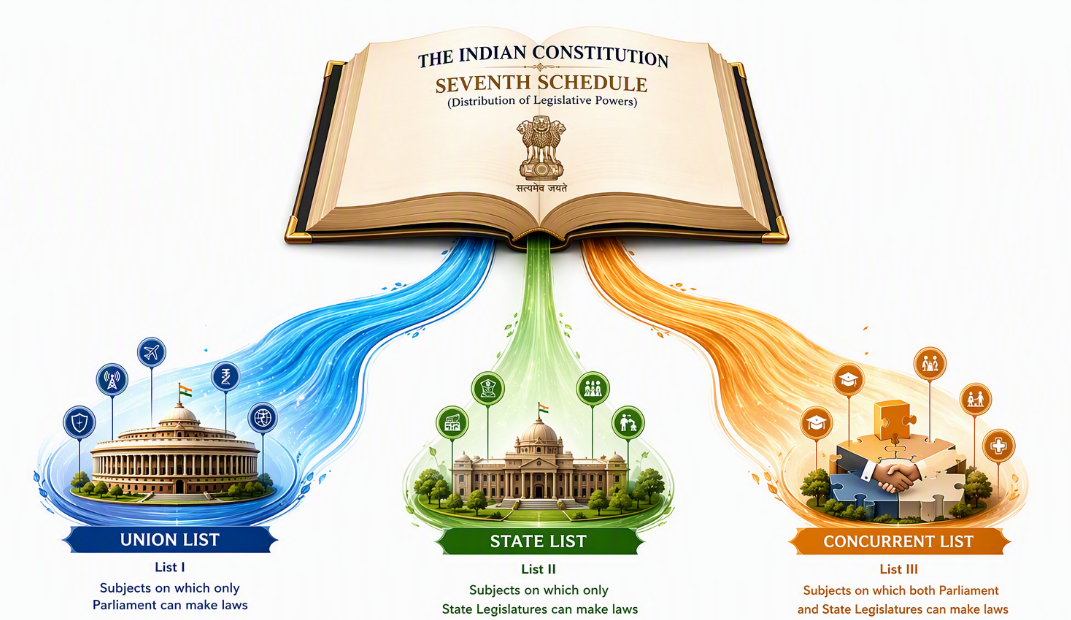
- Seventh Schedule: This is explained in Article 246.
- Ninth Schedule: Article 31B covers it.
Other important links you should know are the Tenth Schedule with Articles 102(2) and 191(2), the Eleventh Schedule with Article 243G, and the Twelfth Schedule with Article 243W. The Third Schedule goes with oaths under Articles 75(4), 99, 124(6), 148(2), 164(3), 188, and 219. This is one of the best ways to make your polity notes better.
Impact of Schedules on Legislative Framework
The schedules help shape the way laws are made in India. They take big ideas and put them into simple categories. These schedules say who can make the rules, who gets protected, and how the main bodies work. A good example is the seventh schedule. It splits legislative authority between the Union and the states.
Their impact is seen in legal rights and political accountability. The Fifth and Sixth Schedules are made to protect tribal interests. The Tenth Schedule helps control defections in Parliament and state legislatures. The Eleventh and Twelfth Schedules give more power to local bodies in both rural and urban areas by dividing work among them.
Changes through the constitutional amendment act have made this role bigger. The Ninth Schedule was added by the First Amendment for land reforms. Later changes brought in new schedules for local government. There are still talks about judicial review, mainly about the Ninth Schedule. This shows that schedules are still an active and talked about part of the constitution, not just simple lists.
Concise List of All 12 Schedules of the Indian Constitution
If you need a quick way to review, the list of schedules of Indian Constitution is a great place to begin. The schedules of Indian Constitution give you a full look at how the Constitution handles administrative, legislative, and other important details. This is a good tool to help you see how the system works in a simple way.
For the UPSC exam, you need to know all 12 by their number and subject. These cover topics such as Indian states, salaries, forms of oaths, rajya sabha seats, tribal areas, division of powers, official languages, land reform protection, anti-defection, panchayati raj, and municipalities. The table below will help make things easier for you.
Quick Reference Table for UPSC Revision
Here is a simple table you can use for quick revision before the UPSC exam. It helps you match each schedule number with its main topic. This will make it easy for you to remember things fast when you practice answering questions or prepare for prelims.
| Schedule | Core Subject |
|---|---|
| First | Indian states and union territories |
| Second | Salaries, allowances, privileges |
| Third | Forms of oaths and affirmations |
| Fourth | Rajya Sabha seats |
| Fifth | Scheduled Areas and Scheduled Tribes |
| Sixth | Administration of tribal areas in northeastern states |
| Seventh | Union, State, and Concurrent Lists |
| Eighth | Official languages |
| Ninth | Laws linked to land reforms and protection from judicial scrutiny |
| Tenth | Anti-defection |
| Eleventh | Panchayati Raj |
| Twelfth | Municipalities |
Keep this table in your notes. The list of schedules of Indian Constitution is easier to remember when you read it by theme, and not only by number.
Downloadable PDF: Schedules of Indian Constitution for UPSC Study
A good PDF about the schedules of the indian constitution should be short. It works best if you link it to each article. Make sure you arrange it by schedule. If you are making notes for UPSC, you should have the schedule number, key subject, related article, and a short line about why it is important for exams.
You do not need big books to revise. A simple paper with everything from the first schedule to the twelfth schedule is enough. It should show Rajya Sabha allocation of seats, tribal areas, official languages, anti-defection, Panchayati Raj, and municipalities. All this should be in one place.
If you want to make your own notes to download, change the quick reference table into a one-page revision sheet. Add links to important articles like Article 246 for the seventh schedule, Article 31B for the ninth schedule, and Article 243W for the twelfth schedule. This will help you get a good and focused revision before the exam.
Key Features and Purpose of Each Schedule
Each of the schedules of the indian constitution has its own goal. A few show the land borders, while some talk about forms of oaths. Others list who can do what, help tribal people, or tell local bodies how to act. The features of the schedules of the indian constitution are all useful and are not just put in to look good.
For UPSC, the best way is to learn what every schedule does in the constitutional provisions. You should ask this: does the schedule define something? Does it protect, distribute, control, or set things up? This helps you know the most asked schedules fast.
Schedules Frequently Asked in UPSC Exams
Yes, there are some schedules that you will see often in the UPSC exam. This is because these have to do with big issues in the constitution. The topics are about things like federal relations, tribal protection, judicial review, and political accountability. You should read and practice these again and again to do well.
The schedules that people ask about the most often are:
- The Fifth Schedule is for Scheduled Areas and the protection of tribal people.
- The Sixth Schedule is for the administration of tribal areas.
- The Seventh Schedule is for the division of powers.
- The Ninth Schedule is for land reforms and for judicial review.
- The Tenth Schedule is for stopping people from switching parties.
Past UPSC questions have often focused on the Fifth and Sixth Schedules and the ninth schedule. So, you should not spend the same amount of time on all schedules when you read or revise. Start with these main topics first. After that, read the Fourth, Eighth, Eleventh, and Twelfth Schedules. This way, you will save time and remember things better.
Schedule for Allocation of Rajya Sabha Seats and Other Notable Features
The Fourth Schedule tells us about how the seats in rajya sabha are shared. If you get a question about which schedule is for rajya sabha seats or who can be in the council of states, then it is the fourth schedule.
The Fourth Schedule is important for more than one thing. It shows how federal relations work by dividing seats between states and union territories. This is linked with Articles 4(1) and 80(2). So, it is not just about facts, but about the rules of the country as well.
You should remember this and some other connected ideas. The Rajya Sabha is for the states in the Union Parliament. The Lok Sabha is for the people more directly. In UPSC, you will see that the Fourth Schedule is important because the allocation of seats is a short topic that is easy to remember. It also has strong ties to state legislatures and the whole way people get represented.
Schedules of the Indian Constitution: Amendments and Evolution
The schedules of the indian constitution have changed since 1950. They have been updated through changes in the law to meet new legal, political, and government needs. Because of this, the schedules of the indian constitution are still active and important in the indian constitution.
At first, the Constitution had 8 schedules. Later on, the number went up to 12. This happened after several constitutional amendment act changes. This shows that the Constitution can change over time, and still keep governance safe, keep legal rights strong, and keep all parts in balance. The big amendments listed below help make this change easy to understand.
Major Amendments and Their Impact since Adoption
The first big change happened with the First Amendment in 1951. This added the Ninth Schedule to the Constitution. The goal was to protect laws that dealt with land reforms and bringing social and economic changes. A key step was stopping the zamindari system. This change is an important part of how the Constitution grew over time.
The Seventh Amendment was made in 1956. It changed the way states were organized and also adjusted how there would be representation in Parliament. This was done by changing the First and Fourth Schedules.
Later, the Fifty-second Amendment came in 1985. It added the Tenth Schedule to the law. The Tenth Schedule was created to stop political defections in Parliament and state legislatures.
The 73rd and 74th reform era made local governance stronger. This was done through the Eleventh and Twelfth Schedules. With time, these changes helped the schedules grow from being just a support into a key part of the constitution. Even talk about the judicial review of the ninth schedule shows that changes have kept the schedules important in law and politics.
Tips for Memorizing Schedules for UPSC Exam
Memorizing the schedules of the indian constitution for the UPSC exam can feel tough if you see them only as random numbers. It will be better to group them into some easy themes. Try grouping them as territory, representation, tribal protection, powers, languages, discipline, and local governance. This way, you make it much easier to remember all the different schedules of the indian constitution.
Good revision is not just reading the same page over and over. Try to use things like mnemonics, article links, and small charts. If you get into the practice of going over topics in an order, and do not feel afraid, you will keep this in your head for a longer time. The next two parts will help you learn that way.
Mnemonics and Tricks for Quick Learning
A good way to learn the schedules of the indian constitution is to group them by what they do. This can help ease the stress on your memory. You do not have to remember 12 things all by themselves. Instead, you follow a simple flow from land to rules about how people are to run things.
Try these quick learning strategies:
- 1 to 4: This part covers the basics of how the Union is set up. It talks about states, how much people get paid, what oaths they take, and the number of Rajya Sabha seats.
- 5 to 6: These sections are about tribal protection. They focus on Scheduled Areas and tribal areas in the northeastern states.
- 7 to 8: Here, you learn about powers and languages. This includes the legislative lists and what the official languages are.
- 9 to 10: These sections deal with politics and law. They talk about issues with land reforms and judicial review. There is also information on anti-defection.
- 11 to 12: This part is about local governance. It explains Panchayati Raj and how municipalities work.
You can put schedule numbers with words in your flashcards. For example, 4 can be for council of states, 7 can be for division of powers, and 10 can be for party discipline. These tricks are easy and quick to use. They will help you when you study for the UPSC exam.
Effective Revision Methods for Retention
Your memory gets better when you study in an active way. Just reading what you have to read one time is not enough. You need to test yourself and see what you remember. Try to link article numbers and go over the list again after a short time. This is the way to make your memory strong before the UPSC exam.
Use methods like these:
- See the full list of schedules of Indian Constitution each day. Try to read all in one minute.
- Try to practice schedule-to-article mapping from your memory.
- Go through old polity questions on the Fifth, Sixth, Ninth, and Tenth Schedules.
- Every week, make a small table of scheduled articles from your memory.
Another good way to study is by using mixed revision. Do not read schedules of the indian constitution by themselves. Try to connect them with other things like articles, amendments, local bodies, judicial review, and federal relations. When you read the schedules of the indian constitution along with these topics, it makes it easier to remember. Your answers will also get better in this way.
Conclusion
In short, knowing the schedules of the Indian Constitution is very important if you want to do well in the UPSC exams. The schedules of the Indian Constitution help set up how the government works. They also show you how laws get made and other constitutional provisions.
If you take time to learn the key parts and the purpose of each schedule, it will help you get better at these topics. This knowledge can boost your chances to score well on the test. Keep reviewing these facts and use simple ways to remember them. Small, regular practice can make a big difference when you study this topic.
For more help, be sure to download our full PDF guide on the schedules of the Indian Constitution. It’s a good tool for anyone who wants to study these constitutional provisions