Key Highlights
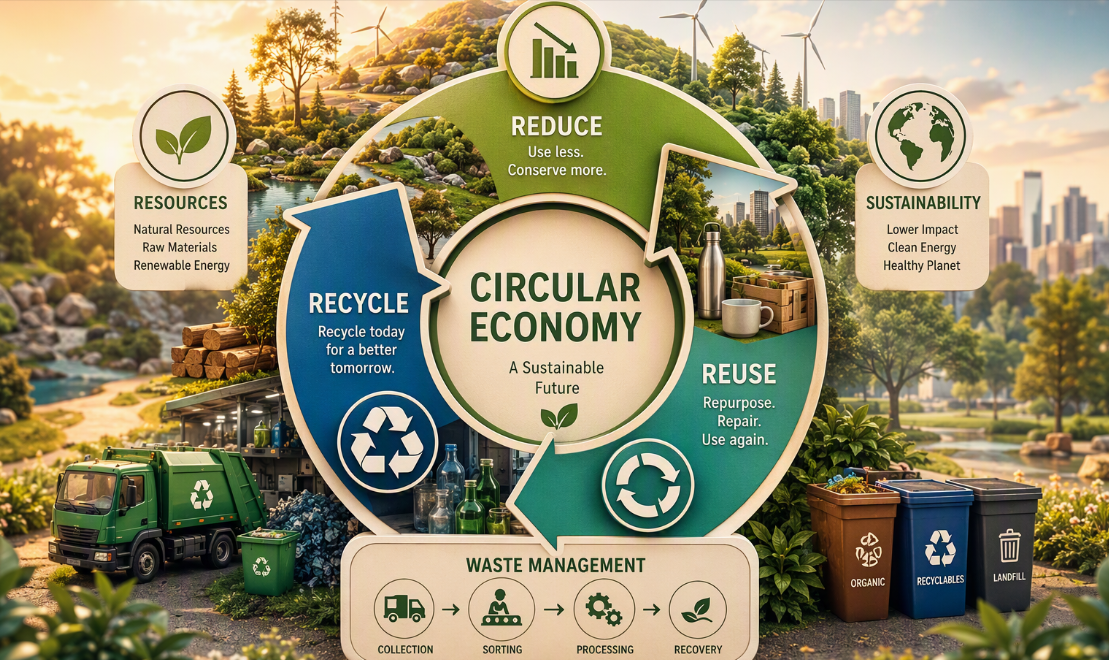
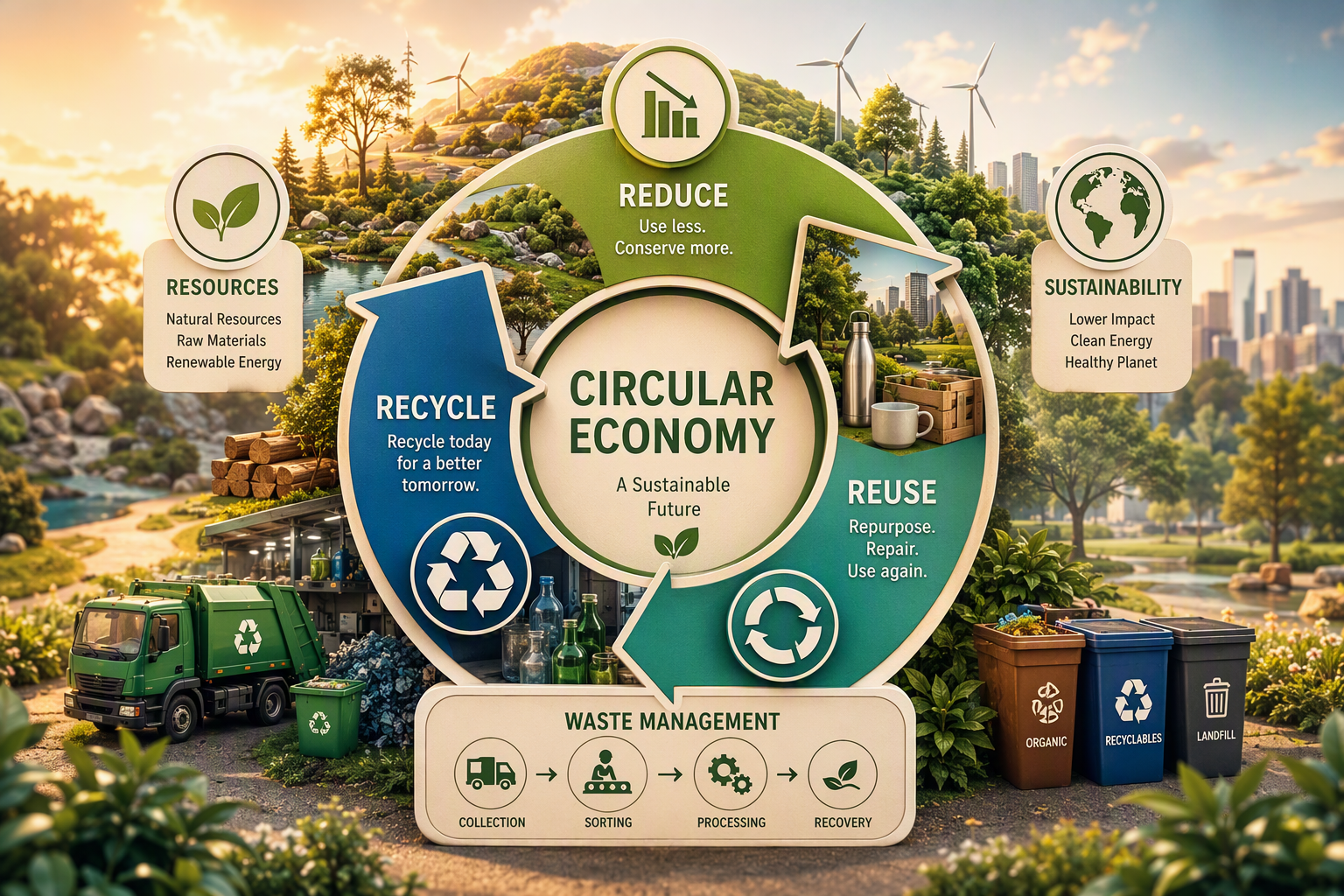
- The circular economy model does not just throw things away after using them. It focuses on reuse, repair, and recycling.
- For UPSC, the circular economy is linked to topics like sustainable development, waste management, and resource management.
- This model helps use less raw materials, makes less waste, and helps fight climate change.
- India is working on the circular economy by changing policies, setting new recycling rules, and making plans for different sectors.
- A circular economy can help keep resources safe, make new jobs, and grow the economy.
- A good UPSC answer must show how the ideas connect with each other, give some principles, show policy steps, and include Indian examples.
Table of Contents
Introduction
The circular economy model is key for UPSC as it brings together the ideas of the environment, the economy, and how things are managed. It is not about throwing away things after one use. Instead, it is about making sure products stay part of the production process for a longer time. This is done through repair, reuse, and recycling.
This way of thinking supports sustainable development. It helps by cutting down on waste, saving resources, and lowering harm to nature. So, if you are studying for the Prelims, Mains, or Essay, you need to know about the circular economy, how the circular economy model works, and some Indian examples.
Meaning of Circular Economy in the UPSC Context
In the UPSC context, a circular economy is an economic system where the products and things we use stay in use longer. The main idea is to not use up so many new resources. This system is different from the way where people make items, use them for a short time, and then throw them out. A circular economy tries to stop so much resource extraction and waste.
This idea follows circular principles like reuse, repair, refurbishment, recycling, and resource recovery. The goal is to cut down waste generation, lower pollution, and boost how things are done. For UPSC, it connects to topics like waste generation, the environment, the economy, city development, and public policy.
Definition and Scope for UPSC Aspirants
The circular economy is a way to keep products and materials in use for a longer time. In this model, things are made to last. People reuse, repair, fix up, and recycle them. The circular economy model sees waste as something useful, not as the final step. This idea is important for rules in public policy.
For people preparing for UPSC, there is a lot you can do. You can use these ideas in Environment, Economy, Governance, Ethics, and Essay papers. It will help you answer questions about resource management, pollution, urban areas, and sustainable development. This is also good for answers about using things wisely and how things are made.
In India, waste management connects with building sustainable cities, handling solid waste from towns, and taking care of plastic waste. It is also tied to how e-waste is managed and how things get recycled. When you read about it, do not stick to just the ideas. Try to link it with government plans, local rules, and real-life samples from India.
Evolution and Importance in India’s Policy Framework
The idea of circularity is now getting more important. The old way of doing things uses up more natural resources. It makes more waste and more pollution. People also need more new raw materials in this model. As India does more economic activities, there is now a stronger need to use raw materials and natural resources in a smarter way.
In the last few years, India began to move faster toward change. We saw this in 2025 with some new policy steps. The Union Budget gave support to domestic recycling and the making of batteries. The BioE3 policy helped turn waste into something useful. The National Critical Mineral Mission put focus on growing recycling capacity and making things from used materials.
This is important because the circular economy helps with sustainable development in simple ways. It helps people get more from the resources we use. This means less need for things from outside the country. It also helps factories work better and brings new jobs for people. When you read for UPSC, you will see India’s policy framework shows that the circular economy is more than just an environmental idea. It is a development strategy that can help the country in many ways.
Core Principles of Circular Economy
The main idea of this way is to use materials in a smarter way. Circular economy principles help people cut waste right from the start. The aim is also to make products last longer. People can use items that are thrown out as new inputs. This keeps things in use and makes resource efficiency better in all sectors.
Another key part is product design. Goods need to last long, be easy to fix, and simple to recycle. When design helps with reuse and material recovery, we use less new resources. The next sections turn these ideas into steps you can use in UPSC answers.
Rethink, Reduce, Reuse, Recycle
A good way to remember the circular approach is to think of four steps: rethink, reduce, reuse, and recycle. When you follow these steps, you help use fewer resources and make things last for a longer period. These actions also cut down on landfill pressure and help make cleaner ways to produce goods.
In practice, these steps include help from both people at home and in big industries. When people use better habits and better systems, it can lead to waste reduction. This also helps with resource recovery, as more things are used again instead of thrown out. These actions cut down greenhouse gas emissions, because we do not have to get and make as many new materials.
- Think about how the products we make and use can help cut down on waste from the start.
- Cut back on resource consumption in both factories and everyday life.
- Reuse things by fixing them and using them for a longer time instead of throwing them away so quickly.
- Recycle by doing waste sorting the right way. This helps get more use out of valuable materials by returning them to the economy.
Designing Products for Longevity and Resource Efficiency
Good product design helps to build a strong circular system. When a product lasts for a long time, it does not get damaged early. You can fix it easily. This means you do not have to replace it often. This is good for resource efficiency. It also brings down waste generation.
This is where sustainable design matters. Products need to be made so their parts and materials can be taken apart, used again, or recycled when needed. When companies plan for the whole life of a product, they use fewer new raw materials. This also helps with material recovery.
In UPSC answers, you can say that design is about more than making things. It has a big effect on energy use, waste management, and the cost over time. For example, electronics that last longer, furniture you can fix, and vehicle parts that are remanufactured, all show how better design can help the circular economy work.
Circular Economy vs Linear Economy
A circular economy and a linear economy are not the same thing. A linear economic model is all about resource extraction, making things, using them for a short time, and then throwing them away. This way of doing things leads to a lot of waste generation. It also means there is always a need to get new raw materials.
A circular system aims to keep products and materials in use for longer by repair, reuse, and recycling. This helps to lower landfill pressure and puts less strain on natural resources. For UPSC, it is good to know this difference. It helps you write clear definitions, make good comparisons, and give better policy answers.
Key Differences Relevant for UPSC Answers
For exam writing, you need to show the difference clearly and fast. A linear system goes in one way, but a circular approach makes loops. This shows up in how people make things, use things, handle waste management, and think about resource security in the long run.
You can add a short comparison in your Mains answers. This can help people who read your answer to see that you know both the idea and how it matters to policy. Try to talk about what goes in, what goes out as waste, and the results you get.
| Basis | Linear Economy | Circular Economy |
|---|---|---|
| Nature of economic system | One-way use-and-dispose model | Loop-based system that keeps materials in use |
| Resource extraction | High dependence on virgin raw materials | Lower dependence through reuse and recycling |
| Waste management | Waste seen mainly as disposal burden | Waste treated as input for resource recovery |
| Resource security | Vulnerable to supply shocks | Stronger security through domestic recycling |
| Environmental impact | More pollution and landfill pressure | Lower waste and reduced ecological stress |
Impact on Resource Management and Waste Reduction
A circular economy helps in better resource management. It makes good use of what we already have. People do not need to take out new materials when production goes up. The focus is on recovery, repair, and reuse. This means less pressure on land, water, minerals, and energy systems.
It also helps with waste reduction in a simple way. If we make products that last longer and are easier to fix or take apart, less solid waste goes to dumpsites. This is important in India because solid waste is growing fast. Cities and local groups feel the pressure as more solid waste piles up.
The system does well when people do waste segregation in the right way. When waste is mixed, recycling and material recovery get harder. If sorting happens at the source, with better collection and good processing places, it can help a lot. For UPSC, it is important to know that design, waste segregation, and less waste are all connected. This is a strong point for any answer.
Pillars of Circular Economy
The circular economy is built on several main ideas. These ideas guide the way people make and use things. The key ideas are durability, repair, reuse, recycling, refurbishment, and regeneration. They all work together to make a loop. In this loop, materials stay in the system for a long time and do not leave the economy right away.
Another big part is regenerative design. This is about more than just causing less harm. It helps the earth and supports natural systems. For example, people work to make soil health better, use less water, and keep pollution down. The next sections will show how these ideas be used in rules and in practice.
Regenerative Design and Closed-Loop Systems
Regenerative design is about making sure economic activities do more than just cut down waste. They should also help the environment in lasting ways. A good circular system can make natural systems stronger. This can be done by saving water, taking care of the land, and keeping everything healthier for the future. So, this idea is about a lot more than just simple recycling.
A closed-loop system uses waste from one process as the input for another. This is what circularity means in practice. It helps cut down the need for new raw materials and also makes resource recovery better in all kinds of industries.
For UPSC, know that this model links the environment and development. It shows how people can keep making things without causing the same amount of environmental degradation. If businesses add value to waste and cut losses at each step, they can work toward a better and more efficient economy. This way, the economy can also repair the damage done to the environment.
Role of Collaboration Across Sectors
No economic model like this can work if only the government acts. Businesses, people, recyclers, city groups, and informal workers all have a part in the results. That is why it is so important for everyone in the supply chains to work together.
Private investment is needed for recycling plants, reverse logistics, waste processing centers, and green technologies. At the same time, local communities have a big part in this. They help with repair, reuse, segregation, and public participation. Without support from the people, a policy stays only on paper.
For UPSC answers, you can say this is a systems issue. Producers need to make products in a new way. Local bodies have to do better at picking up waste. People must also change how they buy and use things. When the producers, local bodies, and citizens all do their part, the economic model will get stronger. It will be more efficient and simple to use in more areas.
Examples of Circular Economy Practices in India
India already gives us good examples that can help with your UPSC answers. You can see that circularity is not just something you read about in theory. It is there in waste management, recycling, energy recovery, farming, and how cities are run.
From changes in plastic waste management to improved ways to deal with organic waste and e-waste, the country is making good plans for sustainable cities. The next parts will show you clear examples. You can remember these and use them for both Prelims and Mains.
Electronics Recycling and E-Waste Management
E-waste is a good example of circular economy practice in India. Old phones, batteries, and other electronic devices have valuable materials in them. We can get these materials back instead of losing them. This helps lower the need to import materials from outside. It also makes domestic recycling stronger.
India’s steps for 2025 support a big change in waste management. The National Critical Mineral Mission will help grow the recycling of e-waste and battery waste. The Battery Waste Management Rules 2025 will also make things easy by using QR codes and digital labels for tracking and following the rules.
- E-waste recycling lets us get metals and other good things back by using material recovery systems.
- Battery waste rules help with tracking batteries better and make producers take care of their waste.
- Domestic recycling of critical minerals makes resource security stronger and helps new industries grow.
Sustainable Agriculture and Water Circularity
Circularity is important in farming too. It means you do not throw away things like farm leftovers or waste from plants. You can use these things as new resources. This helps the farm be better for the land and can cut down on losses. It also means people use what they have in the area and make the most of it.
One big part of this is regeneration. Businesses should help nature heal. They should not just try to slow down harm. In farming, this means we need to work on better soil health. People should also save water and not use too many things that are not needed. These ways of working go well with the bigger circular idea.
Water circularity is important for the same reason. When we use water with care and connect it to recovery systems, it takes some pressure off scarce resources. For UPSC, it is good to say that the circular economy is not only about urban waste. It is also about farming, water management, and helping to support our ecosystem.
Circular Economy and Sustainable Development Goals (SDGs)
The circular economy is good for sustainable development because it links how we produce and use things with how we live and protect the environment. It makes better use of resources, helps people use less, and lowers waste. The circular economy also shows a better way to handle materials in many fields. This can help us reach sustainable development goals.
It also helps with climate action and boosts economic growth at the same time. This happens because it lowers pollution and creates new jobs for people in repair, recycling, and remanufacturing. For UPSC, this makes circularity a good topic to cover across many subjects. The next two sections show how well it matches India’s SDG path and its public policy.
How Circular Economy Accelerates India’s SDG Progress
A circular approach helps India meet its sustainable development goals. It does this by cutting down waste, using resources better, and lowering stress on the environment. It is linked to the way people use goods, having cleaner cities, making new ideas in industry, and keeping the planet safe. This is why it is important in many policies about sustainable development.
It also makes climate action stronger. When we get and use fewer new materials, energy use and carbon emissions go down. Better recycling, reuse, and ways to recover things take pressure off landfills. They also help lower pollution that comes from waste being thrown away. These are some good environmental benefits.
From a governance view, the circular economy helps manage resources in a better way. It lets cities deal with waste well and helps industries use things in a more useful way. People get to live in places that are cleaner. In UPSC answers, you can connect the circular economy with the Sustainable Development Goals (SDGs). Do this by talking about jobs, cleaner production, and less harm to nature.
Integration in Government Schemes and Policies
India’s policy framework now shows more focus on circular ideas. The country has made changes in battery rules, plastic reporting, and how it recycles important minerals. All these areas tell us that India is now adding circular methods into its ways of rule. This is good for your UPSC study because you can use these current and policy-based examples.
The Battery Waste Management Rules 2025 now let producers use QR codes for EPR registration details. This change helps with compliance and traceability in waste management. For plastic waste, new rules made reporting move online through a national portal. This can help improve how people monitor and hold others responsible for plastic waste.
These steps are important only if the ministry of environment, state groups, and urban local bodies work well as one team. Each plays a role in collecting, regulating, and helping with waste processing. In your exam answers, you should say that it is not enough to have good policy ideas. There must also be people in local areas who can put these ideas to use and check how things are going.
Benefits of Adopting Circular Economy Model for India
The circular economy model gives India a good way to grow and care for the planet at the same time. This model helps the environment because it cuts down on waste and lowers pollution. It also puts less pressure on natural resources. Plus, the circular economy model helps with resource security since India will not need to get as many new materials from other countries.
The model gives both economic benefits and social benefits. It creates jobs in areas like recycling, repair, remanufacturing, and reverse logistics. At the same time, it helps make production better and more efficient. The next sections will talk about these gains for the environment and economy.
Environmental Benefits and Reduction of Greenhouse Gas Emissions
One of the good things about the circular economy is how it helps the environment. When you reuse, fix, or recycle products, you need to use less new stuff. This can lower pollution, stop land from getting bad, and can make life better for all living things.
Reusing and recycling things helps lower greenhouse gas emissions. Making new products from raw stuff often takes more energy than using things that people already used before. So, when people choose reuse and recycling, there will be less carbon emissions from factories, moving things, and getting rid of waste. That is why this way matters for climate change and keeping it under control.
Waste reduction gives us more good things. When we send less waste to dumpsites, it helps limit methane and other gas emissions. For the UPSC exam, you can talk about waste reduction and how it helps cut emissions. You can say it works in three ways: lower extraction, cleaner production, and less waste thrown away.
Economic Growth and Job Creation Opportunities
Circularity is not just good for the environment. It also helps economic growth. When companies use things again, fix things, and handle materials in a better way, they save money. This means they don’t have to rely so much on buying new and costly raw materials from outside. In the end, businesses get more out of what they have and spend less.
Another big gain is job creation. There are a lot of jobs in repair services, recycling centers, reverse logistics, waste processing, and remanufacturing. These jobs are for people with different skill levels. The national critical mineral mission in India also thinks there will be many new jobs in the recycling sector.
These changes also help make sustainable cities. Better waste systems, cleaner neighborhoods, and strong local businesses make life in cities better. When you bring in renewable energy and use waste-to-wealth plants, the circular economy gives a bigger development plan. This plan helps people’s jobs and gives more support for the future.
Role of Recycling and Waste Management in Circular Economy
Recycling and waste management are important in any system that goes in a circle. These help bring used things back so they can be used again. If there is not a good system for this, even a good product will turn into waste. This is why having a good setup for recycling is very important.
Still, recycling by itself will not be enough. Efficient waste management starts with knowing how to separate, pick up, and handle all types of waste. If there are gaps in waste collection, many things we could reuse or recycle get lost. In this text, you will read about India’s steps, rules, and real actions when it comes to waste management and waste collection.
Recycling Frameworks in India’s Policy
India’s recycling systems are getting more important because the amount of solid waste keeps rising. Every day, the country makes over 160,000 tonnes of waste, much of it from municipal solid waste. So, how the people and the government recover and process this waste is a key part of planning. A circular system cannot grow, or be strong, without good ways to handle all this solid waste.
Policy steps now include areas like batteries, plastics, and important minerals. A big part of this is Extended Producer Responsibility. But, there are still some gaps in how it is put into action. These rules are made to help make collection, tracing, and recycling better.
For better results in managing solid waste, waste sorting should be done where the waste is made. If people mix solid waste, it gets hard to get useful materials back and the cost to handle waste goes up. In your UPSC answers, you can say that any policy will work best when there is solid waste segregation, good plans and systems, and strong checks in place for all states and cities.
Case Studies of Successful Waste Management Initiatives
India has useful examples that can act as short case studies in UPSC answers. These show how circularity works when policy, the right set-up, and taking action all come together. You can use these examples for questions on urban governance and solid waste, especially municipal solid waste.
Waste-to-wealth projects show how we can turn what we throw away into something useful. In the year 2023-24, the number of plants reached 198. This includes compressed biogas units. Many more were being built and should be ready by the middle of 2025. Projects like these help change waste into new things we need. They also lower the pressure to throw waste away.
- Waste-to-wealth plants help show how waste management can be better when we recover and use waste again.
- Plastic waste reporting portals make it easy to stay on track with rules, keep track, and get better at waste collection.
- Monitoring systems and using data analytics give local groups the tools to handle waste flows in a smart and efficient way.
LiFE (Lifestyle for Environment): Policy Support for Circular Economy
The LiFE initiative helps support circular economy principles by guiding people to make smarter choices when they buy things. This is important because a circular economy is not just about what happens in factories or following rules. It also comes from the way people buy, use, repair, and throw away things in their daily lives.
LiFE helps with climate action by changing how people act and raising public awareness. When people throw away less and keep things for longer, the whole system of change becomes better. The next parts will talk about why LiFE is important and how it can help India move toward a circular way of doing things.
Overview and Significance of LiFE Initiative
The LiFE initiative matters because it gets people involved in taking care of the environment. It does not leave things just to the government or business. Instead, it asks every person to change small things in their daily life. This helps a lot in a circular economy. The way people use and buy things has a big effect on waste. If they use their things better and throw out less, everyone wins.
Public awareness is important here. When people care about repair, reuse, and using things carefully, they help stop waste from building up. This goes a long way to help with climate action, because there is less waste and less need for new things.
LiFE helps make sure that there is room for sustainable design to do well. The best products will not help if people still choose to throw things away quickly instead of using them for a longer time. For the UPSC, you can say LiFE brings together policy and what people do by adding care for the environment into everyday life.
How LiFE Strengthens India’s Circular Economy Transition
India’s move to a circular economy needs more than just rules. It is important for the people, the makers, and the groups to work together. LiFE helps with this. It talks about ways to fix, use again, sort, and cut down on waste generation.
This change in how people act can help with sustainable development. When more people want things that last long, fixed items, and good services, companies will change their business models. This will help bring more leasing, fixing old things, and using product-as-service ideas as time goes on.
LiFE works well with technological innovation. New recycling systems and digital compliance tools can do better when people help out by throwing away things right and using less. For the UPSC, this is an important point for policy. Change in behavior and use of technology need to go together if we want circularity to become a common practice.
Challenges in Implementing Circular Economy in India
India’s move to circularity is not easy. The country faces some big real-world problems. A main problem is there are not enough systems and buildings for it. There is also a lack of good waste sorting methods. Many workers who pick waste are not well included in the process. A lot of money is needed to set up new places to process all of this. Because of these problems, change is slow in India.
There are some problems with rules and how people act. Some rules are there, but different states and groups do not always follow them the same way. A lot of people do not know enough about this issue. Many do not trust products made from recycled stuff. The next parts talk more about these problems, like public awareness, in detail.
Infrastructural and Technological Barriers
One big problem is the lack of good infrastructure. A lot of urban and rural areas do not have strong systems to divide, collect, keep, and recycle waste. Without these basics, the circular way of doing things does not work well. These barriers in the system make it hard to recover waste. They also let more waste leak out.
Another problem is the high cost. The recycling plants and the systems to move and process things both need a big investment to get started. This makes it hard for many to make the move, especially when people or companies are not looking to buy a lot of recycled materials yet. In an economic model that is still growing, being able to keep prices low is very important.
Technological innovation can help with resource management. But it is not the same for everyone. Some places do not have new tools or machines. Things like better recycling systems, digital tracking, and safer ways to recover things need money and skilled workers. For UPSC, the main point is this: weak infrastructure and little technology make it slow and not good to manage resources. This also slows down how fast new rules or ideas work.
Policy and Behavioral Challenges for Stakeholders
Making a good policy is not enough to get results. India still has problems with policy, like not enforcing EPR rules well. There are also different standards in each state, and a gap between what the rules say and what people do. This makes it hard for producers, recyclers, and local agencies to feel sure about what will happen.
Changing how people act matters too. A lot of people do not put repair, reuse, or sorting first. Because public awareness is low, many valuable things end up with regular trash. This makes it harder and more costly to recycle, and less stuff gets reused.
Urban local bodies deal with high waste levels, but they do not have enough ways to handle it well. They need more money, stronger working rules, and support from people in the city. In UPSC answers, you can say that the circular economy will not work if there are weak rules at the ground level or if people do not join in to help.
Circular Economy UPSC PYQ Analysis
UPSC PYQ analysis is a good way to see how the exam uses environmental and economic ideas. If you focus on circular economy, you may get questions that talk about things like emissions, raw materials, how things are made, or rules made by the government. This practice not only makes your concepts more clear but also helps you get better at removing wrong options.
It also helps you give better answers for the mains. When you go through sample questions, you get to know how to write out definitions, use examples, and explain resource recovery in a simple way. The next parts show how you can get ready for both Prelims and Mains.
Sample UPSC Prelims Questions Related to Circular Economy
A good way to get ready is to read questions from UPSC prelims that focus on ideas. UPSC likes to ask questions where you see if the given statements are right. They may also want to know if one statement helps to explain another. This pattern tests your thinking, not just what you remember.
For circular economy, you need to see how it helps to use less raw materials, create less waste, and cut down on emissions. When you get how this system helps with better resource management and leads to sustainable development, it gets easier for you to solve prelims questions.
- Practice statement-based UPSC PYQ on waste reduction, recycling, and cutting emissions.
- Revise how circularity can help lower production loss. See how this supports fighting climate change.
- Learn policy examples from India. This helps you remove wrong or unlikely options.
- Connect ideas like reuse, repair, and recovery with good results in the environment and economy.
Analysis of Mains Answer Approaches
Strong mains answers on the circular economy often have a simple format. First, give a short definition. Then, talk about the idea by using the main points like reuse, repair, recycling, and regeneration. After this, put some Indian examples in your answer. In the end, talk about the good things or problems people see with the circular economy.
You should also mention how this topic connects with larger themes. Talk about how there is pressure on natural resources. You can also include how cities make a lot of waste. It is important to say that policy support is needed for this. This shows that you see circularity as not only a technical issue, but also a governance issue.
To make your mains answers better, you can add examples like the battery rules, plastic reporting reforms, waste-to-wealth plants, and resource recovery systems. When the topic asks for it, try to connect your answer with ideas like sustainable cities, jobs, and the way we care for the environment. A clear structure in your answer is more useful than using big or hard words.
Why is circular economy crucial for India and UPSC?
The circular economy model is very important for India. It helps with sustainable development. It lets people use resources in a better way, makes less waste, and also fights climate change. For UPSC, the circular economy is key because it brings together things like the environment, economy, policy, and economic growth. This is a big idea that joins all these parts.
What are major examples of circular economy practices for UPSC answers?
Useful examples are e-waste recycling, battery waste rules, plastic waste management changes, waste-to-wealth plants, vehicle scrappage, and organic waste recovery. These help show how waste management and resource recovery help make economic activities cleaner. They also improve solid waste handling and help build more sustainable cities.
How can aspirants use UPSC PYQ to understand circular economy concepts?
You should use UPSC PYQ because it helps you see how the exam brings together ideas like resource management, sustainable development, waste reduction, and climate change. Going through PYQs can help you know how statements work. They let you get better at finding the right answer in Prelims. You will also see how to give strong examples and clear structure in your Mains answers.
Many people have questions about the circular economy. They want to know how it can help with sustainable development. A lot of them also ask how good resource management can cut down on waste generation. There are often questions about the part that businesses play in growing economic growth and pushing forward circular principles. People also wonder how waste segregation helps with material recovery and lessens greenhouse gas emissions. Answering these types of questions helps build public awareness. It also helps local communities use better ways to keep the environment healthy.
Conclusion
To sum up, knowing about the circular economy is important. This helps not just UPSC aspirants, but anyone who is interested in sustainable development. When you learn the main ideas—like using resources in a smart way and recycling more—you can help build a better and more hopeful future. Some practices in India show that the circular economy can lead to more economic growth and help with environmental problems too. While there are things to fix, like building better systems and updating rules, your knowledge can help push for these changes. If you want to know more or get help with your UPSC studies about the circular economy, you can book a free talk with our experts. With teamwork, we can help India be strong and sustainable.