Key Highlights
- This guide explains why modern indian history is important for upsc prelims, mains, and interviews.
- You will see the timeline of indian history from 1750 to the time of indian independence. It is given in simple and clear chronological order.
- You will read about every key event, starting from when Europeans first came into India. The guide goes up to the freedom struggle and the Partition.
- The article shares information about the East India Company, british rule, the indian national congress, and big movements led by Gandhi.
- There is also a short review of reform moments, main facts, and good ways for quick revision. This helps you get facts fast while studying.timeline of indian history, modern indian history, indian national, key event, indian history, chronological order, indian independence.
Table of Contents
Introduction
Modern indian history can feel hard if you read it as just a lot of small facts. It becomes much easier when you look at it like it is one big story for the indian subcontinent. First, evrops started trade here. Then, british rule began in India. In the end, we got indian independence. Every part of this story leads to the next one.
If you want to do well in UPSC, try working with a clear timeline. This tool can help you keep up with changes, remember the big events, and understand why some things turned into important steps in the story of modern indian history.
Importance of Studying Modern History for UPSC
Modern Indian history is a very good topic in the CSE syllabus to get more marks. In UPSC prelims, you will get many questions about events, leaders, and when things happened. If you know the history of india well, you can cut out wrong options fast. This will help you score better in your exam. The more you read about modern indian history, the better you do with upsc prelims.
This subject helps you write better answers for the mains exam. When you have topics like the civil disobedience movement, you can talk about their causes, how they happened, and what impact they had. You can do this in a clear way. That is one reason you should pay steady attention to this subject.
Relevance in Prelims, Mains, and Interviews
In upsc prelims, there are lots of questions from modern history. These questions are often about facts or the order of events. You may need to say what happened first. You may also have to tell who was the leader. Sometimes you get asked in which year a reform took place. A strong timeline will help you answer questions faster. It will also make you feel more sure when you answer questions.
For the mains, the cse syllabus asks for more than just remembering facts. You need to talk about the stages of the national movement in a clear way. If you get how early nationalism turned into civil disobedience, and then grew with more people joining the fight, you can make your answers better and more clear.
Interviews at times put stress on clear thinking. You may be asked why a civil disobedience movement was a success, why another did not work, or how the leaders of these acts changed as time passed by. If you know the facts around civil disobedience and learn what was happening in the civil disobedience movement, you can then give clear and calm answers.
Understanding Chronology for Effective Preparation
Chronology helps you put modern history history in order. You get to see how indian history flows. Without this, you might feel the events are all over the place. But with it, you see trade comes before conquest. The rules from outside powers made people push back. Later, with organized politics, india got its freedom.
For upsc prelims, knowing the chronological order is very important. There are a lot of questions that ask about the correct order. They may ask this in a direct or another way. If you remember when the Revolt of 1857, the partition of Bengal, Non-Cooperation, and Quit India happened, you will not make as many mistakes. It also helps you read your notes faster.
A good way to remember the timeline of indian history is to split it into several phases. First, there is the time when the Europeans came into India. After that, you have the period when the Company began to grow. Then, the British Crown took control of India. Next, there was the start of early nationalism. This is followed by many years with Gandhian struggles. At last, there is the Partition. Breaking indian history like this helps you talk about the timeline of indian history clearly. It can also make you give a simple and clear reply in interviews.
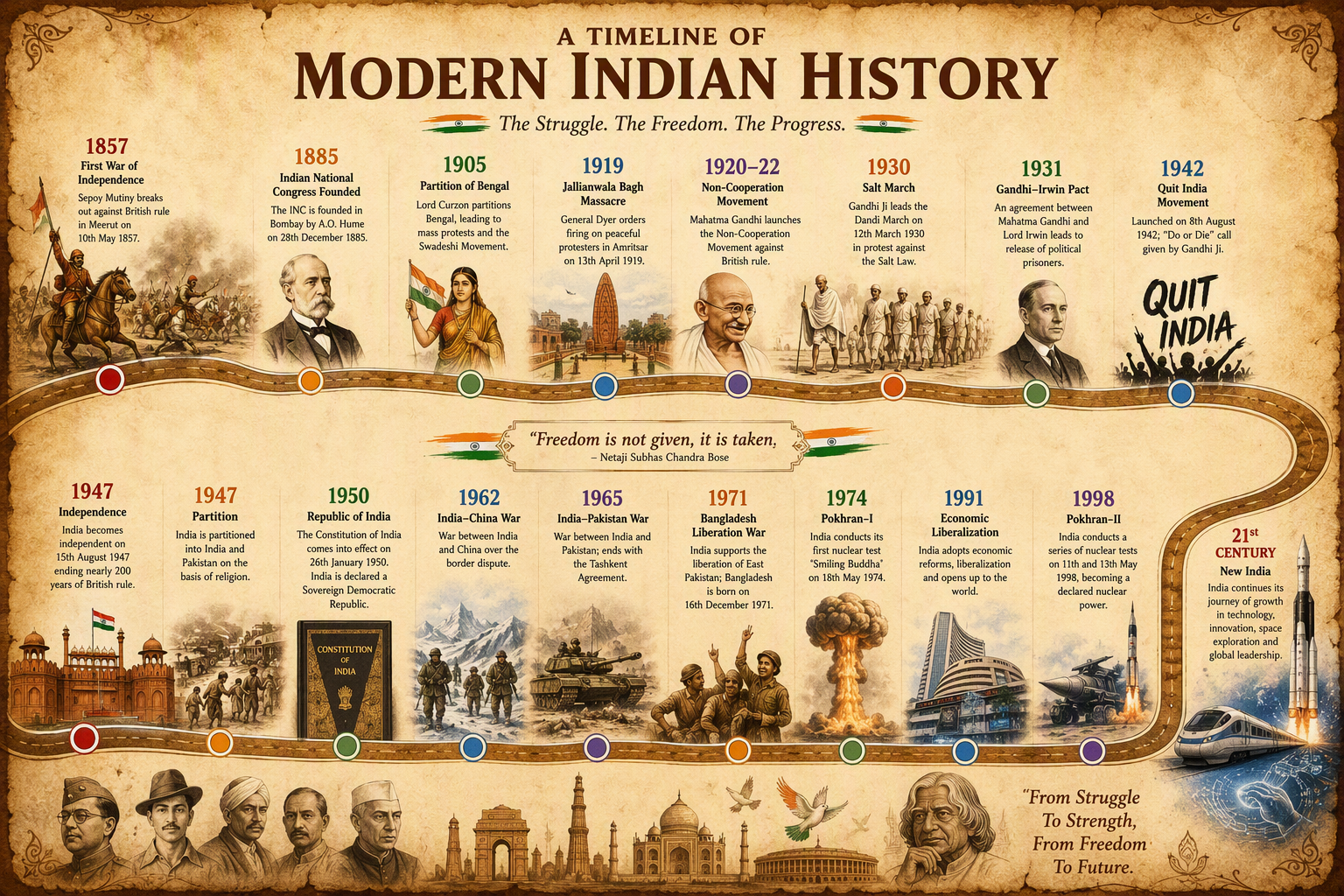
Overview of Modern Indian History Chronology (1750–1947)
If you want to get a good idea about modern indian history, begin when the Mughal rulers started to lose power. At the same time, there was more competition from Europeans in the country. Then, see how the East India Company got control over indian history. Learn about the Revolt of 1857 after that. Soon, people in india started to feel more pride in their country. This led to a rise in nationalism. All these things slowly led up to indian independence. This is a simple way to look at the main events in modern indian history and indian independence.
Putting things in chronological order gives you a better idea of the history of india from 1750 to 1947. It lets you see how the country changed, how it was run, and how people started to fight back. You can also see when big national movements began. In the next two parts, you will see this long period broken up into different times. You will also find key dates that you should remember.
Key Eras and Turning Points
India went through several key times in its modern history. These were the days that pushed the Indian subcontinent to start the fight for complete independence. The rise of nationalism began with the Indian National Congress and the Home Rule League. Both groups worked to bring people together and make them feel united.
Movements like the Dandi March and the Quit India Movement showed that the people were ready to practice civil disobedience. They wanted to stand up to colonial rule even when it was not easy. A few major events, such as the partition of Bengal and the Lahore Resolution, made the struggle feel even more real. Each one helped move people in the Indian subcontinent toward their own rule and complete independence.
Landmark Dates to Remember for UPSC
Some dates from modern Indian history come up again and again in questions. You do not need to know every year. It is better to focus on the big events that changed things during British rule and the national movement. These important dates give your study for the upsc prelims a good plan. When you know about these main events in Indian history, you will feel more ready for the exam.
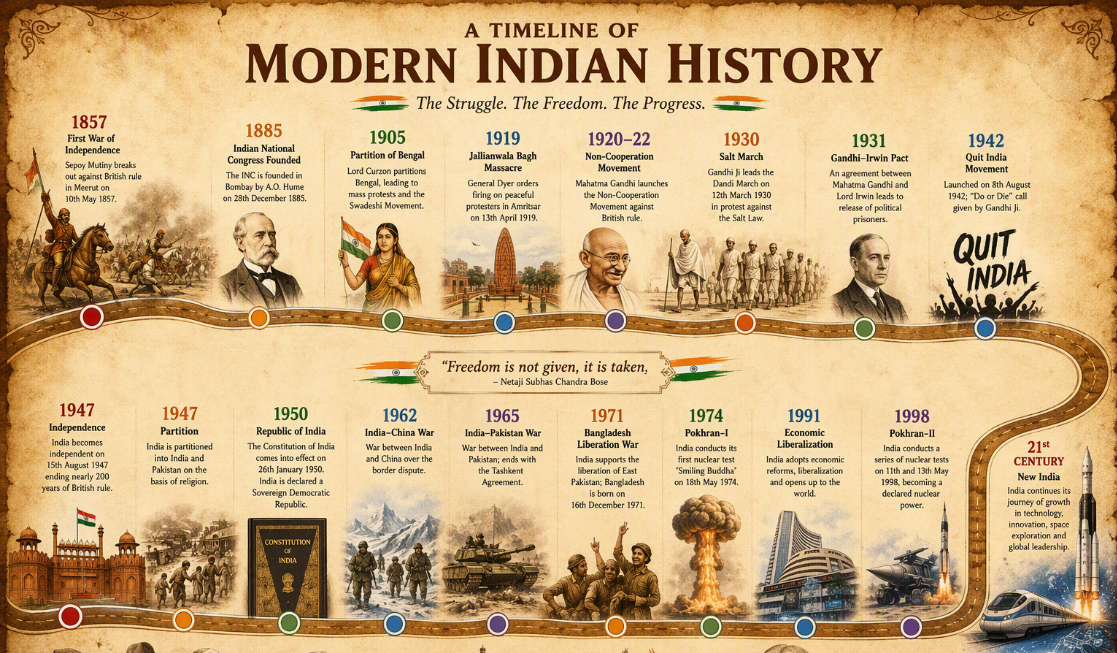
Here is a compact text table you can revise often:
| Year | Key event |
|---|---|
| 1498 | Vasco da Gama arrived in India |
| 1600 | Charter to the East India Company |
| 1757 | Battle of Plassey |
| 1764 | Battle of Buxar |
| 1857 | Revolt of 1857 |
| 1885 | Indian National Congress formed |
| 1905 | Partition of Bengal and Swadeshi Movement |
| 1919 | Rowlatt Act and Jallianwala Bagh |
| 1930 | Dandi March and Civil Disobedience Movement |
| 1942 | Quit India Movement |
| 1947 | Indian Independence Act and Partition |
Go through each item one at a time. For each, try to connect it to a person, a place, and say what happened. This way, you turn just a date list into a living timeline of Indian history. You will start to see every event in the timeline of Indian history feel real and clear.
Arrival and Expansion of European Powers in India
The story of modern India begins when people from Europe came to the Indian subcontinent. In 1498, Vasco da Gama arrived in India. This made a new way by sea. It changed trade and the way people ruled the place. After that, the Portuguese, Dutch, French, and English started to live and work in India.
Over time, small fights over trade turned into bigger fights for power and control. The East India Company started to rise when the Mughal empire was not so strong. If you want to know about the british rule and the freedom struggle, you must first look at how the east india company grew in the beginning and how things started.
British, French, Portuguese, and Dutch Settlements
The portuguese were the first big traders from Europe to come by sea. The dutch, english, and french came after them. At first, they had a goal. They wanted to trade. But soon, they saw they needed forts, ports, and help from leaders. This made things change in many places by the coast.
The East India Company got its charter in the year 1600. After that, it got rights to trade when Sir Thomas Roe went on an embassy. The company set up factories in Surat, Madras, Bombay, and Calcutta. The French did the same and got strong too. This started a long fight between the east india company and the british empire.
This rivalry became more intense during the Carnatic Wars. When Mughal power began to fall, the British started to move ahead of the French in the region. By the middle of the eighteenth century, the Company’s power was not only about trade. It was also starting to be about ruling the land.
The Battle of Plassey and Its Impact
The Battle of Plassey happened in 1757. It was a big turning point in indian history. After this fight, the east india company got a lot of control in Bengal. This helped them go on to take over other parts of india. When Siraj ud-Daulah lost, indian leaders saw their power go down. This was the start of the freedom struggle in the country.
As time went on, more people did not want british rule. Their anger got stronger until almost everyone wanted complete independence. Many great leaders and new movements started to show up. All of this pushed the country to get free from british rule.
British Administration and Legislative Changes
As the British got more control, the way they ran things got more clear. The British Parliament started to make rules for the Company by using new laws. They also changed things with money and courts. This changed how people in India lived each day. These steps made the colonial rule stronger and changed how the whole country worked.
For the UPSC exam, you need to read about both the acts and what changes they brought. Start with the Regulating Act and go up to the Government of India Act. These constitutional reforms show you how power moved from the Company to the Crown after 1857. Each step helped shape the government of india we know now.
Major Acts and Reforms (1773–1857)
The years between 1773 and 1857 had many big changes. These changes helped British control in India get stronger. The Regulating Act of 1773 was the first big step. The Parliament used this act to keep a close check on what the Company did. Then, Pitt’s India Act of 1784 brought in dual control. This made the Company and the Crown share power and work together.
At this time, there were changes in the people who managed things. Warren Hastings tried to make changes to the law and the tax system. Lord Cornwallis brought in the Permanent Settlement in the year 1793. Later, other British officials put the Ryotwari and Mahalwari systems in place. These were not just simple changes in rules or laws. They made life in the village different for people living under colonial rule.
As more land came under British rule, Lord Wellesley started using the Subsidiary Alliance. Later, Lord Dalhousie used the Doctrine of Lapse. During this time, railways, the telegraph, and the postal system began in India. All these things helped set up the India Act. The Government of India Act was made in 1858, after the big revolt in 1857. The government of India changed a lot during this time because of the actions of these men.
Effects of Colonial Policies on Indian Society
Colonial rule changed Indian society a lot. The new ways of collecting money from farmers put much pressure on people who worked the land. At the same time, these changes in the economy made local industry weak. A big drop in handicrafts and less work in factories made people have less work and less money in many parts of the country.
British growth also changed how people and groups worked and talked. The British brought new ways to travel and new ways to manage things. This made different places feel closer and more connected. But in the end, these changes mostly helped the British rulers. There was some trouble because of these changes, but people also became more aware and started to feel connected in new ways.
This pressure made things in society start to change. People also began to feel more angry because of it. There were new political lines, less money for a lot of people, army problems, and people from different groups began to not get along. These things made everyone feel even worse about being under foreign rule. That is why colonial policies were not just rules made by those in charge. The policies became the big reason that so many people started to stand up and fight against foreign control.
Significant Events of the Indian Freedom Struggle
The indian freedom struggle did not happen in one day. It happened slowly, step by step. At first, there was rebellion. Then, people started to send petitions, take part in protests, and join boycotts. After all that, a big mass movement took place and later, there were talks to find an answer. This way of fighting is a key thing in modern indian history. You will find this pattern in indian history again and again, and it comes up a lot in the UPSC exam when you read about the freedom struggle.
A simple flow works well here. It starts with the first war of independence in 1857. After this, you see early nationalism. Then, you get the swadeshi and home rule movement. Next, the Gandhian movements come in. After that, the last stage takes people to 1947.
The next sections will show how this long fight grew step by step.
Revolt of 1857 and Early Movements
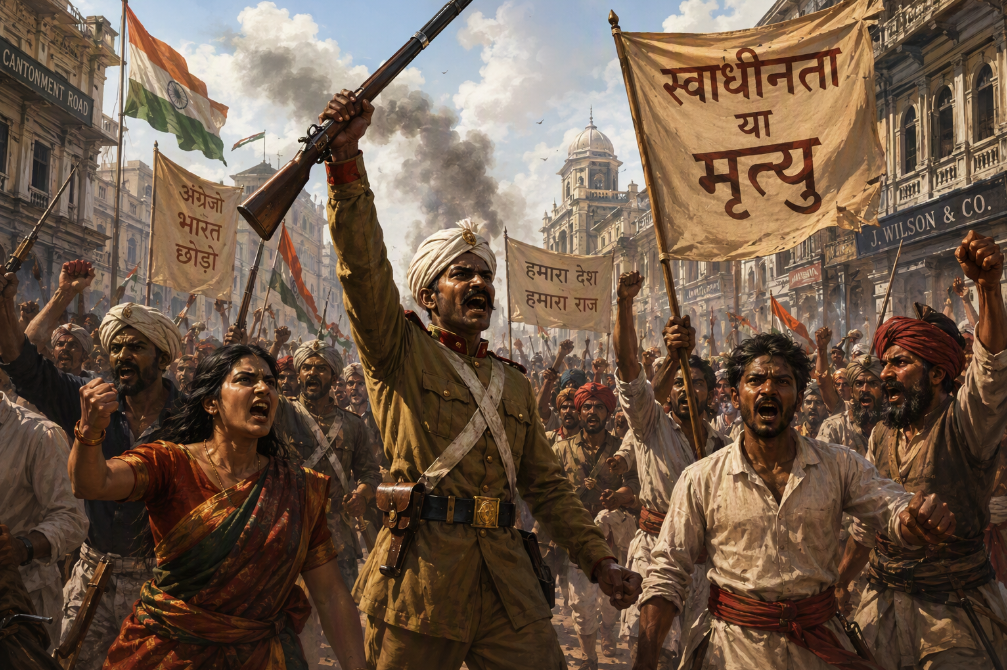
The Revolt of 1857 was a big turning point in India’s freedom struggle against British colonial rule. A lot of people call this event the First War of Independence. The revolt helped people from many groups feel more united. It brought a sense of togetherness and made them come together for a common cause. Groups like the Indian National Congress and many other Indian national reform movements started to get more active after this.
The revolt made the British think over their policies. This later led to constitutional reforms that changed many things in the country. During this time, people also started to practice acts of civil disobedience. These steps helped the rise of nationalism among the people. All of these actions helped shape the path for later movements that wanted complete independence for India.
Formation and Evolution of Indian National Congress
The Indian National Congress began in 1885. This year is a key part of both modern Indian history and Indian history. At first, the Indian National Congress asked for a few constitutional reforms. The group also talked about how the British rule led to economic exploitation. It was important as it helped shape modern India.
Leaders such as Gopal Krishna Gokhale took a calm approach. They used petitions and debate. They worked for small changes that happened slowly over time. But soon, things began to change. Leaders like Bal Gangadhar Tilak and others wanted to do more. They asked for tougher steps. They wanted to get more people involved and push harder for change.
This change is important for UPSC. It shows how Indian politics got better with time. At first, the Congress was only for a small group of people who were elite. Later, it welcomed many more people in. This made it possible for Gandhian campaigns to take place. It also helped Congress become the main group during the freedom struggle.
Key Phases of Indian Nationalism (1885–1947)
The late 1800s and early 1900s were important for Indian national feelings. The Indian National Congress began in 1885. This was the first time that Indian political work was so organized. As time went on, more people did not like British rule. Because of this, ideas like Home Rule and Swadeshi got stronger. Bal Gangadhar Tilak and Annie Besant were both big names who helped these ideas grow.
The Dandi March and the Quit India Movement in 1942 were also big times for the Indian people. People wanted complete independence from British rule. Everything that people did during these years led to the partition of India in 1947. That was a very important time for all Indian nationals. The long work against British rule, and the call for Indian national dreams, shaped the country India would become.
Moderate, Extremist, and Gandhian Movements
The moderate phase of the Indian National Congress was a time when the leaders sent letters and asked for new laws. The indian national congress leaders thought they could talk to the British to make things better. During this time, the indian national group helped people get to know more about politics. It made it possible for people to join and speak together as one.
The extremist phase got tougher. Bal Gangadhar Tilak, Bipin Chandra Pal, and Lala Lajpat Rai wanted to take stronger steps, especially after the partition of Bengal. During this time, people saw more boycotts, swadeshi, and stronger support from the public.
The movement led by Gandhi changed the fight again. When Gandhi came in 1915, many more people joined because of satyagraha and actions that were not violent. Places like Champaran, Kheda, and Ahmedabad showed how he worked first. Later, his actions made the idea of freedom grow strong and wide for people all over India.
Milestones: Non-Cooperation, Civil Disobedience, Quit India
The Non-Cooperation Movement from 1920 to 1922 made the indian national struggle something that people did every day. People stopped using British goods, stayed away from British schools, and did not work in British offices. Because of this, they started to use their own things and skills more. A lot more people joined politics during this time. The movement made a big change, as it was not just leaders doing the work—now all people were taking part in indian national politics.
The civil disobedience movement began in 1930 with the Dandi March. Gandhi led a protest about salt at this time. He showed the people how to stand up to the British in a strong but simple way. The civil disobedience movement showed that one problem can join people from many places.
The Quit India Movement in 1942 made the call for full freedom louder. The people wanted the British to leave India at once. This made the goal of total freedom clear to everyone in the country. If you want to remember the important years in the freedom struggle, think of these: 1920, 1930, and 1942. These are three key steps in the big fight for freedom.
Partition of India and Independence
The end of the national movement saw politics come to a stop. There was a lot of stress between different groups. Each group wanted to have its own role in running the country. The idea of separate electorates, changes made before, and more mistrust between big political groups helped make the idea of a separate nation even stronger. By the 1940s, these problems became a big part of important talks.
The Lahore Resolution of 1940, Direct Action Day in 1946, and the demand for a quicker transfer of power helped things move fast toward the partition of india. The Indian Independence Act of 1947 gave rise to two new free countries. For UPSC, you need to remember the win of indian independence, and also think about what people lost during the partition of india.
Political Negotiations and Major Leaders
The last step to freedom was not easy. There had to be both politics and people working for change. The round table conferences were there to talk about India’s future, but no simple agreement came out. When the Cabinet Mission Plan came after that, it also could not bring all groups together for long.
In this time, different leaders had their own ways of doing things. Mahatma Gandhi led many big groups and was always part of every main political talk. Subhas Chandra Bose pushed people to fight with the Indian National Army. Muhammad Ali Jinnah became very involved in politics right after the Lahore Resolution was made.
For the UPSC exam, you should not see these leaders as people who acted alone. Look at what each one did in talks, how they brought people together, and how they had different ideas about India’s future. This will help you write better answers. You will also get to know why India became free at the same time when partition took place.
Aftermath and Consequences for India
The partition of India had strong effects for the people there. Creating a separate nation was not easy. Many saw people leave their homes at that time. There was fighting between groups. A lot of people went through tough times in that area. Life changed for everyone after the partition of India.
The Indian Independence Act stopped British rule in the country. But when India got its freedom, there were many big problems. The new borders had to be watched and kept in order. A lot of people had to move and find new homes. The new states needed to be made strong and safe. This time was one of the hardest for people in South Asia. It was not easy for anyone living there when Indian independence came.
The effects of Partition did not stop in 1947. This event changed how India and Pakistan handled politics, how people saw who they were, and how they spoke to each other for a long time. For UPSC, you have to know that getting independence was a big win after many years of fighting for it. But this time was also full of pain, fear, and problems that did not end.
Socio-Religious Reform Movements of the 19th Century
In the 19th century, India saw a lot of change. Many people wanted to make society and religion better. Groups like the Brahmo Samaj and Arya Samaj started to look at Hinduism in a new way. They told people it is good to learn more and stop treating others badly because of caste.
Leaders like Ram Mohan Roy and Annie Besant worked hard at this time. They got people to talk about gender equality and social justice. Many started to think about what is fair and to see things with new eyes.
This was an important time because it woke people up. It helped with the rise of nationalism. After this, more people joined together for the freedom struggle and to fight colonial rule.
Contributions to Social Change
Socio-religious reform was a key part of modern indian history. These reform groups wanted to make life better for people. They spoke out against bad customs. They also worked hard to grow education. They asked people to look at social and religious life in a new way. Their work helped people talk about things besides politics in indian history.
The Brahmo Samaj, Arya Samaj, Prarthana Samaj, Satyashodhak Samaj, and Ramakrishna Mission all helped people a lot. The groups gave people a way to talk with each other. They got people to think about value, being fair, and doing what is right.
This reform movement mattered because political freedom does not just happen by itself. People began to change the way they think as society changed. They started to ask questions about who has power. People came together. They made groups. They also started to dream about a better time for everyone. This is why you need to read about these movements when you get ready for the UPSC exam.
Influential Personalities and Ideas
There were several people who played a key part in changing things in the nineteenth century. Ram Mohan Roy was one of these people. He started the Brahmo Samaj in 1828. He was also one of the first to talk about new ideas and trying new ways to live. He was very important when we talk about the early days of modern thinking in India.
Other important people include Atmaram Pandurang, who was in the Prarthana Samaj. Jyotirao Phule started the Satyashodhak Samaj. Swami Dayanand Saraswati led the Arya Samaj. Swami Vivekananda worked with the Ramakrishna Mission. Annie Besant was also a big part of change in India because of her work with the Theosophical Society.
What brings these people together is not that they are the same, but that they all care about social change. Their ideas helped grow the way people think and talk about what is right and wrong. For UPSC, you need to know about both the group and the person who started it.
Tips and Shortcuts for Memorizing Timelines for UPSC
If you find it hard to remember the timeline of Indian history, you do not have to read your notes over and over again. For UPSC prelims, it helps to group events together. Go over them many times. Practice putting these events in the right order. This will make your memory of Indian history better. You will feel more ready for the UPSC prelims.
Try to use easy tricks to remember things. You can use small tips, pictures, and short notes. The goal is to not read the history of india as only dates and facts. You should try to see how everything works together. The next two parts will show some ways that help you learn faster and save time.
Mnemonics and Visual Learning Strategies
Mnemonics and looking at pictures can help you understand the timeline of indian history for your upsc practice. You do not have to read the same thing many times. Try to change long chapters into easy shapes or patterns you can see. When you do this, you will remember the timeline of indian history in a better way.
Try these simple methods:
- Draw one line from side to side. Put the big years between 1757 and 1947 on this line.
- Pick one color for acts. Use a different color for movements. Use another color for leaders.
- Next to each year, write one short word. For example, Plassey, Congress, Dandi, or Partition.
- Go over steps in the way things happened like 1857, 1885, 1905, 1919, 1930, 1942, and 1947.
- Break big ideas into small cards. Read them each day to help you remember.
These tricks help you feel less stressed. When you use visual learning, you can remember things quicker for prelims. Mnemonics also help you speak better in interviews. It is good to keep what you do simple and practice it many times. If you do this, your memory will get better.
Topic-Wise Notes for Efficient Revision
Topic-wise notes are very helpful when you study modern indian history. They make indian history feel less confusing and more clear. Do not put all your notes in one long notebook. Try to split your notes, so every theme is easy to read when you have the exam.
You can organize them like this:
- The European entry and the growth of the East India Company
- The British ran the administration through several acts and brought constitutional reforms
- The Revolt of 1857 and the start of early nationalism
- The Indian National Congress, swadeshi movement, and the demand for home rule
- Movements led by Gandhi, the Partition of India, and freedom from British rule
Keep each page short and clear. Write the date, leader, cause, and result on new lines. This helps you read and go over your notes faster. You can get ready for upsc prelims quicker this way. For mains, your notes stay tidy and in themes. So, it is easy to use them.
Conclusion
To sum up, it is important to know the timeline of modern history if you want to do well in the UPSC exam. This will help you see the main events, why these matter, and how Indian society has changed over the years. When you learn the important dates, the big names, and the main ideas, you can get ready for the exam in a better way. You might also start to feel more respect for India’s path to freedom. You should use good ways to remember things and write short notes while you study. If you stay focused and use the right methods, you can do well in your UPSC journey. If you want help that suits you, feel free to ask for a free consultation!
Frequently Asked Questions
What are the must-know events from modern Indian history for UPSC?
You should be sure to read about the Battle of Plassey, the Revolt of 1857 (people also call this the first war of independence), and how the Indian National Congress started in 1885. You also need to know about the partition of Bengal, the Non-Cooperation movement, the Civil Disobedience movement, and the Quit India movement. Try to learn about the main events that took place before Indian independence happened in 1947.
These are the topics that are very important if you are getting ready for the UPSC prelims. The keywords you need to remember for this part are civil disobedience, quit india movement, civil disobedience movement, indian national congress, indian national, indian independence, partition of bengal, and first war of independence.
How can I effectively memorize important dates and milestones?
Make a visual timeline of indian history. Group the events by phase to make it more clear. You can read over the same date list many times to help you remember. Use easy tricks and link keywords together. For example, add 1930 with Dandi and the civil disobedience movement. This way, people can remember modern indian history better. When you study the timeline of indian history like this, it becomes easier to learn. Civil disobedience is a big part of this method.
Is there a quick way to organize notes for modern history UPSC prep?
Yes, it is good to make notes for each topic instead of writing one long summary. You should keep separate parts for things like European expansion, colonial acts, the Congress, Gandhian campaigns, and Partition. Add short points for the dates, leaders, reasons, and what happened after. This helps you read faster for upsc prelims. It will also help you track the civil disobedience and civil disobedience movement in a clear way.