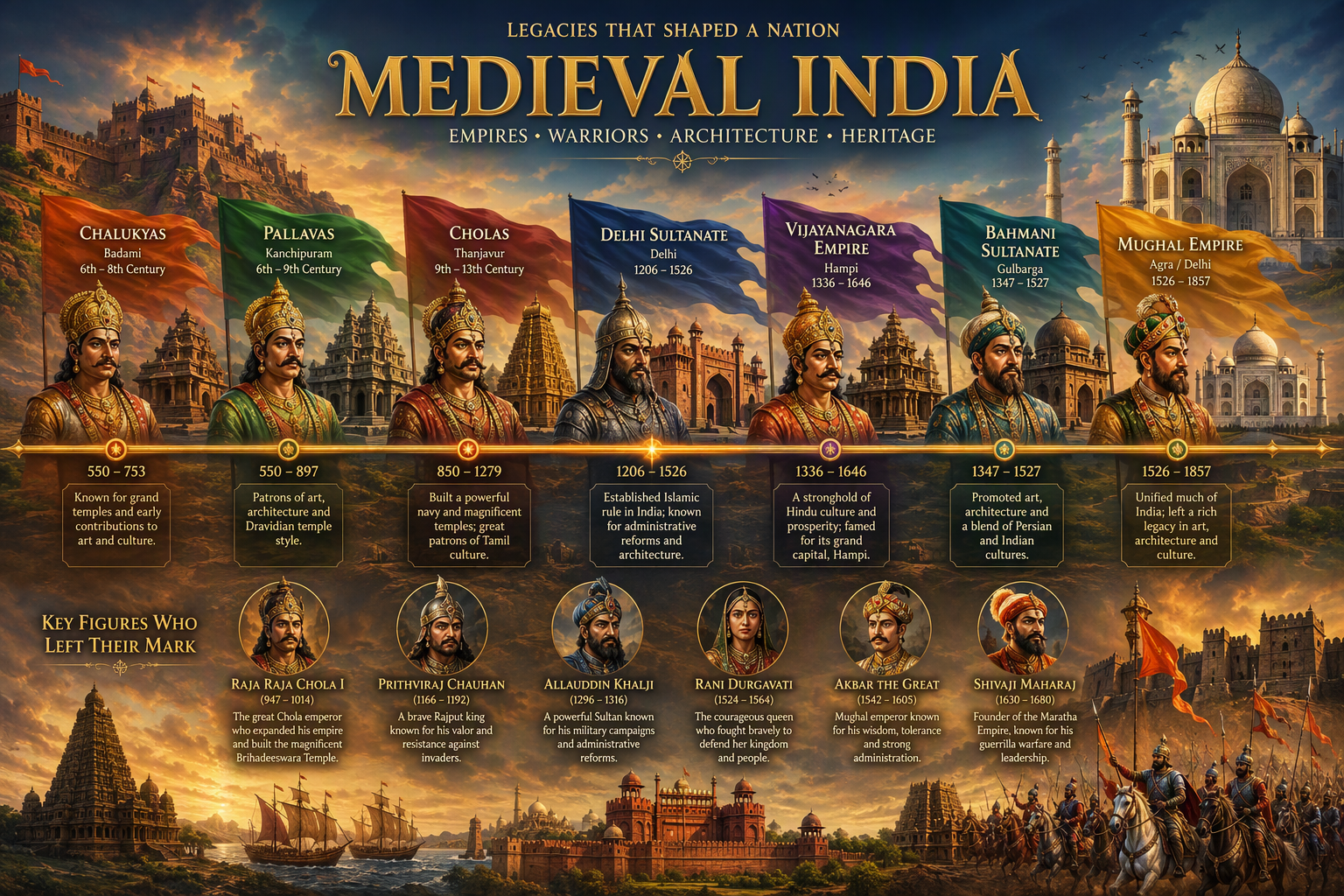
Key Highlights
- Medieval India is a big part of both Prelims and Mains for the UPSC exam.
- The Delhi Sultanate and Mughal Empire are some of the key topics in Indian history.
- You should also read about Vijayanagara, Bhakti-Sufi movements, and the different regional powers.
- The UPSC asks questions about administration, economic policies, culture, and social changes from this time.
- NCERT books, previous year papers, and short notes help us go over things fast and save time.
- A smart way to prepare is to give more time to important topics and high-value themes. You do not need to read every single thing about medieval India.
Table of Contents
Introduction
Medieval Indian Medieval History UPSC Notes: Key Topics for 2026 Exam can help you score well in indian history if you have a good plan to get ready. For the upsc exam, this part is not just about names, rulers, or dates. You need to know how things worked in government, society, trade, and in cultural developments. In the Prelims, the questions ask for facts and details. In the Mains, you need to show how things be different now than in the past.
If you want to get ready for 2026, start with the syllabus. Look for the important topics. Go over those topics with short and clear notes. This way you will be ready for anything in the exam.
Medieval Indian History Syllabus for UPSC 2026
The syllabus for medieval India in the UPSC exam is part of both Prelims and Mains. But you have to read for each part in a different way. In Prelims, the questions are direct and based on facts. When you look at the Indian history topics in Mains, like medieval India, you have to think more and write longer answers that explain your ideas.
You need to read about early medieval kingdoms, the Delhi Sultanate, the Mughal Empire, Vijayanagara, Bahmani Kingdoms, Bhakti and Sufi movements, and the different states in the area. It is good to look at the syllabus well. This helps you know what to do when you start to study. The sections after this will help you find key themes, so you can get ready faster.
Core Themes and Periodization in Medieval History
To learn about the medieval period, it is good to use an easy plan. UPSC wants you to begin with early medieval India. After that, you should read about the big empires. Then, you look at the regional powers. This will show you how ancient history changed into new political systems in medieval India.
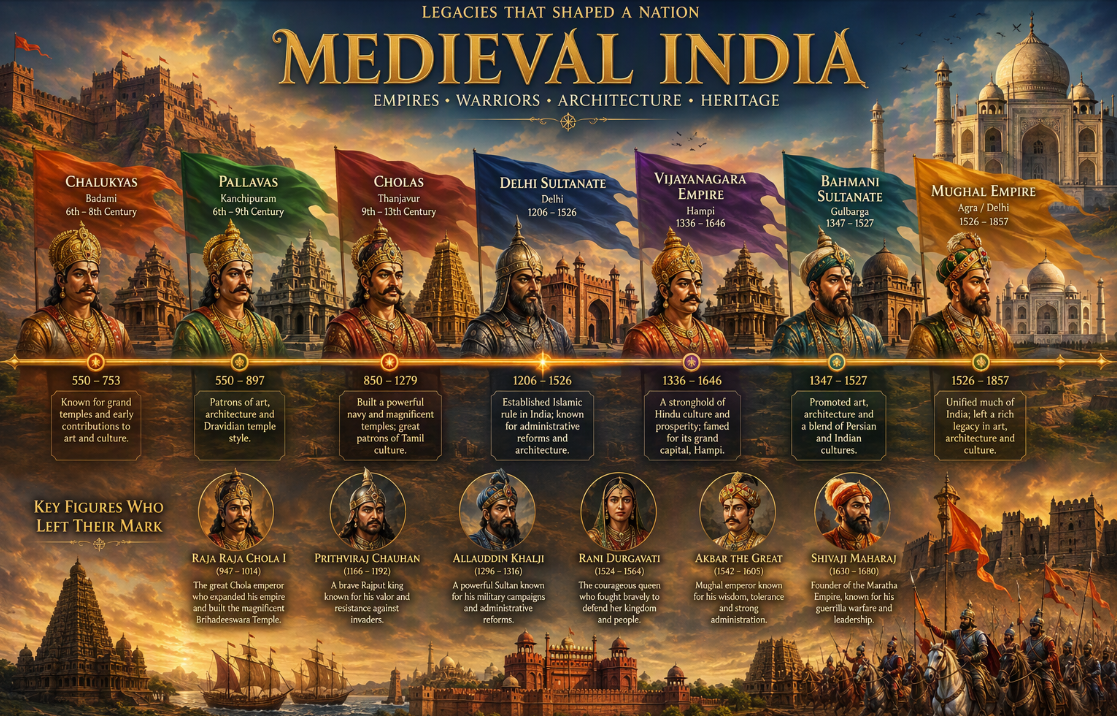
The course teaches about early medieval kingdoms. These include the Cholas, Palas, Pratiharas, and Rajputs. Next, you get to read about the Delhi Sultanate and Mughal Empire. The lessons also cover Vijayanagara and other regional states. Bhakti and Sufi movements show how religion is linked to society and cultural changes.
The main points to know are political authority, administration, economy, trade routes, social structure, and Indian heritage. When you put these topics in groups, it is easy to read them again. You can also give better answers because you can link rulers, places, and big historical events.
Key Dynasties and Empires: Delhi Sultanate, Mughal Empire
If you want to know where to start, read about the Delhi Sultanate and the Mughal Empire first. You see these topics many times in the UPSC exam. That is because they talk about things like politics, how people were ruled, military change, and culture.
Focus on the main rulers and the big changes they made. Also, try to understand how a state is built. The UPSC wants questions about big ideas, not just small facts. So, you need to look at how things were during one ruler’s time. Then, see how that was different from another ruler’s time, and what new things came from their rule.
- The Delhi Sultanate had several dynasties. These were the Slave, Khalji, Tughlaq, Sayyid, and Lodi dynasties. The Delhi Sultanate did a lot to change things in India.
- Sher Shah Suri is famous for many things. He is best known for making the Grand Trunk Road. The road made sure people could go to different parts of India. He also made new ways to run things better, which helped during his rule.
- The Mughal Empire began with Babur and lasted until Aurangzeb. Babur was the first of the mughal rulers. The people who ruled after him made the mughal empire stronger and well-known. This was a time when art, wars, and trade all grew.
- Shah Jahan is known for his love for building great things. He built the beautiful Taj Mahal and the Red Fort. Many people in the world come to see these sites and feel their beauty.
- Bahadur Shah was one of the last mughal rulers. His rule shows the time when the mughal empire started to end and change. His story tells us about how things started to shift in the last mughal days.
Social, Cultural, and Economic Aspects of Medieval India
If you want to get good marks in Medieval India for UPSC, do not read only about kings and dynasties. You should also read about the new economic policies, cultural developments, and the social side of that time. A lot of people lose marks because they only read about the rulers.
On the social side, see how the Bhakti and Sufi movements helped bring change to society in the medieval period. These religious reform groups made people think about how to live their lives.
For culture, you can look at temple building, Mughal monuments, and how local art and writing grew in many parts of India.
These ideas show what the medieval period did for Indian heritage across many areas.
You should get ready for questions about things like land revenue, how people pay taxes, trade routes, and how money is collected for the state. The UPSC has asked about the taxation system of Krishna Deva and how the system works before. So, your notes should have things about social life, the economy, and culture all together. Do not keep these topics apart. Try to connect trade routes, land revenue, taxation system of Krishna Deva, and revenue collection when you read or make notes.
Most Important Topics for UPSC – Medieval Indian History
The most important topics in medieval Indian history are the Delhi Sultanate, Mughal administration, Vijayanagara Empire, Bhakti-Sufi movements, and regional powers. These are asked often because they help us see how governance, religion, the economy, and cultural changes worked together in Indian history. It is a good way to understand how different parts of life changed at that time. If you study these important topics, you will get a clear idea about the main events, regional powers, and cultural changes in medieval Indian history.
Unlike world history, this part of the UPSC exam helps you more if you choose topics with care and read them again and again. If you use timelines and maps and practice with previous year questions, you remember things better. You also get to build your analytical skills. Let’s look at the top themes one by one.
Rise and Expansion of the Delhi Sultanate
The Delhi Sultanate began in the early medieval period. It was a big change for northern India. New leaders took charge and they changed how people ruled in the indian subcontinent. This topic is important for UPSC. It helps you know about the ways governments worked at that time.
Keywords: delhi sultanate, medieval period, early medieval period, northern india, indian subcontinent
You should take time to read about the five dynasties of the Sultanate. You have to see how their rule got bigger by using both their way of running things and their army. If you are getting ready for the UPSC, understanding gets easier when you link the rule changes in the dynasties with words like iqtas, taxes, and how they set up the different areas.
There are many questions about these systems.
Another thing that can help you is to pay attention to the problems and how everything comes together. A lot of different things made the Sultanate plan for what it needed to do. For example, there were attacks from other groups, the Mongols were a threat, and people in different places fought back.
So, when you read or get ready for your test, you should not just read the facts about each ruler. Try to link things like how the Sultanate grew, how it worked inside, and what problems it faced. This will help you get good marks in both Prelims and Mains exams.
Mughal Empire: Administrative and Military Innovations
The Mughal Empire is an important part of Indian history. It played a big role in medieval Indian history. The UPSC often asks about how the Mughal Empire made new rules for government and managed the army. These steps helped the Mughal Empire to grow and stay strong.
Your notes need to cover three things. The mansabdari system, what the mir bakshi did, and how land revenue worked with each main ruler. Akbar set up the Dahsala system, so you should take a close look at that. In Prelims, you may get questions about words and ranks in the setup. In Mains, you might need to write about how the empire managed such a big area.
It is good to see how the rulers led the Mughal Empire. Babur was the first to start the Mughal Empire. Akbar made it strong and stable. Shah Jahan showed just how big and rich it could be. Aurangzeb pushed the empire’s borders even more. Looking at it this way makes it easier for you to answer questions about how the rulers managed the state, ran the army, and about the decline of the Mughal Empire. You do not have to remember only the names of each ruler.
Bhakti and Sufi Movements: Ideologies and Impact
Bhakti and Sufi movements are good to know about. They show us the way religion was part of life in the medieval period. UPSC tells you that these movements were not only about faith. Both played a big part in religious reform and made cultural changes happen.
When you read about bhakti saints, you should see what they taught. It is good to know the lesson they gave, how they talked to people, and what they changed over time. Bhakti saints and Sufi movements are often in questions that want to know if you understand the idea, not just if you remember facts.
- Bhakti saints like Kabir, Tulsidas, and Mirabai spoke about devotion and personal faith.
- Sufi orders such as Chishti and Suhrawardi changed how people lived and how they thought about their religion.
- These movements made it easier for people to show how they feel about religion in public.
- They made a big impact on language, music, and local ways of living.
This topic is very good for Mains. It helps you put your ideas, society, and indian heritage together in one answer.
Concise Notes on Medieval History: Must-Know Points
Good notes are very useful before an exam. When you go over medieval Indian history, keep your notes short. Try to make them link well with each other. Keep notes simple so you can read them later. Do not make your notes long. You will not go back to read them again.
Group the important topics under administration, economy, religion, art, and regional powers. Add maps and timelines when you review. Do one-line comparisons if possible. This can help you remember things better and improve your answer writing practice. The next parts will give you a short structure for quick revision.
Art, Architecture, and Literature of Medieval India
Art, architecture, and books can help you get more marks if you read them in a good way. In medieval india, you can see how power, faith, and culture come together. These topics also help us see how history links with indian heritage.
For architecture, look at the main spots and famous buildings. When you think about the time of shah jahan, the Taj Mahal and Red Fort come to mind. Vijayanagara links with Hampi, Virupaksha Temple, and Vithala Temple. These are not just any buildings. They show how rulers like shah jahan’s helped art and shaped their culture.
You need to see how people found new ways to write and make art in different courts, local customs, and in devotional groups. Bhakti and Sufi groups shaped how people talked and shared what they thought. If you want your short notes, split them into sections like Sultanate, Mughal, and local. This can help you go over your notes in a better way. Your answers for Mains will also feel clear and set out well.
Regional Kingdoms and Their Contributions
Regional kingdoms are important to study when you read about indian history. In the UPSC exam, questions on medieval indian history are not just about Delhi and Agra. South india and many other regional powers also get asked about. You might get questions in the exam that look at how these groups ran their administration, what life was like for people, their culture, or even how their economy worked.
The Vijayanagara Empire is an important topic to read about. UPSC gave questions on Krishna Deva, tax rate for land, and how they set up their government. You can see that kingdoms in the different parts of India are not small topics. They help you get more marks on your test.
- The Vijayanagara Empire is famous for how the people handled the government, the big city called Hampi, huge temples, and the way taxes were set up when Krishna Deva was the king.
- Bahmani Kingdoms had main cities. Gulbarga and Bidar are two that stand out.
- In early medieval India, the big groups included the Cholas, Palas, Pratiharas, and Rajputs.
- Later in medieval India, the Marathas and some small regions became strong.
These facts help us see what medieval India was like. They show how many groups ruled and highlight the Vijayanagara Empire’s known taxation system set by Krishna Deva.
When you work on these kingdoms, think about what each one gave to the world. Do not only look at the time when each was in power.
Trade, Commerce, and Economy During Medieval Period
The economy in medieval India is very important. The UPSC often asks about how people dealt with money and did business at that time. If you learn about trade routes, how revenue collection worked, and how the government helped trade, you will feel more sure when you answer questions. This can help with questions that ask for facts and ones that need you to think more.
Trade helped bring inland towns and ports together. Sher Shah Suri built the Grand Trunk Road, which made travel between places easier. Big ports such as Surat, Masulipatnam, Calicut, and Goa were key spots for trade. Economic growth came from taxes, workshops, and money earned from land.
- Land revenue systems were key to how the Mughals got money for their empire.
- Trade routes brought Bengal, Delhi, Lahore together and connected these places to others like Persia and China.
- A few cities, such as Ahmedabad and Patna, became more important due to business and trade.
Keep these points as notes. This can help you get ready fast before your exam.
Analysis of Previous Year Questions & Exam Trends
Previous year questions help us see how medieval Indian history is asked in the UPSC exam and civil services examination. In Prelims, you need to know things like words about rule, money the government takes, places, and times of events. For Mains, you need to explain how things are, or how they are not like each other.
Keywords used: indian history, civil services examination, medieval indian history, previous year questions, upsc exam
Looking at trends helps you read in a more focused way. You do not need to guess what to read next. You just follow what is needed. Here is a simple text table that shows what UPSC often wants:
| Exam Stage | Usual Focus Areas | Type of Demand |
|---|---|---|
| Prelims | Administrative units, rulers, taxation, capitals, cultural sites | Fact-based MCQs with traps |
| Mains | Governance, social change, economic policies, Bhakti-Sufi impact | Analytical descriptive answers |
| Interview | Historical relevance to present issues | Balanced opinion and context |
Medieval History Questions in UPSC Prelims
UPSC Prelims usually has questions from medieval Indian history. The exam pattern shows that you will not just find questions about well-known kings. Many questions are about the ways people ruled, how money was used, and the smaller regions in indian history. This short list of questions is important for the exam.
Some past exams have followed this kind of trend. In 2020, UPSC asked about the right order of Pargana, Sarkar, and Suba. In 2019, there was a question to do with the taxation system of Krishna Deva in the Vijayanagara Empire. In 2021, one question was about Hampi being the capital of Vijayanagara. These topics are very clear and they are also important.
The main idea here is that Prelims focus on your understanding of systems, capitals, and institutions. When you read the material, to do well, make notes or lists of things like administrative divisions, big cities, taxes, and changes made by different rulers. This matches how previous year questions about medieval topics are set.
Medieval Indian History in UPSC Mains
In Mains exams, medieval Indian history is not made up of just one or two facts. You need to talk about the way of life, work, money, people, and how religious groups changed things. So, it is good to practice writing answers when you read about indian history and medieval indian history.
General Studies Paper I looks at Indian heritage, the history, and the geography of the world. It also covers society and some questions focus on medieval topics. The questions talk about the Delhi Sultanate and how it ruled. You may also get questions about the land revenue system of the Mughals. There are other questions on Bhakti and Sufi traditions and how they changed society.
So, how should you get ready?
Write your answers in short sentences. Use headings. Make timelines to show how things happened over time. Compare different events or rulers. Practice linking rulers to the changes they made in indian history and what happened after. For example, do not just talk about Akbar. Show how his administrative reforms mattered in medieval indian history. This way of writing works well for UPSC Mains.
Topic-Wise Weightage and Difficulty Level
The share of medieval India questions in Prelims is not as high as modern history. But it does matter. Even a few questions can change your score. The material shows that there are about three to five questions from this area in many years. Still, if you look at history as a whole, medieval India has a bigger part.
The level of difficulty depends on where you read the material and the way you study it. Students who read ncert books first feel like medieval topics are easier. This is because these books make basics clear for them. The hard part is not how much you read. It is about getting the words, names of places, and important groups right.
- Easy to moderate: Bhakti saints, main Mughal rulers, Hampi, and well-known monuments.
- Moderate: The dynasties of the Delhi Sultanate, and a comparison between Bahmani and Vijayanagara.
- Moderate to difficult: Units used in government work, land revenue, and ways of collecting taxes.
- Best to read: NCERT books and some good medieval history books written by Satish Chandra.
This is why you want to pick topics in a smart way. It is not good to read random things all the time.
Conclusion
To sum up, being good at medieval Indian history can really help you do well in the UPSC exam, especially for 2026. You need to read about the main dynasties, big cultural changes, and important money points in indian history. This gives you a clear idea of what happened then. Make simple notes that show the core ideas and facts. Look at older exam questions to spot what comes up again and again. When you use smart ways to go over your notes and keep ready, your chances of success get better. If you want more help, feel free to ask for a free session. This can help you study better and feel ready for your upsc exam.
Frequently Asked Questions
How do I make short and effective notes for Medieval Indian History in UPSC?
Start with the NCERT books to read about Indian history. Then, read about medieval Indian history and write short notes. Make your notes with headings like rulers, how they ruled, economy, religion, and culture. For important topics, use bullet points. Try to use timelines and maps too. Make sure every topic you read fits the UPSC exam pattern. Try to make short sheets to read again later, and not long summaries of every chapter.
Which are the best sources and books for Medieval History UPSC preparation?
The best way to read about medieval India is to use NCERT books for class seven to ten. These chapters give a good start for the topic. After that, you can read NCERT class eleven by Satish Chandra. You should also read History of Medieval India by Satish Chandra, and A History of South India by K.A. Nilkantha Sastri. Begin with the NCERT books. Then, go to other books to learn more about medieval India and south India.
What strategies help with revising Medieval Indian History for UPSC?
Use short notes and mind maps to study medieval Indian history. Read the same topics more than one time. Check previous year papers to find what questions are common. Try answer writing practice for Indian history Mains. Go over administrative terms, capitals, and economic systems many times. A mix of remembering, mapping, and quick tests works well.