Key Highlights
- This guide shows the upsc economics syllabus for prelims, mains, and the optional subject in an easy way.
- You will get to see how the indian economy part links to economic growth, budgeting, and public finance.
- It points out why the economic survey, Union Budget, and current affairs are important when you read for the exam.
- The blog keeps prelims facts and mains analysis apart, so you know what to read for each stage.
- It also gives a list of good books, free resources, and previous year questions.
- You will find steps for revision, answer writing, and picking the right topics.
Introduction
Economics can feel tough when you start, but the upsc economics syllabus gets easier if you break it into simple parts. You are not just looking at the indian economy as a bunch of ideas. You learn how things like growth, policy, tax, and welfare all go together. A good way to begin is to start with basic economic theory. Then, go on to see what is happening now, learn about budgeting, and practice how to use what you know. If you want better results for Prelims and Mains, this guide will help you go through the syllabus with a clear plan.
Overview of Economics UPSC Syllabus Structure
The upsc economics syllabus covers three parts. It is in Prelims, Mains, and for some people, the optional paper. The syllabus first talks about economic theory and basics of the indian economy. After that, it moves into topics on economic growth and economic development. You will also read about budgeting, agriculture, infrastructure, and reforms.
For Prelims, you need to cover a wide range of topics. Focus on key ideas, with facts from current affairs. For Mains, these topics require you to think deeper. You need to give examples and show you understand problems when you talk about the indian financial system and policy choices. This is the main difference. It will shape how you get ready. The next parts will help you see this in a clear way.
Difference Between Economics UPSC Prelims and Mains Syllabus
A common question is this: what is the change between prelims and mains in the upsc economics syllabus? The big thing is depth. Prelims wants to see if you can find terms, schemes, reports, and ideas from the economic survey and news. Mains is about if you can tell the causes, what happens, and what you can change in a clear answer.
| Aspect | Prelims | Mains |
|---|---|---|
| Nature | Objective and concept-based | Analytical and descriptive |
| Focus | Facts, definitions, schemes | Issues, arguments, evaluation |
| Sources | NCERTs, basic books, updates | Standard books, reports, PYQs |
| Use of current data | Limited recognition | Strong answer support |
If you pick economics as your optional, it gets even harder. Each paper asks for more theory and deeper use of the subject. So, you should get ready for prelims by learning to remember things. Prepare for mains by being able to explain things well. Use the optional to really know the subject. This way to learn helps you save time and makes you stay focused.
Importance of Economics in UPSC Exam Pattern
Economics is important in UPSC because it shows up in every stage of the exam. In Prelims, you can see questions on the indian economy almost every time. In Mains GS Paper 3, topics about the economy, like economic growth, jobs, money planning, and farming, hold a lot of marks. Having good knowledge helps in the personality test too, as you need to know about policy changes.
You get help from sharing topics. Subjects like economic development, inflation, subsidies, banking, and public distribution link with things about government plans and current affairs. So, if you study one area well, it can help you in more than one paper. It does not just help with one part.
To answer economics questions, keep your way simple. Begin with the main idea. After that, talk about the problem. Then share what impact it has and what could come next. Try to use points that show both sides.
If your topic is public distribution or growth, link it with ideas like welfare, how it is done, and what we get from it. This helps make your answer stronger and ready for exams.
Core Topics in Economics for UPSC Prelims
To prepare for Prelims, start by learning the high-yield basics of the indian economy. You need to know about inflation, banking, taxation, budgeting, poverty, employment, agriculture, and the external sector. If you understand economic theory well, you can answer tough multiple-choice questions better.
You should also read about the supply of money, Reserve Bank tools, fiscal policy, things to know about GDP, and big plans made by the government. A lot of questions will check your basic understanding along with what is new right now. When you know these things well, you can move on to study each topic more closely for the next parts.
Indian Economy – Key Concepts and Definitions
The indian economy section is a very important part of the syllabus. Many topics that come after this need you to know it well. You have to be clear about the concepts before you read about reforms, budgeting, or work issues. UPSC wants you to know the difference between economic growth and economic development. You also need to know how to measure output.
Focus mainly on easy words that help to explain national income accounting and bigger policy talks.
- National income shows the total income of a country. It brings together money people earn from work, businesses, and other sources. It is important to feel how people in the country are living.
- GDP finds out the value of everything made inside the country in a year. The way to find GDP can change. Past years can have changes in what is counted to keep numbers up to date.
- Economic growth means the country is making more goods and services than before. Economic development is a bigger thing. It does not only mean there is more stuff. It also shows how life gets better for people, like good schools, clean water, and fair jobs.
- Potential GDP is about the most the country can make if all is working well. A few things change what this number will be. These include the people who work, machines, and skills people have.
- When more people have jobs, the economy gets bigger. If some cannot find jobs, we say there is unemployment. These patterns can change, but each tells us about economic growth, national income, and economic development in the country.
Once you know the basics, it is easier to get the bigger ideas. You will be able to understand things like jobless growth, V-shaped recovery, or structural unemployment. This part will also help you give good answers in Mains because many questions ask you to compare the indicators, methods, and outcomes in the indian economy.
Government Policies, Budgeting, and Fiscal Measures in Prelims
Budgeting is an area you can count on in Prelims. So, it is not a good idea to read it only at the last minute. UPSC asks about the budget, revenue, and capital parts. They also ask about tax changes and why certain money steps are taken. You will see these same ideas later in the Mains exam, as well, where they come up in questions about different issues.
You need to learn about fiscal policy using real-life ideas like fiscal deficit, revenue budget, capital budget, and how the government handles spending. The Ministry of Finance, the Union Budget, and the FRBM framework are all important. These help you see how public finance links with what the state can do and how it makes rules.
An easy way to read about this topic is to watch the changes in the Budget each year. You should also look at some basic ideas that do not change. When you understand what the budget wants to do, why people care about deficits, and how spending helps growth, you will be ready for the Prelims. This will help you feel more sure and clear in your preparation.
Major Economic Current Affairs for Prelims Preparation
Current affairs are key for your economics preparation. In Prelims, the UPSC likes to link basic ideas to new policy steps, reports, or new government moves. This is why the economic survey, Union Budget, and updates from the central bank are so important. These tools help you see how theory works in real life and stay up to date with what is going on now.
You need to keep notes on the same things that come up often.
- Highlights from the economic survey and trends in each sector
- Updates on monetary policy and steps taken to deal with inflation
- Big changes in economic reforms and different scheme updates
- News about national income trends and the latest on GDP
There are free resources you can use. NCERT books can be found online for free. You can get the economic survey and other official reports without paying anything. If you check previous year questions, you will know what kind of current affairs or economics questions UPSC looks for. This helps you to make your revision better and more real.
Detailed Breakdown of Economics UPSC Mains Syllabus
In Mains, the economy questions are not just about what words mean. You have to talk about how economic development has happened in the indian economy. This includes talking about planning, budgeting, farming, systems for travel and power, and changes made by the government. A lot of questions also want you to say what the good things, the limits, and the missing parts are in these rules.
The main areas you need to focus on are economic growth, inclusive growth, mobilization of resources, government budgeting, food security, land reforms, industrial policy, infrastructure, and investment models. Mains gives more marks for deep answers, so the subtopics listed here are the ones you need to know really well to write a good analysis.
Growth, Development, and Inclusive Growth Themes
Growth and development do not mean the same thing. The UPSC often asks questions about this. Growth talks about how much output goes up. On the other hand, economic development is about more than just numbers. It covers things like the way people live, jobs, and chances people get. It is very important to know this difference when you write your GS Paper 3 answers.
Inclusive growth is important because UPSC wants you to know who gets help when the economy grows. The exam asks questions on things like financial inclusion, social services, energy access, and how fairness goes from one generation to the next. These topics show that social welfare is not just a different part in policy analysis. It is a key part of it.
You need to link inclusive growth with sustainable development. If growth does not reach all regions, groups, or future generations, there will be problems later. In your Mains answers, talk about access, equity, what people can do, and what happens after. This helps to show a complete picture of development. It is better than just focusing on numbers.
The ideas of inclusive growth and sustainable development work together and are important for any area to do well in the long run.
Resource Mobilization and Economic Planning Issues
Questions about resources often come up in Mains. No plan can work without money, good teamwork, and knowing what matters most. UPSC connects mobilization of resources with things like planning, saving, spending, taxes, and how well money is used. So, read this topic as something about both money and how things are run.
Economic planning in India has also changed how it works. People often ask about the difference between NITI Aayog and the Planning Commission. This shows that you need to know how these groups shape planning, set targets, and help put things into action in the real economy.
Public finance and fiscal policy play a big role in this field. How you raise money, handle deficits, spend, and budget are all important here. The Ministry of Finance leads many of these plans. When you write your answers, you should connect how money is raised, shared, and used to reach development goals over time. Do not see these things apart from each other. Always show how they work together.
Agriculture, Land Reforms, and Food Processing
Agriculture is still important in the Mains exam. UPSC often asks about cropping patterns, irrigation, subsidies, buffer stocks, food security, and how technology helps in the aid of farmers. It also looks at how agriculture is linked to rural income, employment opportunities, and supply chains. So, you need to prepare well for this part.
Some themes come up in this area again and again.
- Land reforms can change how land is given to small farmers. This can help them get more land or make better use of it. When land reforms happen, small farmers can grow more crops. This can make their life better.
- The minimum support price sets the lowest price the government will pay for crops. Small farmers feel safe knowing they will get this price. There are also subsidies that help them with money. But, there are worries about how fair and easy it is for all farmers to get these help.
- The public distribution system helps with food security. It gives food to people at lower prices so no one goes hungry. But, there are some problems with getting enough food to everyone. It is hard to make sure the right people get the help they need.
- Food processing helps keep food good for a longer time. Food needs good storage, so it does not spoil. Marketing of agricultural produce helps farmers find ways to sell what they grow. A good system lets farmers get their crops to more people. This is good for everyone involved.
Food processing plays a big role because it connects farming with adding value and creating jobs. Land reforms are important as they shape how much food can be grown and who gets the benefits. When you write this section, try to link production, distribution, and how people live. This way, the answer is not just about the names of policies or plans, but shows how food processing and land reforms work together for the betterment of all.
Advanced Topics in Economics for UPSC Mains
Once you have set your base, you should start with the next topics for Mains. These are economic reforms, industrial policy, infrastructure projects, different ways to invest, and the outside sector. They need you to know how policy can change things over time.
You should also read about the Indian financial system, foreign direct investment, and the problems linked to capital account convertibility and trade openness. These topics come up often in new policy talks. The next sections will help you put them in order so you can write better answers.
Infrastructure, Investment Models, and Economic Reforms
Infrastructure is a big topic for Mains. It matters because it helps the economy grow, creates jobs, and makes the country more competitive. UPSC often asks questions about areas like energy, airports, roads, railways, and moving to clean energy. You need to know how having better infrastructure can lead to faster and fair development, especially in a large country like India.
Investment models are very important. A lot of questions talk about Public Private Partnership and joint ventures. The exam wants you to know why the private sector is part of long-term projects. You should also know what good things it can bring, and what could go wrong if the deals are not strong.
Changes in the economy in this field are not only to have more money spent. They are about making better plans for projects, good money management with public finance, and smart contracts that work. In your answers, talk about what these steps are for, what is hard about them, and why strong systems are needed. This will show that you know the problems with building and running things are both about the economy and rules for how things should be done.
Liberalization, Industrial Policy, and Effects on Indian Economy
Liberalization comes up often in UPSC. This is because it had a big impact on the indian economy. Most questions are about what it did to manufacturing, exports, jobs, and competition. You should talk about both the good things and the problems. Don’t look at only one side.
Industrial policy is important because the growth in industry does not always match how fast the overall economy is growing. The UPSC has asked why the making of goods is slow, why jobs that need a lot of workers are not growing fast in exports, and what changes in rules can make things better. So, you need to look at the industrial growth with a focus on jobs, how much people can produce, and how well companies can compete.
When you write about liberalization, try to link it with economic development. Do not see it as just a thing from history. Talk about how changes in industrial policy can shape local firms, jobs for people, and the way things get made. A good answer in Mains will look at both good sides and bad sides, instead of only praise or only blame. This will help to give a clear and fair view of the topic.
Best Economics UPSC Books for Prelims and Mains
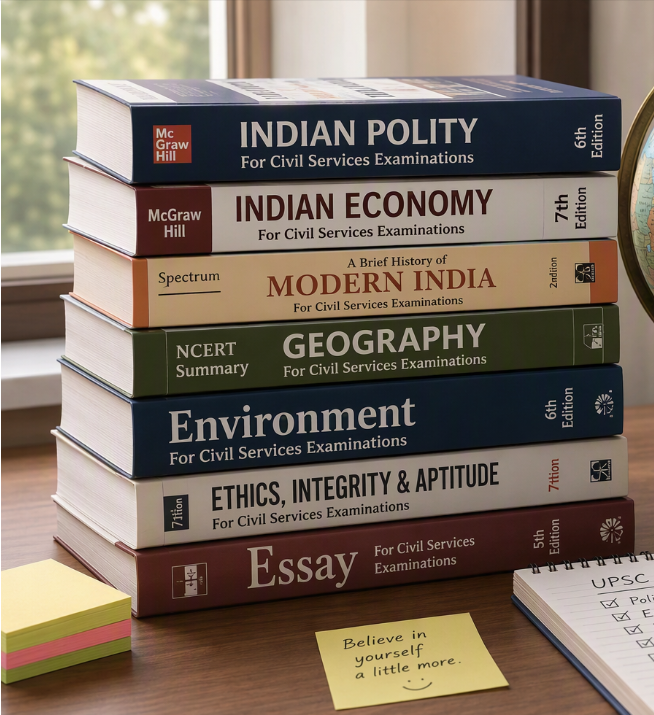
Choosing books is important because there is not one source that explains the whole upsc economics syllabus well. The books you pick should fit the part of the exam you are on. For prelims, you will want books that are clear and cover the topics. For the mains, you need books that go deeper. These should also have examples and focus on issues you may see in the exam.
People who want to take economics as an optional subject will also need to use extra reference books. The list of books given below will help you get good sources for the prelims, mains, and your optional paper. This way, you will not feel tired or lost with too many books at once.
Recommended Books for Prelims Economics Preparation
For prelims, it is best to use books that tell you about economics in simple words. These sources help you get the main ideas first. After that, they give you facts and help you understand current affairs. Many people get good results when they read NCERTs along with just one main book, instead of going through many that feel the same.
Commonly recommended books include:
- Indian Economy by Ramesh Singh
- Indian Economy by Nitin Singhania
- The Indian Economy by Sanjiv Verma
- Indian Economy by Jayant Parikshit
NCERTs are the real base for your study. Start with Class 11 Indian Economic Development and Class 12 Introductory Macroeconomics and Microeconomics. If you know economic theory well, you can read one standard book. After that, read current affairs, the Budget, and the economic survey. This is a good mix for a quick and useful way to get ready for prelims preparation.
Top Economics UPSC Mains Reference Books
To do well in mains, you need more than just a quick read. You must use books that help you explain trends, look at different policies, and add real depth to what you write. A good source for mains should help you answer questions on inflation, budgeting, and changes in farming. It should also cover reforms and issues in the world market, like international trade.
Useful reference books for mains include:
- Indian Economy by Mishra and Puri
- Indian Economy by Datt and Sundharam
- Macroeconomic Analysis by Edward Shapiro
These books help you learn more about the indian economy.
Along with these, you should keep the economic survey and Union Budget near you when you study. They give new examples and help you understand what’s going on now with policy. If what you write has the idea, why it matters now, and both sides of the story, these books help you a lot more than if you just read them without thinking.
Notable Economics Optional Subject Books
If you choose economics as your optional subject, you need to prepare for the paper in a focused way. The optional paper will need a good understanding of economic theory, models, and how to use them well. You cannot just use material that is for the GS level. You should practice often with previous year papers. This practice will help you do better in your optional subject.
Here are some books that are often named for the optional subject:
- Modern Microeconomics by A. Koutsoyiannis and Microeconomic Analysis by H. L. Ahuja
- Macroeconomics by H. L. Ahuja and Macroeconomic Theories and Policies by R. T. Froyen
- Indian Economy Since Independence by Uma Kapila and Economic History of India by Tirthankar Roy
To do well in the optional paper, use these along with the RBI website, Economic Survey, and policy sources like NITI Aayog and PRS. After that, try previous year papers to see how you can turn what you read into good answers for the exam.
Accessing Economics UPSC Mains PYQs and Prelims PYQs
Previous year questions help you understand the upsc economics syllabus very well. They show what the UPSC likes to ask. You can see how topics will be in the exam and which areas come up again and again. This is true for both the prelims and the mains.
You should use previous year papers for more than practice. You can use them to map topics too. If you see which themes come up again, you will know which parts of the syllabus are important. The next sections will show you where to get previous year papers and how you can use them in a good way.
Where to Find Previous Year Economics Questions for UPSC
If you are looking for previous year questions, start with official and exam-focused collections. These books or sources sort the economics questions by topic and year, mainly for mains. This will help you read and go over things faster, as you do not have to go through each paper one by one. It is a good way to work with previous year questions without wasting time.
Useful places and formats include:
- Here you can get UPSC previous year papers for both prelims and mains.
- You will find topic-wise compilations of economy PYQs here.
- There are collections of economics previous year question papers.
- You can also get free downloadable PDF sets and old question archives.
You should keep the economic survey with you when you practice previous year questions. A lot of questions become clear when you link them with what is happening now in policy and what issues are in the news. When you work on both prelims and mains sets, use previous year questions to guide you. Do not see them just as practice tests.
How to Analyze Economics UPSC Mains PYQs for Success
Doing previous year questions can help, but looking at them closely is what helps you do better. You should start by putting them into themes like agriculture, budgeting, economic growth, infrastructure, or economic reforms. This will show you what the UPSC keeps asking about over the years.
While analyzing, focus on these points:
- The UPSC wants to see the main idea or key point that it is testing.
- Check if the question wants you to talk about causes, impact, what people don’t like about it, or how to fix it.
- A good answer should have a balanced point of view.
You should also look at the words used in the question. A question that asks you to comment is not the same as one that asks you to look at things in a more careful way. This kind of looking closely helps you make your answers clear. It also helps you stop making common mistakes, like starting with an introduction that is not needed or missing what the question really wants you to do.
Conclusion
To finish up this guide on the Economics UPSC syllabus breakdown, it’s clear that you must have a good understanding of economics to do well in the UPSC exams. You need to know the difference between the Prelims and Mains syllabus. You should go over the main topics and cover all the important points. Learning these parts will help you get ready. It will also give you knowledge that you need in the civil services.
Use the right resources and practice with questions from earlier years. This will help you find your way through the syllabus. Do not wait to begin. Start your studies now and give yourself the best chance to do well.
How Should I Approach Studying Economics for UPSC Optional?
Start getting ready for your optional subject by picking the right books for each paper. Make sure you build a good base with economic theory. After that, link what you read to the economic survey and current affairs. This will help your answers not feel just like classroom writing. Practice papers from past years on a regular basis. This is very important, mainly for topics about economic growth and how policy gets used in real life.
What Strategies Can Help Remember and Understand Economic Concepts?
Start with NCERTs first. After that, make short notes on each topic, not long chapter summaries. Use tables and flowcharts. These are good for things in the indian economy like national income, inflation, and fiscal policy. When you match economic theory with real examples from the indian economy, it will help you remember things faster and better when you read again.
Are There Free Resources Available for Economics UPSC Preparation?
Yes, you can find good free resources for the upsc economics syllabus. NCERT books are easy to get online. The economic survey is also very helpful, and you must read it. You should look at previous year questions to know what gets asked. Try to read Budget material too. Make sure to read current affairs notes from official and exam-focused websites or books. These can all help you get ready for the exam without any extra cost.