Key Highlights
- A constitutional amendment act added fundamental duties in Article 51A. These were not included in the original Part IV of the Constitution.
- The duties tell every citizen to respect the national flag, the national anthem, and the Constitution.
- The fundamental duties be there to balance fundamental rights. They also ask people to show civic responsibility and national discipline.
- The supreme court uses these duties to read and understand the Constitution.
- There were 10 duties in the beginning. Later, one more was added.
- For UPSC, fundamental duties be important in polity, ethics, essays, and current affairs.
Table of Contents
Introduction
The Constitution of India gives people their rights. It has directive principles and asks every citizen of India to be responsible. But the original constitution did not have fundamental duties. Later, these duties were added. This was to make sure all citizens know that with freedom, there are some things they must do. For the UPSC exam, this topic is important. It shows how the constitution of India connects rules with how people act. It also explains how ethics guide life in the country. If you want to know more about rights, duties, and how people should follow the constitution, learning this subject can help you feel clear and balanced.
Understanding Fundamental Duties in the Indian Constitution
The concept of fundamental duties is about the duty of every citizen to follow constitutional values in their daily life. It is not just words in the Constitution. Fundamental duties act as a moral compass for people. They connect being a citizen with the things we do every day.
They tell people to feel proud of the nation. They ask us to stay true to noble ideals. We should have the spirit of common brotherhood. They want everyone to be united and follow rules. They hope people will care for each other. We should work for the good of all. If you want to know more, start by reading Article 51A. Then, look at how these values show up in real life.
Overview of Article 51A and its Significance
Article 51A is the only article listed in Part IV-A of the Constitution. It talks about the fundamental duties that people have. These fundamental duties help build civic thinking in the country. They remind us that what we do is as important as the rights we have in a democracy.
Article 51A talks to people about the basic norms of democratic conduct. It tells people to respect national symbols. It asks to remember the values of the national struggle. The article says to protect the integrity of India. This is why it matters for everyone, both in public life and when you study for exams.
Its importance comes from the way it connects with the Union of India and the big rules we follow in the country. The directive principles of state policy help the state do what is right. Article 51A tells people what they have to do. Both work together and make a fair system and good values for all of us.
General Scope of Fundamental Duties for Indian Citizens
The duties of every citizen of India cover many things in our lives. A citizen of India should respect the Constitution. People must also help take care of public property. Every citizen should care about environmental protection as well. It is the duty of every citizen to help keep harmony in the country. These are the civic obligations for all of us.
They matter because rights cannot do the job by themselves. When you have freedom, you must respect the rights of others. The fundamental duties help us with civic responsibility. The fundamental duties also help stop careless or bad actions in society.
Another key thing to remember is that these duties are not just for one person. The duty of every citizen can help shape the duty of the state. Judicial thinking supports this idea. Even if there is no legal action, social sanctions can still get people to act in a more responsible way.
Historical Background and Evolution of Fundamental Duties
The story of fundamental duties starts with the original constitution of India. When the constitution of India was made in 1950, there was no list in it for what people should do. The original constitution of India did not include fundamental duties for people.
Later, in the emergency period, the government decided to look at this issue more closely. The leaders set up the Swaran Singh Committee to help with it. The recommendations of the Swaran Singh Committee were used at that time. You can read the amendment to see how this change took place and why it was done.
Origin and Constitutional Amendment Introducing Fundamental Duties
Fundamental duties were added to the Constitution by the 42nd amendment act in the year 1976. This amendment act brought in Part IV-A. It included Article 51A. The 42nd amendment act was a big constitutional amendment act. It changed the text of the Constitution. This new amendment act put in a list of duties for all citizens.
This step goes to the days when there was the internal emergency in India, and Indira Gandhi was the leader. At that time, the political climate shaped what happened. The Soviet Union also had an effect, as it put people’s duties next to their rights in its Constitution.
A key thing to know about the UPSC is that the committee wanted to add fewer duties. But the amendment act ended up putting in 10. So, when you look at the 42nd constitutional amendment, keep in mind what the committee said and what was finally added to the constitution.
Objectives Behind Including Fundamental Duties in Part IV-A
These duties are listed in Part IV-A to help people remember an important thing. Life with the constitution is not only about what you get as rights or what you can ask for. It is also about your moral obligations. You need to care for the nation, the society, and other fellow citizens.
These duties help people learn to be disciplined and feel proud of their country. They make national unity strong. The duties also create social harmony among the people. Everyone is asked to protect the rich heritage of India. Because of this, the duties work with directive principles and make the ethical rules in the constitution stronger.
If you want to do well in exams, this is key. Many questions ask why the rules in the constitution exist. It is not just about dates or article numbers. If you know the goals of Part IV-A, you can answer law, ethics, and essay questions better. You will feel more confident about your answers.
List of Fundamental Duties as per Article 51A
Article 51A tells us the fundamental duties of the citizens. It plays a key role in constitutional law for UPSC. The fundamental duties are basic things every person should follow. These duties keep national life safe, help maintain public order, and protect the culture of the constitution.
They are often read at the same time as directive principles of state policy. This is because both do not have the force of law. The list includes respect for the Constitution, defense of the country, national service if called, living together in peace, caring for heritage, protecting the environment, building a scientific temper, and getting education. The next two parts will explain this in a clear way.
Enumeration and Concise Explanation of Each Duty
Here is the list in a simple way. For the UPSC, you have to learn the words and what each duty is. Article 51A gives a short and strong message about how to be a good citizen.
These duties connect love for your country with what you do each day. They ask you to show respect for national symbols. They want you to care for the rich heritage of the country and help protect the natural environment. These duties also try to get people to build a scientific temper and work for social peace.
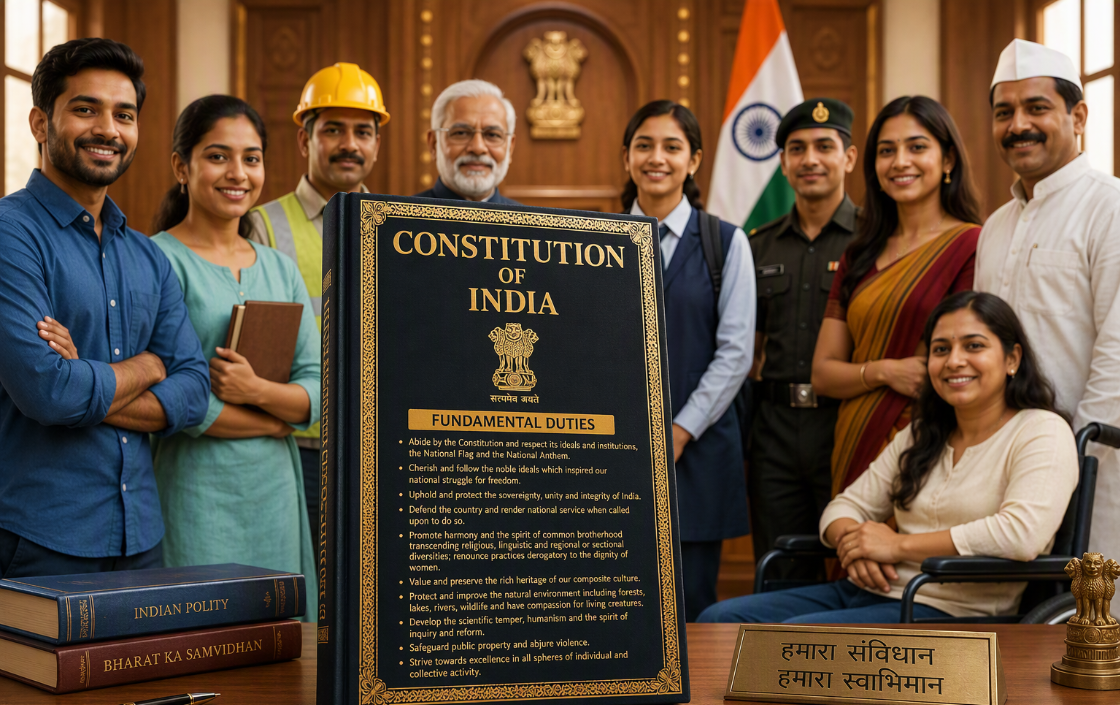
- Show respect for the Constitution, its values, and the institutions of our country. Show respect for the national flag and national anthem as well.
- Always follow the noble ideals of the freedom movement.
- Work to protect the integrity of India, keep its unity, and make sure it stays strong.
- Stand up for the country and be ready to join national service if you are called.
- Help and support harmony and the spirit of common brotherhood. Do not stand for anything that harms respect for women.
- Help keep the rich heritage of the country safe and strong.
- Work to protect and improve the natural environment. Be kind to every living thing.
- Try to think in a scientific temper, follow humanism, and ask questions to help make things better.
- Keep all public property safe. Do not use violence.
- Try to do well in all areas of your life.
- Give good education to every child between six and fourteen years old.
How Many Fundamental Duties are Specified in the Constitution?
A common question in UPSC is about the number of fundamental duties. There are 11. At the start, the 42nd constitutional amendment act in 1976 brought in 10 fundamental duties. One more was added after that by another amendment act.
The 11th duty was put in with the 86th constitutional amendment act in 2002. It says a parent or guardian has to make sure that their kids who are between age 6 and 14 get to go to school. These duties are listed in part IV-A, and not in part IV.
You can use this table to help you know how things changed as time went by. The AIIMS Students Union case helped people see why students union should be talked about when we think about the constitution. The list stayed the same after that case, but it made people think more about why these things are important.
| Stage | Change |
|---|---|
| Original Constitution | No fundamental duties were included |
| 42nd Constitutional Amendment Act, 1976 | Added 10 duties under Article 51A in Part IV-A |
| 86th Constitutional Amendment Act, 2002 | Added the 11th duty on education for children 6–14 |
| Present Position | 11 duties apply to every citizen of India |
| Judicial Relevance | AIIMS Students Union stressed their importance in public life |
Key Features and Legal Perspective of Fundamental Duties
Fundamental duties play a big role in constitutional law. They help us become responsible citizens. Unlike fundamental rights, these duties are not forced by law in the same way. They are moral and civic obligations. Every citizen should follow them. The duties remind us to be disciplined and stay united. They show us how we must act with others in public.
Courts do not forget about social sanctions. The Supreme Court and High Courts often look at them when they read and understand laws. They also think about social sanctions when they talk about constitutional values. This way of looking at things is important for the UPSC. You need to know about enforceability, legal sanctions, and social sanctions to write good answers for polity.
Are Fundamental Duties Enforceable by Law?
The short answer is no, you cannot go to court only for this. Fundamental duties are not the same as fundamental rights. You cannot ask the court to make someone follow them like you can with rights. This is one of the most important things about fundamental duties.
Still, this does not make them useless. The Supreme Court and High Courts say they use them as helpful guides when they read the constitution. If Parliament decides to make a law to support one duty, that law can get a stronger spot in the constitution. Because of this, legal sanctions can be made by new laws, not only from Article 51A.
This feature tells us how they came in at the time of the emergency period. It took place because of a constitutional amendment act. The people who made that amendment act wanted to set up a civic code for the people. But this code cannot be enforced right away. If you are getting ready for exams, it is good to know this difference.
Keywords used: amendment act, constitutional amendment act, emergency period
Importance of Fundamental Duties in Civic Life
In everyday life, fundamental duties are a constant reminder to be a good citizen. You are part of what happens around you. It is not just about sitting back. You should enjoy your rights. At the same time, you have to respect the country, public order, and the things that matter to all people. That is why fundamental duties stay important in books and in real life too.
They also act as a moral compass. They make people feel civic responsibility. This helps keep public property clean. There is more respect for women and the environment. The goal is to build social harmony. Good habits and responsible actions help with this.
For people who want to get ready for the UPSC, the duty of every citizen is very important. The exam may ask you questions about this. It can talk about how you read the Constitution. It can also cover your role in ethics and essay writing. When you know why these things matter for citizens, your answers can be clear. They will be balanced, too.
Comparison Between Fundamental Rights and Fundamental Duties
Fundamental rights and fundamental duties relate to each other. But they are not equal. Fundamental rights help to keep a person’s freedom safe. They also protect their dignity. Fundamental duties ask people to do things for the country. People should help the nation, give support to our society, and look after the rights of others in the democratic framework.
Both rights and duties are found in the constitution. But they are not the same. Rights can be taken to court. Duties are mostly moral obligations for people. These duties seem much like directive principles. They help guide us in how we act and how the law is read. The next sections will show the differences between rights and duties. They will also explain how both are linked in Indian polity.
Differences and Similarities in Constitutional Status
You can see that rights and duties are tied to each other in the constitution. A right is made to keep freedom safe. A duty helps to show how people should act in the country. We need both of them if we want a stable democracy. Yet, the law deals with them in different ways.
Fundamental rights are rights that you can take to court, and the court can help protect them. Fundamental duties are not like that. You cannot ask the court to make someone follow their fundamental duties. Because of this, fundamental duties feel more like directive principles. Even so, fundamental duties are in the Constitution. They show the basic norms of democratic conduct.
Keep these quick points in mind:
- Fundamental rights are there to protect people. Fundamental duties guide citizens about the way to act.
- Rights can be taken to court to defend them. But you cannot do this with duties.
- Duties help keep the rights of others safe. They stop people from using freedom in a careless way.
- Directive principles tell the state what it needs to do, while duties tell people what needs to be done.
- Rights feel like things you claim. Duties feel like things you must do in the system of the constitution.
Relationship and Coexistence within the Indian Polity
The link between rights and duties is based on how people live together. It is not about them fighting. The Constitution does not ask anyone to choose just rights or just duties. It shows there is both. They come together as one group of constitutional values.
When you use a right the way it should be used, you help make democracy strong. But if you do not do your civic obligations, trust and order can break. This is why duties matter in the union of india. Duties help people stay together. They bring discipline, peace, and help us all share responsibility.
For the UPSC exam, it is important to know how people live together. This idea helps in polity answers, ethics case studies, and essays about responsible citizenship. If you say rights need duties to be real, your answer will show you have a good and grown way of looking at the constitution.
Recent Amendments and Notable Changes to Fundamental Duties
There have not been big changes to the fundamental duties since they began. The largest change came in 1976 with the 86th constitutional amendment act. This amendment act put in a duty about children’s education.
Other than this, most of these rules were made by the Supreme Court and the High Courts. Cases like the AIIMS Students Union showed why these rules matter when put to use. To know what changes have happened, it is good to look at changes in the constitution and listen to what judges in the Supreme Court and the High Courts have said and done.
Updates Since Introduction and Supreme Court Judgements
Since 1976, the fundamental duties have stayed almost the same. A big change came in 2002. A new duty about education was put in then. So, if you ask about change in the fundamental duties, remember only one new duty has been added since the first list.
The Supreme Court has had a big impact because of its ruling and how it sees constitutional law. In the AIIMS Students Union case, the Court said that duties are just as important as rights for everyone in public life. In other cases, judges said that people should look after the environment. They also asked people to respect public property and follow rules in public places.
High courts and the Supreme Court look at these duties when they read the constitution. They do not turn them into rules that people can go to court for. But, the Supreme Court and high courts use these ideas in their work. Judges keep the text as it is. They help it fit real life by adding meaning.
Impact of Changes on UPSC Preparation
These changes have a crucial role in UPSC preparation. They help you get ready for both types of questions. One is about facts, and one is about thinking. You may see a question about the amendment act, how many duties there are, or a case law that changed what they mean. That is why this topic is good for both Prelims and Mains.
Cases like the AIIMS Students Union are important. They show us how courts look at doing good, public duty, and what the law says people should do. When schools give more support to students, new questions can come up about changes and social rules. These ideas are often part of exams about the AIIMS Students Union or any other students union.
This topic matters a lot for essays and ethics. It connects the idea of national unity, the way people act in public, and the need to protect the rich heritage of India. If you want to practice with objective MCQs, you should focus on the article number, changes that be made, how many duties there are, and key judgments about Article 51A.
Conclusion
To sum it up, knowing about the fundamental duties in the Indian Constitution is very important. This matters to all citizens, not just those getting ready for UPSC exams. The fundamental duties help everyone feel civic responsibility. These duties help all of us live better together. When people understand why the fundamental duties are important, they be more aware and involved in society. It does not matter if you are a student, have a job, or you just want to help the country. Doing these fundamental duties makes the community a more peaceful and responsible place. If you want to learn more about the fundamental duties for UPSC, find a good PDF on the topic. This will help you to be a smarter and more responsible person in society.
Can I download a reliable PDF of fundamental duties for UPSC?
Yes, you can use a good PDF that has Article 51A from the Constitution of India. The PDF should show all 11 duties and talk about the national flag. It has to cover how Article 51A links with directive principles. Make sure it talks about important cases, like the AIIMS Students Union case. This will be helpful for a quick UPSC revision.
How are fundamental duties tested in UPSC MCQs?
UPSC MCQs usually have questions about how many articles there are, what changes have been made, how many duties there are, and things about important case law. The questions can be about the supreme court. They may also talk about the extra duty for education and about how these link with directive principles and directive principles of state policy. You can also see questions about rich heritage, public property, and the aiims students union. A statement-based question may ask about these points or also talk about a students union.
Why are fundamental duties relevant for Indian citizens and aspirants?
They matter because they help people become good citizens. These remind us that rights come with moral obligations. For the ones who want to learn, they show how the constitution works. They help people know what public ethics mean and why social harmony is important. They bring together noble ideals from the national struggle with what the Union of India needs now.