Key Highlights
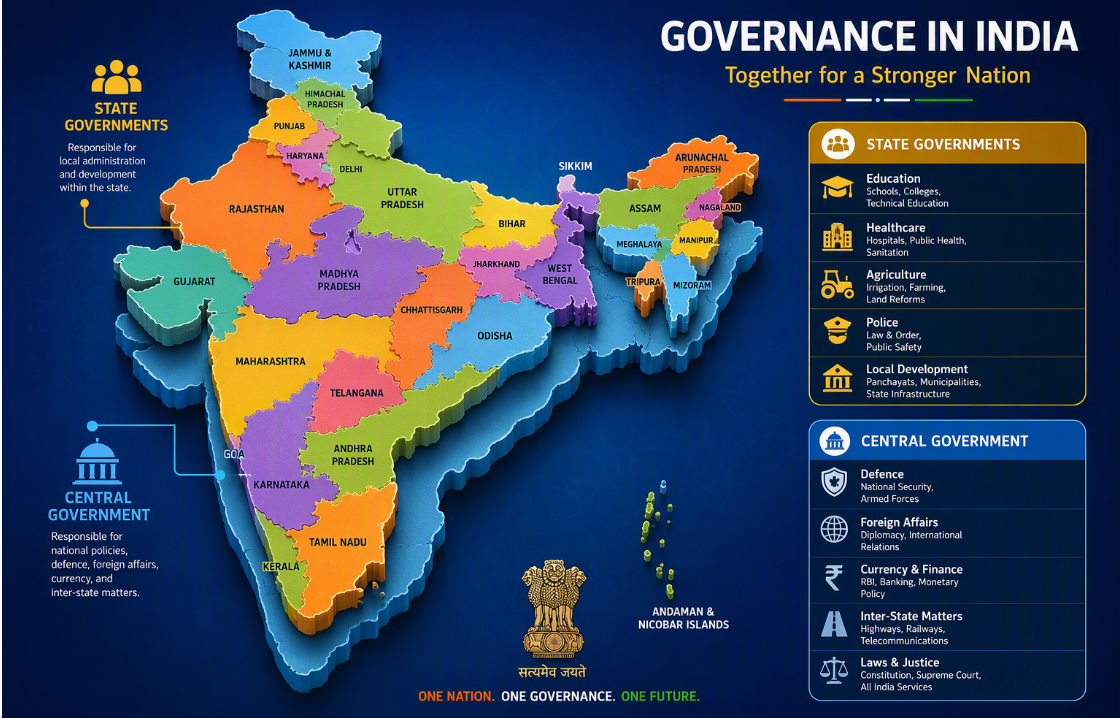
- The Indian Constitution makes a federal system. The powers are split between the central government and the state governments.
- The division of powers is clear and is set by the Union List, State List, and Concurrent List, all found in the Seventh Schedule.
- The Supreme Court protects the federal structure. It handles fights between different levels of government.
- India also has some unitary features. Because of that, many people say India is quasi-federal.
- Through cooperative federalism, the central government and states work together. This helps them meet public needs and reach national goals.
Table of Contents
Introduction
Federalism is a key part of the Indian Constitution. It is important when you want to learn about the Indian system of government. Federalism tells us how the center and the states share power. This way, one authority does not get all the control. If you are preparing for UPSC, you need to read about federalism. This topic is linked to rules, how the government works, and recent news stories.
If you like to know how India keeps together as one country but stays different at the same time, federalism helps us see that. It gives you the main idea for understanding this balance.
Foundations of Federalism in India
India has a federal system. This means power is split between the Union and the states. The Constitution of India set up this federal structure. It helps to manage a big and diverse country by using different levels of government.
That is why federalism is so important for how India is run. It lets the country look after needs from each region, but it also keeps national unity strong. From the time people in the Constituent Assembly were making decisions to what we see in current affairs now, this balance is always there. It plays a big part in how India works today.
Defining Federalism and Its Global Overview
Federalism is a system of government that splits power between a central authority and its smaller parts, like states or provinces. Each one has its own area to work in. They can do some things on their own. This setup keeps all power from being in just one place.
In a federal state, there are two main levels of government. One level takes care of things for the whole country. The other level looks after regional issues. This set-up helps with national unity. It is a good way to manage large countries that have many languages, regions, and identities.
All over the world, you can see two main ways that federations start. In one way, some states come together and set up a federal government. The United States shows this kind of model. In the other way, a big country shares its power more within itself so that things work better inside, much like India does.
Some key things you usually find are a written constitution, division of powers, a two-house system, and an independent judiciary.
Historical Origins and Evolution of Indian Federalism
Indian federalism did not start just after 1950. The idea of splitting powers showed up before, with the Government of India Act, 1919. This act split power between the center and the provinces. That old law helped shape what came later in the Indian constitution.
The Constituent Assembly wrote the Constitution of India at a time when the country was very different in many ways. The people who made the constitution had to build a system to keep the country together. They wanted states to have an important role. But they made the union government stronger on the main issues. The framers did not do this by chance. This was their clear choice.
Keywords used: constitution of india, constituent assembly, union government
Since India became free, indian federalism has changed a lot through practice, politics, and court rulings. The government of india and the states have sometimes worked together, and other times faced problems. Events in current affairs, such as big talks about things like Article 370, keep showing that federalism is still alive and active in how the country is run.
The Role of Federalism in Modern Indian Governance
In modern India, federalism helps the country run smoothly. The central government looks after the matters that affect all of India. State governments take care of things that matter to their own areas and people. This system lets people get the help they need faster. It also makes sure the government in modern India works in a better and more useful way.
You can see how useful federalism is in everyday life. Things like agriculture, public health, and the police need local know-how. But when it comes to defense, foreign affairs, and national security, the country needs one strong plan. Federalism allows both local and national needs to work together. This is why it matters a lot for India.
Federalism helps keep national unity strong and does not miss the idea of diversity. It lets the states in India talk about their own regional needs, while still working under one main way of doing things. In this way, Indian federalism is not just about leaders sharing power. It is also about making sure the country is steady, open to all, and able to work well, no matter how things change.
Federal Features of the Indian Constitution
The Indian Constitution has many federal features that show there is a shared way to govern. Some of the main federal provisions are a written constitution, a clear division of powers, an independent judiciary, two houses in the parliament, and the idea that the constitution is above all laws.
These features work together to help answer a common question. What are the key features of federalism in the Indian Constitution? They give rules that both the Union and the states need to follow. The next sections show how each part helps the federal structure work in practice.
Written Constitution and Its Importance
A written constitution is needed first for any federal constitution. Without this clear text, it is hard to say what powers the different levels of government have. There will be more fights over issues, and people will not have a final text to look at for answers or guidance. A written constitution helps keep things clear between the levels of government.
The Constitution of India is a written constitution. It is also one of the longest and most detailed in the world. This is important for a federal system to work well. A federal system needs things to be clear. The Constitution of India tells you the structure, powers, and tasks of both the Union and the states. This way, there is less confusion about what each can do.
The importance of the Constitution is not just about how things are done. Because it is written, the Constitution supports the basic structure of the constitution. It helps keep the balance between the center and the states. It also gives a steady base for running the country. The judiciary uses the Constitution as a guide whenever there are issues between the center and the states.
Division of Powers: Union, State, and Concurrent Lists
One of the main federal features is the division of powers between the center and the states. In India, this is stated in the Seventh Schedule. The Seventh Schedule makes three lists. Each list gives law-making power to either the center, the states, or both of them together.
Here is an easy text table that shows the structure:
| List | Who Legislates | Typical Scope |
|---|---|---|
| Union List | Parliament | National subjects such as defense, foreign affairs, railways, and banking |
| State List | State legislatures | Regional matters such as police, public health, and agriculture |
| Concurrent List | Both Parliament and states | Shared areas such as education, forests, and labor welfare |
This system explains how powers are split between the Centre and the States in India. The union list is for things that matter to the whole country. The state list is to keep control in the hands of each state. The concurrent list lets both work on the same thing at the same time. If there is a fight over a thing in the concurrent list, the central law wins.
Supremacy and Rigidity of the Constitution
In a federal system, the Constitution is higher than both the Union and the states. This is what people mean when they talk about the supremacy of the constitution. A law made by Parliament or a state legislature cannot go against the Constitution. If any law breaks the rules set by the Constitution, the courts have the power to remove it.
At the same time, the federal structure has to be safe from simple political change. This is why rigidity is important. Key parts of the federal structure cannot be changed like normal laws. A special majority is needed in Parliament to change them. For some changes, half of the state legislatures also have to agree.
So, how do changes in the Constitution change how power works between the Union and the states in India? They can shift this balance. But it does not happen easily. The basic structure idea also puts a limit on how far these changes can go. This means that federalism in India can change as needed, but it will still be safe from big changes that ruin it.
Bicameral Legislature: Rajya Sabha and Lok Sabha
A bicameral legislature is one more important part of a federal setup. In India, the Parliament is made up of two houses. These are the Rajya Sabha and the Lok Sabha. This system gives both the people and the states a seat in the process of making the country’s laws.
The Rajya Sabha is called the federal chamber. It is because this house gives state representation in the Union government. The Lok Sabha is for the people. It is the one that speaks for all and carries the big democratic power. The Lok Sabha is more powerful in some things than the Rajya Sabha. But having both houses makes debate strong and lets balance happen.
A few points make this structure important:
- The Rajya Sabha speaks for the states and union territories at the national level.
- The Lok Sabha is there to speak for the people, and its members are chosen through direct elections.
- Having two houses allows us to mix what most people want and what the different regions need when making laws.
Independent Judiciary as a Pillar of Federalism
An independent judiciary is very important in a federal structure. This is because there will be times when the different levels of government do not agree. India has a system of government that has an integrated court system. The Supreme Court of India is at the top. Below it, there are High Courts and other smaller courts. The supreme court helps solve problems that can come up between these different levels of government.
This setup is important because there has to be someone to read the Constitution the right way. The judiciary does this job. It checks if the Union or the states have gone beyond what they are allowed to do. The judiciary also keeps our fundamental rights safe, and this makes the whole system stronger. In this way, the judiciary is more than just a legal body, it is also a watchful protector of the Constitution.
The Supreme Court of India has a big part in keeping the federal structure safe. It looks at and solves fights between the center and the states. The Supreme Court also checks laws and makes sure that the rules in the constitution are followed. When there is trouble between the center and the states, the Supreme Court’s review helps keep things equal and fair under the constitutional rules.
Unitary and Quasi-Federal Aspects in Indian Governance
India is not a classic federation. It does not fit the strict meaning of one. The Constitution has some unitary features along with its federal ideas. These unitary features let the center be stronger in some cases. Because of this, many people say India is a case of quasi-federalism.
Article 1 says India is a union of states. It is not a federation built by several different countries coming together. In India, emergency provisions, central authority in main areas, and many parts of the Constitution help make this set-up special. The next sections will show what gives Indian federalism its mixed nature.
Unitary Features of the Indian Constitution
The Indian Constitution has several unitary features. These help the center hold more power than what you see in a pure federation. These features are there for national unity. They also help the country move together during tough times. This is why the indian constitution leans more towards a strong center. These ideas support national unity in many situations.
A big example of this is emergency provisions. When there is an emergency, the center gets more control over the states. President’s Rule under Article 356 is a strong tool as well. It lets the Union take over the running of a state when things go wrong. This can have an effect on normal state autonomy.
Some major unitary features include:
- During hard times, emergency provisions give more power to the central authority.
- President’s Rule lets the central authority stop usual state rule for a time.
- The Union also has more power when it comes to national security and the wider needs of the country.
Quasi-Federal Structure: What Makes India Unique
India is called quasi-federal. This is because its federal structure leans more toward the center. This does not mean that states do not have powers. The Constitution tries to find a balance between state autonomy and a strong national framework.
That balance shows up in more than one way. The Union keeps leftover powers for itself. Parliament can make rules about some things in the State List when there are special events. The center picks governors and can also change state borders. Because of these things, states have less freedom when you compare this system to some other federations.
What makes India special is the reason behind choosing this system. The country needed a way to handle its many kinds of people, keep everyone together, and stay in good order. So, quasi-federalism in India is not really a problem. It is a smart design of the rules, shaped by the country’s past and how big the country is.
Distinction Between Indian and Other Federal Systems
Indian federalism is not the same as many other federal systems. It is called the holding together type. In the United States, many states came together to make a federal government. But in India, it was just one big group first, and then it gave power to smaller groups on its own. The indian federalism way is different from what the united states did with their federal government.
This changes the way the federal structure works. India follows a dual polity. But the center holds more power than some other classic federal systems. The Rajya Sabha does not give equal seats to all states. The Constitution gives the Union more control in many areas. That is why India does not match the American model.
A few clear differences stand out:
- India is called a holding together federation, but the United States is known as a coming together federation.
- In India, the center has stronger powers than what most classical federations have.
- Indian federalism brings both federal and unitary features into one constitutional system.
Division of Powers Between Centre and States
The division of powers is at the center of Indian federalism. It tells us which levels of government can make laws about which things. This is set down in the Seventh Schedule. This is done through the Union List, State List, and Concurrent List.
Because India has different levels of government, this division helps avoid confusion or doing the same work twice. It also gives a clear answer to a common UPSC question. To help you understand this better, let’s look at each list. We will also see how disputes between the different levels of government are fixed.
Union List—Powers Reserved for the Central Government
The Union List has topics that need the same rule all over the country. In a federal system, there are things that feel too big or important for each state to handle in a different way. So, the central government gets to make the rules for all of us on these things.
These subjects are often connected to the national level. They are foreign affairs, defense, railways, banking, and atomic energy. These are matters that impact all people in the country. That is why only Parliament can make laws about them. This helps keep things the same across the country and takes care of big national interests.
You can see the Union List as the topics where the central government needs to be in charge.
- The defense and protection of the country
- Foreign affairs and the way we deal with other countries
- Big national bodies and services that have to follow the same rules everywhere
State List—Autonomy and Powers of States
The State List lets state governments manage things that are local or for their own area. This is where you can see state autonomy in action in the law. State governments should know more about these things because they are closer to the people.
The topics on this list are police, public health, and agriculture. For these subjects, the state legislature is the one that can make rules. This helps give regional autonomy. It allows each state to do what is best for their own needs and situations.
The State List is important because federalism needs real power for the states to work. This list gives states the right to manage public services and look after day-to-day administration. Even though the center is strong in India, the Constitution lets states handle things in their own way in some areas through the State List.
Concurrent List—Shared Responsibilities
The Concurrent List is a key part of the Seventh Schedule. It is for things where the union and the states both have to take action. The Constitution has not put these matters in only the Union List or the State List. Instead, it lets both work together by sharing these powers.
Some examples of these issues are education, forests, and labor welfare. These things matter across the country, but also in each state. A shared approach works well for this. One law for all of India might not cover everything. At the same time, if only states take action, that may not be enough either.
The Constitution has a clear rule for conflict. If there is a clash between a central law and a state law on a concurrent list subject, the Union law comes first. The concurrent list helps people work together, but the rules make sure things stay clear. This is how shared jobs can work without legal problems.
Mechanisms for Resolving Power Disputes
Even when you have a detailed Constitution, the federal system can still see disputes over power. This is normal in this kind of system. What matters most is that there are strong institutions that can handle disagreement. These institutions help to keep the balance of the Constitution safe.
The Supreme Court of India plays a key part when there is a dispute. It looks at the Constitution and says if the Union or a state has stayed inside what the rule allows. The Finance Commission and NITI Aayog also help. These bodies work with the Supreme Court, the states, and the center to keep money matters and plans working well. This way, center-state ties are better managed.
Some key mechanisms include:
- The Supreme Court helps to settle problems about the constitution.
- The Finance Commission works to keep money matters fair between different levels of government.
- NITI Aayog helps to make sure policy ideas are discussed and matched between the government.
Cooperative Federalism and Its Significance
Cooperative federalism is when the central government and state governments help each other. They do not see every problem as a fight for power. In a union of states like India, cooperative federalism helps to run things well and keeps work moving smoothly.
It does not take away the lines drawn by the constitution. Instead, it helps different governments work together on shared goals. Along with competitive federalism, it shapes the way rules and plans move in practice. The next parts talk about what it means, give examples, and share new things that show why this is important.
Concept of Cooperative Federalism in India
Cooperative federalism means the union government and states work together within the law. The distribution of powers is still important here. But, things get better when both sides help each other, not when they work alone.
This idea is very helpful in India. Many public problems go beyond state lines. Things like development, welfare, planning, and running day-to-day affairs need people to work together. Because of this, NITI Aayog is seen as a platform that helps the center and states talk to each other and work together.
At the same time, there is cooperative federalism and also competitive federalism. States may try to do better, get more investment, or find ways for policies to work. But they must still work with the Union for bigger goals. This is what makes the idea important. It mixes working together with the positive energy that comes from healthy competition between them.
Key Examples of Cooperation Between Centre and States
You can see how cooperative federalism works if you look at some examples. In India, the center and the states need to work as one when there are things that touch many regions. This way of working together is easy to spot in current affairs, especially when India faces big problems that touch the whole country.
Disaster management shows that problems can cross state borders. The same is true for public health. People need to work together, especially when big changes and help are needed. The Finance Commission is important, too. It helps decide how money is shared and helps things work well across the country.
A few useful examples include:
- NITI Aayog is used as a platform. This is where there is talk about policy.
- Disaster management needs all governments to work together. It takes planning and teamwork to get things done.
- Public health and Finance Commission work are linked. They both join policy and resources together.
Recent Developments Strengthening Cooperative Federalism
Recent events show that cooperative federalism is more than just an idea. It gets tested all the time by real problems in government. Current affairs show how states and the center need to work together, especially when they talk about policy, money, or how the constitution is read.
Institutions such as NITI Aayog and the Finance Commission play a big role in this work. They give a place for people to talk, share money, and plan together. These things are important because economic growth in a big country needs both a strong plan from the whole nation and good work by states.
At the same time, recent problems have tested the system. There has been debate about Article 370 and how the Supreme Court looks at the power in the constitution. This has brought big questions about federalism back for people to talk about. These times do not always make federalism weaker. Often, they make people think more clearly about how cooperation and power should work.
Challenges Facing Indian Federalism
Indian federalism is based on a detailed rulebook in the Constitution. But, it still has many problems to deal with. There can be tension in politics, how things are managed, when it comes to money, and when goals for the country change. These can all get in the way of the federal structure working well.
State governments want to have more control and freedom to make decisions. But the Union usually talks about what the nation needs. It also wants everything to be in sync. Things like economic growth, how public work is done, and problems with the law play a role in shaping this bond. In the next parts, we will see the big problems that Indian federalism faces right now.
Political and Administrative Challenges
One big problem is about how much control the central authority has compared to state governments. States do have some powers in the law, but the union government often has more control in several things. This gap can cause arguments, mainly if the union government and a state do not have the same political views.
There are also worries about how things are set up. The center is the one to pick the governors, not the states. The Union has the power to affect how the states work through many institutions and services that are found all over the country. When there is tension in politics, this way of doing things can cause arguments between the chief minister and the larger group of people who run things by law.
President’s Rule is a sensitive topic in federal set-up. When the Union takes over state work, people always talk about the balance between the two. The big challenge for India now is to keep strong national power but not to take away the true role of the states. This is important to protect their space while using president’s rule.
Economic and Fiscal Issues
Economic and fiscal issues are always a challenge in any federation. In India, the way the Constitution handles the distribution of powers does not always take away the financial dependence. A state may have the main job in big public areas, but when it comes to both resources and direction of policy, the center is often involved as well.
That is why the Finance Commission matters so much. The commission helps set up the way money is shared between the Union and the states. Still, there are many talks about if this is fair, if there is need, and if there is enough freedom for each side. Right now, in current affairs, these questions feel even bigger when there is more growth or when there is more need to spend money.
This has an effect on state autonomy in clear ways. A state can hold the legal right to handle a subject. But, when it does not have enough money, its real control is not strong. One of the biggest problems for Indian federalism is not just about who gets formal authority. It is also about which one has the resources to do something that matters.
Contemporary Events Testing Federalism
Current affairs show the true power of the federal system. In India, some recent events have pushed the center and the states to see how well they can work together. They also test if the center and the states can stay within what the constitution says. These times change federalism from just an idea in books to something real that affects the way we run the country.
The Supreme Court of India has had a big part in these moments, more so when a court case about the constitution comes up. At the same time, things like disaster management and public health show how things can get tense fast. This can happen when two or more governments have to work together in tough times.
Some new issues test how federalism works now. These include:
- There are some disputes about the constitution that need the Supreme Court of India to step in and say what the law means.
- When there is a disaster, good coordination is needed to handle the situation well.
- Sometimes, there are public health problems that need both the state governments and central planning to work together.
Conclusion
To sum up, knowing about UPSC federalism and how governance works is important if you want to understand India’s political system. The way central authority and state autonomy balance each other helps meet the needs of all people in the country. The Indian Constitution has both federal and unitary features. This mix helps all levels of government work together and keeps them accountable. When we see the problems that Indian federalism faces now, we know how important it is to make these systems stronger so there can be stability and good governance. If you want to learn more or ask questions, you can talk to our experts for a free consultation!
What are the main features of federalism in the Indian Constitution?
The federal system in India has some key features. It has a written constitution. There is a clear division of powers in it. This division is set out through the union list, state list, and concurrent list. It also has institutions that help keep a balance between the union and the states. The courts also protect the rules made by the constitution
How does Indian federalism differ from other federal structures worldwide?
Indian federalism is sometimes called “quasi-federalism” because it has both the center and the states, but the central authority is stronger than in many other federal systems. In some countries, states come together to form the federal government, but in the Indian model, even though states have important powers, they do not have full state autonomy in several parts of the constitution. This means the central authority often has more say over what happens in the country.
What role does cooperative federalism play in Indian governance?
What role does cooperative federalism play in Indian governance?