Key Highlights
- This guide gives you the main points about key sociological thinkers that you need for the UPSC sociology syllabus. It helps you feel ready for your optional subject and answer writing.
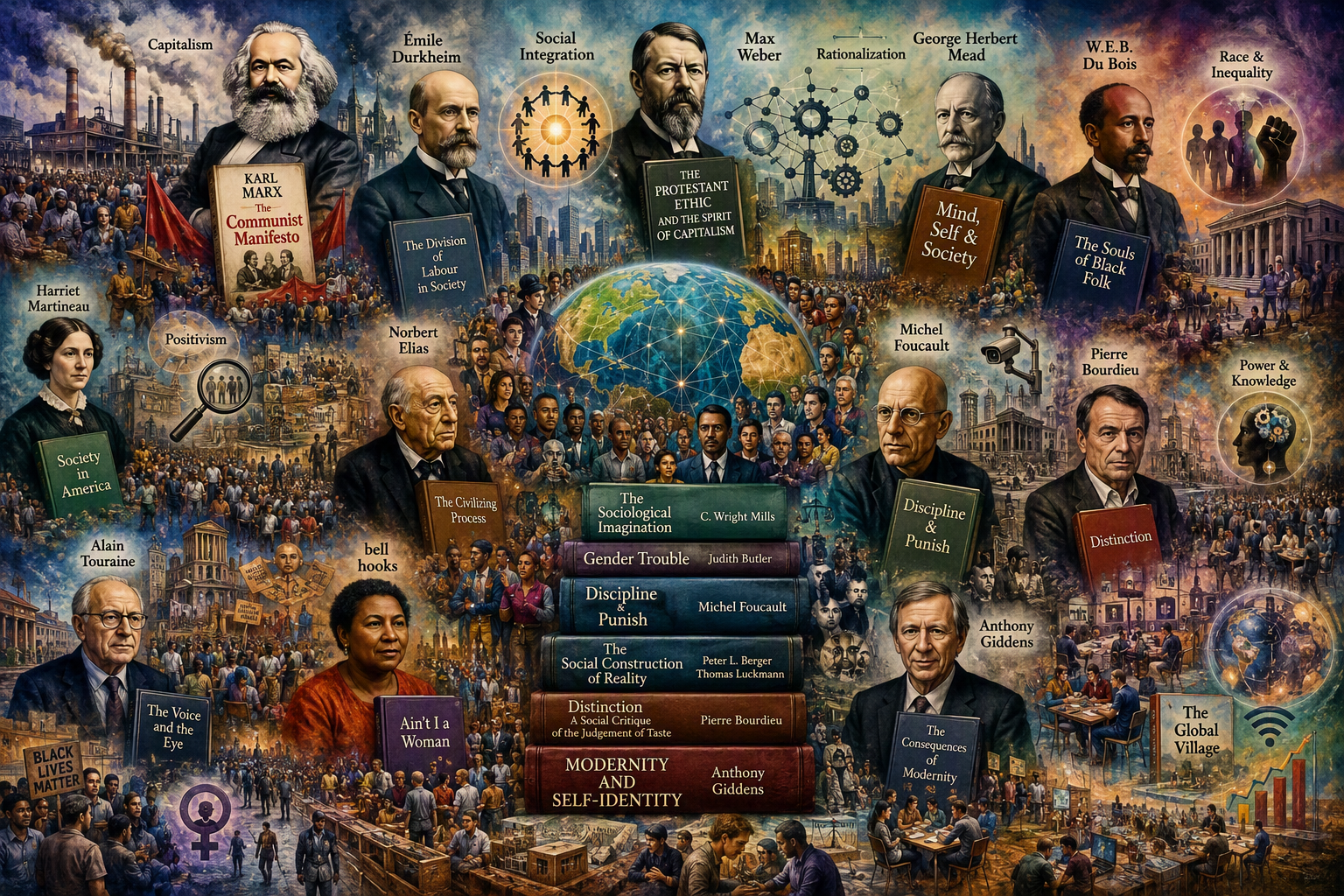
- You will read about Karl Marx, Emile Durkheim, and Max Weber. You get to see how their ideas fit into topics like social change and how you can use them when writing your answers.
- You will also find how G.S. Ghurye, M.N. Srinivas, and A.R. Desai help people learn about Indian society.
- This guide shares simple tips to use class struggle, social mobility, and social movements in your UPSC mains answers.
- The blog shows how modernization of Indian tradition fits what you need to practice now for answer writing.
Table of Contents
Introduction
If you choose Sociology as your optional subject, you need to do more than read about topics. The sociological thinkers in the UPSC sociology syllabus help you see things like power, religion, caste, and change in society in a new way. Their ideas let you give more than just facts and make your answers much better in answer writing. When you learn how each thinker talks about society, you get ready in a better way. This makes your review simple and helps your answers have the depth the exam looks for.
Keywords: sociological thinkers, upsc sociology, answer writing, sociology syllabus, upsc sociology syllabus, optional subject
Essential Sociological Thinkers for UPSC Sociology Optional
The most important part of the sociology syllabus is in the ideas from big thinkers. Karl Marx, Emile Durkheim, Max Weber, Talcott Parsons, Robert Merton, and George Herbert Mead are main names here. Their thoughts make it easier for you to read and understand every topic in Paper I.
These sociological thinkers do not just matter in books. They help you to talk about issues like inequality, religion, rules that people follow in groups, who we are, and how things in society change. When you use their ideas in your answer writing for Paper II, your answers get better. A lot of ideas about Indian society become clearer when you use these ways of thinking. Now, let’s look at the main classical sociological thinkers first.
Karl Marx – Conflict Theory and Useful Frameworks
Karl Marx is a big name in sociological theory for UPSC. He views society as being shaped by conflict. He does not see it as smooth or peaceful. The concept of historical materialism from him tells us that the economy controls things like institutions, ideas, laws, and politics. Because of this, his theory fits well for questions about poverty, inequality, labor, and social stratification.
You need to think about class struggle, mode of production, and the theory of alienation. Marx helps you see how people can feel disconnected from their work when they are in a capitalist system. These ideas matter, too, when you talk about industrialization, work problems, and how new jobs are changing today.
- Use Karl Marx to talk about things like inequality, exploitation, and who has money and power.
- Bring up class struggle when you write about work and protest.
- Show how historical materialism is tied to things like the state, religion, and other groups.
- Talk about the theory of alienation when you explain today’s work life and how jobs get split between people.
Emile Durkheim – Functionalism and Key Concepts
Emile Durkheim helps you see things in another way. Karl Marx talks about conflict, but Durkheim looks at order. He shows how people come together. For Durkheim, sociology is its own science. He was the first to speak about the idea of a social fact. A social fact means there are things in society that are outside each person. These things affect how people act. That is why he is a big part of the sociology syllabus.
His thoughts about division of labour show us how people move from living with mechanical solidarity to living with organic solidarity. This shift matters when we talk about modern society. More people focus on their own jobs and rely on each other. He also studied religion and showed that social institutions help build shared values.
One useful idea for UPSC is Durkheim’s theory of suicide. He said that suicide rates tell us more about the way people live together than about how one person feels. This idea helps us look at stress, broken rules, and weak bonds in indian society from a sociological angle. The theory of suicide shows us how social reality can change suicide rates.
Max Weber – Interpretive Sociology and Modern Relevance
Max Weber is important in sociology because he helps us see why people act the way they do. He said people do things not only for money, but also because of their own reasons, values, and beliefs. The idea of social action from Max Weber is good for studies. You get to see how people feel and react to the world they live in. In the UPSC sociology syllabus, his ideas are used to bring balance to learning. This way, you do not only look at big rules and systems. The UPSC sociology syllabus shows that choices made by people matter in sociology, using his thoughts.
Weber’s concept of ideal types gives you a simple way to build strong models to help you understand the world. His thoughts about authority and how bureaucracy works show you how people in power run things. The protestant ethic and the spirit of capitalism explains that the values and ideas people have can change how they act in the economy and also help a country grow.
- Use max weber when you talk about topics like bureaucracy, authority, and social action.
- Mention status groups for answers on caste, prestige, and hierarchy.
- Bring up ideal types if you are doing a structured comparative analysis.
Modern Sociological Theorists in UPSC Syllabus
After the well-known thinkers, the sociology syllabus brings you to modern theorists. These people set how we now see the world around us. Talcott Parsons, Robert Merton, and George Herbert Mead share their own ways for you to learn about groups, actions, and change in society.
These thinkers can help you a lot when you do answer writing. They connect ideas from sociological theory to real-life examples you can see around you. You can use their work for topics like modernization, deviance, self, groups, and institutions in both Paper I and Paper II. In the next sections, you will see how each one of them can help you think and write better answers.
Talcott Parsons – Structural Functional Approach
Talcott Parsons is important in structural functionalism. He said that society is a social system. The parts of it, like family, religion, education, and government, all need each other. They work together to keep things going well. This way of looking at life shows how things stay steady, how values move through people, and how the different parts of society meet and work with each other.
His way of thinking can be hard to understand at first. It gets easier, and you see how useful it is, when you practice answer writing. Parsons helps you show how social institutions keep things stable in society. He also makes it easier to talk about how roles change from old to new in Indian society.
- Talcott Parsons said the main job of groups like family, schools, and government is to help things go well in society. Each group helps keep everything working. This is what a social system does. Family members teach kids what is right and wrong. In school, you learn rules and new things. The government makes laws that people must follow. This helps to keep order and helps people work well together.
- A social system can be seen in family, schools, and government. The family gives care and teaches values. Schools help you read and write. They also help you learn how to share and dream. The government keeps people safe and the rules fair. When every part does its job, society works well.
- When talking about social stratification and what people should do, we can use Talcott Parsons’ way of thinking. Every social system has places for people. Some have more power, and some have less. These levels are a part of all systems. We think about who does what and how they act. This makes society run. Talcott Parsons’ framework helps us see how each group and person fit into the social system, social stratification, and the jobs we expect people to do.
Robert K. Merton – Middle-Range Theories
Robert Merton is seen as one of the most practical minds for UPSC. He did not go for big ideas. Instead, he gave middle range theories. These are easy to test and use. This makes his thoughts very helpful in answer writing. They are also good when you want clear examples and case studies.
His strain theory helps us see why people break rules. It shows the gap between what people want and what they can do to get it. The idea is useful when we talk about crime, corruption, or about young people feeling upset. His idea about reference groups helps us see how people try to be like others. People often want the things they see in a social system.
Merton’s ideas feel more clear with Indian examples. Reference groups let people see how everyone wants a certain place in society, and show that the culture changes as time goes by. Latent and manifest functions also help give better answers in sociology, both for short replies and for long explanations.
George Herbert Mead – Symbolic Interactionism in Society
George Herbert Mead lets us see society in a small way. He does not focus only on big groups or systems. He looks at how people talk to each other. He asks what things mean in these talks, and how we build who we are. His idea, called symbolic interactionism, shows the self is built when people talk and join in with others. This idea helps when you answer questions about socialization, youth, or how someone’s identity changes.
His idea about the “I” and the “Me” helps us see how people respond to things happening around them. It also shows how they help shape the world, too. You can use this idea when you talk about social action and social mobility. It helps explain how people deal with their lives right now. This idea is important when we think about how people change as life gets more busy and modern.
For answer writing, Mead is good to use for topics like education, family, and social media. He helps you talk about social change by focusing on things that happen every day in life. This lets you make your answers more interesting because you are not just using big sociological theory.
Pioneers of Indian Sociology for UPSC Preparation
Paper II asks you to look at indian society using indian sociology. It is not all about western theory. That is why G.S. Ghurye, M.N. Srinivas, and A.R. Desai matter a lot for your optional subject.
These thinkers guide you as you talk about caste, village life, nationalism, and the social structure. They help you to see why these ideas are still important now. Their clear points also make answer writing easier. You learn more about modernization of Indian tradition, social mobility, and conflict because of them. Let’s now look at each of these important Indian sociologists in a simple and focused way.
G.S. Ghurye – Indological Perspective on Indian Society
G.S. Ghurye is a main person in indian sociology. He uses the indological perspective to look at indian society. That is, he looks at texts, old writings, history, and traditions from India. This way lets you see the big picture about things like caste, religion, and social habits in indian society.
His work is helpful for people who have questions about caste and tribes. Ghurye talked about what makes up caste. He also looked at how tribes are part of the bigger Hindu social order. When people talk about religion, his ideas help us look at types of religious practices and how culture stays strong as time goes on.
For answer writing in Paper II, start with G.S. Ghurye if the question is about caste and tradition. Talk about how his work focuses on texts. Then, compare this with later researchers who look more at people and their lives. This shows you know the main ideas in sociological theory. It also makes your answers in Paper II stronger.
M.N. Srinivas – Social Structure and Cultural Change
M.N. Srinivas was a useful thinker for Paper II. He looked at indian society by doing fieldwork in villages. His village studies helped indian sociology stop focusing on only old texts. He talked about how people live, how the social structure works, and how caste and power change things in villages.
His idea about dominant caste helps you see how power works in villages. It shows you the role of land and local politics in the countryside. He spoke about Sanskritization and Westernization as well. These ideas show you how culture can change and how people move up in society in India. This is good to use when you write about social mobility and the effect that dominant caste has in the country.
- Use M. N. Srinivas when you talk about village studies, how caste changes, and movement between castes.
- Talk about the idea of dominant caste when you look at who leads in the village and how power is spread.
A.R. Desai – Marxist Analysis of Indian Society
A.R. Desai looks at indian society using ideas from Marx. He studied things like how people feel about their country, how farmers fight for their rights, and what the state does using class and money systems. This makes him very important when you think about development, unfairness, and power.
His framework is good if you want to learn about social movements, agrarian distress, and the way colonial rule changed things. Desai helps you go deeper and not just say what is happening. He teaches you to ask who benefits from economic development, who is not included, and how class interests play a role in making policies.
In answer writing, you can use Desai to ask about welfare claims and class struggles in India. If you put his ideas with Karl Marx, it helps show how people get used in the system. You see what working conditions are like and who feels left out in India.
Perspectives and Theories Frequently Asked in UPSC Mains
UPSC mains does not ask questions only about what things mean. The exam looks for answers that talk about topics in a bigger way. This is why you need to get ready with conflict theory, functionalist theory, and interpretive approaches. Use these as frameworks each time you write. Do not keep them as just one note. You should be ready to use all of them in your answers at the same time.
A good way to improve at answer writing is to use previous year papers for comparative analysis. This helps you see how sociological theories are used in questions about social change, caste, religion, and institutions. The next two sections will show how you can compare these ways in a clear way. You will feel more confident as you practice answer writing.
Conflict, Functionalist, and Interpretive Approaches
There are three main ways that people use in sociology answers. Conflict theory looks at power and how people do not get equal treatment. Functionalism talks about how things stay in order, and how people work together in the society. Interpretive approaches focus on meaning, what drives people, and social action. If you compare these ideas well in your answer writing, your writing will show more deep thinking and not just give facts.
These ideas are good to use when you discuss the division of labor, religion, rules, systems, caste, and status groups. Marx helps us see conflict. Durkheim wants you to understand how things stay together. Weber shows the meaning and power. Using comparative analysis makes your point clear. It also helps you keep your answers well-structured.
| Approach | Core Focus | Useful Thinker | Best Use in Answers |
|---|---|---|---|
| Conflict theory | Inequality, class, power | Karl Marx | Poverty, labor, exploitation |
| Functionalism | Order, integration, institutions | Emile Durkheim | Religion, solidarity, division of labor |
| Interpretive approaches | Meaning, motive, action | Max Weber | Bureaucracy, authority, status groups |
Comparative Study of Western and Indian Thinkers
A good Paper II answer is about connecting western sociology with indian sociology. Western thinkers give the main ideas and ways to study things. Indian thinkers show how to use these ideas for real things like caste, village life, religion, and farming. When you do this comparative analysis, your answer becomes deeper and stays on the topic.
Marx gives you a way to see class groups in people. Desai takes this same idea and talks about indian society. Weber looks at status groups. You can use his ideas when you think about caste. Durkheim explains how people feel close to others in their group. Srinivas talks about social structure and how people change their place in real life in indian society.
- Western sociology sets up ideas that cover a lot, and Indian thinkers make these suit life in India.
- Indian sociology focuses more on caste, village studies, and the changes people go through.
- Try to use both Indian sociology and Western ways of thinking when you talk about modernization and social structure.
Effective Strategies for Studying Thinkers and Their Theories
Studying thinkers is easier when you do not treat them as stand-alone topics. Try to match each name with ideas in the sociology syllabus, such as class, religion, family, politics, and change. This makes your revision work better for you.
You should use memorization methods with answer writing practice. It helps if you read short thinker sheets and look at them many times in case studies. Try to link them with the techniques of data collection or with current themes. This will help you remember things quickly.
The next sections will show you how to remember, use, and tie these ideas together in both papers.
Memorization Techniques and Application for UPSC
An easy way to remember sociological thinkers is to make a one-page fact sheet for each. On this page, write the thinker’s name and key concepts. Add a quick line to explain what these key concepts mean. Add two topics where you can use these ideas. This simple method can help you stay on track the time you read for exams. It can also help you feel calm and ready to focus when the test comes.
Don’t just work on the memory part. Make sure to practice answer writing every time you read this stuff. Ask yourself, “Which thinker will I bring up for topics like caste, labor, religion, youth, or identity?” This will help you turn facts into good ideas for your answers. You can link social media to thinkers such as Mead, Marx, or Merton too.
- Make short notes by thinker and by topic.
- Try to put one thinker in every mains answer.
- Use answer writing practice to work on your speed and to help you remember what you read.
- Make examples that take ideas from current social reality and social media trends.
Integrating Thinkers’ Concepts Across Papers I & II
One good way to get better marks is to connect Paper I to Paper II. Thinkers need to look across the whole syllabus. For example, you can use Marx to answer questions about poverty, labor, and farming. Weber is good for talking about caste by using status groups. Merton works well when you write about movement or what people want in life on topics in paper ii.
This way of using what you know helps make answer writing easier and more fun. If you get a question in Paper II about caste or village change, use the sociological theory from Paper I. If you find an abstract question in Paper I, give Indian examples, like from Srinivas or Desai. This makes sure your answers get good marks.
You can also connect this with new events and research methods. Use things like gathering data, ideas for fieldwork, or real-life stories. This helps show that sociological thinkers are not just about old ideas. They are tools you can use to look at and understand society.
Conclusion
To sum up, it is good to know the main sociological thinkers for UPSc Sociology. People like Karl Marx, Emile Durkheim, and Max Weber, along with Indian thinkers like G.S. Ghurye and M.N. Srinivas, help us see society in new ways. When you read their ideas and use them in your UPSC sociology study plan, you get better at thinking. You also do better in the exam. If you learn from these thinkers, you cover the whole UPSC syllabus and understand more about how society works. If you want to get started, you can ask for a free talk with our experts.
Which sociological thinkers appear most often in UPSC mains?
The top sociological thinkers in the UPSC sociology syllabus are Karl Marx, Max Weber, Emile Durkheim, M.N. Srinivas, G.S. Ghurye, and A.R. Desai. You find them in both theory, and Indian sociology topics. These thinkers help you with answer writing, and give strong sociological theory for the UPSC sociology syllabus. Their ideas make it good for your notes and help you understand Indian sociology better.
How can I summarize the main theories of Karl Marx for UPSC?
Here are four main ideas from Karl Marx for UPSC:
Historical materialism: Marx said that the things people use and the work they do, like the land, machines, and jobs, shape how their society works. The way people make things and use tools can change how they feel, how they live with others, and who rules them.
Mode of production: This is about how people grow food, use tools, or work in factories. These ways of making things decide who gets power and money. When these ways change, everything in society can change too.
Class struggle: Marx said there are always two main groups fighting. One group owns places like factories, while the other group works there. This fight brings big changes and can keep going as long as there are two groups.
Alienation: If people have to work in ways they do not want, or cannot feel good about what they make, they feel cut off from their own life. This happens a lot in places where people do not have much say in their work.
Where can I access concise notes on major thinkers for UPSC sociology?
The best short notes come from your own work with the sociology syllabus. Try to make simple sheets with the main ideas of each sociological thinker. You should write what they said, and practice answer writing, too. For each thinker, add one link to something in current affairs and one good Indian example. This helps with revision of your optional subject better than looking at long notes.