Key Highlights
- Ancient India is a big part of the UPSC exam and civil services examination.
- The Indus Valley Civilization, Vedic period, Mauryan Empire, and Gupta Empire are key topics you should read about.
- Looking at previous year papers lets you see the themes and facts that are asked again and again.
- Ancient history gets you ready for both the objective prelims and the descriptive answers in mains.
- A lot of questions be about religion, how things were run, culture, trade, and the big dynasties.
- If you read by topic, it be quicker to revise and you remember things better before the exam.
Table of Contents
Introduction
Ancient India is very important for the UPSC Civil Services Examination. It helps you build a strong base in Indian history. This will be useful for both the Prelims and Mains when you take the civil services examination. In this part, you are not just asked to remember names or dates. You also need to know about the first people who lived in ancient India, new changes in religion, the work of rulers, and the growth of culture. If you want to get a good score, you must pay close attention to the key areas. This guide will show you the most important topics for ancient India. It will also help you get ready for the civil services easily and in the best way.
Understanding the Scope of Ancient History for UPSC Exams
The history section in the UPSC syllabus has a mix of topics. You will read about ancient India, medieval times, modern times, and world history. In ancient India, you will get to know about early people, Vedic society, big kingdoms, main religions, trade, art, and the political developments of that time. The civil services examination will give you both fact-based and simple questions from the history section.
To get ready in a good way, read about ancient india one topic at a time. Make sure you look at previous year questions, too. This will help you see which parts are most important. You can also find out which topics to skip for now. The next two parts will also help. They show how each period is different and what year questions are common.
Differentiating Ancient, Medieval, and Modern History in the UPSC Syllabus
The best way to read the history section is to break it up by time periods, main ideas, and who was in charge during that time. In the UPSC syllabus, the ancient india part covers things like early people, the indus valley civilization, the Vedic age, the Mahajanapadas, the mauryan empire, the gupta empire, and big changes in society like Jainism and Buddhism.
Medieval history begins when the old ways of running the land come to an end. In this time, there are big kingdoms. The Delhi Sultanate and Mughal rule start. People practice Bhakti and Sufi ways. New changes come to South India. People see power move to new leaders. The way things are done also changes. People start to learn about Indo-Islamic culture.
Modern history talks about things like colonial expansion, the time of British rule, the Indian national movement, civil disobedience, and when India got independence. If you read about Vedic texts, Ashokan inscriptions, or the spread of Buddhism, this content is part of ancient history. But if you read something about Mahatma Gandhi or the Indian National Congress, you know it is from modern history.
Exam Pattern and Weightage for Ancient History Questions
In the UPSC exam, you will find history as a part of the General Studies Paper I. If you look at previous year papers, you can get that history questions make up around 15-20% of the paper. The questions are about ancient India, medieval, modern history, and also world history. So, ancient India is very important, but you should not forget the other parts as well.
You should look at year questions to know how the exam questions are asked. The UPSC likes to ask about things like civilizations, dynasties, religion, trade, inscriptions, and cultural developments. So, you need to choose your topics carefully.
| Area in General Studies Paper | Broad Trend in Questions |
|---|---|
| Ancient History | Early civilizations, Vedic society, Mauryan Empire, Gupta Empire, Jainism, Buddhism |
| Medieval History | Delhi Sultanate, Mughal rule, regional kingdoms, cultural change |
| Modern History | British rule, reform movements, freedom struggle, civil disobedience movement |
| World History | World War I, World War II, French Revolution, American Revolution |
Central Themes and Key Topics in Ancient Indian History
If you want to study ancient India for the UPSC syllabus, try to pay close attention to the topics that show up the most. You need to read about the Indus Valley Civilization, the Vedic period, the Mauryan Empire, the Gupta Empire, and main religious movements. These are the parts that people have to know to do well with ancient India in the exam.
For Prelims and Mains, you must watch for major events, political structure, and economic policies. You also need to look at trade, literature, art, and architecture. The next sections will help you see the key civilizations and empires for your exam. This will give you a clear plan when you revise.
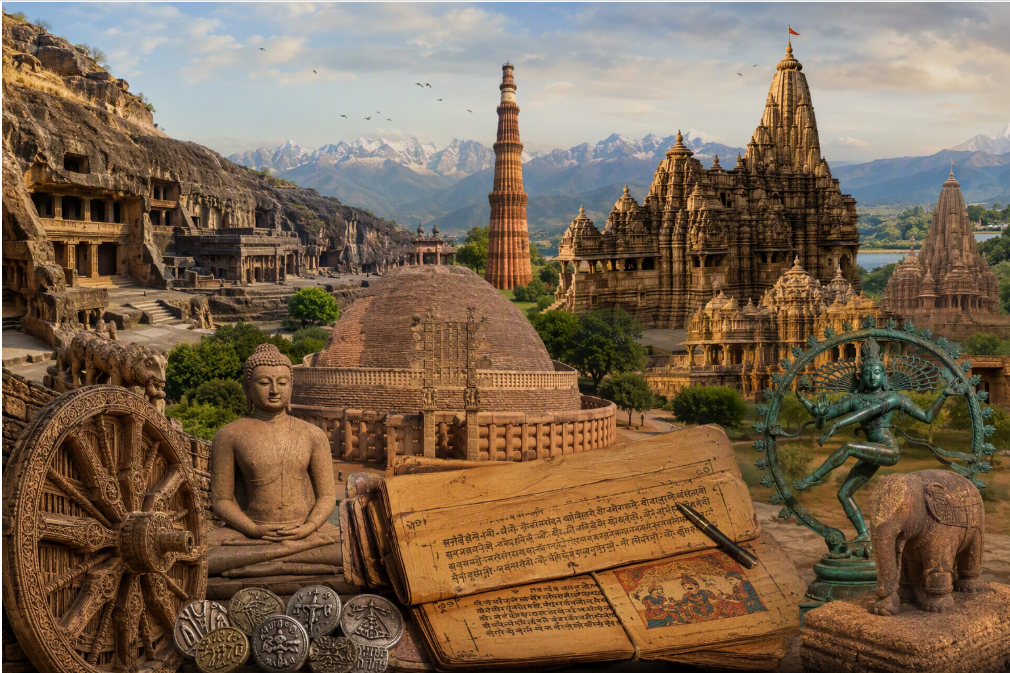
Important Civilizations: Indus Valley, Vedic Age, and Later Vedic Period
The Indus Valley Civilization and the Vedic period are both big parts of ancient India. Many people want to know about city life, how the economy worked, social groups, what people believed, and how the early political structure started during these times. In Indian history, these important topics show how early society changed, grew, and became what it is today.
The Indus Valley Civilization is known for well-planned cities. Some names you may know are Harappa and Mohenjo-Daro. The people who lived there took part in trade and craft work.
The Vedic period came next. It is famous for the Vedic texts, many new religious ideas, and a change in the way people lived. This time grew into what is called the Later Vedic phase.
- The cities of the Indus Valley were planned in a smart way. Some of the most important sites are Mohenjo-daro and Harappa.
- The people in early settlements made a living from farming, trade, and work like making things by hand.
- The Vedic texts tell us about their beliefs, what they wrote down, and how they thought about the world. Religion and ideas were important in that time, called the vedic period.
- During the vedic period, people had ways to work together as a group and follow leaders. They had systems for how people in the group were treated and rules for government.
- Later, there was a change to what we call the Later Vedic period, when many things in their life and rules started to change.
People often ask these questions. They do this because these are the base of ancient India.
Mauryan and Post-Mauryan Empires: Administrative and Cultural Highlights
The Mauryan Empire is a key topic in the UPSC syllabus. You should be clear about how the Mauryan Empire started, what Chandragupta Maurya achieved, how Ashoka ruled, how the kingdom was managed, how the economy ran, and how the spread of Buddhism happened. This is very important for UPSC because you get to look at the political story, the system of government, and the culture people had during that time.
After the Maurya kingdom, the Shunga, Kanva, Kushan, and some other post-Mauryan rulers became important. They show the administrative changes during that time. Trade grew a lot too. These things also connect to religion and tell us how different places felt their influence.
- Chandragupta Maurya was the first to make a big empire in India. He joined many small kingdoms together. This helped him get more power and made the land much safer for his people. The Mauryan Empire grew strong because of him.
- Ashoka was one king who was very important after Chandragupta. He changed how the mauryan empire worked. He made a strong administration and showed care for the people. After a big war, he made a choice to follow and spread Buddhism. The spread of Buddhism became a very important part of his rule.
- Once the Mauryan Empire ended, other dynasties took over different parts of India. These new dynasties opened up new trade routes. This led to more trade with people from other places. It also helped people from different lands meet and share things with each other.
- The Gupta Empire is known for its golden age. There were many good things happening in art, literature, and science. A lot of people see the gupta empire as one of the high points for Indian culture and learning. Their cultural contributions have left a mark that can still be seen now.
The Gupta Empire is important because it took big steps in science, literature, art, and the way the state was run.
Frequently Repeated and High-Priority Ancient History Topics
Many exam questions in ancient India repeat a few main topics. If you look at previous year questions, you will find that things like civilizations, dynasties, religion, inscriptions, trade, and cultural forms come up again and again. So, it is good to focus on these topics first. This way, you do not need to read everything the same way. A selective way of reading will help you get more from your time with previous year questions and exam questions in ancient India.
For the upsc prelims and mains syllabus, you have to start with the Indus Valley Civilization. Then, read about Vedic society, Mauryan rule, Gupta rule, Jainism, Buddhism, plus art and architecture. The parts below will show the common patterns in a clear way.
Commonly Asked Topics and Chronological Patterns in UPSC Exams
A good way to prepare for the UPSC exam is to read about indian history in the right order. It is important to follow the timeline. Begin with old Indian societies. Then read about the Vedic age, Mahajanapadas, Magadha, and the mauryan empire. After that, learn about other rulers. This way, you remember facts and understand ideas better in indian history. Using this method can help you do well in the UPSC exam.
If you look at the previous year, you will see that UPSC often asks questions on the main ideas. They do not choose random or small points. The upsc syllabus gives marks to those who know about changes and links between topics. It’s not just about knowing single facts.
- Indus Valley Civilization grew fast, and early city life did as well. People started to build big towns at that time. The indus valley civilization is known for its old ways, houses, and how they would plan the whole town.
- During Vedic and Later Vedic times, life began to change. People started living in bigger groups, and the way families and work were made new.
- When Magadha grew, about big changes. At that place, big towns had fights, and these moves led to major events before the first strong empire started.
- The Mauryan Empire came next. People like Ashoka left big marks in the world. After the mauryan empire, a lot changed and many smaller places came up.
- The Gupta Empire started later. Life, culture, and rule began to change and feel new. The gupta empire made a time where art, rule, and work took a new way.
This pattern gives you a smart revision order.
Major Art, Architecture, and Cultural Developments in Ancient India
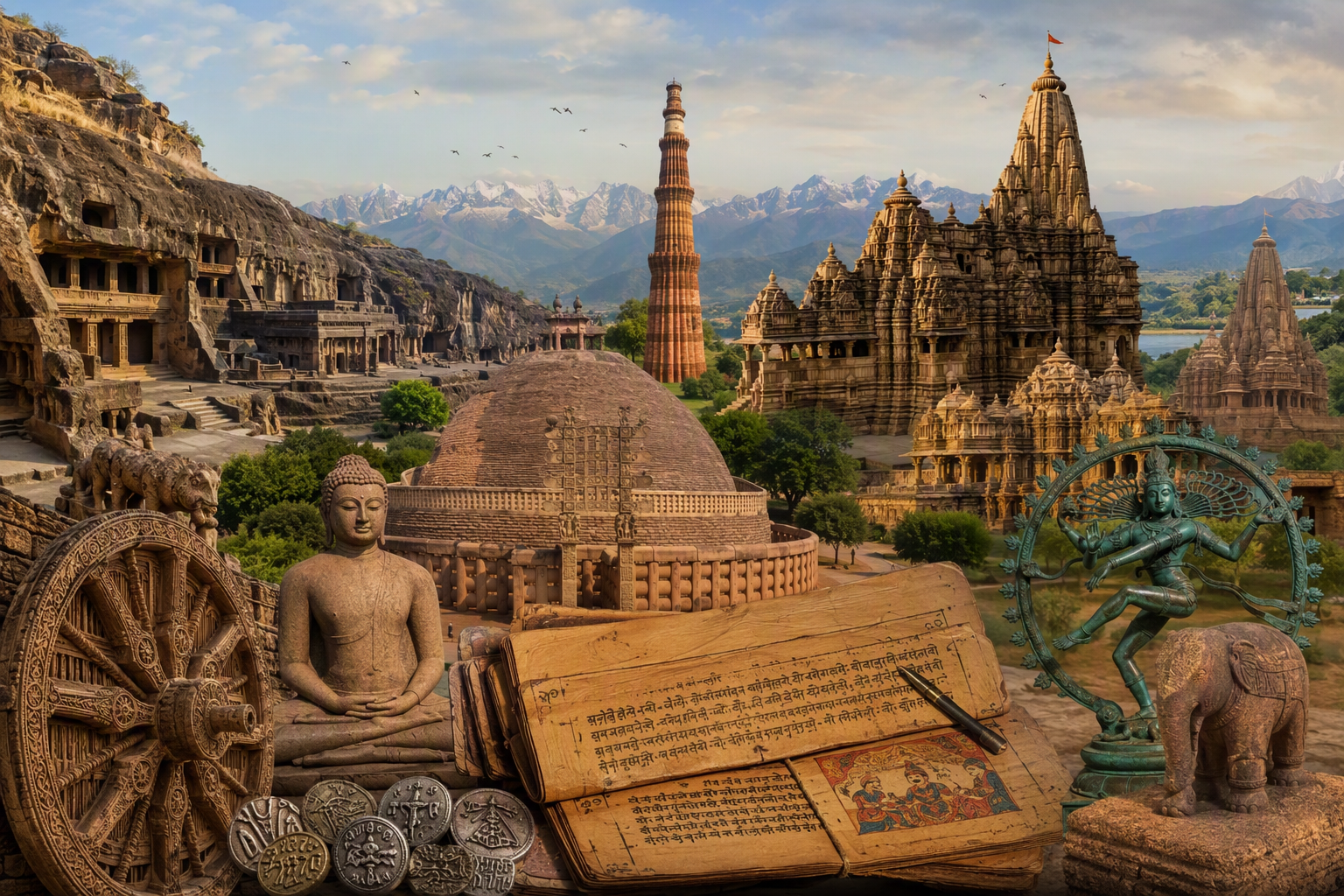
For Mains, do not limit your study of ancient India to only rulers and battles. The UPSC wants you to have good knowledge of Indian culture. You should read about art, architecture, literature, and religion. These cultural developments can be asked as direct questions or be part of bigger answers that need you to explain more.
Ancient India mixed together political power and cultural contributions in many ways. You can see this in the art and building work from the Mauryan time. It is also easy to notice in Buddhist traditions and the things the Gupta period gave us. There was also growth in writing in languages like Sanskrit, Pali, Prakrit, and Tamil. This shows how culture and power joined together in ancient India.
- The art and things people made in the Indus Valley
- Mauryan art and buildings, plus what was written and carved
- Buddhist art and buildings
- Gupta art, writing, and science
If you get all of these ready as linked ideas, your answers will be stronger. It will be easier for you to write in the exam too.
Conclusion
To sum up, knowing ancient history is important when you get ready for UPSC. It helps you see how people and leaders helped shape India with time. When you read main things about big civilizations, famous empires, and main topics of ancient history, you use your study time in a good way. This can also help you feel ready for the test. Go back and check main topics many times. Look at what questions shows up the most. Doing this makes you know more and helps you think better. Learning about ancient history gives you good practice, and you get to know a lot. If you want a plan for you or need help, feel free to get in touch for a free talk!
What are the main sources to prepare for Ancient Indian History in UPSC?
Start with NCERT textbooks to build a strong foundation in Indian history. Use reference books after that. Also read short study material to help you remember things. Practice previous year papers to know what kind of questions come. These papers help you find which ancient history topics matter the most.
How should I prioritize and revise Ancient History topics for UPSC?
Start with key topics like the Indus Valley Civilization, the Vedic age, the Mauryan Empire, the Gupta Empire, Jainism, and Buddhism. Look at previous year questions. This will help you know which parts to focus on and what be important. When you read the history section, go by the order of time. Make short notes from it. These notes will help with the UPSC mains syllabus.
Which Ancient Indian dynasties are most important for UPSC?
The Mauryan Empire and the Gupta Empire were some of the most important dynasties in ancient India. You need to remember these for the UPSC exam. It is good to know the main rulers who came after the Mauryan Empire. Also, read about the new changes that happened in northern India and south india. The Delhi Sultanate belongs to medieval history. So, you should keep that topic apart when you study for your exam.