Key Highlights
- Polity is a big part of the UPSC Prelims Exam in recent years. You can get about 12 to 18 questions on this topic in the prelims exam.
- When you read, pay attention to the Indian Constitution. Go over rights, duties, recent amendments, and major constitutional provisions.
- Many questions come from the Lok Sabha, Rajya Sabha, President, Prime Minister, and Judiciary. Be sure to spend time on these topics.
- The polity syllabus has both must-read topics and current affairs. You should keep up with recent amendments and supreme court decisions, too.
- If you want to do well, use smart revision ideas. Look at previous year papers, practice with mock tests, and read your notes. This helps you remember faster and get the answers right.
- A plan for what to read first will help you finish all main topics of the polity syllabus. After that, start reading the things that change with time.
Table of Contents
Introduction
If you want to do well in the UPSC Prelims Exam, don’t leave out Polity. It is one of the best subjects to score good marks in. Polity is about ideas, the indian constitution, how rules work here, and how our daily life is shaped. The big issue is that the polity syllabus is large. There are times when you feel lost about where to start and what to read most for this part. A clear list of important topics can help a lot. When you use your time well, Polity becomes one of the strongest subjects for the upsc prelims.
Understanding the Importance of Polity in UPSC Preparation
Polity is a big part of the Civil Services Examination. It can help you get more marks in the exam and helps you build a strong base in the topics. Everyone who wants to do well in this exam learns about the constitution of india. But it is important to know which parts of the polity syllabus you should focus on the most.
It is good to start with the Indian Constitution. After that, read about the Parliament, Executive, and Judiciary. Then learn about federalism, local government, and constitutional bodies. When you know this well, connect it with current affairs. This way can save you time. It also helps you answer both direct and question-based questions.
Why Polity Holds Significant Weight in UPSC Exams
Polity is a key topic in the civil services examination. It comes up in the paper every year. In recent years, you can find between 12 to 18 questions on this subject. That is why it is one of the most dependable subjects when you get ready for the UPSC civil services exam.
The Indian Constitution is a key part of most exams because it controls and explains many topics. You will often find questions about Fundamental Rights, directive principles of state policy, Parliament, President, Governor, Judiciary, and emergency provisions. These are very important topics. The Indian Constitution gives the backbone and rules for how the country is run.
There is one more good thing for you. Polity helps you learn both the basics and what is in the news now. A new court decision, a bill, or a talk in the constitution can turn a simple topic into an important one for your exam. So, if you want to get the most important areas, you should first read about the main ideas in the constitution. After that, read about the issues that came up in the current affairs.
Role of Polity in UPSC Prelims and Mains Papers
Polity is useful for both stages of the exam. The time you spend on this will help you for a long time. In the upsc prelims exam, you get questions in the general studies paper that ask about facts, main points, and several statements. In mains, you have to explain these topics so people read and see that you know how things happen and connect.
The polity syllabus gets you ready for the test in two ways. A lot of the big topics show up again in different parts. If you know the basics well, it will be easier for you to look things over before the exam.
- Start with the main chapters first. These include rights, Parliament, Judiciary, Executive, and federalism.
- Check out previous year papers. These will show you which themes keep coming up. It can help you know what to read about the most.
- Keep some short notes on articles, amendments, and constitutional bodies.
- Try to link fixed topics with new events. This will make it easier for you to remember them.
So, what is the best way to go over your work? The best thing to do is read less and check your work more. Keep going over what you did and check it often. This will help you get faster and remember things better.
Decoding the UPSC Polity Syllabus
The polity syllabus might feel big at first. But it will get better if you split it into small parts. Use study material that starts with the Indian Constitution. After this, read about rights, duties, Parliament, Executive, Judiciary, federalism, local government, and constitutional bodies.
If you want a list to focus on for the coming UPSC Prelims, start with the areas that get asked the most. These are high-priority parts. It is good to read these first. Do not try to cover everything all at once. The next sections will break these topics down. They will help you get ready in steps and in a way that works well.
Overview of Key Topics in the UPSC Polity Syllabus
If you look at the polity syllabus, you will find that not every chapter is important. A few topics come up a lot. These are there to test how well you know the main things about the Constitution. So, it is good to begin with the topics that show you how the system works.
The main things that you need to learn in indian polity are the important parts of the Constitution and how it was written. Be sure to know about the Preamble, Fundamental Rights, and the directive principles of state policy. It is also good to understand Parliament, the Executive, and the Judiciary. Learn how federalism works in the country. The questions about indian polity and state policy usually cover these topics.
- The Indian Constitution has a long story. It shows how the country’s government and its laws started.
- Some important things about the Indian Constitution are its main use and the Preamble. The Preamble gives a short idea of what this Constitution is about.
- There are things called Fundamental Rights that people have, and there are Fundamental Duties that everyone should follow.
- The main law-making group is called Parliament. The President is the head, and the Prime Minister runs the government. The Council of Ministers helps them with their work.
- The Supreme Court and the High Courts are the top courts in the country. Judicial review lets these courts check if new laws are good or not. Over the years, there have been some changes in the Constitution.
After you finish with these topics, you can read about local government, schedules, and constitutional bodies. You will also see what is happening now with current developments.
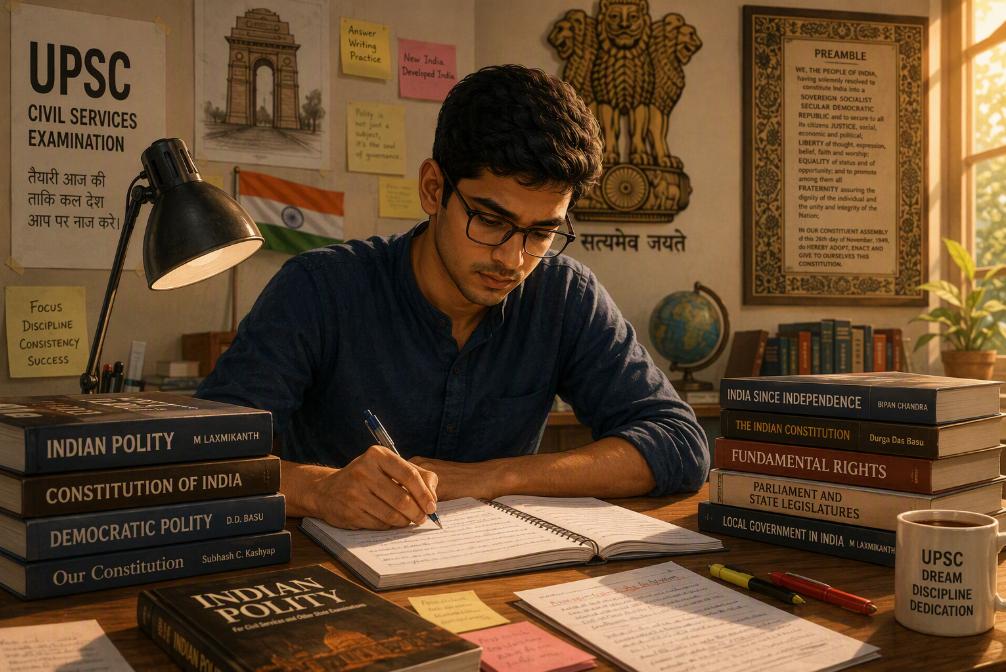
Categorizing Polity Subjects for Effective Preparation
You can read key Polity and Governance points faster if you break them down into simple groups. Do not read the constitution of india all at one go. Try to sort your study material into two parts. One part can be basic facts. The other part can be new things tied to what happens now. It will be easy to read it again if you use this way.
A good way to begin is to learn about the basics of the constitution. Start with the Preamble, rights, duties, directive principles, important articles, schedules, and changes called amendments.
The next group should look at the main institutions. This group has Parliament, state legislature, the President, Prime Minister, Governor, the Judiciary, and constitutional bodies.
The last part can talk about federalism, local government, emergency provisions, and how the whole system works together.
Start by making a simple plan. Focus on one group at a time. Take a look at it again in ten days. Try to tie it to what is happening right now. This will help you remember the facts. You will also see how the system works in real life.
Most Tested Parts of the Indian Constitution for UPSC
Some parts of the Indian Constitution are asked about more in UPSC Polity exams than the others. If you do not have a lot of time to study, you should put the most focus on these main parts. The main parts are the Preamble, Fundamental Rights, Fundamental Duties, directive principles of state policy, emergency provisions, Parliament, Judiciary, and important constitutional amendments.
You must read these key topics from the Indian Constitution because you will find many questions from them on the exam. So, if you want to get a good score, you need to read each part well and know what is in them. Doing this will help you use your time in a better way and feel more ready when you see these questions in your exam.
Questions often check if you get what a constitutional rule is. It is not only about the article number. When you read, you should look at what the rule means, how you can use it, and how it is different from other rules that feel the same. The next two sections will go over the main points that most questions cover.
Fundamental Rights, Duties, and Directive Principles
If you ask what is asked most in the UPSC Prelims about Polity, these three areas be the main ones. A lot of questions come on fundamental right. These can be straight or have some twist. That is because these show how people and the state link with each other. UPSC likes to bring questions that compare things in this area.
Along with rights, fundamental duties matter a lot and should be looked at closely. They connect with the bigger values in the Constitution and to the duties of citizens. The directive principles of state policy are also important and need our attention. These give ideas to the state on how to rule and are often talked about with rights in many questions.
Do not read these by yourself. You should read about how rights can be limited. You also need to read about how more duties were added. Try to understand how state policy can change welfare and how a place is run. Cases like Kesavananda Bharati, Golaknath, and Menaka Gandhi are tied to these ideas. That is the reason this needs to be clear to you. It will help you get a better score.
Key Constitutional Amendments and Schedules
Constitutional amendments matter a lot. They let us see how the system changes over time. UPSC likes to ask about big changes, why they happen, and what they do. You should look at amendments that people talk about the most when you study. Some main constitutional amendments to know are the 42nd, 44th, 52nd, 73rd, 74th, 86th, and 101st.
A connected area is at the center of the basic structure. The Kesavananda Bharati case is still important because of this. It made sure that Parliament cannot change everything in the basic structure. When you read about amendments, stop and ask yourself: can this change hurt the basic structure? Doing this helps you know more about the basic structure and the Kesavananda Bharati case.
| Amendment / Area | Why It Matters for UPSC |
|---|---|
| 42nd Amendment | Linked with wide constitutional changes and often discussed with basic structure |
| 44th Amendment | Important for rights and emergency-related corrections |
| 52nd Amendment | Core to Anti-Defection Law |
| 73rd and 74th Amendments | Key to Panchayati Raj and urban local bodies |
| 86th Amendment | Important in rights-related discussions |
| 101st Amendment | Linked with GST and Centre-State financial relations |
For UPSC 2024-2025, you must watch for recent amendments. You should keep up with what is being said about the constitution in Parliament.
Structure and Functions of Parliament and State Legislatures
Parliament is one of the main things you need to study in Polity. Start by read about lok sabha and rajya sabha. Then go to vidhan sabha and the legislative council in your state. Know their powers, how they are made, how they work, and what makes each one different. Knowing all these points will help you do well in your studies.
You should know how the council of states works in the federal setup. If you understand the basics of Parliament, it will be easy to remember how state legislatures work. The next two sections will help you keep this part clear and well organized.
Powers and Procedures of Lok Sabha and Rajya Sabha
The lok sabha and rajya sabha are always important topics in UPSC Polity. You have to know how both are made up, how long they last, what powers they have, and what role they play in making laws. Most questions are about the ways lok sabha and rajya sabha are not the same. This includes what they do with money, who has more say, and their special jobs in the Constitution.
The Rajya Sabha is called the Council of States. It is special in the system. It stands for the states. The Rajya Sabha does not break up like the Lok Sabha. The Lok Sabha shows what people in the country want. This is a big difference that you need to know. It can help you answer many prelims questions about lok sabha and rajya sabha.
UPSC often asks about how things work. So, read about the Money Bill and the Financial Bill. You should know about the no-confidence motion and censure. Learn what parliamentary privileges are. Also read about the different sessions in Parliament. Make sure you understand the types of majority, like absolute, effective, and special majority. If you get these ideas and check some examples, you will feel more ready for any questions.
Special Provisions Related to State Legislatures
Many students do not pay much attention to the state legislature. But this can be a problem. UPSC asks simple questions about Vidhan Sabha, legislative council, and legislative assemblies. After you read about Parliament, this part gets easy to know.
For prioritization, you should set state topics right after Union institutions. This order works well because the framework is almost the same as the Union. But details in the state topics can be confusing and different. These things can make people get stuck in the exam.
- Find out how unicameral and bicameral state systems are not the same.
- Get to know what the Vidhan Sabha does, who can be in it, and how it works.
- See where a Legislative Council is at and how it is not the same as the lower house.
- Go over how the Governor, Chief Minister, and the state legislature are all linked.
This way helps you not mix up the state and Union features when you get ready for the prelims.
Union and State Executive: President, Prime Minister, and Governors
Questions about people who are in charge come up because the news talks about them a lot. People also talk about them most of the time. You must know about the President of India, Prime Minister, Chief Minister, Governors, and the council of ministers. UPSC often asks about things such as how the prime minister, chief minister, and council of ministers get their jobs. It also asks what power they have, how they work with the law makers, and the role each plays when making choices on their own.
Recent trends show that the powers of the President and powers of the Governor often get attention when there is news about them. So, it is good to read facts and news together in this section to help you understand more about current affairs.
Appointment, Powers, and Functions of Key Executives
For the UPSC Prelims, the same executive topics often show up. These include how leaders are picked and removed, what they can do, and the difference between real and not-so-real power. You should read about the President of India, Prime Minister, Chief Minister, and Governor at the same time. Do not read about them as separate sections. These roles link to each other and are key for the upsc prelims.
The council of ministers is very important. It shows how executive responsibility works day to day. You need to know who gives advice to whom, who is responsible together as a group, and where the constitution puts the limits.
- The President of India be picked through an election. He has powers like pardoning people. The President also plays a key role when there is an emergency.
- The Prime Minister is chosen to lead the government. He is the head of the Council of Ministers and acts as a link between them.
- The Chief Minister works in the state. He has to work with the Governor and talks with him often.
- The powers of the Governor include making his own choices sometimes. He can bring in ordinances and looks after the daily work in the state.
If you put these offices side by side, it makes it easier for you to remember when you look over things again later.
Recent Trends and Frequently Asked Questions in Executive Polity
In recent years, the UPSC has started asking more questions to executives that go beyond basic meanings. It now looks at how roles like the President of India, Governors, and state governments work in real life. So, you need to pay attention to current affairs about the President of India, Governors, state governments, and those chosen for key jobs.
Many talk about how pardoning powers work under Articles 72 and 161. People also ask about what a Governor does when the person makes ordinances or uses rights given by the rules in the constitution. There are also some questions about the way the prime minister and the chief minister get their jobs and how they can be removed.
For UPSC 2024 or 2025, watch the news, especially when the topic is about constitutional debates. You do not need to read from many sources. Try to connect the news and updates from lawmakers with the main concepts you know. This will help you answer executive-related prelims questions in a good way.
Judiciary: Supreme Court, High Courts, and Judicial Review
The judiciary is a big part of the UPSC Prelims. You need to learn about the Supreme Court, High Courts, and subordinate courts. Study judicial review and public interest litigation. You should know what the jurisdiction of the Supreme Court covers. These topics often come in the exam and connect to key Supreme Court cases. Make sure you read about the Supreme Court, High Courts, and subordinate courts. Go through every topic to feel ready for the UPSC Prelims.
Don’t only keep the definitions in your mind. You have to understand the structure, how the thing works by itself, what powers it has, and what kinds of jurisdiction it has. When you get these points in your head, it gets easier to read decisions and understand new debates in the law. The next parts will talk about this.
Structure and Independence of the Judiciary
In topics about the judiciary, many questions ask about the way it works, what power it has, and how free it is. You need to know how the Supreme Court, high courts, and subordinate courts are set up. The UPSC wants to check if you know how these parts work to protect the Constitution and the rights of people.
Judicial review is important. It gives courts the power to see if a law or action is right or not. This is tied to the basic structure of the system. Judicial review has played a big part in many famous cases. So, do not take it as a minor subtopic.
You need to watch the jurisdiction of the supreme court. There are main types, like original jurisdiction and advisory jurisdiction. These and some other types are good for you to know. If you know them well, you will feel ready for questions on the supreme court. Try to learn these by looking at what they do. Do not just learn the words. This way, you can keep the information in your mind for a longer time.
Landmark Judgements and Their Relevance for UPSC
Landmark judgments play a big role in the UPSC exam. The reason is they show if you can connect the points from the Constitution to the way we use them every day. The supreme court of india gives several important decisions about Polity. These rulings change how we know key ideas. You will see questions about the supreme court in your exam. They be asked in both clear and hidden ways.
The Kesavananda Bharati case is important for this topic. It made sure that the basic structure of the Constitution stays safe. It said that Parliament does not have the power to change that basic structure. This case shows how changes to laws, judicial review, and keeping the Constitution balanced all connect.
- Kesavananda Bharati case: The basic structure idea came from this case. It shows that the constitution has some rules that cannot be changed. This is the source for what we call basic structure.
- Golaknath: This case matters when we talk about rights and changing the constitution. It helps us see how rights stay safe.
- Menaka Gandhi and Puttaswamy: These cases help us understand more about liberty and privacy.
If you have to make a list that is important, begin with judgments about rights, changes, and how courts use their power. These questions are the ones that appear in the exam a lot.
Federalism and Centre-State Relations
Federalism is an important topic and can come up many times in prelims exams. You should know how power is divided, how the Centre and the States work together, and how money gets shared between them. Also, you need to understand what happens with Inter-State problems. The way union territories be part of this system also matters. Emergency provisions like national emergency and state emergency can change how federalism works, and you will get questions about these often.
Recent trends show that the UPSC connects federalism with how we run the country and what is happening now. We need to keep an eye on topics like administration of tribal areas. GST is important and so is how states work with the Union. There is a lot of focus on what states do and what the Union does. Give extra attention to these topics.
Division of Powers and Administrative Mechanisms
The division of powers is there to test how you get federalism for the UPSC. You need to know how power that is shared between the Union and the states. You must also see how the Centre-State links work when things are normal, and what takes place when there are tough or special times.
Administrative mechanisms are important because they help the way things work, not just how it sounds on paper. This is about how states work with each other. It also includes how money is handled between them. There are groups that help people work together or solve problems when they come up.
- The Seventh Schedule deals with how topics are shared between the Centre and the States.
- The Centre-State financial relations and the Finance Commission explain how money is divided between the two.
- There are also ways to handle things, like commissions, councils, and different ways to solve problems.
When you read this part, keep emergency provisions in mind too. A national emergency or a state emergency can change how the center and the states share power. This topic is not just about ideas. It is also important for exams.
Challenges and Contemporary Developments in Indian Federalism
Indian federalism is not just found in books. It keeps changing in practice, by court rules, and policy talks. This makes current affairs, and what happens between the Union and a state government, really important in talks about federalism. When the Union or a state government do not agree about power, money, or running the show, that is when questions of federalism pop up.
Recent talks are about how states and the center work together. A lot of talk is about the GST Council and how it works. There are also talks on how states deal with each other. Some say that central laws look at issues that matter to the public.
The talks may be about tribal areas. Union territories might get discussed too. People may ask who is in charge when things get tough.
For UPSC 2024 or 2025, make sure you focus on big changes that show either tension or work between parts of the federal system. You do not have to read or remember all news stories. All you need to know is the main constitutional idea for each topic. If you do this, you can use logic to give answers, even if you do not know much about that topic.
Local Self-Government: Panchayati Raj and Urban Governance
Local government takes up a lot of marks. It is part of our constitution and has rules that are clear. Many students skip this section or do not read it well. You have to focus more on panchayati raj and urban governance. Be sure to read about the 73rd and 74th Amendments too. Some questions talk about the administration of tribal areas and how they connect to our constitution. You should know these points if you want a good score.
To get good sources, start with your main Polity book. Use your notes about the Constitution, and look at news for the latest updates. When you know the basics, it will be easy to read this topic again. You will also do well in the exam.
Evolution and Importance of Local Governance Bodies
To get the main ideas about panchayati raj and local government, start learning about local government early in the second half of your study. When you already know about Union and State groups, it is not hard to understand panchayati raj. You can see how being in a group and the way leaders answer to people works in bigger government, so panchayati raj will feel easier to get.
Local government is important because it lets people get involved right where they live. Everyone has a chance to speak up and take part in local matters. This is a good way to show the duties of citizens and how they can join in. It helps with making decisions close to home. That’s why UPSC often asks about local government.
When you read about local government, see how it is set up, why it is there, and how the constitution backs it. Do not try to keep single facts in your head one by one. Try to see how these local groups fit into the bigger system of democracy. This way, you feel that local government is tied to everything else, and it will feel like part of your main Polity studies, not just a side topic.
73rd and 74th Amendments: Features and Impact
The 73rd Amendment and the 74th Amendment are two important topics for study. They gave rural and urban local bodies a spot in the constitution. UPSC can ask why these changes were made. The exam can also ask how local bodies in the country are formed and what changes came with these amendments. If the news is about decentralization or city government, then these topics may show up in the exam for you.
You should know that these changes come from real problems. Some of these problems are about who has power and who gets money. It is also about who can speak for the people. In some cases, the administration of tribal areas matters a lot when people talk about local government and how it should work.
- 73rd Amendment: This gave panchayati raj institutions their spot in the constitution.
- 74th Amendment: This gave urban local bodies their spot in the constitution.
- Both amendments: The goal is to give power to local groups.
- These are good to know when you get questions about panchayati raj, how people join in local work, and how things are done.
Please check these changes for 2024 or 2025. Also, see if there is any ongoing talk about local groups, money matters, or how things can change in management.
Important Committees and Commissions in Indian Polity
Committees and commissions are a big part of indian polity. UPSC often asks about these bodies. You need to know their status, their powers, and what they do. Be clear about which body is constitutional and which is not.
Start with the Election Commission, Finance Commission, CAG, UPSC, and other big national commission institutions.
Do not leave out the National Human Rights Commission and other large groups. Even if things about them seem clear, you should still talk about them in your work. If you name them in the right way and show what they do now, it will be much easier for you. This can also help you get better marks.
Constitutional and Non-Constitutional Bodies
Questions about constitutional bodies and non-constitutional bodies are common. The exam often checks if you can put them in the right group and if you know their purpose. The Election Commission is one of the main examples. You must read about it closely. In the UPSC exam, you will be asked if a body gets its power from the Constitution, a law made by the government, or a government order.
This topic will be easier if you start by making the main groups. After you do that, add more facts to each group. This helps you when you read everything again. You will not get things mixed up. It also makes it better when you get a question that needs a statement.
- The main constitutional bodies are the Election Commission, Finance Commission, CAG, and UPSC.
- National commissions for SCs, STs, and OBCs are also important.
- There are some bodies that are not constitutional. These are NITI Aayog, NHRC, CBI, Lokpal, and Lokayuktas.
- Make sure to go over their status, what they do, and how people get into these jobs if needed.
As per recent trends, the UPSC picks groups that the news talks about often. This may be to do with votes, the work the government does, or talks on how to make these groups answerable.
Role of Commissions like Election Commission and Finance Commission
Of all the commissions, the Election Commission and the Finance Commission need to be at the top of the list. The Election Commission has a big job. It talks about things like political parties, voting, by-elections, and the rules we must follow. This helps keep our democracy strong. We often read about elections in the news, so the Election Commission is always an important group.
The Finance Commission has a big part in how the Centre and States work together on money matters. It looks at grants and how money and things get shared. When there is talk about federalism, you will hear about the Finance Commission as well. This makes it important, not just in set ways but also in ways that can change over time.
You should read about the National Human Rights Commission and other national commission groups. These topics often show up in questions about rights, groups, and who does what. Try to understand their role, where they stand in the country, and the type of work they do. That level of knowledge is usually enough for the prelims stage.
Tips and Strategies for Revising UPSC Polity Topics
The best way to review key Polity ideas before the UPSC exam is to keep it simple. Use your same study material that you have used before. Do not read new books now. Go through the main chapters again. Read your notes and check quick summaries in articles. This will help you get ready and remember your work.
Previous year papers and mock tests are great for your last bit of study. They show the kind of questions UPSC puts in the exam often. When you read the polity syllabus and practice these questions, it gets easier to remember things. You can also choose the right answers faster in the exam. The sections below will show how you can do this in an easy way.
Techniques to Prioritize and Remember Core Polity Concepts
Yes, there is a simple way to remember key topics in Indian Polity. You only need a few study materials. Read them again and again. In recent years, many students got good scores in Indian Polity by doing this. They read key topics many times. They also compared them and tested what they knew. They did not read too many books or notes.
A good revision plan should begin with topics that are asked the most. Next, you should look at topics that are linked to current events. Use previous year papers to know what you need to focus on. This will help you avoid reading too much and remember the points that matter most.
- Make short notes for the articles, amendments, and bodies. Use simple flowcharts for these too.
- Put ideas that are similar, like rights and directive principles, next to each other.
- Read the text again within ten days after your first read. After that, read it again every week.
- Look at previous year papers to see what ideas or topics keep coming up.
- Try to remember the main points without using the book. Practice doing this many times.
This way, you get random information and use it to help you remember things for your test.
Recommended Study Sources and Revision Approaches
For Polity, use a small number of clear sources. Start with M. Laxmikanth to learn the main parts. The NCERT Political Science books give a strong base. If you want to understand the constitution of india better, use D.D. Basu. Reading the simple parts of the constitution of india will help with some topics as well.
To stay updated with current events, read The Hindu or Indian Express. These papers give news about what is happening now. PIB and PRS India are good places to check if you want to know more about laws and changes in how things work in the country. These sources cover all you need. Be steady in reading them every day and do not start looking at too many other sources.
To revise, use the same study material as before. Then, practice with previous year papers and mock tests. This is a good way to keep the polity syllabus in check. It will help you remember key facts and main ideas for the exam.
Conclusion
In short, you need to be good at UPSC Polity to do well in the exam. This subject is a big part of both the Prelims and Mains. If you know the Constitution, how Parliament works, and about federalism, you will feel ready for any question. Try to group topics and go over them often. This will help you with your study plan. Also, practice a lot and keep up with recent news. Doing these things, you will not only be ready to pass, but you can be better than many others in the UPSC exams. If you feel you need more help or want advice made just for you, feel free to ask for a free talk. A win in UPSC Polity can be yours soon!
Which parts of Polity are most likely to be asked in UPSC Prelims?
In the UPSC Prelims Exam, most questions are about certain main areas. You will find topics like fundamental rights, fundamental duties, directive principles of state policy, Parliament, Judiciary, and emergency provisions. The exam also asks about big constitutional amendments. These topics are often there because they test how well you know the constitution and if you understand how it is used in real life.
Are there recent changes in Polity topics relevant for UPSC 2024-2025?
Yes, you need to look at recent amendments, important bills, and current affairs that connect to constitutional provisions. Changes made by the Government of India, the Parliament, the courts, and during elections, or anything about how power is shared, can help in making questions. The main ideas stay at the center. But knowing about new constitutional amendments and debates can also give you a good edge.
How to effectively cover important Polity topics within limited time?
Use only a few study material. Start with topics in the polity syllabus that have high weight. Go over these topics many times. Use previous year papers and mock tests to find out where you need to spend most of your time. Break the polity syllabus into smaller blocks. These blocks can be Constitution, rights, Parliament, Judiciary, federalism, and bodies. When you revise, always go over the basic structure and updates as well.