Key Highlights
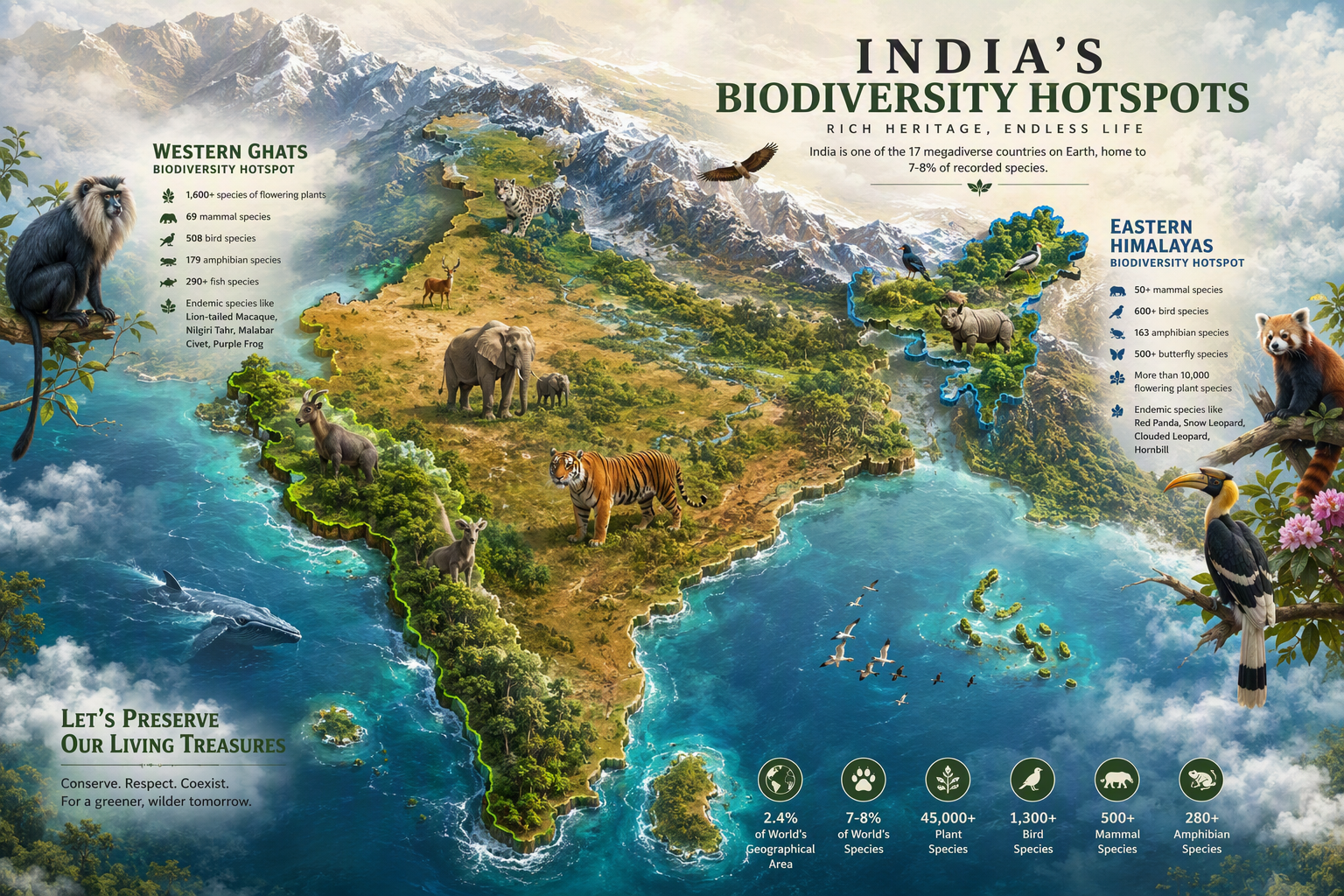
- India has four main biodiversity hotspots. Each of them is very important for the world, conservation efforts, and learning for the UPSC exam.
- The western ghats and the eastern himalayas have many endemic species. They also show high species richness.
- These hotspots are picked based on how many plant types are there and how much habitat loss has happened. The same way is followed all over the world.
- The hotspots in India have mountain areas, forests, wetlands, and islands. A lot of endemic species are found in them.
- Habitat loss, climate change, new harmful species, and lots of human activity put these hotspots in danger.
- The UPSC exam often has questions about these important places. You will read about their use, threats like habitat loss and climate change, which endemic species are there, and what conservation efforts people are making.
Table of Contents
Introduction
Biodiversity hotspots are a big topic for UPSC candidates who study the environment. In India, the places called hotspots show the world how there can be a lot of species in one area. These places also have many species that you only find there. They are important because they show how people take care of nature, too. This topic is real and useful for your exam. You need to know the names of these hotspots, why they are special, what problems they face, and why they are needed for nature.
India has four spots that people around the world see as important biodiversity hotspots. The topic is important for geography, the environment, and also what is happening right now in nature. This is simple to study. If you learn well about these, you can do good and get more marks in the UPSC exam.
Understanding Biodiversity Hotspots
Biodiversity hotspots are places full of life in a small area. There are many types of plants and animals in these spots that you will not see anywhere else. They have high endemism. This means the species of plants and animals found there live only at that place. That is why these hotspots are important for those trying to help nature.
The idea spread across the world because of Norman Myers. Today, people see these spots as very important for the globe. They help experts choose sites that need fast protection. If you want to know about India’s hotspots, you need to learn about the idea, where it came from, and the rules that help to define it.
Definition and Origin of the Biodiversity Hotspot Concept
A biodiversity hotspot is a place that has high species richness. This means there are many different types of plants, animals, and other life living there. A lot of these living things are found only in that area. Even though the space is not big, these places have a high number of species. A biodiversity hotspot is special because it is full of life, but it also faces many problems. A lot of the original habitat in these areas is damaged or even gone, so these places are at risk.
The idea came from Norman Myers in the late 1980s. In 1988, he showed some places that held a lot of different plants and animals. These places were in danger. What he said helped people in science choose the most important spots in the world for saving nature.
Soon after, Conservation International started to share the idea. In 2000, Conservation International worked with Myers and some other people to set up the modern biodiversity hotspot plan. Now, the idea of a biodiversity hotspot is important when you talk about global conservation. It helps people see how many kinds of life in an area are linked to the danger these places face. This way, it is easy to know and measure what we need to do.
Criteria for Identifying a Biodiversity Hotspot
So, how do people in India use the world rules to say a place is a biodiversity hotspot? A hotspot must have many plant species that you only can find in that area. It must show high endemism. Also, there has to be big habitat loss happening in the place. Because of this, not every spot with a lot of species can be a hotspot.
The two core conditions are:
- The place must to have at least 1,500 species of vascular plants that only live there.
- It should have lost 70% or more of the original habitat.
- This area must show a big need for conservation because the natural parts are now under a lot of stress.
These rules matter because you need to look at both the real risk and the importance of life there. A place can have many kinds of plants and animals. But the place must also have unique life forms and a big loss of original habitat to fit these rules. For UPSC, make sure you know both. They ask about these points in objective and descriptive questions.
Global Significance of Hotspots in Conservation
Hotspots are important places all across the world. There is a lot of life in these small spaces. A big part of the world’s plant species, animals, and insects can be found in them. But these spots cover only a small part of earth’s land surface. This is why people think they are top places to save when thinking about how to protect the world’s plant species and animals.
Conservation International made this framework well-known. It helps people take steps that really count. Because of this, resources are not spread everywhere. Policymakers and groups working on conservation can use it to focus on places with high species richness. They also look at areas where nature faces lots of stress. This way, planning and protection get better.
For UPSC, you need to know why the world values these places so much. Hotspot questions often ask about ideas, numbers, and the reason people work to save these areas. It’s important to know where the hotspots are. You also have to understand how they give us ecosystem services. This includes things like water, soil, and how they help with the climate. These services help both the country and the rest of the world.
Overview of Biodiversity in India
India is a country with rich biodiversity. You can find many types of plant life and wild animals in different places. There are forests, mountains, islands, wetlands, and grasslands. All these places have many living things. Because of this, India is known as a megadiverse country.
Across the Indian states, there are many different natural areas. You can see the himalayan region in the north. The peninsular india makes up the south part. There are also island spots in the bay of bengal. All these diverse ecosystems show why India is home to four important spots in the world. To get more details about them, look at what plants and animals are found in these places and the main zones in the country.
Unique Features of India’s Biodiversity
India is known for its species richness because it covers a large geographical area. The country has many types of land. In the north, there are snowy mountains. The south has thick tropical forests. To the west, you see dry places. There are also many island groups that are not close to the mainland. This natural range makes it possible for many types of living things to live in India.
Another important thing is the climate diversity in India. There is high rainfall on india’s western coast, and this helps thick forests grow in that area. In the cold areas of the Himalayas, the plants and animals are not the same. These zones have very different kinds of living things. The monsoon system also has a big part in shaping the land and how things change through each season.
Endemic species are what make places feel extra special. In India, many birds, mammals, reptiles, and amphibians can only be found in some spots. So, India’s biodiversity is not just about how much life there is. It is also about the many kinds you see, which is really unique. That is why we should care for and look after these rare endemic species.
Major Biogeographic Zones of India
India sits at a place where different natural regions come together. This shape of the biogeographic region makes it clear why animals and plants from other places get to live here. It also leads to some areas in India having high levels of endemism and a mix of many species.
The main big places that show what a hotspot is are:
- The Indian Himalayan region is a place where you see things change as you go up in height. You can find forests at lower places and then high mountain areas as you go higher.
- Northeast India is joined with the Indo-Burma system. This area is famous because of its tropical forests and wetlands.
- Peninsular India is in the south. The western ghats, also called the western ghats, are part of peninsular india and run along the western coast.
India is in a special spot for nature. Plants and animals from the world come together here. This mix gives India a big strength. For UPSC, you can link geography and ecology, not just to remember where hotspots are. You can also look at how the places and the living things fit together.
Wildlife Diversity Across Indian Ecosystems
Wildlife in India can be found in mountains, tropical forests, wetlands, mangroves, and islands. Different places have their own animal species. A lot of animals live in special spots that give them the weather and land that they need. This is why there are so many animal species in India. Different places help add more kinds of wildlife.
In the Himalayas, you can see the snow leopard, red panda, Himalayan tahr, musk deer, and Kashmiri Stag. These animals live in the cold mountains.
In the Indo-Burma area, you will find the Bengal tiger, Asian elephant, clouded leopard, Indian One-Horned Rhinoceros, and Hoolock gibbon. These animals live in thick forests.
Each animal stays in a place that is best for it.
Bird species are all over India. There are island birds in the Andaman and Nicobar area. Some birds live in forests in the western ghats. Mountain birds are found in the Himalayas. All these birds help make India’s nature rich. For exam preparation, it is good to connect each bird species to where it lives. This helps you revise well. The western ghats play a big part in this.
List of Biodiversity Hotspots in India
If you are getting ready for the UPSC exam, you have to know about the four biodiversity hotspots in India. The four places are the Himalayas, Indo-Burma, the western ghats, and Sundaland. Sundaland is found through the Andaman and Nicobar Islands. You could get questions about their names, where they are, and some of the important endemic species that live in them. The western ghats are also one of the main hotspots you need to remember.
Here is a quick text table for easy recall:
| Biodiversity Hotspot | Indian Area Covered | Key Note |
|---|---|---|
| Himalayas | Indian Himalayan region including states such as Himachal Pradesh, Uttarakhand, Sikkim, and Arunachal Pradesh | Mountain ecosystems with strong altitudinal variation |
| Indo-Burma | Northeast India and parts of West Bengal | Tropical forests, wetlands, and high endemism |
| Western Ghats | India’s western coast from Gujarat to Kerala | Evergreen forests and many endemic species |
| Sundaland | Andaman and Nicobar Islands | Island ecosystems, mangrove forests, and rainforest diversity |
Western Ghats
The western ghats go along india’s western coast for almost 1,600 kilometers. The western ghats are one of the best-known places in india for different types of life. This mountain line is narrow, but it has many places on high or low ground. That change in height makes many homes for living things in the area. This helps many plants and animals live in the western ghats.
High rainfall from the southwest monsoon helps keep the evergreen forests on the western slopes of the Western Ghats thick and green. But the eastern side of the Western Ghats gets less rain, so that area be drier. This difference in how much rain falls makes many types of habitats in the western ghats.
The Western Ghats are well known for high endemism. A lot of tree species, amphibians, reptiles, and mammals are only found in the western ghats.
Some important animals live only in this area. These include the lion-tailed macaque, Nilgiri tahr, Malabar giant squirrel, and frogs like the Malabar gliding frog. A lot of people have used the original natural vegetation for their needs. Still, the region is very important for saving nature. The endemic species need the forest areas that remain to live and survive.
Eastern Himalayas
The Himalayan hotspot in India is known for its rich plant and animal life, especially in the eastern himalayas. This area includes states like Sikkim and arunachal pradesh. It is a part of a bigger Himalayan system that also covers land in the countries nearby. There are big changes in height in this region. These changes affect the weather and the kinds of plants that grow here.
As you go up, the land changes. First, you see subtropical forests. After that, you find temperate spots. Then, there are coniferous forests and rhododendron forests. Next, you walk into alpine meadows. When you get to higher spots, there are not many plants. The weather is tough up here. This way of different layers is great for many special kinds of plants and animals.
The eastern Himalayas are home to animals like the red panda, snow leopard, Himalayan tahr, and musk deer. You also see many rare plants in this area. The place gives clean water to the region. It helps keep the climate steady. If you are getting ready for UPSC, remember that the Himalayas are not the same everywhere. There are many differences inside the area. This is one big feature of the region.
Indo-Burma Region
The Burma biodiversity hotspot is in many countries in Southeast Asia. A lot of it is in northeast India. In India, you can find the hotspot in Assam, Arunachal Pradesh, Manipur, Mizoram, Meghalaya, Nagaland, Tripura, and some parts of West Bengal. The Burma biodiversity hotspot also connects with southern China and Myanmar.
This area has many kinds of land. There are evergreen forests, and there are also semi-evergreen forests. You will also find moist deciduous forests here. Bamboo, grass fields, and wetlands are part of the place too. This mix of land helps many species live in this area. People know this place for its many flowering plants, as well as mammals, birds, reptiles, and amphibians. It is also known for its endangered freshwater turtles.
Key species in northeast India are the Asian elephant, Bengal tiger, Indian One-Horned Rhinoceros, clouded leopard, and Hoolock gibbon. Northeast India faces habitat fragmentation, illegal logging, and problems from new roads and buildings. There are many types of plants and animals in this area. But these issues put them at risk. The Indo-Burma hotspot is often mentioned in UPSC environment questions for being rich in life and facing danger.
Sundaland (Nicobar Islands)
The sundaland hotspot is mainly not in India. India is part of it because the andaman islands and nicobar group are found there. These islands are in the bay of bengal. A long stretch of sea keeps the islands away from the mainland. Being so separate from the rest of India has given them special natural features.
The islands are known for their many evergreen forests and mangrove forests close to the coast. You will find a mix of plant life and many kinds of animals, both on the land and in the water. The thick forests, island feel, and coastline show that these islands are not like the mainland.
This place has rare animals like the Andaman wild pig, Andaman shrew, Rutland Island blind snake, Andaman scops owl, and Andaman cuckoo. There are some unique plant species too. The area has protected spots like the Great Nicobar Biosphere Reserve. There are marine spaces that keep coral reefs safe and help protect the coast.
Key Features of Indian Biodiversity Hotspots
Indian biodiversity hotspots have many kinds of plants and animals. These places show big species richness and high levels of endemism. A lot of these living things are found only in one mountain, one forest, or just one island. That makes these regions very important for nature.
Hotspots are about more than just having many kinds of animals and plants. They also show special traits in the way life is spread out on the earth. The number of species can be higher or lower, which shows species evenness is not the same everywhere. What makes a place special is when it has rare or special living things. That is what makes the area different from others. These things help show why the region is important.
Endemism and Unique Flora
Endemism means that a species lives in just one part of the world. You will not find it in other places. This is an important fact about India’s hotspots. A high degree of endemism shows there has been a long time of isolation, special weather, and new changes in how species grow all over the years.
Plant species help us find hotspots. The rule is to count how many special vascular plants are in an area. It is not about the total number of all types of things that live there. The western ghats, Himalayas, and several island groups have many kinds of special trees and flowering plants. Forest plants in these places need the local weather and land to grow well.
Examples from India are plants found in the Andaman and Nicobar Islands. These include the Andaman bulletwood and the Andaman satinwood. In the Himalayas, you can see many kinds of plants. They live in small parts of the mountain by height. If they lose their original habitat, these endemic species are in more danger. They cannot go to other places easily.
Faunal Diversity and Importance for Conservation
India’s hotspots have many kinds of animal species. In these places, there are mountain mammals, island birds, and forest reptiles. That is why these areas matter for conservation efforts. When we protect the hotspots, we help all the animals living there. We are not saving just a few popular animals. We protect the whole group of them together.
In the Himalayan region, animals like the snow leopard and red panda help us see how fragile the mountains are. In the western ghats, animals like the lion-tailed macaque and Nilgiri tahr need forests to be joined together so they can live. On islands, some unique mammals and birds find home because there are still small places with the right kind of habitat.
Places like the Great Nicobar Biosphere Reserve show us how protecting important areas works in real life. By keeping safe the places where many animals live, only found in that one area, India helps these habitats stay strong. This keeps the balance in nature and takes care of many different living things for a long time. For UPSC, it is good to say how saving different kinds of species goes with taking care of hotspots. These are not two separate things.
Climatic and Geographical Characteristics
Climate and the shape of the land have a big impact on making India’s hotspots. A large geographical area often has changes to the height of the land, how much it rains, and how far it is to other places. Because of this, different parts can turn into many types of nature. In one country, there may be mountain forests, green areas that stay the same, wetlands, and island systems. All these places give a home to many living things.
Some major physical drivers are:
- The western ghats get high rainfall when the monsoon comes.
- In the himalayan region, you can see land is not at the same height. This makes many places for plants and animals to live.
- The bay of bengal has islands that stand alone. In the andaman and nicobar area, this gives special spots for many kinds of life.
These conditions let diverse ecosystems grow in India. Mountains bring many kinds of plants and animals. They are set in a vertical line. Monsoon rain changes how plants grow and where they spread out. Islands help new kinds of species form. All these weather and land features make India rich in many types of life. If you are getting ready for UPSC environment tests, India is a key place to learn about.
Importance of Biodiversity Hotspots for UPSC Aspirants
For people who want to clear the UPSC exam, biodiversity hotspots are not just points on a list. These places show big species richness. There are many kinds of plants and animals living there. The land is also very special in these areas. People try to save nature here and follow rules set by the government. Because of this, knowing about them helps in Prelims, Mains, and interviews. You may get questions on the environment in India.
You can get questions about names, rules, dangers, safe zones, or animals that are linked to each hotspot. This topic comes up in both the general and news sections, so you will need to study it well. The next parts show where this topic matters most on the test and what parts you should read again and again.
Relevance in Prelims and Mains Exams
In the Prelims, you will often get questions about biodiversity hotspots. These questions can be about simple facts. You may be asked how many hotspots are in India, their names, or where they are found. Some questions will be about the rules used to find these hotspots. Other questions can ask what can put these areas in danger, like habitat loss, alien species coming in, or climate change.
In Mains, you need to look at the topic more closely. You must explain why biodiversity hotspots matter for saving nature. It is also important to say how high endemism can put an area at risk. You should talk about what happens when original natural vegetation is lost, and how it changes the balance in the environment. In this part, you need to know facts well and write your answer in a clear way.
The topic goes together with things like rules about the environment, wildlife care, biosphere reserves, and development that can last. This is why it comes up a lot in UPSC study guides. When you read and learn about hotspots, you also get better at other topics. You will understand things like protected areas, people working together to save nature, and problems that hurt nature in India.
Frequently Asked Topics Related to Hotspots
When the UPSC asks about hotspots, it usually covers the same main things again and again. If you read these parts many times,you will feel better with this topic. A lot of questions just mean something simple. They also have examples from India. Most of the time, these places have many plants and animals. A lot of them are in danger.
Commonly asked themes include:
- The names and place of India’s four hotspots.
- The list checks things like how many species of plants are there, and which ones are endemic species. It also looks at habitat loss.
- There are some issues like habitat fragmentation, invasive species, and climate pressure.
You should get ready with some examples of animals found in certain places. For example, the red panda can be seen in the Himalayas. The lion-tailed macaque is in the western ghats. The Andaman wild pig is found in the islands. Doing this makes it simple to answer questions. UPSC gives marks when you link the animal to where it lives. This way, you can use these examples in questions or short notes.
Role in Environmental Policies and Strategies
Hotspots are useful in India’s environmental planning. They help us see where conservation efforts are needed right away. These places have some rare species. A lot of habitat loss happens here. So, we need to focus on protecting these spots. We also need to fix them and keep an eye on them.
This idea fits with the worldwide way that groups like Conservation International think about conservation. They use the idea of hotspots. In India, knowing about hotspots helps teams with wildlife rules. It also helps make plans for biodiversity. Teams use this to run programs for certain species. Leaders know where to focus, so they get good results for nature.
Hotspot protection helps ecosystem services. Trees on mountains help manage water flow. Island areas keep coastlines safe. Forests help the soil stay strong and store carbon. So when the rules protect these hotspots, they are not just saving animals. The rules also help people, protect the climate, and keep nature healthy for the future.
Major Threats Facing Indian Biodiversity Hotspots
India’s biodiversity hotspots face a lot of stress today. Habitat loss is not the only problem here. The land is also changing because of invasive species, climate change, and actions people take. These changes are happening so quickly that the ecosystems do not have time to recover.
The result is hurt to places where animals and plants live. Now, there is less space for many kinds, and rare types feel more pressure. It does not matter if you look at mountain forests, areas near the equator, or islands, the problem is the same. Rich areas that have many different plants and animals are now not as strong as before. The next parts talk about these risks in a way that will help you with exams.
Habitat Loss and Degradation
Habitat loss is the biggest reason that people need to focus on these hotspots for conservation. These places are full of life, but they have lost much of their natural space. Cutting down forests, changing how people use land, building roads, and new development have all taken away areas where native plants and animals live.
When the original habitat is lost, animals and plants that need the local food, climate, or places to breed start to go down in number. This happens a lot in hotspots. A lot of animals and plants in these places live in only one area. They cannot move to another place if their original natural vegetation goes away.
Habitat fragmentation makes things worse. The land gets divided. Now, instead of one big area where all living things can move and live, many species are trapped in small places. It is hard for them to move, breed, and live for a long time.
For UPSC, you need to keep this in mind. A hotspot is at risk not only because it has many kinds of species (species richness). It can be even more at risk if the place already has had a lot of damage to its land and nature.
Invasive Species and Overexploitation
Invasive species are living things that come from outside an area. These alien species can push out local plants and animals. They change how food moves in nature. Invasive species can make places weaker, especially when there are already problems in the habitats. This is a big issue in places where endemic species can only live in certain ways.
Overusing natural resources is a big problem. It includes illegal logging, poaching, taking too much, too much fishing, and using up resources in ways that cannot last. Places with rich biodiversity often feel more stress. This is because they be home to forests, animals, and sea life that people want.
Plant life and animal groups feel the stress. In the Andaman and Nicobar Islands, there is overfishing and illegal logging. These are big threats. On the mainland, people trade wildlife and use resources from the forests. This adds more pressure. These problems make it hard for the ecosystem to stay balanced. It also makes it tough for everything to heal or grow back with time.
Climate Change and Human Activities
Climate change is changing places in India that have a lot of plants and animals. It affects how much rain there is, the temperature, and where animals and plants can live. The timing of things that happen in nature also gets changed. Mountain areas feel this the most. Animals and plants that like cold places cannot move far when the weather changes. Islands feel this too. A small change in weather on the islands can touch the forests, beaches, and sea life.
Human actions make this stress worse. City growth, farming, making power, mining, building roads, cutting trees, and tourism that does not help nature all add more pressure to weak habitats. When plants go away and this loss matches these changes, it makes nature less strong. This puts endemic species at more risk.
In island places, coral reefs and mangroves now face more stress. This comes from climate change and what people do in these areas. So, we need rules that fix problems from the climate and those caused by people. When you talk about the UPSC, always show that the loss of plants leads to less land for animals to live in. This breaks up living spaces. It also makes it harder for different kinds of life to do well.
Conservation Strategies and Initiatives in India
India uses many conservation efforts to keep its biodiversity hotspots safe. There are protected area networks, biosphere reserves, and programs that focus on different species. Local people also help out in these efforts. The threats are not the same everywhere. They change in places like mountains, forests, wetlands, and islands. So, the way we protect these areas has to fit each region.
India follows its own rules to keep animals safe. The country has built special reserves for wildlife. India has also taken extra steps, like Project Snow Leopard and Project Elephant. People who live nearby now help more in plans to save animals for many years.
The next parts will show how these plans work in real life. They also explain why these steps matter for saving places with lots of animals and plants.
Protected Area Networks and Biosphere Reserves
Protected area systems are one of the top ways India saves hotspot places. India keeps land safe to help the species, habitats, and nature in the area. This covers national parks, wildlife sanctuaries, and biosphere reserves found in several hotspot regions.
You can see this with some examples. In the western ghats, there is Eravikulam National Park and Silent Valley National Park. They keep important habitats safe. In the Indo-Burma region, Kaziranga National Park and Manas National Park work to protect wildlife. In the island area, the Great Nicobar Biosphere Reserve looks after special nature spots that are very sensitive.
These protected areas support work for different animals, like Project Elephant in the forests. A protected area may not solve every problem, but it gives the place its legal and basic needs to last. For UPSC, link hotspot conservation with saving the site and also helping animals get better through steps like Project Elephant.
Community Participation and Sustainable Practices
Conservation works better if local communities join in. People who live close to forests, mountains, wetlands, or islands are with these places every day. They have a key part in keeping safe the natural heritage. These people help guard the land and also take care of their own needs in a way that fits for everyone.
Community involvement helps watch over habitats. It stops illegal actions and helps use resources better. The information shows that conservation efforts using community-based ways and Joint Forest Management are important in India. These ways help people feel like the land is theirs. This makes them stay committed for a long time.
Sustainable practices matter because these hotspots can go away if we use too much or build without thinking. The way people travel, use land, and help local groups that care for nature can make things easier for the environment. For UPSC, know that the best way to keep a hotspot safe is to have strong rules, good science, and the community working together.
Role of Government and International Collaborations
The government plays a big role in making sure hotspots stay safe. It uses rules, plans, and looks after protected spots to help with this. Laws like the Wildlife Protection Act and the National Biodiversity Action Plan help guide what should be done. Many hotspots are found across several indian states, so these places need to work together.
International collaborations matter a lot where land and nature cross borders. This is true in places like the Himalayan and Indo-Burma regions. In these areas, countries have to work together. If they research, check nature, and make plans together to protect it, they get better results. Working together helps them deal with big problems across landscapes. This way, they can take care of different species as a team.
Organizations like Conservation International had a big part in creating the hotspot idea. This work still shapes how people look at saving nature in the world and set goals for it. In India, saving hotspots does not just stay inside the country. It connects to nature outside, works with people across borders, and helps everyone care for the environment together.
Conclusion
To sum up, knowing about the biodiversity hotspots of India is very important. It helps with saving the environment and with getting ready for the UPSC exams. These places have many kinds of plants and animals. A lot of them have problems because of people and climate change. When you learn about these hotspots, you get more knowledge. This can help you do well in both Prelims and Mains exams. You also learn about ways to protect nature and how people can help. This gives you new ideas about how environmental rules work. Make use of this chance to learn more and show that you care about saving nature. If you want help to get ready for UPSC, you can ask for a free consultation that will guide you on your path.
What is the difference between a biodiversity hotspot and a hope spot?
A biodiversity hotspot is a place that has rich biodiversity. The area has many endemic species. Habitat loss is also a big issue in these places. A hope spot is about marine conservation, but it is not the same as a biodiversity hotspot. A biodiversity hotspot is a formal priority area. A hope spot is about parts of the ocean that need extra care for conservation.
Which endemic species are found in India’s hotspots?
India’s hotspots have many rare animals and unique wildlife. These animals are seen only in these areas. For example, the red panda lives in the Himalayan region. The lion-tailed macaque and Nilgiri tahr can be found in the western ghats. The Andaman wild pig lives in the islands. There are also several plant species here. The western ghats and some other places show high endemism. This means many types of animals and plants be found only in these spots.
How has vegetation loss affected biodiversity hotspots in India?
The loss of plants has reduced the original natural vegetation in many places. Because of this, you see habitat loss and habitat fragmentation in spots that once had more life. When there is less land for living things, animals and plants get stuck in small pieces of land. This makes it hard for them to live. Some native animals and plants need a very special place to live and cannot move to other places. This puts them at risk and makes it even harder for them to survive.