Key Highlights
- Ocean currents are steady movements of seawater. They help shape earth’s climate and link faraway parts of the ocean.
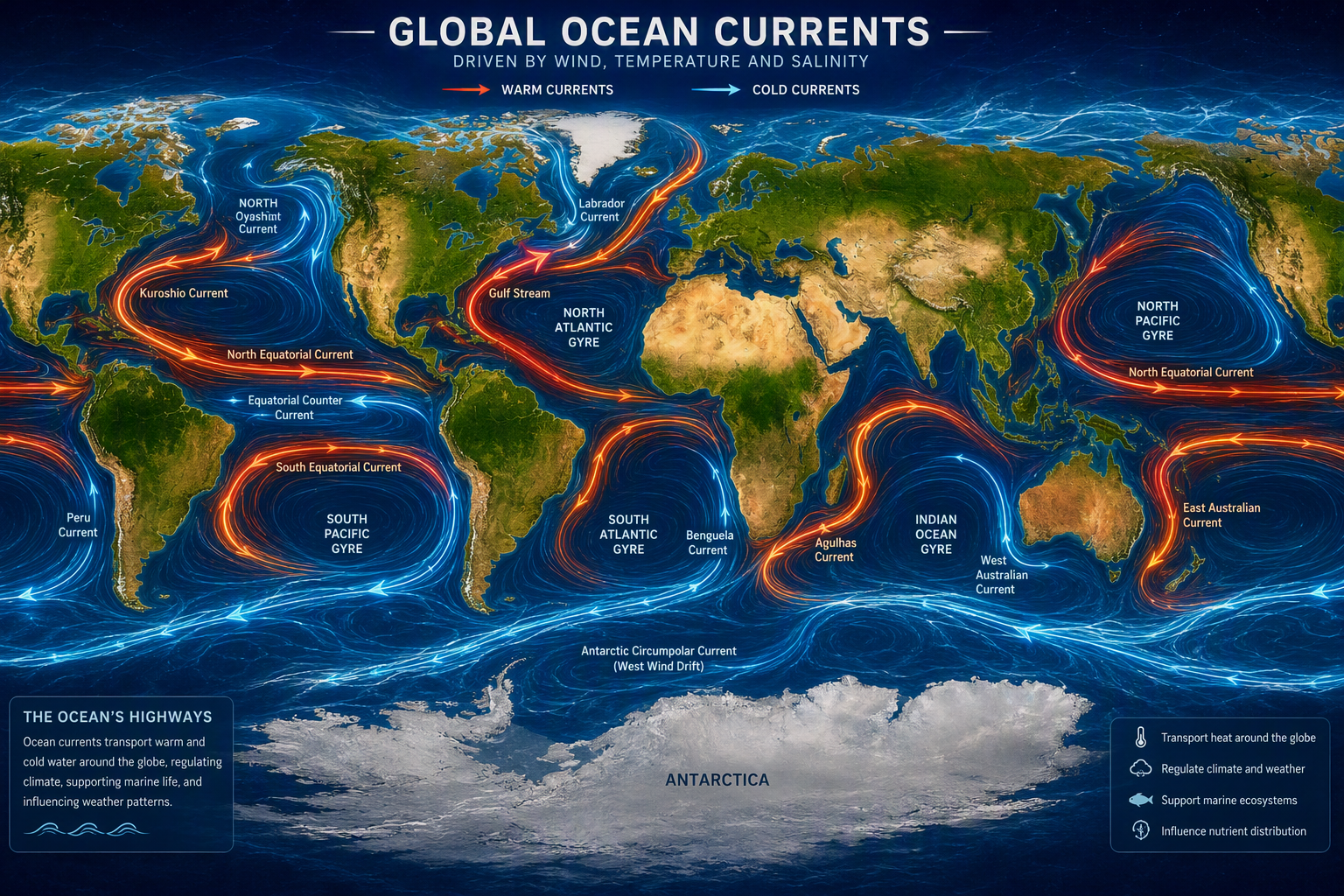
- Warm currents carry heat toward the poles. Cold currents move cool water to places closer to the equator.
- These flows can strongly change patterns of climate change. They also affect rainfall and air temperatures in areas close to the coast.
- Ocean currents support marine life. They do this by moving nutrients, oxygen, and salty water across ocean basins.
- When cold currents cause upwelling, good fishing grounds and lots of sea life appear.
- You need to understand current systems if you want to study UPSC geography, climate, oceans, and how ships travel.
Table of Contents
Introduction
Ocean currents play a big role in the Earth’s climate system. They work like giant streams of water that move heat, salt, and food for sea life all around the world’s oceans. Because of this, they change weather, the temperature near coasts, how much rain falls, and life in the sea in a big way. If you are getting ready for UPSC, it is good to know about ocean currents. It helps you link geography with the climate, the way life, fish, and people live and work near the sea, in a clear and useful way.
Defining Ocean Currents and Their Global Importance
Ocean currents move water in a steady and expected way. They help guide how water goes on the surface of the ocean and down in the deep ocean. You can think of ocean currents like rivers in the sea. These oceanic currents move water that has its own feel and salt levels.
These ocean currents are important for global circulation. They move heat, nutrients, and oxygen from one ocean basin to another. The major ocean currents help guide climates. They affect fishing areas and marine places where animals live. To see why ocean currents matter so much, it is good to first look at what they are, how they work, and why they are good for nature.
Meaning of Ocean Currents
Ocean currents are steady, moving water. They help push seawater across big ocean basins. Some ocean currents move along the surface of the ocean. Others go deep below the water. The movement of seawater is not random. These water currents follow set paths and link far-apart areas of the world’s ocean.
Ocean currents start when the wind, changes in temperature and saltiness, pressure, and earth’s rotation move water around. Surface flows are mostly pushed by global wind systems. The deep ocean moves because of water density. This keeps both the surface and deep ocean moving all the time.
These water currents are important. They move warm water, cold water, and nutrients. They also carry marine organisms to different places. The movement of seawater is a basic part of ocean geography.
Characteristics That Distinguish Ocean Currents
Not all currents move the same way. Some, like western boundary currents, are fast and narrow. Others are wide and slow. The way they go and how quick they are depend on water temperature, density differences, wind, and the shape of the ocean floor and coasts.
A few things help people spot ocean currents:
- Surface currents are in the top part of the ocean. They happen mostly because of the winds.
- Deep flows are there when the water has density differences from temperature and salinity variations.
- Water that is saltier or colder gets denser. It sinks below the other water that is lighter.
- Tidal currents come from tides. Major current systems are much bigger and last longer.
- These currents can bring warm water or cold water to other places.
Because of these traits, scientists can group currents by how deep they are, how warm or cold they feel, and how fast they move. This is why their effects can be different. Some can help control the climate, and some can provide nutrients.
Why Ocean Currents Matter for Climate and Ecosystems
Ocean currents are important. They move heat around the Earth. Warm currents make the air feel warmer near the coast in that place. Cold currents cool the air and can make it rain less. This helps the climate system. Ocean currents also help shape regional climates for a long time.
Their ecological role is important. Currents move nutrients, oxygen, and salty water in the sea. In places with upwelling, deep cold water comes up to the surface. This cold water helps plankton grow. Plankton support primary production. That makes the base of marine food chains.
For marine life, this leads to better feeding, breeding, and moving around. Where warm and cold waters mix, there is more life. These places are also good for fishing. Ocean currents connect climate, the living things in the sea, and the work people do in a whole system.
How Ocean Currents Form: Driving Factors Explained
Ocean water doesn’t move by itself. It reacts to several forces that push and guide the water all around the globe. The big ones are wind patterns, uneven heating, salt levels, gravity, and the Coriolis effect from earth’s rotation.
Some things start the flow, and some things change its speed or move it a different way. Coastlines, ocean basins, and the ocean bottom also push or turn currents that are already moving. To give a good UPSC answer, you need to know how wind, density, and things like planets work together.
Influence of Wind Patterns and Coriolis Effect
Wind patterns are the biggest reason for surface currents. Trade winds and westerlies are global wind systems that move ocean water forward. The friction between air and water makes the water start to move. When one layer of water moves, it pulls the layer below it with it.
The flow does not go right along with the wind. Earth’s rotation, known as the Coriolis effect, makes water move to the right in the northern hemisphere. In the southern hemisphere, water moves to the left. This action helps form big gyres and puts current systems in order.
Another main idea to know about is Ekman transport. In the ocean, every water layer moves a little differently from the one right above it. As a result, the total movement of the water starts to turn away from where the wind is blowing. This is important because it shows how winds can push water, shape gyres, and help guide the way major ocean currents go. Ekman transport plays a big part in how ocean currents work.
Roles of Temperature and Salinity Differences
Temperature and salinity variations are important for deep ocean circulation. Warm water gets bigger and lighter. In contrast, cold water is heavier. Also, salty water is heavier than fresh water. All these changes cause clear density differences in the ocean.
When water density shifts, water starts to move up and down. Heavy water goes down. Light water stays at the top. This is how thermohaline circulation works. People call it the global conveyor belt. It connects seas far apart with deep water moving slowly but strongly.
So, if you want to know how ocean currents start, it is not only because of wind. Surface currents mostly come from wind. Deep ocean currents are made by changes in temperature, salinity variations, and water density. All these work together to keep the ocean moving all the time.
The Impact of Ocean Basin Shape and Earth’s Rotation
Even when currents start to move, they are not able to go in one straight line for a long time. Ocean basins, continents, islands, and coastlines work to bend, split, or block how they flow. Because of this, the way the world’s oceans are shaped has a big effect on the direction of current systems.
Earth’s rotation has a big part to play in how oceans move. The spin of the earth makes the Coriolis force, which causes the movement of water to turn to the right in the northern hemisphere. In the southern hemisphere, the force turns the water to the left. This effect helps the water form large circular paths called gyres. It also explains why the big currents move in curves around the ocean basins.
Ocean bottom shapes play a big part in how deep water moves. Things like ridges, trenches, and shelves can change how water gets around. These places can help guide or slow down ocean currents. The way ocean currents start and move is not just about wind and how dense the water is. It also comes from how the planet turns and what physical blocks are in the way.
Major Types of Ocean Currents
Ocean circulation is made up of different types of flows. The main ones are surface currents and deep ocean currents. Each of these moves water in its own way. Surface currents are mostly pushed by wind. Deep ocean currents, on the other hand, are moved by how dense the water is and by sinking water.
Currents can be grouped by their temperature. You can call them warm or cold. This way of sorting helps to show how they affect climate, fishing, and living things in the ocean. The next parts will compare these types in a clear way. You can use this information to get ready for your exams.
Surface Currents vs. Deep Water Currents
Surface currents and deep water currents are not the same. They are set apart by how deep they are, what causes them, and what they do to ocean water. Surface currents are found in about the upper 400 meters of the ocean. They cover nearly 10% of all ocean water and are moved mostly by winds. On the other hand, deep water currents are part of the other 90% of ocean water. These deep water currents move because of changes in water density. So, when it comes to water currents, surface currents and deep water currents are different because of depth, the energy that moves them, and how water density and density differences play a role.
A simple comparison makes the distinction easier:
| Feature | Surface Currents | Deep Water Currents |
|---|---|---|
| Main driver | Global winds and friction | Water density changes due to temperature and salinity |
| Depth | Upper ocean, about 400 meters | Deep ocean layers |
| Water type | Often shifts warm water across the surface | Often carries cold water and dense deep water |
| Speed pattern | Can be faster and more visible | Slower but global in reach |
| Example | Gulf Stream, Kuroshio Current | North Atlantic Deep Water, Antarctic Bottom Water |
In short, surface currents move heat around fast, while deep water currents help keep ocean circulation going over a long time. Both surface currents and deep water currents are important for the global system of water currents in the ocean.
Warm Currents and Their Geographical Distribution
Warm currents take warm water from around the equator or places close to it and move it to higher latitudes. You can often find these warm currents near the eastern coasts of continents at low and middle latitudes. In higher latitudes, they are usually along the western coasts. The main thing warm currents do is move heat from one place to another.
The Gulf Stream is a well-known warm current. It moves from the Gulf of Mexico along the east coast of the United States. Then, it flows into the North Atlantic. Its extension, called the North Atlantic Drift, helps keep the climate in Western Europe mild. That is why many people call it a warm blanket.
In the north Pacific, the Kuroshio Current moves north near East Asia. It is fast. You will find rich marine life and good fishing areas near Japan because of it. The Brazil Current and Agulhas Current are other warm currents. These also affect the local weather and the sea conditions by the coast.
Cold Currents and Noteworthy Examples
Cold currents move cold water from polar regions or higher latitudes to warmer places. They cool the coastal areas nearby. These currents often help with upwelling, which pulls nutrients to the top. This is good for fishing and dry coast climates.
A well-known example is the Humboldt Current, also known as the Peru Current. It flows along the west side of South America. This current causes strong upwelling. It helps make one of the best fishing areas in the world.
The Benguela Current goes along southwest Africa. It works in a way that is much like the Humboldt Current. This is why the Namib coast is dry.
The Antarctic Circumpolar Current is a big cold water flow. It moves around Antarctica from west to east. It is the largest ocean current on the planet. Cold currents like this make sea life stronger, but they can also cool the air along the coasts. This can mean less rain for places close to it.
Major Ocean Currents of the World
The major ocean currents in the world are put into groups based on each ocean basin. Each basin has its own pattern of oceanic currents. But all the major ocean currents are part of global circulation. This helps move heat and water to many places on the planet.
For UPSC, it can make things easier if you look at oceans one by one. The Pacific Ocean, Atlantic Ocean, and Indian Ocean have good examples of warm flows and cold flows. They also show how these patterns affect each area. Let us put the most important flows on a map and talk about why they matter.
Key Pacific Ocean Currents and Their Effects
The Pacific Ocean has the most studied currents in the world. In the northwestern Pacific Ocean, the Kuroshio Current moves north near East Asia. This current is warm and fast. It helps many sea creatures live and makes good fishing zones near Japan.
Farther east in the north pacific, the north pacific current flows east between Japan and North America. Close to the coast of America, the current breaks into two. One part becomes the warm Alaska Current. The other part turns into the cold California Current. This split shows that the same current can make coastal areas feel very different.
Near the equator, trade winds help shape the equatorial current. The North Equatorial Current and South Equatorial Current move from east to west. The Equatorial Counter Current goes the other way, from west to east. The Humboldt Current, also called the Peru Current, travels along South America. This Humboldt Current creates strong upwelling. It also changes El Niño events.
Important Atlantic Ocean Currents
The Atlantic Ocean has some well-known current systems in geography. The warm Gulf Stream goes north from the Gulf of Mexico. It moves along the east side of the United States. The Gulf Stream is fast and carries heat. It helps to control the climate in the North Atlantic.
The North Atlantic Drift is an extension of the Gulf Stream. It moves toward Western Europe. This helps keep temperatures there more mild. In the tropical Atlantic, the south equatorial currents go west. These currents are part of a gyre system. The Caribbean Current is also involved in the Gulf Stream. It affects the path of cyclones in this area.
The Labrador Current has cold water that moves south along the east side of Canada. It carries a lot of oxygen. When the Labrador Current meets the warm Gulf Stream near Newfoundland, you get fog. This place is known for its rich fishing grounds. The Canary and Benguela currents also help by making ocean water move up, which supports good spots for sea life.
Indian Ocean Currents and Their Regional Relevance
The Indian Ocean stands out because its current systems shift with the monsoon. The water moves in a different way during these times. It is not like the steady movement found in the Pacific and Atlantic Oceans. This change in the movement of seawater is a key point for UPSC exam.
Warm currents in this area are the Mozambique Current, East Madagascar Current, and Agulhas Current. These flows shape the temperatures and sea life near the east and south coast of Africa. The warm currents also link some key parts of the Indian Ocean circulation.
The Somali Current is very special. It changes both the way it flows and how warm it is with each season. During the southwest monsoon, the current is a cold current. In the northeast monsoon, it turns into a warm current. These changes can have a big effect on regional climates, the amount of food in the water, and how well sea life can grow.
Ocean Currents and Their Influence on Climate Patterns
Ocean currents do more than just move the water around. They help spread heat in the ocean and the air. This is important for global climate and regional climates. A warm current can make coastal places hotter. A cold current can cool the land. Cold flows also stop rain from coming.
Because ocean currents help shape how the climate acts, even small things that change in their movement can be important. Many scientists try to find out if the way currents move is linked to climate change. If you want to see this more clearly, look at how these currents work around the world. They also have effects on India and the Pacific, like with El Niño and La Niña.
The Role of Ocean Currents in Global Climate Regulation
Ocean currents help control the global climate. They do this by moving heat from warm waters near the equator to cooler places. Warm currents can make the air feel milder near the coast. Cold currents can cool the air and take moisture out of it. This is why places by the coast can feel different from places farther in, even if they are at the same spot on the globe.
A big part of this is ocean circulation, at the top and deep in the sea. Thermohaline circulation, also known as the global conveyor belt, moves the water through long deep paths in the ocean. It spreads heat, salt, and oxygen all around the planet.
Ocean currents, like the Gulf Stream and North Atlantic Drift, play a big role in Earth’s climate. The Gulf Stream and North Atlantic Drift move warm water into the North Atlantic. They help to keep Western Europe warmer. Because of this, ocean currents can change air temperature, the amount of rain, and how wind moves near the coast. These changes happen over time and have a strong effect on places next to the ocean.
Impacts on Monsoons and Weather in India
In the Indian Ocean, ocean currents change with the monsoon. The wind in each season makes the currents move in different ways. This shift also changes the water temperature in the ocean. Because the monsoon needs the ocean and air to work together, these changes are important for the area’s weather.
The Somali Current is a good example of how things change in the indian ocean. In the southwest monsoon, the water flows north as a cold current. When the northeast monsoon comes, it turns around and becomes a warm current. This shows that the climate system over the indian ocean does not stay the same, but changes with time.
For coastal regions, the changes can affect sea surface in many ways. These can change the rainfall patterns. They also change how much life there is in the sea. When you talk about the monsoon in UPSC answers, you should bring up how the indian ocean shows current reversal. This gives an important part of the physical geography in the answer.
Case Study: El Niño and La Niña Phenomena
El Niño and La Niña are big events that happen in the Pacific Ocean. They are connected to changes in ocean currents and winds. These events show that what happens in the ocean can change the weather in many parts of the world. Because of this, people often say El Niño and La Niña are some of the best ways to see how the ocean and air work together.
Most of the time, trade winds move warm surface water to the west in the tropical part of the Pacific Ocean. At the same time, cooler water comes up near South America. During El Niño, the trade winds get weaker. Then, the eastern tropical Pacific gets warmer than usual. The Humboldt Current area takes part in this change.
La Niña is the opposite phase and it causes cooling. It changes rainfall, temperature, and weather in many places outside the Pacific Ocean. In simple words, ocean currents and current systems move heat around. This affects the weather and climate all over the world when normal winds and currents do not work as they should.
Ocean Currents and Marine Ecosystems
Marine ecosystems need moving water to work well. Ocean currents help by bringing nutrients, oxygen, and heat. All of these things change how marine life lives, from small plankton to big fish. When water temperature or nutrient supply changes, it often tells you where life can grow and survive.
Some coasts have good fishing grounds because of the way currents move. Other coasts do not get as much fish, so they are less productive. Currents also help make spots with lots of different life and places where water from deep in the sea comes up.
The next parts explain how currents help make food in the sea, fishing grounds, and areas at the coast.
Nutrient Circulation and Support to Primary Production
Ocean currents help marine life. They move nutrients from one place to another. In some areas, nutrients get around because of upwelling. That is when cold water from the deep ocean comes up to the surface. This water has a lot of nutrients and reaches the sunlit area. Upwelling shows a strong link between ocean currents and living things.
When nutrients come up to the surface, phytoplankton starts to grow fast. This growth leads to more food being made in the ocean. It helps build the base for the marine food chain. Fish, seabirds, and bigger animals all get what they need from this healthy and busy system.
Salty water plays a big part in this because it changes how heavy or light the water is. This helps water move up and down in the ocean. Areas that see upwelling, like places near the Humboldt and Benguela currents, are rich in life. Ocean currents do more than just move things around. They also feed and support creatures in these ecosystems.
Effects on Marine Biodiversity and Fisheries
Ocean currents shape marine life in many ways. They move nutrients, oxygen, and set the temperature for the ocean. Because of this, places where warm and cold waters meet are full of sea life. In these areas, there is a lot of ocean currents’ mixing. This makes it great for many kinds of fish and other marine life to live and grow.
A cold current is very important for fishing grounds. This is because it can often cause upwelling. The Humboldt Current near South America and the Benguela Current off the coast of southwest Africa make some of the best fishing grounds in the world. Another great example is where the Kuroshio-Oyashio meet, near Japan.
This is how currents affect fishing businesses everywhere. They decide where fish group together. Fleets need to know how far and how long they must look for fish. Currents also change how good coastal waters are for fishing. In short, strong currents help shape where fish live and how well commercial fishing does.
Influence on Coastal Ecosystems and Upwelling Zones
Coastal areas feel the effect of ocean currents more than other places. The movement of water can change the water temperature near the shore. It can also change nutrient levels and the oxygen in the water. Because of this, ocean currents help shape the coastal areas and marine habitats found there.
Upwelling is a key process that happens along the coast. Winds and ocean currents move surface water away from the shore. When this happens, cold water from deep in the ocean comes up to take its place. This cold water holds many nutrients. It helps plankton grow, and is good for fish and other marine life.
This is why upwelling zones have high biological productivity. The currents do more than move water from one place to another. They set the physical conditions that help coastal ecosystems get rich, diverse, and valuable for the economy.
Human Uses and Impacts of Ocean Currents
People have used ocean currents for a long time for things like travel and trade. These currents help with finding the best way for ships to go, catching fish, and helping people who live by the coast earn money. Even now, ocean currents help ships use less fuel and time when they stay on the right route.
They can also bring risks like fog, moving icebergs, and changes in the sea. To see why these things matter to people, it helps to look at sea travel first. After that, we can look at fishing and how people make a living around the water.
Navigation and Shipping Routes
Ocean currents make it easy to move ships across the water. They give natural paths that sailors can use. In the past, people at sea would use the current systems and trade winds. This helped them go faster and made long trips better. Today, ocean currents and trade winds are still very important. Ships still plan their routes based on these currents, because they change travel time and also help save on fuel.
The Gulf Stream is one of the main currents that can help ships move forward. This makes it easier for ships to travel in the right way. These currents have played a big part in exploration, trade, and sea travel for many years. They still matter a lot now when people plan routes.
Still, ocean currents can be risky too. The Labrador Current brings icebergs into North Atlantic shipping paths. When this cold water meets warmer water, thick fog can form. Because of this, ocean currents help with getting around at sea. But to be safe in the North Atlantic, people need to know the risks and how these currents change with the seasons.
Significance for Fishing Industry and Coastal Economies
Ocean currents play an important part in the fishing industry. They help decide where the nutrients go and where the fish will grow. A place with upwelling or mixing in the water often turns into a great fishing ground. This helps people who live by the sea get the marine resources they need.
Cold water currents like the Humboldt and Benguela bring a lot of life to the sea. These places are known to have some of the best fisheries on Earth. When warm water and cold water meet, such as near Newfoundland and Japan, they make rich fishing spots. In these parts, marine life is easy to find. Many fishing boats come here because there are plenty of fish and other animals in the water.
Coastal areas get money from jobs in fishing, processing, trade, and things that go with these. If patterns change, fish might move to new places. Ocean currents do not just help with nature. They also play a part in work, local income, and what people eat in many areas around the world.
Conclusion
To sum up, it is important to know about ocean currents because they play a big part in our climate and the world’s ecosystems. Ocean currents help change the weather and keep temperatures steady. They are also important for sea life and fishing. When we understand how ocean currents work and how they shape both nature and our lives, we see how everything in the oceans is connected. Knowing more about ocean currents helps us choose better ways to protect nature and practice good habits. If you want to learn more or have any questions about ocean currents and why they matter, feel free to ask for a free consultation!
What factors determine the direction and speed of ocean currents?
The way ocean currents move and how fast they go is mostly affected by wind patterns, the coriolis effect, water temperature, water density, and the shape of ocean basins. Coastlines, what is on the bottom, and changes during the year can also change how the flow works. This is even more true when monsoon winds or small paths push the current in different ways.
How do ocean currents influence weather and marine life?
Ocean currents play a big part in the climate system. They move heat from one place to another. This can change both the global climate and local climates. Warm currents can make the coast feel warmer. Cold currents can make it feel cooler. Ocean currents also help marine life. They carry nutrients and oxygen, which is important in places where upwelling and mixing happens.
Can ocean currents have adverse effects on coastal regions?
Yes, current systems can hurt coastal areas. Cold water currents can lower how much rain coastal areas get. This makes these places dry, like what you see near desert coasts. A strong water movement can also change how the coast looks by causing erosion. If water currents change because of climate change, this can change how much life there is in the sea. It can also change weather or the way people live by the water.