Key Highlights
- India now faces growing problems with water security as the need for water goes up but the supply gets lower.
- The composite water management index has shown that this is a big crisis. It affects millions of people in both the city and the villages.
- A lot of homes still do not have safe drinking water. This makes people worry about public health.
- The main reasons are that groundwater is going down, water gets dirty, and the management systems for water are not strong.
- Jal Shakti and other new plans look to help with water conservation, raising up groundwater levels, and making sure more people get access to water.
- If you read this for UPSC, know the issue is linked to governance, development, environment, and social justice, and depends on water management, drinking water, and systems for all.
Table of Contents
Introduction
India’s water crisis is here now. It is not just about the future. This is a big development issue today. The country’s water resources feel stress because the number of people living here keeps going up. The water supply systems are not good. There is also a lot of pollution. Rain comes at different times and in a different way now. When people do not get clean water, things get worse for health, farming, cities, and people’s work. This is why water conservation cannot be just about the environment. It is about how we are led, how we grow, and how we feel as people. For the UPSC, this is a key topic. It is tied to water resources, water crisis, water supply, and saving water for all.
Understanding Water Security in India
Water security means people have safe water for their daily needs, farming, jobs, and for nature. In India, water use is going up. At the same time, water demand is rising faster than the amount of water there. This makes it hard to plan and have water every day.
The world faces a big challenge with sustainability. Bad water governance, less groundwater, dirty water, and unequal access make it hard to reach sustainable development. The NITI Aayog report says water stress is not just a lack of water. It is also about the quality, how we manage it, and if we can save water for the future.
Definition and Dimensions of Water Security
Water security means having steady and safe water for people, farming, the economy, and the balance in nature. It is about both how much water there is and if it is safe to use. A place might get rain, but if there are problems with how they store, send out, or clean water, they can still have trouble with water security.
Another part of this problem is water use. India needs a lot of groundwater, especially for farms and drinking water. When people take groundwater faster than it can be replaced, it puts a lot of pressure on villages, towns, and big cities. Poor water resources management makes this gap even bigger. Good steps are needed for the future of water resources in the country.
The NITI Aayog says the crisis is not caused by just one thing. They see many reasons that come together. These include more people asking for water, the extraction of groundwater going up, dirty water, weak roads and pipes, and different groups not working as one. Bad weather also makes things harder. All of these cut down on water security. These are big problems for how we live today, and they also make it harder to have enough water in the future.
Global Significance vs. Indian Context
Water scarcity is a problem all around the world. In India, this problem is even bigger because there are so many people. India has about 4% of the global freshwater resources, but there are almost 17% of the world’s population living here. That big difference means water availability is a main issue when we talk about development in the country.
NITI Aayog says that India is dealing with a lot of water stress. The water quality in the country is not good. A lot of people in India rely on groundwater, and much of it is running out. This makes the problem even worse. Countries that have better ways to store and manage water do not face this much stress.
- India has only a small part of the global freshwater resources, even though there are a lot of people living in the country.
- Nearly 600 million people deal with high to extreme water stress each day.
- India is low in ranking for water quality. This shows that the problem is not just about the amount of water but also how good the water is.
Current Status of Water Resources in India
India’s water resources are being used too much. The main worry is groundwater depletion. This happens most in states where farms need to take a lot of water from underground for irrigation. The water tables are falling. This hurts farming and this hurts what people have for daily water use at home.
At the same time, the quality of water is getting worse. A lot of groundwater is not clean. Dirty lakes and rivers also make it hard to get enough water for people to use. Poor groundwater management has made the problem even harder. If you want to see how big the problem is, it helps to look at water availability trends and differences between regions.
Present Water Availability and Usage Patterns
India’s yearly water availability for each person has gone down over time. In 2021, it was around 1,486 cubic metres. This is in the water stress range. It may drop to 1,341 cubic metres by 2025 and 1,140 cubic metres by 2050. If we keep seeing this, the pressure on water supply will get worse. The water availability, water supply, water stress, cubic metres, and capita water availability are key points here.
One big reason is more water use. Farms take up the most water, but towns and cities are using more each year. When the water system is weak and there is a lot of leakage, this gap gets even bigger for homes and farms.
| Year | Capita Water Availability |
|---|---|
| 2021 | 1,486 cubic metres |
| 2025 projected | 1,341 cubic metres |
| 2050 projected | 1,140 cubic metres |
This slow drop makes it clear that India needs to change how it plans for water right now.
Regional Variations and State-wise Water Stress
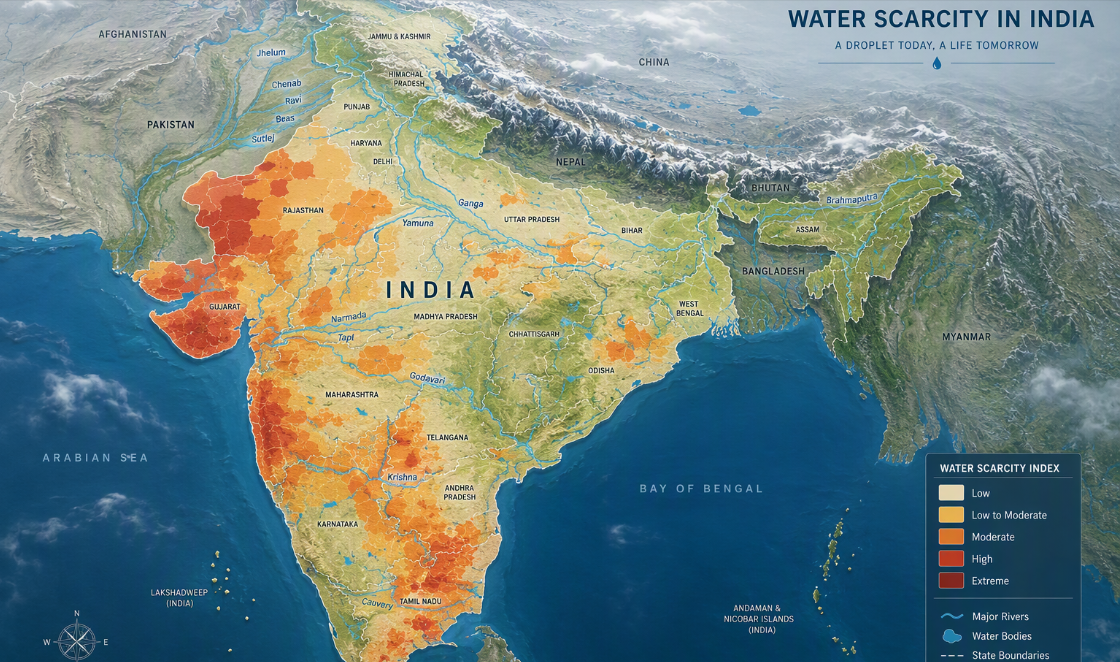
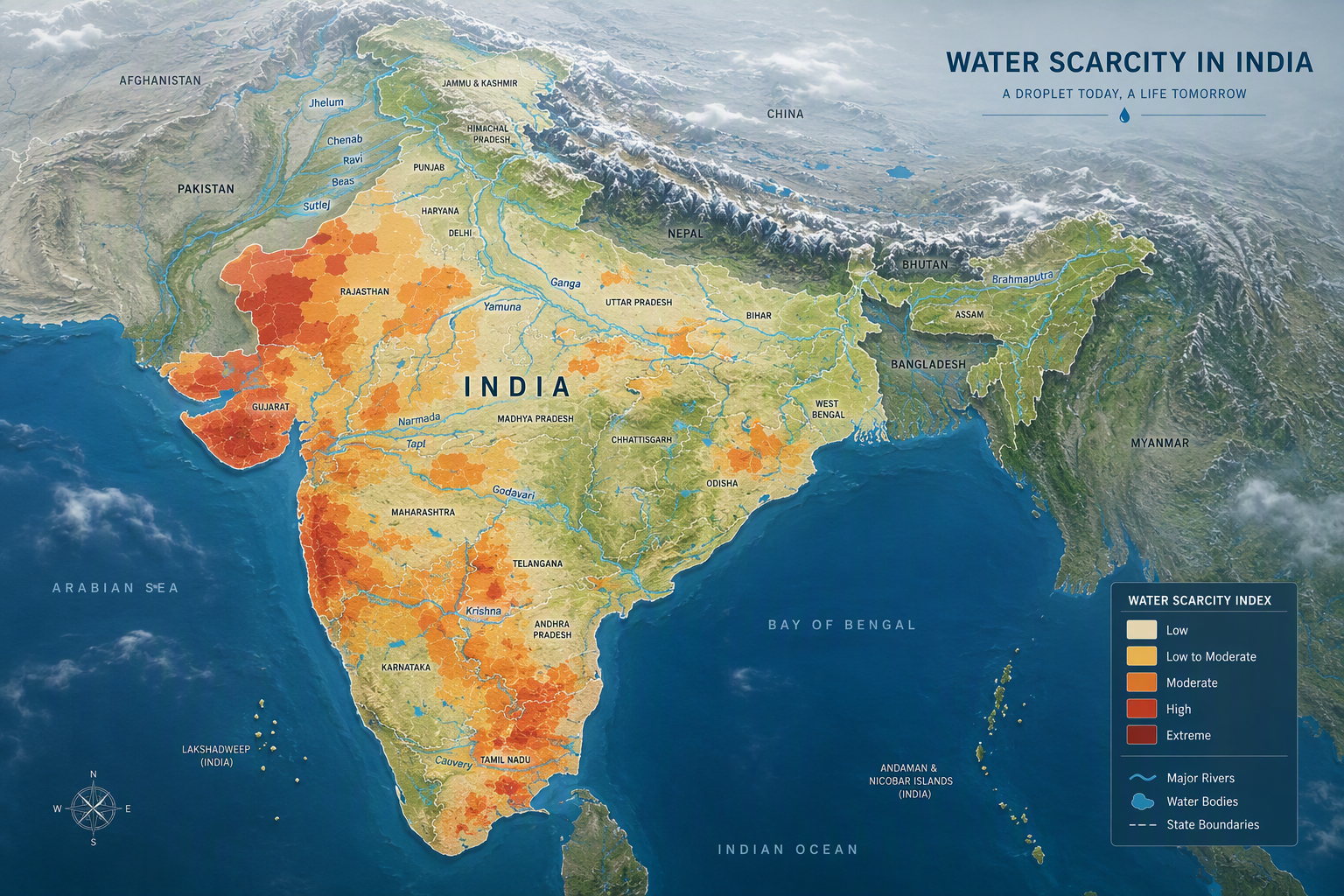
Water stress is not the same in all parts of India. There are some regions that have a lot of water problems. This is because rain does not fall evenly across the country, the ground water is weak, and some of the water bodies in those areas have been harmed or built over. South India is at more risk where rocky ground can not hold much water.
Water scarcity depends on farming, how cities grow, and how little water goes back into the ground. In Punjab and Haryana, using too much water for crops has made groundwater drop. Tamil Nadu does not have enough storage and often goes through dry times. States with many people like Uttar Pradesh and Madhya Pradesh now see more water demand.
- Tamil Nadu has stress again and again because storage is low and the ground water gets weak fast.
- Uttar Pradesh needs more water since a lot of people live there and there is a big need for farming.
- Madhya Pradesh has many places where water is a problem because the supply does not reach everywhere in the same way.
Insights from the NITI Aayog Report on Water Crisis
The NITI Aayog report uses the composite water management index to send a clear warning. The report says India is in the middle of the worst water crisis it has ever seen. This water crisis is not a problem just for some areas. It is a big national development challenge for all of us.
I have used the given keywords: water management, water crisis, composite water management, water management index, composite water management index, niti aayog, niti aayog report, worst water crisis.
The water management index put a spotlight on water scarcity, bad results, and how some states do much better than others. The findings showed that there is weak governance, dropping water levels, and low water quality. All of this is part of a bigger problem. The next two sections share the main findings and name the states that feel the impact the most.
Key Findings Shaping Water Security Concerns
The report gives clear points that are easy to remember for the UPSC exam. About 600 million people in the country face high or even extreme water stress. By 2030, the water demand could be twice as much as the water that is there. This shows why water security is important for the nation right now.
It also shows that there are weak management systems. Many groups work alone, storage is poor, and there are leaks. Pollution and using too much groundwater also play a part. These things make it hard to use water resources well. India does not do well on the water quality index. This means there are problems with water quality, not just access. A lot of the trouble comes from water contamination, too.
- India is now in the middle of the worst water crisis of its history.
- Every year, about 200,000 people lose their lives because they do not have safe water.
- A big part of the water that people get is not clean, which makes water management even harder for all.
States Most Affected by Water Scarcity
The report says that water scarcity is not a problem for just one state. It shows that this issue is seen in many parts of the country. Some states, though, feel it more because they have less water underground, more people, or not enough places to keep water. Places where people get most of their water from deep underground can be at bigger risk.
Tamil Nadu keeps coming up because dry times make it hard to get water, and the aquifers do not store much. Uttar Pradesh has to meet the needs of many people. There is also a lot of demand for water to grow crops. Madhya Pradesh is part of this chat because it tries to manage water stress and has trouble getting water to all areas.
- Tamil Nadu often runs low on water and feels strong pressure on what is there.
- Uttar Pradesh sees a lot of need for drinking water and for water used in fields.
- Madhya Pradesh has some places where there is not enough local water supply or refill that meet what they need.
Major Causes of Water Scarcity in India
India’s water scarcity is caused by both nature and what people do. As the number of people in India goes up, the water demand in homes, on farms, and in cities also rises. But the ways to get water and let it soak back into the ground have not kept up with this growth.
Groundwater depletion is a big problem. Too much extraction of groundwater, mainly for farming, is a key reason why several areas are in trouble. The NITI Aayog says that the crisis is also caused by pollution, cities growing, poor rules and plans, and changes in rain because of the weather.
Natural Factors Contributing to Scarcity
Natural conditions in India already put the country at risk. Rainfall comes at certain times and does not spread out evenly. A lot of places in India need the monsoon for water. When the rain pattern changes, less water goes into the ground and local water storage drops fast.
Climate change is making things harder. There are erratic monsoons, longer dry spells, floods, and droughts now. These events mess up how people get water and make it tough to plan ahead. They also hurt water bodies and upset the ecological balance that helps with water recharge and storage.
- Irregular rainfall means you can’t count on getting enough water each year.
- Climate change can cause more droughts and floods. This makes it hard for people to get water when they need it.
- Some places have weak natural ways to hold water, especially rocky aquifer areas. This makes it more likely for them to run out.
Human-Induced Challenges and Mismanagement
People are making the crisis worse and quicker than nature does. A lot of the problem comes from the way people use land, mainly for farming. This has caused the extraction of groundwater to go up. A good example of this is paddy fields in Punjab and Haryana. Paddy needs a lot of water, and these places are already under water stress.
Water governance is also a big problem. Surface water and groundwater are looked after by different groups. This can lead to poor planning. Bad city design, broken lakes, untreated sewage, and not enough good infrastructure make things worse. All these things put more stress on the already weak management systems.
- Using too much groundwater for farming has caused water tables to drop a lot.
- Encroachment and pollution have made lakes, wetlands, and ponds less valuable.
- In the past, before the Jal Shakti Ministry grew in its role, different groups worked alone and this stopped people from working together as one.
Impact of Water Crisis on Development
Water scarcity is a big problem that touches more than just what comes out of the taps or the water tanks. It slows down economic growth. It makes food security hard to achieve. It also puts public health at risk. When water is not safe, it spreads disease and raises medical costs. This hits poorer households the most.
The crisis also affects social stability and social justice. Some groups can get things they need all the time, but others cannot. Because of this, inequality gets worse. People in rural and urban India feel it, but the way it shows can be different. The next parts will talk about how this impacts communities, the economy, and the environment.
Effects on Rural and Urban Communities
Rural areas need wells, ponds, and underground water for farming and daily chores. If these ways to get drinking water stop working, women and children have to walk more to bring water home. When crops do not grow, the people lose money and feel less safe each day.
Urban areas see a different trend. Water shortages happen when the groundwater level goes down. Many people start to use water tankers. The tap water supply is not good, and lakes are often dirty. In big cities like Delhi, Bengaluru, Chennai, and Hyderabad, there is a lot of stress on groundwater. These cities often have problems with water supply and tap water.
- Rural groups are seeing a drop in their local water supply and farm production may change from year to year.
- People in cities often have a water supply that is not steady and have to rely more and more on outside sources.
- The lack of regular tap water can make things feel less fair for people, whether they live in villages or cities.
Economic, Social, and Environmental Implications
The cost to the economy is big. Water scarcity may cause India’s GDP to fall by 6% by the year 2050. Agriculture, industry, and services all need a steady water supply to work well. If there are problems with water, it can affect jobs, the prices of things, and the country’s economic growth in the long run.
Shortages of water often lead to fights between different areas, groups, and states. Arguments about rivers like the Kaveri and Krishna show how water problems can upset social stability and the way states work together. Poor families feel these issues first, so it is also a question of fairness.
- The loss of rivers, wetlands, and living things hurt the ecological balance.
- Water conservation and making sure water goes back into the ground are needed for things to last in the long run.
- When people in the community help out, it makes sure everyone does their part and takes care of what we all share.
Government Efforts and Water Security Initiatives
The Government of India is working to make water management better and help with water shortages. The Ministry of Jal Shakti now leads most work that is about drinking water, water saving, and settling arguments about water.
The main steps taken include Jal Jeevan Mission, Atal Bhujal Yojana, Jal Shakti Abhiyan, and the National Water Policy. All of these focus on bringing water to homes, raising water levels, saving water, and good planning. To see how these efforts work, let us talk about the main programs and what people learn while doing this work in the field.
Major Policies and Programs for Water Management
India’s latest steps show a shift toward better water management. Jal Shakti Abhiyan works on collecting rainwater, refilling the ground, and fixing old water sources across all districts. Jal Jeevan Mission wants to give more rural homes piped water. Atal Bhujal Yojana will help states, where water is low, use groundwater in a good way.
Other actions to help water resources are the National Water Policy, Namami Gange, mapping of water layers underground, saving wetlands, and Amrit Sarovars. All these efforts show that the country is moving from single-step plans to a better way of water resources management. Now, there is a focus on integrated water resources management that brings many ideas together for better care of water.
- Jal Jeevan Mission works to give tap water to homes in villages.
- Atal Bhujal Yojana helps people use and refill groundwater in a good way.
- Jal Shakti Abhiyan encourages people to save water and bring back small water storage places.
Success Stories and Lessons from the Ground
The material shows that there are useful ways to solve problems, not just one great example for the whole country. Old ways of saving water like Ahar Pynes in Bihar, Johads in Rajasthan, and Kudimaramath in Tamil Nadu tell us that water conservation gets better when people in a community join in and do things together.
There are some important things to learn from new water policies. Tamil Nadu made rainwater harvesting a rule, and this model is seen as helpful for others. The Swajal model in Uttarakhand and the online water dashboard in Andhra Pradesh show that water governance gets better when people in the community take part and when we use real-time data.
- The old ways can help the ground water fill up and help keep water nearby.
- When town builds more tap water connections, there should also be work to keep water sources from running dry.
- Safe drinking water gets better when local groups and people take care of it together.
Conclusion
To sum up, fixing water security in India is not just a big task, but it is also key for sustainable development. Water scarcity is something that can hurt both people in cities and in villages. It can also harm our economy and nature. Climate change and what people do each day keep making this problem grow. So, it is very important to use good policies and take action now. We need to take the time to learn about water resources and why they are in danger. When people work together, solutions can be found. If we keep talking about water scarcity and choose new ideas, we can help save this important resource. Let’s do our part to protect water for us and for people in the years to come.
Frequently Asked Questions
How has per capita water availability changed over the years in India?
India’s capita water availability is getting less over time. In 2021, it was about 1,486 cubic metres. Experts say this number will drop to 1,341 by 2025 and could go down to 1,140 by 2050. This fall in water supply puts stress on water resources and drinking water access. It also impacts how states do in the water management index, which tracks water management in the country.
How does India compare globally in terms of water security?
India makes up about 17% of the world’s population but has only around 4% of its global freshwater resources. This big gap leads to high water stress for the country. The composite water management index, along with low water quality scores, shows that Indian cities and rural places feel more pressure than many areas in the world that have better water management.
What are the recommended reforms to tackle India’s water crisis according to the NITI Aayog report?
The way forward discussed by NITI Aayog talks about the need for stronger water governance and more control over groundwater. It covers water resources, water conservation, rainwater harvesting, mapping the aquifer, and making sure people take part at the local level. The National Water Policy and the idea of integrated water resources management are also key. These things help us link together the water supply, quality, recharge, and long-term planning for our water resources.