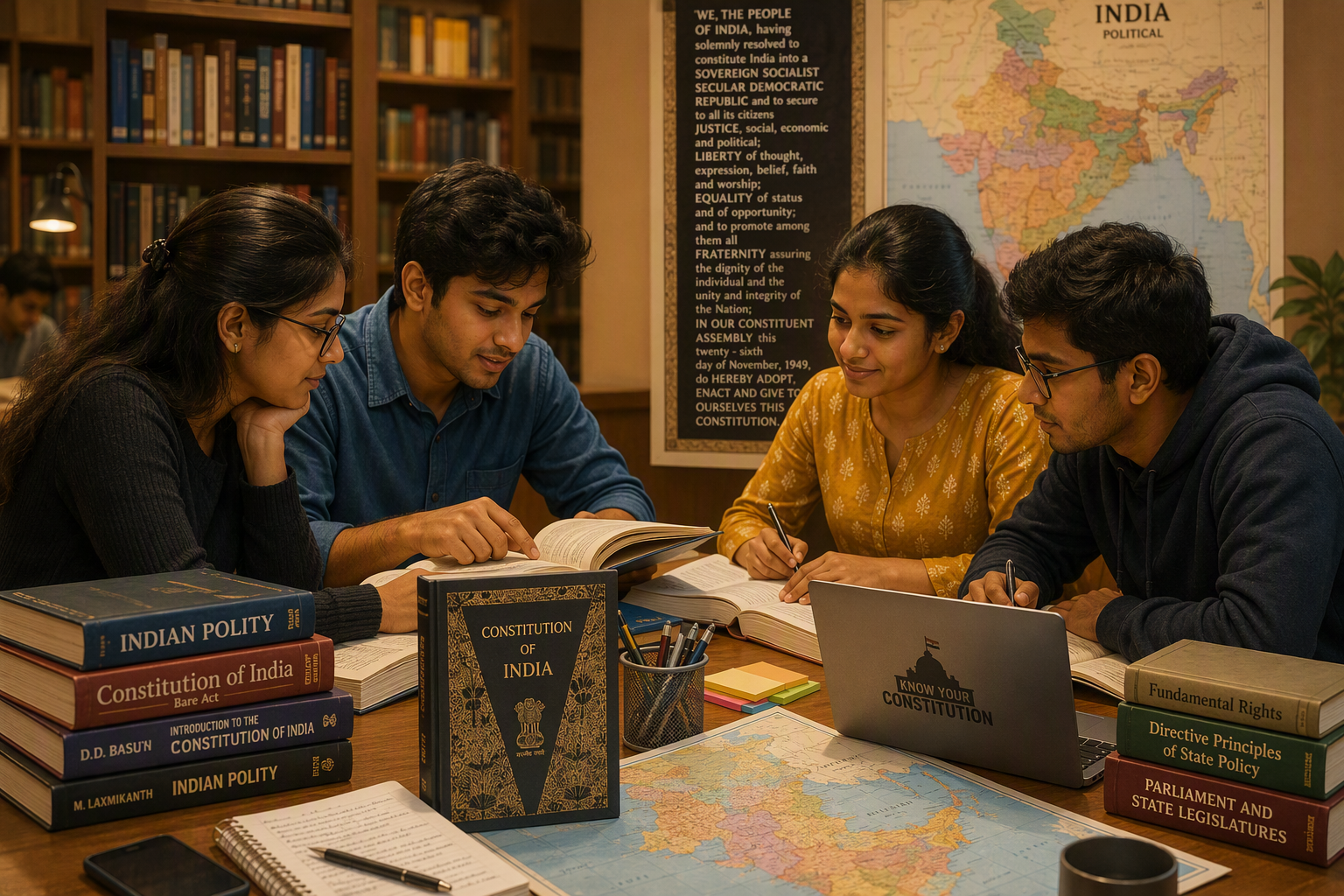
Key Highlights
- Indian polity is one of the important topics for UPSC prelims 2027. A lot of the questions are from clear constitutional provisions.
- You have to read the Indian constitution, parliament, judiciary, constitutional bodies, and local government.
- Fundamental rights, DPSP, and constitutional amendments are must-learn sections for the UPSC prelims.
- Recent developments, supreme court decisions, and government policies often come in statement-based questions.
- Previous year papers help you know repeating indian polity themes and exam patterns.
- A smart way to revise is to read static facts with current affairs at the same time.
Table of Contents
Introduction
If you are getting ready for the civil services exam, then you should not skip polity. In UPSC Prelims, knowing the basics of polity can help you get good marks. Many questions in the test are about the Indian Constitution, constitutional structure, and public institutions. So, you need to study the main ideas well. This guide will show you the important polity topics you need to read for UPSC Prelims 2027. It will help you to focus on key things and not feel lost with so many subjects.
Indian Polity for UPSC Prelims 2027 – Overview of Key Areas
Indian polity is a big topic in the prelims exam. You will find it many times in the general studies paper. Questions there are sometimes about ideas, and sometimes you get statements to read and answer. You need to look at the history of the Constitution. Make sure you read about fundamental rights, Parliament, the judiciary, and constitutional bodies.
Constitutional amendments, federal relations, emergency provisions, and local government are very important for your UPSC study. The UPSC connects these main topics with current affairs. So, it is important to read about recent developments in governance and learn about big court decisions. The next sections will break down each area to help you understand them better for your preparation.
Relevance and Weightage of Polity in UPSC Prelims
Polity plays a big part in the UPSC Prelims. A lot of its ideas do not change, so you can read it more than once and feel good about it. This makes Polity a bit easier to get for civil services than other topics. In the civil services examination, if you take the time to know things well, it really helps. When you read the Constitution in detail, you may find that you can answer many questions. Some might look hard at first, but with practice, they get easier.
A good way to find important topics is to read previous year papers closely. You can look at areas that come up often like fundamental rights, Parliament, the President, the Prime Minister, the judiciary, constitutional bodies, and emergency provisions. When you do this, you learn about the exam pattern. It will help you not to study in a random way.
| Polity Area | Why It Matters in General Studies |
|---|---|
| Fundamental Rights and DPSP | Frequently asked through article-based and concept questions |
| Parliament | Very high priority, often tested every year |
| Union Executive | Powers, roles, and limitations are commonly examined |
| Judiciary | Important due to judicial review and recent developments |
| Constitutional Bodies | Popular for statement-based questions |
Recent Syllabus Updates and Trends in Polity
There is no new update for the polity syllabus for UPSC Prelims 2027 in the shared details. But, you should not keep your way of study the same as before. The exam pattern for UPSC prelims often changes. Many times, they ask questions that check how you think about statements and ideas.
The most important thing is to look at the trend. Recent developments, constitutional amendments, and government policies are now more linked with the main topics in polity. You should not read the Constitution by itself. It is better to connect each important topic with what is going on right now. Think about how the government works and how it runs its main bodies.
In the past few years, polity questions ask more about what things mean instead of just facts. You have to read articles, look at powers, check bodies, and go over steps to see how it all works for real. This helps you feel ready, even if the syllabus stays the same.
Constitutional Framework – Essential Topics
The base of the constitution of India is very important. It helps to hold up the whole system. This topic is good to study for the Prelims. You often get questions on how the constitution was made. There will also be questions on its main parts, big articles, and some key constitutional provisions. These constitutional provisions say how things work in the country.
You need to look at the Constituent Assembly. See how changes can be made. Study the schedules. Understand the basic structure doctrine. These parts help you answer both clear and hidden questions. The subtopics below show what you should focus on most.
Historical Background and Making of the Constitution
Start here and connect modern history with polity. UPSC asks you to learn how British laws helped make the government of India. First, read about the Regulating Act of 1773. Then look at Pitt’s India Act of 1784. After that, check the Charter Acts. Next, study the Indian Councils Acts. Also, go over the Government of India Acts, like the ones from 1919 and 1935.
Next, look at the steps in politics that led to the Constitution. Some big events in this time were the Cripps Mission and the Cabinet Mission Plan. You also have to see how the Constituent Assembly came to be. It is important to learn who was in the Constituent Assembly. Know about the main groups inside it. Dr. B.R. Ambedkar had a big role with the Drafting Committee.
Finally, know that the Constitution has its roots in the past and 26 January 1950 is a key date. This matters because it helps you see how parts like constitutional amendments, the federal feature, and rights come together. While ancient history is not a part of this, the UPSC may check if you can tell how constitutional history is not the same as other old history topics.
Salient Features and Amendments
This topic is one of the important topics in polity for UPSC Prelims 2027. The UPSC often asks about the features of the Indian Constitution. The test can look at where the federal part and unitary part join. You have to read Article 368 and know the steps to change laws in the Indian Constitution well.
Another key area is the basic structure doctrine. This makes it possible for UPSC to ask what Parliament can or cannot change. Big constitutional amendments are also often seen, especially when they change how the government works, affect people’s rights, or change local groups or systems.
Focus on these amendments and features:
- The government in our country works in the Parliamentary way.
- It has both federal and unitary features.
- The idea of the basic structure comes from the basic structure doctrine.
- There have been many changes over time: the 42nd, 44th, 73rd, 74th, 86th, and 101st amendments.
- The Constitution has different parts, and there are 12 Schedules in it.
Preamble and its Significance
The preamble in the Indian Constitution is short, but it is important. It shows how the state thinks and gives a feel for justice, liberty, equality, and fraternity. In the Prelims, UPSC can ask questions to check what you know about the words, what these words mean, and how they link to other constitutional provisions in the Indian Constitution.
You need to read the preamble and see how the larger setup of the constitution works. The ideas there link to things like fundamental rights, directive principles, and how democracy happens in India. Sometimes, there are questions about what values like secularism are. This ties back to freedom of religion.
Do not think of the preamble as just a nice way to begin. The preamble helps you get what the Constitution is all about. It can help a lot when you have questions that ask what things mean. If you study law or government, the preamble can make it easy for you to connect and remember more things later on.
Fundamental Rights, Duties & Directive Principles
This part is important in the Prelims. The questions can be about fundamental rights, fundamental duties, human rights, and directive principles of state policy. These things matter because they are in the constitution. They also tell the state what to do. The way people are treated in life is linked to all this.
You have to be ready for the articles, the key ideas, and how they link with each other. The Supreme Court has been important in telling us what these things mean. The subtopics below will help you go over what you need for the exam in a clear way.
Fundamental Rights and Latest Supreme Court Judgments
Fundamental Rights from Articles 12 to 35 are very important topics in polity. The UPSC likes to ask many kinds of questions about these. You can get both easy and hard questions about equality, freedom, safety, freedom of religion, rights for culture and learning, and rules under Article 32.
These fundamental rights give people the freedom of religion. People can practice their own faith in the way they want.
There is a clear trend now. The Supreme Court is playing a bigger part in how we look at our rights. So, it is good to check your knowledge about these rights. Go over big Supreme Court decisions. Learn about writs. See how rights connect to the basic structure of the Constitution.
Human rights topics can also show up in current affairs.
Focus on these areas:
- The Right to Equality, the Right to Freedom, and the Right against Exploitation all play a big part.
- People get the freedom of religion. They have cultural rights and education rights too.
- There is the Right to Constitutional Remedies. Article 32 helps to keep these rights safe.
- Writs help people when needed. These are Habeas Corpus, Mandamus, Certiorari, Prohibition, and Quo Warranto.
Fundamental Duties – Key Points for Prelims
Many students do not give enough time to the fundamental duties. This can be a problem. The Constitution of India talks about this in a small section. It is helpful for questions in prelims. UPSC often gives questions with statements. So, you should read these duties with care.
When you get ready for civil services, read fundamental duties with rights and DPSP. Do not read these things by themselves. When you read them together, you see how what people must do fits with what the government must do. This helps you feel the balance in their jobs. It also makes it easy to pick the right answer if two choices seem alike.
This place is not large. That might help you. Try to read again about the idea and see where it fits in the constitution. Learn how its jobs be part of the government of india and how it makes life better for people. If you read short topics more than once, you can get good marks.
Directive Principles of State Policy (DPSP)
Directive principles of state policy are important as they show what the state should aim for. These are not enforced in the same way as fundamental rights. The UPSC often asks about what these mean, how the groups are made, and how they link with state policy and how the people run things. These ideas are at the heart of social justice and the way welfare works.
You should connect DPSP with state policy and government policies. Many welfare steps, development aims, and reform ideas can seem clearer when you see them through the lens of the constitution. This helps you get a better idea of why these things happen. So, when UPSC gives a question about public policy, you will understand what they want.
You should also look again at how the DPSP and fundamental rights go together. This topic comes up many times. It checks if you know how the Constitution makes things fair. If you want to get your basics right in polity, you need to spend good time on this when you read again.
Union Government – Structure and Functions
The union government plays a big role in politics. UPSC asks many questions about the executive and the legislature. You should know what the President, Vice President, Prime Minister, Cabinet, and Parliament do. Also, it helps to know the main parliamentary procedures.
This part will be easy if you see powers, limits, and how groups work with each other at the same time. Parliament gets a lot of focus, so the next topics are about the things you see a lot in Prelims questions.
President, Vice President, and Prime Minister – Roles
The President, the Vice President, and the Prime Minister are key people in the Union Executive. Many UPSC questions can be on them. You need to read about how they are chosen. You should also know their powers, what they do, and where they are placed in the constitution. For prelims, no detail is too small. So read well, pay close attention, and make sure you understand the prime minister and vice president too.
Pay attention to what power the President has to make new rules, say no to bills, and do things when there is an emergency. You should also look at what the Vice President does and how he or she can be removed. If you are studying about the Prime Minister, know that the UPSC often asks about the Prime Minister’s power, the Prime Minister’s role as the head of the Cabinet, and how much real control the Prime Minister has in the system of government.
Revise these areas well:
- President: how the election works, what veto rights he has, and what he can do using his ordinance power.
- President: the part he has in emergency provisions and what emergency powers he gets.
- Vice President: what jobs he does and how he may be removed.
- Prime Minister: his powers, what he does, and how he leads the Council of Ministers.
Parliament – Lok Sabha & Rajya Sabha Focus Topics
Parliament is a big deal, and in recent years it gets tested often. You have to get ready by knowing about lok sabha and rajya sabha. Learn how both are made. Know the rules to be a member, and why some people can’t join. Find out what makes lok sabha and rajya sabha different. A lot of times, these basic facts are in questions that look hard.
Next, learn about parliamentary procedures. You will want to know about Question Hour, Zero Hour, joint sitting, privileges, parliamentary committees, and the budget process. UPSC often asks what types of bills there are. This has Money Bills, Financial Bills, and Bills that change the constitution.
The anti-defection law is in the Tenth Schedule. People feel that this law also needs another look now. This topic is an important part of the system of government that you read about if you study for exams. The exam pattern often has many questions about it. If you know the basics of Parliament well, you will feel good about many polity questions.
Cabinet & Council of Ministers
If you want to look at what matters most in polity, start with the Cabinet and Council of Ministers. Put the prime minister and Parliament on your list too. These are at the heart of how the government of India works. They are important because they help you get a better idea of both public administration and polity.
You need to know what collective responsibility is. It matters to see how the prime minister, Cabinet, and Council of Ministers act together. The UPSC may ask to find out if you get the rules and roles of each group. Sometimes, this comes up even if the question looks simple.
This part is not too hard. But it can feel confusing if you try to remember things without seeing how the levels fit together. So, go over it by looking at how groups join up in a company or group. You will get who makes big choices. You will know who has to answer for things. You will see how people in charge really do their jobs.
State Government and Local Administration
UPSC asks you to read about more than only the Union level. You have to know about the state government, the chief minister, the state legislature, and the local government. These points are a big part of the syllabus. A lot of questions see if you can compare the Union and state groups in a clear way.
You need to know about the Governor, Chief Minister, panchayati raj, how laws are made in the states, and the main groups in cities. These topics matter a lot when the UPSC asks about federalism or law changes. Let’s look at them one by one.
Governor and Chief Minister
A good way to get going is to read this topic right after you read about the Union Executive. This helps you see how the two are alike or different. The Governor and the chief minister matter a lot. They help show how the states work and how the rules are made in India.
You need to look at how the Governor works. You also need to know what powers he or she has. It is good to see where the Governor stands next to the government that people choose. UPSC can link the Governor to emergency provisions. This is mainly important when the way things run at the state level matters for the rules. Most of these questions come as statements.
Learn about what the Chief Minister does and what powers this role has. Find out how he can use his powers for the state government. See how the Chief Minister’s job is tied to state policy and how the cabinet works in the state. If you know about both the Union and state executive well, then getting the right answers in the Prelims will be much easier.
State Legislature – Structure and Powers
The state legislature is a small but important topic for UPSC Prelims 2027. It is good to know how the state legislature works. You have to see what it can do and how it connects with the state government. In UPSC Prelims, you may get questions about the difference between making laws at the state and making laws at the national level.
This part will be more simple if you look at it by comparing things. You should check how parliamentary procedures work in the state government. You can also look at how government policies get support from the rules made by the lawmakers. UPSC wants to see if you get the big ideas, and not just some facts, so it is important to know how things connect.
Do not skip any basic things here. At times, you may think a question is short, but you should know about the legislative power. It is also good to know how things happen and what the basic setup of the constitution is. This topic helps people learn about bigger things, like federalism and the way the country is run. It also talks about the link between the center and the states. You may get these kinds of points in the exam.
Panchayati Raj & Urban Local Bodies (73rd and 74th Amendments)
Local government is very important because it connects panchayati raj, constitutional amendments, and the way things are done. The 73rd and 74th constitutional amendments are key for your exam. You should read about panchayati raj and urban local bodies. This will help you see how things get managed near the people. These give people a way to make and run things at a small level in the country.
The UPSC often has questions about the powers, groups, and rules about reservation in these changes. This topic is also linked to state votes and money systems. The scope of this topic is clear and limited. If you read it well, you can score well in this part.
Focus on these points:
- The panchayati raj structure lets local people take part in running the places where they live.
- The Gram Sabha can talk about and share ideas on plans and how money will be used.
- The State Election Commission makes sure panchayati raj and municipal corporations have fair and open voting.
- The State Finance Commission tells panchayati raj and municipal corporations how to use money for the work they do.
- Urban local bodies, like municipal corporations, take care of cities. There are rules so all groups can join in.
Judiciary – Key Topics for Prelims
The judiciary is a key topic in polity. UPSC often puts together old ideas and new changes in this area. You need to read about the supreme court, high courts, subordinate courts, and judicial review. Learn what the constitution says about these courts. Make sure you get these topics well and also keep up with recent developments.
This area is now getting more attention because of recent news and big court decisions. If you know the way the courts work and what they can do, you will find it easier to answer many questions based on statements. The next parts talk about some tips that will help you most for Prelims preparation.
Supreme Court & High Courts – Functions
The Supreme Court and High Courts play a key role in how the judiciary works in India. It is good to know the structure of each court, what power they have, and what jobs they do. A simple comparison can help you see what each court does and who gives them their power. The UPSC wants to see if you know about the role of the supreme court and high courts and where they fit in the system.
This topic is about appointments. It talks about how the Supreme Court works and how judges are picked by the collegium system. You need to know about high courts and subordinate courts as well. UPSC can ask you about these, sometimes in easy ways and sometimes in tricky ways. So, do not skip reading about high courts and subordinate courts.
Recent developments make this topic stand out even more. When courts are in the news, the UPSC can ask about the main rules from the Constitution that are linked to these events. So first, read about the powers and what courts can do. Then, connect them with big ideas like rights, the way we are governed, and judicial review. This will help you see how current affairs are tied to these topics.
Judicial Review and Activism
There is a big change in the UPSC prelims over the years. Now, there are more questions about constitutional provisions. A lot of these are on courts and how they make sure rules be followed. You may get questions on topics like judicial review and even judicial activism. These show how courts check the wrong use of power and make sure people follow what is written in the Constitution.
This topic is important if you are getting ready for civil services. It helps you see how the courts connect with the way a country is run, people’s rights, and how groups get along. Judicial review links to the basic structure. The basic structure doctrine is found in many statement-type questions in UPSC exams.
Revise these points carefully:
- Judicial review is when the courts check if the laws and government actions match the constitution. The main role of judicial review is to make sure the government follows the most important rules set out in the constitution.
- Judicial activism is when courts take more part in fixing issues in society. PIL, which means Public Interest Litigation, lets people bring big problems to court, even if these matters don’t affect them in a direct way. This lets the court take steps that can make life better for many people.
- The idea of judicial review comes from constitutional provisions. These are the laws and rules written in the constitution that give courts the power to see if any law or government step is against the constitution.
- Judicial review links with the basic structure. The basic structure doctrine says the government cannot change or damage the core part of the constitution. Courts use judicial review to protect this basic structure and make sure it stays the same, no matter which government is in power.
Important Recent Cases and Constitutional Interpretation
There may not be any official updates to the syllabus. But, recent developments have made it important for you to know how the Supreme Court looks at the Constitution. When you read about polity, do not just read what the law says. The UPSC wants answers that connect the text of the law to how the Supreme Court uses it in practice.
Instead of just trying to keep case names in your head, you should try to understand what problems courts really deal with. The courts hear real issues about basic structure, human rights, how institutions have power, and fundamental rights. This way to study works better for Prelims. For the Prelims, the questions are usually from key ideas, not from long legal details.
If you want to know if recent cases matter for upsc prelims 2027, the answer is yes. These cases show you what is going on right now. They help you get the Constitution in a better way. You can also match what you read in the Constitution with how the government and courts act.
Constitutional & Non-Constitutional Bodies
Constitutional bodies are an important topic in politics. The UPSC often asks easy and straight questions about them. It is good to read about the Election Commission, UPSC, Finance Commission, and CAG first. These bodies are the most important ones and come up often in the exam.
You also need to learn about non-constitutional bodies. UPSC likes to ask questions where you have to compare these bodies. The main thing is to know which one is in the Constitution and which one is not. If you know this, you can avoid small mistakes. The next two parts will tell you about the important bodies you need to read for this topic, including constitutional bodies.
Election Commission & UPSC
If you want to make a list of what to read first for general studies, start with the Election Commission and the Union Public Service Commission. These two are very important. You will see questions about them in many competitive exams. It is easy to know when they come up in tests like UPSC.
The Election Commission is important. It plays a key part in keeping democracy and making sure elections are fair.
The Union Public Service Commission is about more than just the exam. It holds a special place in the constitution. You need to learn about its jobs and rights as well.
A good way to look at these bodies is to break them into three parts. First, what the constitution says. Second, what they do. Third, where they have power. This makes it easy to understand and saves time. It also helps you remember things fast. Since these bodies are about facts and ideas, you can read them quickly. This is good for mock tests or your real exam.
Finance Commission, CAG, and Other Bodies
Finance Commission and CAG be two of the main constitutional bodies to read about for Prelims. UPSC many times make questions about the National Human Rights Commission, National Commission for SC/ST, Central Vigilance Commission, Lokpal, and Lokayuktas. The question can be about what these bodies do and how they work.
These put focus on constitutional bodies, human rights, national human rights commission, and national commission.
To read about these topics, it is good to start with the standard study material. After that, you should check previous year papers and the official website if you want more practice. A simple way to understand this topic is to put the bodies into two groups. One group is constitutional, and the other is non-constitutional. This can help clear up a lot of confusion.
Keep these bodies in your notes:
- Finance Commission
- Comptroller and Auditor General (CAG)
- National Human Rights Commission
- National Commission for SC/ST and other big groups
Conclusion
To sum up, you need to know the main topics of indian polity if you are getting ready for upsc prelims in 2027. The indian polity system is very important for our government. It is also a big part of the types of questions they ask in the exam. You should read about the rules of the constitution, read about new court rules, and also read about how the government works at the state and the national level. Doing this will help your study plan a lot.
It also helps to look at any changes in the syllabus and see what new things come up. This can give you an edge in your studies. If you want to do well, make a plan and try to study every day. Working hard over time really helps you get good results. If you want to get better at your preparation, you can book a free talk to get some ideas made just for you!
Frequently Asked Questions
Which polity topics have the highest chance of being asked in UPSC prelims 2027?
In the UPSC Prelims, there are some important topics in indian polity. These are fundamental rights, parliament, constitutional amendments, emergency provisions, judiciary, and constitutional bodies. When you check previous year papers, you will find these come up again and again. So, you should have these as your main focus to match the exam pattern and do well in the test.
How should I prioritize polity subjects for UPSC prelims preparation?
For UPSC preparation, begin with the Constitution. Next, read about fundamental rights, Parliament, Union Executive, and the judiciary. After this, move on to state government, local bodies, and constitutional bodies. Use mock tests often. Keep doing revision to know which areas need more work. This way will help you for general studies and other competitive exams.
What are recommended sources for studying key polity topics?
Use only a few study material when getting ready for civil services and the GS paper. Rely on previous year papers for practice. Check the official website to get real updates about institutions or anything to do with the exam. Your sources should help you go over constitutional provisions, know key bodies, and look at common polity topics. This way, you will not put too much work on yourself. Stick to what comes up in previous year papers to keep your work simple and useful.