Key Highlights
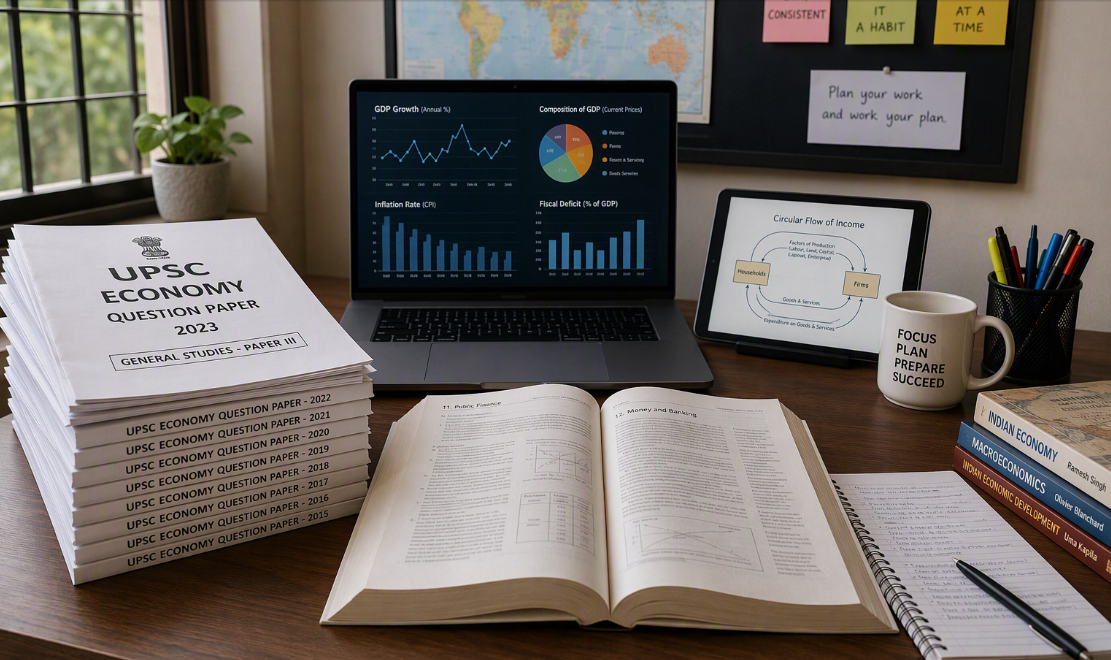
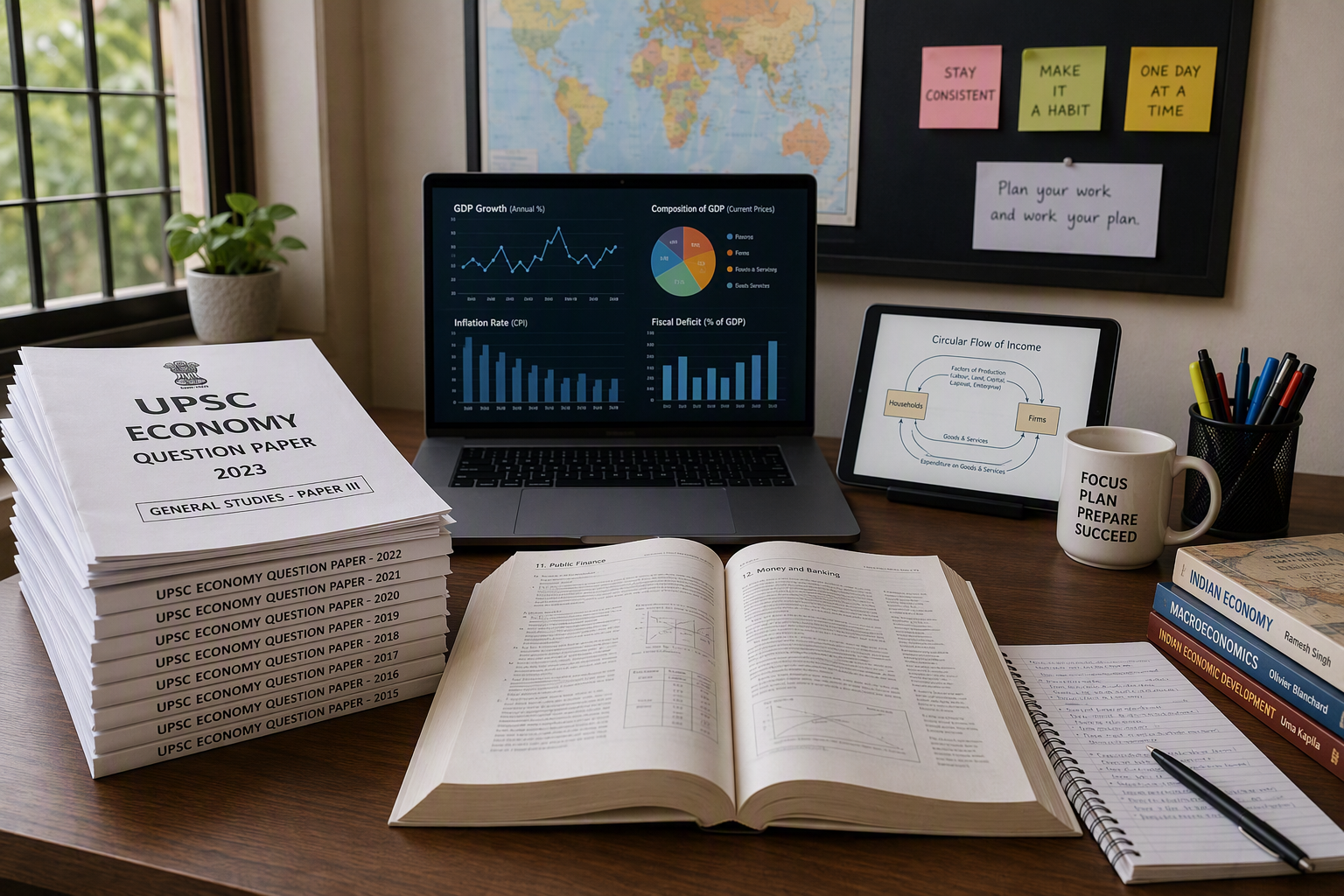
- This guide talks about upsc prelims economy questions from 2020 to 2025 by looking at past exam papers.
- It points out the parts that show up again and again in the indian economy, economic development, banking, and public finance.
- You get a year-wise and topic-wise look, so it can help you revise and practice in a better way.
- The blog shows how the Prelims question types match with what is asked in Mains, so you get a good way to prepare.
- It stays on the upsc prelims syllabus, shows important previous year (PYQ) questions, and goes over topics about the government of india.
- Current affairs, government schemes, and policy news get extra attention where they can change how questions are asked.
Table of Contents
Introduction
If you want to get ready for upsc prelims, the indian economy may feel big and hard to get. This guide is here to help you. It puts previous year questions from 2020 to 2025 in easy parts that you can read and understand.
You will see how the ideas in the indian economy match with the upsc prelims syllabus. You can read about what is going on right now and what the government of india wants to do. The guide uses words like the real test, so you get practice that is easy to read and good for you.
Get help to see what indian economy topics show up often, what the government of india is working on, and feel ready to do well in your exams.
Overview of UPSC Economy PYQ Prelims 2020-2025
In recent years, the upsc prelims questions on the indian economy have not been just about theory. These questions bring in both basic ideas and real-life situations. When you look at previous year papers, you can see that the questions join topics like economic development, banking tools, inflation, trade, agriculture, and public finance.
That is why it is good to look at the exam from 2020 to 2025. You can see what has stayed the same and what has changed in this exam. The next parts will go over these things. They will talk about the patterns in the exam. They will also look at the syllabus. You will get some ways to get ready for it too.
Importance of Economy PYQs in UPSC Prelims Preparation
Start with the previous year papers. These papers help you see what UPSC prelims ask most. You do not have to read the whole economy topic with no plan. When you look at the papers, you find out which things come up over and over. This lets you use your time in a good way and makes your revision better.
Another good thing is that you get better at finding patterns. You will see that questions about economic growth, inflation, banking, financial inclusion, and government plans often have answer choices that are almost the same. If you practice with past year questions, you can start to see small changes in the ideas. This helps you not just guess the answers. You feel more sure about what you pick.
Here is how you can use previous year economy questions for your UPSC Prelims prep. First, put all the questions into groups by topic. Then, match each question to the syllabus and your notes. After that, read that part again, try the questions again, and check why the other options are wrong. This method helps you remember answers and also shows you how to leave out the wrong answers in the UPSC Prelims.
Analysis Period: 2020 to 2025
The 2020 to 2025 timeline is good to see what has come up in the upsc prelims in recent years. With this, you can look at how topics like inflation, banking, taxation, agriculture, and the external sector are there again and again. It also helps you see how current affairs shape the kinds of questions they ask.
Looking at this time helps you see what parts of the indian economy are old and what things are new now. Many questions still need you to know what is in the indian economy syllabus. Now, these questions are also linked to things like policy, reports, and topics about the budget.
This time matters a lot when you look at how questions have come up in the UPSC economy mains papers across the years. The Mains exam often makes these topics more important and asks you to write more about them. When you read both at the same time, you get to see how one idea can be asked in Prelims as a short question and also as a long answer in Mains.
Structure of Economy Questions in Prelims
In UPSC prelims, the economy section uses a few main ways to ask questions. You might see questions that use statements. Sometimes, you will find questions that ask for a clear meaning of a word or idea. There are also questions where you need to use what you know in real life. Some questions may tie a big idea to a government policy. All this shows that you need to know the facts and also understand what they mean in upsc prelims.
Many questions will ask if you know how to tell two things apart that sound close in meaning. For example, you will see tools that are used in monetary policy and tools that are used in fiscal policy. There may also be questions that show direct investment and another option like portfolio flows. Some questions will not ask for the textbook meaning. Instead, they will ask what a certain action does.
Yes, you can find recent UPSC Prelims economy previous year questions with answers explained. But the smart way to read these is to look for patterns. You should ask what idea is being tested. Think about why one choice is right. Try to notice which word in a choice can change the answer. Doing this practice can help you get faster and more right answers.
Role of Previous Year Questions in Cracking UPSC
Many people read a lot for the upsc prelims. But there are still some who do not get the exam trend. This is why practice with previous year questions is so important for your exam. These questions show how upsc prelims need you to use what you read, not just remember the syllabus.
They are very helpful for topics about economic development. Many times, the options you get can look much the same. PYQs can help you see how the person making the test can change the words. They also show how the test maker can mix things from before with new things. This will test how sure you are about basic ideas when you feel stress.
Use them in a structured way:
- Try to solve sets for each topic before you take full-length mocks.
- Mark points that show up again and again for economic development and banking.
- Write one simple takeaway under every question.
- Go over wrong answers after each practice session.
- Keep track of tricky parts in statement-based upsc prelims questions.
When you practice PYQs many times, they are not just old question papers. They can guide you and help make your preparation better.
Evolution of Pattern in Economy Section
Yes, there are some repeating patterns in economy questions in the UPSC Prelims. In recent years, the questions mostly cover inflation, how banks work, the outside part of the economy, help for farmers, taxes, and how welfare is linked with economic development.
Now, the way these topics come in the exam has changed. You will not get many short recall questions these days. Most questions still use the same topics as before. But now, they are often mixed with things like government policies, reports, or news that people talk about in policy. This makes the questions harder, even when there is not much change in the main syllabus.
You will notice that nlp words from the syllabus will show up often in many ways. A topic like fiscal deficit can appear again as revenue receipts, public debt, or budget management. So, this is not by chance. There are layers to it. That is why looking at PYQ analysis can be so helpful.
Understanding the UPSC Prelims Economy Syllabus
Before you start to work on lots of questions, you should know what is in the UPSC prelims economy syllabus. The indian economy part in the UPSC prelims has things like ideas, groups, areas, planning, changes, budgeting, trade, and growth. So, you need a plan that helps you read each topic step by step.
It can be good to see how monetary policy and fiscal policy fit into a bigger plan. When you know the syllabus well, past year questions get a lot clearer. The parts below show the syllabus as simple areas you can read and practice.
Microeconomics and Macroeconomics
Microeconomics and macroeconomics are the base you need when you get ready for the economy part of upsc prelims. In microeconomics, you learn about supply, demand, how easy it is to change the amount you buy or sell, how people act when they buy things, how people act when they sell or make things, and types of markets. These topics help you see how choices made by people and firms build and shape markets.
Macroeconomics focuses on the big picture numbers. In this subject, you learn about things like national income, growth rate, inflation, and unemployment. You also learn about exchange rates and large trends in output. Words like GDP, GNP, and growth rate are very important here. You need to know these terms if you want to study the economy on a national level.
The exam does not always start with theory questions. A question about inflation, taxation, or banking often comes from the basics in macroeconomics. This is why you should not look at these topics as separate chapters. They are the base for the indian economy syllabus.
Indian Economy – Key Focus Areas
The indian economy part of upsc prelims is huge, but some topics come up a lot. You will find national income, inflation, agriculture, industry, banking, taxation, the external sector, planning, and development linked to welfare. If you know these topics well, you will cover most of the important areas.
A good way to learn is to link each topic to budget management and what the government does. For example, you can talk about inflation and connect it with actions taken with money. You can also link public finance to things like deficits, revenue, and spending. This way, it is easier for people to remember these facts.
You need to watch for places where the government of india is part of the syllabus. This is about things like reforms, schemes, planning groups, and steps shown in budgets. In the exam, it is often good to know facts when you put them in a policy or development setting.
Government Schemes and Policies
It is good to learn about government schemes because many questions in the economy ask how you can use these ideas in real life, not just their meaning. In the past years’ questions, you see how things such as help for people, help for farms, giving money, and sharing things are all connected. This is where easy ideas come together with rules and plans that the people use.
If you want to know about the main topics in the indian economy for upsc prelims, you need to focus on schemes and policies. There are always questions on food security. You might get questions on how the government of india buys crops from farmers, and how they set prices for agriculture. Some questions are about jobs and help given to people. Many questions are about how the social sector works in india.
Key areas to revise include:
- The minimum support price and support price ways help the farmers get a fair price for the crops they grow. The government sets these prices to help make sure that people who grow food feel safe about the money they get. This also helps make life more stable for them.
- Food security is about making sure all people have enough food to eat. The public distribution system helps reach this goal. The government gives food at low prices to the people who need it most. This helps many families get their food every month.
- The national food security act and the idea of issue price mean the government promises to give food grains at low prices. These prices are set so people who need help can get it. The Food Security Act makes this right strong for many people. It helps give them the food they need to live better.
- When we talk about planning and government programs for people’s well-being, there are many steps taken. These programs help link food and health, so people feel safe. The government works hard to make sure food security reaches everyone through these public distribution system schemes.
These areas are important because they bring farming, poverty, money plans, and rules all together. This way, we can look at everything as one big picture.
Banking and Financial Institutions
Banking is an important topic for the upsc prelims economy. You need to know about the reserve bank of india and the different types of banks. You should be clear on how rules are set, which tools control money flow, and what new things have changed in the banking area. The upsc prelims may ask you questions straight about this, or mix them with other topics about how policies work.
The syllabus is about financial institutions. This does not mean you should learn only about banks. You also have to know about intermediaries, insurance bodies, and people who watch over the capital market. If you see Bank of India in the text, it is there to see if you understand the ideas. It is not just about facts for one institution.
Do not forget the money market because it is important. UPSC wants to know if you understand how short-term funds, ways for people to get cash fast, and ways of handling money all work together. If your banking notes talk about money supply, inflation, and how changes in policies move from one area to another, you will find them easier to read and use later.
International Economic Organizations
This part of the syllabus talks about big international economic groups and how India is involved with them. You should know about different groups like the World Bank, IMF, WTO, groups linked with BRICS, and the Asian Development Bank. The questions can be about what these groups do, what their main jobs are, or why they matter for the world economy.
The link with international trade is very important. These groups often show up when people talk about trade rules and where development gets its money. They also come up when there is help from the government or talks about new changes. So, do not see them as just names by themselves.
Foreign exchange and things happening outside the country are tied to this area. You may get a question on exchange rate systems or on groups who change how money is lent. There may also be questions about how different policies work at the same time, or about funding development. When you look at the big picture, it helps you remember better. It also helps you choose the right answer and avoid the wrong ones.
Economic Development and Planning
Economic development and planning are a big part of the economy syllabus. You need to know what planning means, what the main aims are, and see how India has used different ways of planning over the years. These questions do not just look for you to remember dates, but test if you truly understand the ideas and what they mean.
The syllabus has topics on planning in India. It talks about old planning models and the Planning Commission. The text also covers later changes in planning. NITI Aayog is in this because it shows the new way of planning in India. You should know what role NITI Aayog plays. It helps guide development and with all planning for the country.
Another important part is inclusive growth. There can be questions that join planning with infrastructure development. You might see questions about how money is raised, how people put money in, or how the society moves forward. This topic is about more than just one chapter. It lets you see how policy works to boost development for many people and places.
Current Affairs in UPSC Economy Section
Current affairs do not take the place of the static syllabus for upsc prelims. But in recent years, we see that they often change the way economy questions look. It is now easier to ask questions about ideas when they link to policy events, inflation trends, or yearly reports.
That is why you need to keep an eye on things like economic growth, food inflation, changes in taxes, and news about budget management. Even if the question is about an idea, it might be linked to something that happened not long ago. A lot of people miss some marks because of this.
The smart way is simple to follow. First, read and know the main idea. Then, read about the current affairs. After that, see which news goes with which chapter of the syllabus. When you go over things like this, recent years’ questions will not feel so unclear. They will feel more like small changes to what you already know.
Year-Wise Analysis of Economy PYQs (2020-2025)
A year-wise analysis helps you see the changes that you might not get with topic-wise study. In UPSC prelims, the previous year paper from each year still uses the same Indian economy syllabus. But the main focus can change every year. One year, it can be about banking. The next year, it might be about agriculture or public finance.
That is the reason this section talks about the years 2020 to 2025 by itself. The aim is not only to help you remember. It also checks the tone, focus, and how you set things up. This can help you make changes in a better way.
Economy Questions in UPSC Prelims 2025
The 2025 paper in upsc prelims is much like the ones from recent years. The test is to check if people know clear ideas and feel good about current affairs that are tied to policy. It is not only about knowing facts. The questions make you connect economic growth with knowing how systems work and how money moves.
One good way to look at 2025 is to group questions by the main idea they cover. This helps you see why each answer is right, so you will not have to just remember small details. For example, with a monetary policy question, you can see how it asks about the tools used and what they do. A question about fiscal responsibility checks if you know things like being careful with a budget and thinking about the deficit.
| Area | What to check in explanation |
|---|---|
| Monetary policy | Identify the tool, its purpose, and effect on liquidity or inflation |
| Fiscal responsibility | Link it with deficits, budgeting discipline, and public finance logic |
| Current affairs | Match the event to the syllabus chapter, not just the headline |
| Economic growth | Separate growth indicators from welfare or development measures |
This way, you get the recent previous year questions from the UPSC Prelims on the economy. Each question has an explanation. This helps you read and go over the answers in an easy way.
Economy Questions in UPSC Prelims 2024
The 2024 paper is like the papers from recent years. It brings together basic ideas of economics and shows how to use them in real policy cases. The questions ask about financial institutions, taxes, deficits, and rules for some groups. This is what the upsc prelims often covers in recent years.
A key thing in this type of paper is to make sure the ideas go together well. The exam will not only ask for the words’ meanings. It can mix topics like economic development, public finance, and how groups work. So, when you read or practice, try to read ideas that link instead of doing one at a time.
You should also see how the government of india is part of these questions. A lot of the time, rules, public policy, and how things work all come up together. When you look back at 2024, think about which chapters the question comes from. You also need to ask what idea or point is being tested. This helps you get better results than just looking at the right answers.
Economy Questions in UPSC Prelims 2023
The economy part in the 2023 upsc prelims was likely a mix of topics. There were questions about banking, farming, public finance, and other sector topics. You often see this mix in the upsc prelims. The test tries to check if people know about all parts of the syllabus, not just one topic.
You need to look at the parts where economic development links to policy steps. Things such as industrial policy, changes in the public sector, and actions for welfare are often in questions that need close reading. The same goes for topics about banking and financial inclusion.
The outside part of an economy still matters. A question on the current account might look simple, but it can be tricky if the answer choices sound much like each other. So, it is good to put ideas in groups when you read for 2023-type questions. Make one group for trade, one for banking, another one for agriculture, and one more for money topics.
Economy Questions in UPSC Prelims 2022
The 2022 paper is very helpful. It shows that the economy part can take up a big amount in just one exam. There were questions about economic growth, tax rules, support for farms, and how welfare is given out. So, this is a good year to look at when you want to review these topics.
Agriculture-linked policy is still a top topic here. You will see many questions on support price, procurement, subsidies, and the food security act. A lot of these questions come as statements. To answer them right, you need to understand each one exactly. This is important because there are words in policy that sound like each other. Food security, support price, and the food security act are the main things you need to know.
You should not forget about tax topics, like capital gains. The upsc prelims will sometimes ask about this along with things related to marginal farmers or food support. This tells us that the paper has a wide range of topics. If you can move from farming to capital gains and rules for the public without trouble, your prep will get better.
Economy Questions in UPSC Prelims 2021
You can read the 2021 paper as one that asks more practical economy questions. It seems that current affairs had some part in setting the background. But, the main ideas of the subject stayed about the same. So, if your concepts were not strong, just reading news on current affairs would not help you much.
This year, government policies will be key. You may see questions about things like minimum support, support price, and minimum support price. There could also be questions on budgeting, inflation, or banking reforms. It is good to know what all these terms mean. You should also get to know the policies behind these topics. You will see these questions often in the economy section now.
When you look back at 2021, do not just check the answer key. Think about how budget management was tested during that time. Was it about deficits, receipts, spending, or by using some policy rules? You should also see if there was any link made between economic development and some plan or a new reform. These small things can help you do better the next time.
Economy Questions in UPSC Prelims 2020
The 2020 economy section is a good place to start if you want to look over PYQ analysis for each year. It has ideas on national income, farming, public money, and policy. This helps to do a simple review.
You need to pay more attention to food security and revenue deficit questions. UPSC will often give you answer choices that look very close to each other in these topics. A small change in the words can make you pick the wrong answer. So read every question with care.
Infrastructure development should be in your review. It connects the Indian economy with industry, public money, and things the government of india does. When you see questions about the indian economy, you will find the government of india is often involved in some way. This is a strong reason to use 2020 as a place to start your work.
UPSC Economy Mains PYQ – Relevance for Prelims
Many people think Prelims and Mains are not the same. But this is not very helpful when you read about the indian economy part. A upsc economy mains pyq will often ask about the same indian economy topic that you will see later in upsc prelims. The way the question is asked can change, but the main idea stays the same.
This overlap matters a lot because it can help you understand things in a better way. When you study both topics at the same time, you get to see how the government of india, changes, and development issues come up at different times. The next parts will show you how you can make use of this overlap in a good way.
Overlap Between Prelims and Mains Economy Questions
There is a real connection between the prelims and mains in economy. This can help you. For example, fiscal policy can be a topic in the prelims. You might get a question about deficits during this part. When you start with the mains, there may be a UPSC economy mains PYQ where you have to explain how fiscal policy helps development. Both parts need you to use the same basic ideas.
This is why you should not use previous year questions for only one stage. If you wonder how to use economy previous year questions for UPSC Prelims, remember that these also help for Mains. Use Mains questions to find out why a topic matters. Then, go back to Prelims questions so you can practice staying clear and exact.
Monetary policy, economic development, planning, and trade are often linked. If you know how the parts work, you can answer MCQs more easily. The Mains exam helps you understand things in a deep way. The Prelims test helps you stay disciplined. Both ways, you remember and understand what you read better.
Examples of upsc economy mains pyq Used in Prelims
You do not need to use the same words to see that there can be some overlap. A UPSC economy mains PYQ about agricultural pricing can help you get ready for Prelims questions about support price, buying food, or how food is given out. In the same way, a Mains question about changes in the outside sector can help you answer Prelims questions about the current account or balance of payments.
The idea is simple. Mains let you see the bigger picture of an idea. Prelims help you look at short and clear points. If you read and practice just one, you will not get all that you need to know. It is good to use both formats. This way, you get to know more about the topic.
Common overlap examples include:
- In the indian economy, there is support price. The system also gives subsidies. A public distribution system is there, too.
- The indian economy has a current account. There is an exchange rate in it. It deals with balance of payments as well.
- The indian economy has reforms that are linked with public finance.
So when you see the previous year Mains questions, do not just ask yourself, “Can I write this answer?” You should also think, “What MCQ concepts are hidden in this topic?”
Comparative Analysis of Prelims and Mains Economy Syllabus
The upsc prelims and upsc mains have a different format, but many of the topics are the same. In upsc prelims, you need to pick the right answer in each question. It checks if you know the main ideas, the words, and also the way rules work. In upsc mains, you have to write answers. You need to explain your thoughts, give deeper details, and look at the topic from many sides. Still, the main economy ideas are in both exams and are connected closely.
Let’s talk about economic development. You may see this topic in the Prelims when you read about things like inflation, planning, human development, or signs of growth. In the Mains, you will get questions about development plans, problems like inequality, or how the state gets work done around development.
The public sector often comes up as a topic in exams. In the Prelims, you can get questions about things like disinvestment or how the budget is made. For Mains, there may be questions about what big changes mean for the government. So, when you look at both sections of the syllabus, it is not just something you do because you have to. It is a good way to avoid repeating the same work and to help you study smarter for your exams.
How to Integrate Mains Preparation with Prelims
A good way to start is to read about topics you see often. Make notes about things like inflation, banking, public finance, agriculture, trade, and planning. Try to write your notes in a way you can use for both prelims and Mains. This can help you save time and remember what you read better.
You should use each UPSC economy mains PYQ to build your ideas. Start by reading the topic first. Then, find out which chapter it is from. Write down the key words that could show up as questions in the prelims. After this, practice MCQs on the same topic. This way helps a lot when you read about economic development.
Current affairs should be part of your daily study, not something that you read on its own. If there is news about fiscal deficit, support price, or what is going on in the external sector, add this news to where it fits best in your main notes. This will keep your notes short and good for the exam. If you keep doing this, you will see it helps you do well in both Prelims and Mains.
Key Topics from Economy PYQs in UPSC Prelims
When you check the previous year papers, you will find that some main topics come up again and again in upsc prelims. These topics are right in the middle of the indian economy part and also link with big ideas in economic development. If you know these topics well, your revision will be better and you will use your time well.
This part shows how these themes fit together in a clear way. You do not see the questions as random facts now. You can see that topics like banking, policy, agriculture, trade, and welfare are the main way to get ready for the economy. These chapters come up again and again, and this is what builds a strong base for your preparation.
GDP, GNP, and National Income Accounting
National income accounting is an important part of the economy. You should know about GDP, GNP, NDP, NNP, and what national income is. UPSC may not ask about these things right away. But many of their questions need you to understand these terms and what they mean.
The exam wants you to know how economic growth is different from other things. GDP shows the total output a country makes. GNP is not the same because it also adds income from other places. It is good to keep this in mind, as some questions in the exam try to mix up words that are alike. This helps you not get confused about economic growth and the other ideas.
You need to know that the current account is not the same as national income accounting. These are both big ideas in macroeconomics. When you study, make sure you link these topics, but keep them apart in your mind. A clear idea here can help you do well in topics like growth, development, the external sector, and other things linked to budgets too.
Banking Systems and RBI
The banking system comes up a lot in old economy exam questions. This is because there are many banks, rules, and ways to handle money in the system. You should know about the reserve bank, the Reserve Bank of India, scheduled banks, regional rural banks, co-operative banks, and newer banks like small banks and payment banks.
RBI tools are very important. You may get questions to check if you know about things like repo rate, reverse repo, CRR, SLR, and other steps that handle money supply. These are not just different facts. They help change how much money is out there. They also affect inflation, loans, and what is happening in banks.
Do not look at banking as just a list of words or names. Try to link financial institutions to what they do, and how they are part of the rules or policies. When you see this, practice questions from the past years will feel easier. A question may seem like it is only about a bank, but it could also be about how money moves, or how rules work in the system.
Financial Markets and Instruments
Financial markets help link the money that people save with the money put into investments. They also help cash move all through the economy. In this text, you will read about the money market, the capital market, and the basics of the stock market. You will also learn about mutual funds and some other main financial tools.
Questions on this test often use words from real life. For example, you may read a question that looks like it is about the market. But it may really want to know if you get how short-term and long-term funds are used. So, it is good to sort your ideas to answer well.
You need to link these markets with big ideas like capital formation and public debt. When you see how government borrowing, private finance, and what people use in the market go together, your revision will feel easier. This topic will help you more when you understand it, not just try to remember facts. This is very true when you answer questions where the choices are close to each other.
Monetary Policy and Fiscal Policy
Monetary policy and fiscal policy are both very important for the economy section in UPSC. You need to know who uses monetary policy and who uses fiscal policy. It is also good to learn about the tools they use in these policies and the results they want to get. This can seem simple at first, but many people still get it wrong.
Monetary policy is all about the RBI and the tools it uses. This covers things like repo rate, reverse repo, and CRR. The RBI manages money in the market using these tools.
Fiscal policy is different. It is about taxes, spending by the government, deficits, and how plans are made for government money.
The UPSC exam wants to check if you know what makes monetary policy different from fiscal policy.
A question can talk about fiscal deficit, revenue receipts, capital expenditure, or public debt. So, do not just read the definitions. Ask yourself what each one changes and how it is used in making rules or plans. This small habit helps you understand the ideas well. It also helps you pick out answers that are not right.
Government Schemes Related to Economy
Government schemes that connect to the economy often come up because they link government policy to what happens in real life. If you ask what the big things are in the indian economy for upsc prelims old questions, this is one of the top areas. Banking, money gaps, and trade are also on this list.
You need to read and look at all schemes by knowing the main idea behind them. A question about food support is not just about the names. It can ask how people get the food, what price they use to sell the food, how the subsidy is given, or how food is given to people. That is the reason you have to read every policy and think about the syllabus as you read.
Key themes include:
- Minimum support price is there to help farmers. The government plans to set a support price for farm products. This price helps farmers get a good price for what they grow.
- Food security means people have enough food to eat. The public distribution system gives food at low rates to help people who need it. This system is a big part of the government’s food security plan.
- Welfare delivery under the Food Security Act helps people get food they need. The Food Security Act takes care of each step for giving food help. The National Food Security Act and the public distribution system work together so all people get food support.
These topics matter a lot. They put together things about farming, money handling, issues with poverty, and the way rules work. All this is covered in one area for exams.
Agriculture and Allied Sectors
Agriculture plays a big part in the economy. It links to things like growth, money, trade, and the price of food. You need to talk about the way people grow crops, loans for farmers, water for farms, how crops are sold, help from the government, and changes in the market. This area is about much more than just farming itself.
Sometimes, you may see questions that connect food processing with agricultural produce. They can also ask about the WTO, or how the public uses money for farms. So, it is good to read about things from the field to wider topics like rules and plans. UPSC tends to give more marks to people who look at the big picture.
Do not forget about land reforms, rural areas, and marginal farmers. These words matter a lot. They show how things are made, how people get help, and how plans for growth go ahead. If you read about agriculture and keep land reforms, rural areas, and marginal farmers in mind, you will find it much easier to answer statement-based questions.
Infrastructure and Economic Growth
Infrastructure is very important for any economy. It helps bring together cash used today and more goods or services in the future. Roads, railways, airplanes, logistics, homes, and energy all belong in this list. In past year questions, you can find questions only about infrastructure or in topics like policy and development too.
A good way to remember things is to connect infrastructure projects with economic growth and industrial development. This helps you do more than just remember what types there are or what the plans say. You start to see why these infrastructure projects are important in the bigger picture of development.
The public sector has a big role in this area. You might get asked about how things are paid for, selling things that the public owns, working with private people or groups, or how plans are made in each field. If you see infrastructure development as a piece of the bigger indian economy, you will be able to answer questions about ideas and also about how things work in real life.
Sustainable Development and Environment
In recent years, more people see that the economy and the environment are connected. Now, sustainable development is not on its own. It is part of things like energy, money, planning, and the way people live. So, if you want to get ready for work in the economy, you should also know about sustainable development.
You need to talk about renewable energy, climate finance, and ways to fight climate change. You should also mention how people get used to new weather patterns. Talk about the steps that help the environment and support development. These topics are in the syllabus. You may get questions about policy or about the main ideas in these topics.
Inclusive growth is a key idea here. The UPSC may ask about development that gives people a fair chance and cares for nature, or development done with public planning. So, you should see this chapter as part of the economy topics. It is not just about the environment. This way of thinking is common in recent years and fits the mixed changes we see now.
Inclusive growth helps link development to fairness and nature. Keep these points in mind when you read about growth.
International Trade and Foreign Exchange
The external sector is a topic that you see many times in economy previous year questions. You should know the main ideas about international trade and foreign exchange. This includes things like the trade balance, the way money moves, reserves, convertibility, and how the exchange rate is set up.
Talking about exchange rate can get confusing if you read it fast. The words depreciation, appreciation, devaluation, and revaluation sound close. But, they do not all mean the same thing. The same is true for capital account and current account. UPSC uses these words to ask tricky questions.
The balance of payments is something you need to look at with care. It puts together many ideas from outside the country. If you get to know the balance of payments well, you can answer questions about trade, as well as about money flows, reserves, and the way rules or laws can change things. When it comes to the balance of payments, it is more important to understand the main idea than to read a lot about it.
Social Sector Initiatives and Welfare Programs
The economy syllabus also covers the social sector. It can be easy to skip this part. But welfare programs are very important. These show how the government works to help people. They work on areas like health, education, skill development, and sanitation. These programs and support steps help make sure everyone gets the benefit from economic plans in real life.
Human development is a key idea here. You might see questions that talk about fighting poverty with how the government acts, jobs, food, or how students do in school. So, read this part when you read about development economics. Do not read it like a different social topic.
You need to remember that the way welfare programs work is often connected to how money is planned and how rules are made. If the exam has a question about how these programs run or what changes they bring, the answer may rely on what you know about the social sector. That is why it is very important to read and review this chapter again and again.
Patterns and Trends in Economy PYQs
Looking at several previous year papers at once helps you see some helpful patterns. The economy section does not change just for the sake of it. It keeps talking about banking, inflation, support for farming, public money, and things from the outside part. You will notice these points better when you look at papers from many years together.
In recent years, people have begun to use more specific framing. Many important NLP words still come from the syllabus. But now, the words feel more focused on seeing things clearly. The next parts will look at these trends. They will show what can be seen in practice.
Frequently Asked Topics in Prelims Economy
Yes, you can spot some usual ways of asking about the economy in UPSC Prelims. When you look at previous year UPSC Prelims papers, you will see some topics that are asked many times. The words in the questions may change, but the main ideas are the same.
These repeat areas are usually from the main parts of the syllabus. So, when you start your upsc prelims plan, focus on the most important concepts that come up many times. You can read about the smaller details after you understand the main topics. This way, you can remember things better, and it’s easy to read your notes again.
Commonly recurring areas include:
- inflation, how money is handled, and how banks are checked
- gaps in money, taxes, and plans for spending tied to the government of india
- how farming is helped, food plans, and ideas about economic growth
When you know the areas that people ask about the most, it helps you study better. The idea is not to guess. The goal is to help you focus on what you need the most.
Question Difficulty Levels Analysis
Economy questions in upsc prelims can feel hard even if you know the topic well. This is because the way the question is written can make it tricky. A topic that is simple can feel difficult when the answer choices are very close. This makes it hard to pick the right answer, even when you have read and studied the material.
An analytic review can be good for you with this. You should see if the question is asking for a meaning, how things are used, making a match, or using skills to take away wrong choices. A lot of economy questions are in the middle, not too hard and not too easy. This is because you have to read the question well. It’s not only about doing math.
Topics like economic development can feel hard for many people. This is because they talk about rules, roles in groups, and big changes that happen with time. If you read only facts to get ready for this, you may feel the questions are harder than they are. But if you know the ideas well and practice old questions many times, it is not so scary. You will feel better about how to handle these questions.
Static vs Dynamic Economics Questions
One key thing to keep in mind for economy preparation is to understand the difference between static questions and dynamic questions. Static questions come from fixed topics like GDP, inflation, tools banks use, or basic ideas of how public money is managed. You need to read these again and again to remember them well.
Dynamic questions ask about things that can change because of current affairs. A new rule, a change in the budget, or news from a group can change how you look at the question. But, most answers still come from things that do not change over time. So, only keeping up with current affairs is not enough.
In the upsc prelims, you will see economic development questions that use a mix of both old and new things. There could be some new changes in the questions, but to get rid of wrong answers, you need to be sure about the basic facts. So, start your notes with the main idea. Then add news about what is going on right now. After that, put in past year question (PYQ) examples. This way to make notes will work well.
Weightage of Economy in Prelims Over Years
The economy is a key subject in the upsc prelims. You have to get ready for it in the best way you can. The numbers say that from the year 2014, there are about 15 to 25 questions about economics each year. This tells us how big a part it is of the exam.
Looking at previous year papers can help you use weightage in a good way. You do not have to study every small part the same. You should spend more time on chapters that have the most value. The chapters that give the most are banking, inflation, agriculture, external sector, taxation, and budgeting. These topics come up again and again, so they can help you get more marks.
Topics about economic development matter a lot in this section. This is because these topics can also appear in the Mains and essay parts. So, the economy is useful for scoring in the Prelims, but it is also a key subject you have to know well. This means it is good to study these topics all the time. Do not just read them fast right before the exam.
Topic-wise Recurrence in Prelims Papers
Studying by topic makes it easy to see which questions show up again and again in the economy part. When you check previous year papers chapter by chapter, you can spot the things that often get repeated. You stop seeing each question as alone. Instead, you notice clear groups of questions that people get asked more often.
This is where trend analysis can help. One group can focus on inflation and price index words. Another group can cover banking tools, money supply, and what the RBI does. A third group can look at farm support, food policy, and ways to give help to people.
In upsc prelims, you need to check which topics show up again and again. You should not focus only on what comes up each year. This helps you see the parts and ideas where the test repeats questions. When you see these main topics, you can read them again quickly. You feel more sure about what questions may come. This also lets you write short notes that cover what the real paper asks.
Recent Trends and Changes in Economy Questions
In latest years, upsc prelims economy questions focus more on how they are used in real life. The questions are still part of the syllabus. The trends say that it is important to know the main ideas well. But now the questions often bring in things like policy context, what several groups do, and what is going on at this time.
That change has changed the way people prepare for exams. It is good to have your basics clear. But you also need to connect them with economic development topics. You should also look at the new ways people talk about how things are run. The next parts will talk about these changes in a simple way.
Inclusion of Contemporary Economic Issues
Many new papers now show a clear trend. More economy questions deal with things happening right now. These questions are not just random news stories. The questions fit the syllabus. They often cover new rules, what big groups do, or large talks in public.
You need to read current affairs along with the main chapters. A topic like fiscal responsibility is not just a part of public finance. The government of india, budget rules, new policy words, and talks about how things are run can also include this topic. So, it can come up in many places.
The same thing happens with economic development topics too. It does not matter if the topic is about inflation, trade, welfare delivery, or planning. The UPSC now tests you using news from today to check old ideas. When you read both the old and new things together, questions feel more easy and do not surprise you as much.
Emerging Themes in Recent Years
When you read the economy part over the last few years, you can see some new ideas show up. These ideas are not part of the main topics, but the exam pays extra attention to them now. If you spot these areas, it can help you when you make your final notes.
The shift does not mean you will see all new chapters. It means there will be new ways to mix ideas that you have seen before. This is why smart preparation should be about how the ideas connect with each other. You should not just make a list of facts.
Important emerging themes include:
- Sustainable development is linked to energy, planning, and money used for the climate.
- Food security is tied to buying food, giving out support, and the way food is given to people.
- Economic growth is about welfare, helping people feel included, and having rules for each part of work.
These themes matter for UPSC. They show that the economy questions are getting more broad. But, the questions still come from topics in the set syllabus.
Shifts in Question Framing Style
There has been a big change in the economy part of the test. The questions are now asked in a new way. Before, there used to be simple, direct questions that wanted just one fact. Now, there are more questions with several statements and words that mean almost the same. You also have to use what you know to answer them. This change in how questions are given has made the tests better.
You have to read every question with care. A question about monetary policy will not just say, “What is the repo rate?” It can also ask how you use the repo rate, what it is for, or how it is different from other tools. This also happens with things like taxation or trade.
The topic of economic development has changed these days. The UPSC prelims does not ask big questions like it used to some years ago. Now, you will see short questions that need clear answers in the UPSC prelims. So, if you want to do well, you do not need to read everything again and again. You should have a good idea of the main points, read them many times, and practice with old UPSC prelims questions.
Questions Based on Recent Government Reports
Questions about recent government reports matter a lot now. They help you know how today’s events are tied with old ideas we read about. In the economy, these reports can show you things like economic growth and how money is spent. They also tell you if prices go up, who gets help, or how each part of the economy is doing.
The best part is that you do not need to get ready for each report in its own way. You just have to look at what the report says about the topic in the syllabus. If a government of india report talks about things like growth, deficits, food management, or development, add it to that chapter in your notes.
Yes, I can give you the recent UPSC Prelims economy previous year questions. I will also add the explanations with reports. These reports will help you see the background for each question. When you read the explanation, it will link back to the main topics of the syllabus. This way is good to read them again and know how the main idea matches what is in the news.
Detailed Solutions for Selected UPSC Economy PYQs (2020-2025)
Selected previous year questions help a lot when you read about why each answer is right or wrong. For UPSC prelims, it is good if economy solutions show the main point that the question is focused on. You should know why the right answer is good. Also, you must understand why the other choices do not fit. This way, people get better and learn more from practice with previous year questions.
This section talks about using solutions as one way to learn. The goal is to help you feel more sure when you work with economic development questions. This can also help you get rid of wrong answers and remember the big ideas.
Step-by-Step Approach to Answering Economy PYQs
When you see a PYQ about the economy, don’t just pick the answer that seems right. Start by checking what chapter the question is from. Is it about banking? Or is it about inflation, taxation, trade, farming, or public finance? This step helps you not get lost. You can then think better and focus on what the question wants.
Next, read each word with care. UPSC can put a trap in one word, a small sign, or a wrong link. If you slow down and really look at it, you get better at picking the right answer.
Use this step-by-step method:
- Find what the text is talking about before you read all the answers.
- Look at every answer. See if it goes with what the text says.
- Cross out answers if you see any clear mistake or if they do not fit well.
- Read the note with the question after you look at your answer.
This way is the best to practice making good solutions. With time, you get faster. You start to see new ideas more clearly.
Explanation of Commonly Misunderstood Concepts
Many people feel lost when it comes to big ideas in the Indian economy. A lot of this is because topics like monetary policy and fiscal policy seem hard to understand. Fiscal policy is about how the government spends money and takes taxes from all of us. Monetary policy is how the Reserve Bank of India controls the money supply in the country.
There are words like ‘minimum support price’ and ‘food security’ in the indian economy that often get mixed up. Minimum support price, or support price, is there to help farmers get a good price for what they grow. Food security is about making sure people get enough food wherever they are.
When we use simple words and explain these terms, it helps people know more about how the indian economy works. It is also easier to think and learn about all these ideas and rules.
Model Answers with Conceptual Clarity
To write good model answers, you need to understand each idea well. You must share these ideas in a way that others can get. It helps if you use the main keywords like “economic growth” and “monetary policy” in your writing. This shows the examiner you know what is important. Try to give examples in your answers, as these make your points strong.
A simple way to set up answers is to start with a short opening part. Then, talk about the main ideas of the topic. End by saying what the topic means or why it matters for people and for other things. This lets you show the examiners that you can think in a deeper way, which is very helpful for upsc prelims.
This way of setting up your answers can help you remember what to write. It also helps you write better and more helpful answers. Using clear writing and a good order can make you feel good and ready for your work on topics like monetary policy and economic growth.
Critical Reasoning in Economy Questions
Critical reasoning is key when you try to solve economy questions in the UPSC prelims. If you practice this skill, you will look at things like fiscal policy, monetary policy, and market changes in a better way. When you work with data, you can spot trends. You also see what economic policies like minimum support price can mean for things like farming or industry.
Logical thinking helps you break tough questions into small, clear steps. This helps when you want to know about things like minimum support, support price, the balance of payments, or monetary policy. It gives you a clear view, so you can see how these steps might help or hurt different sectors.
If you practice questions from previous year papers, you will get better for the UPSC prelims. You learn how to read and answer things in the right way when the time comes.
Thematic Segmentation of Economy PYQs
The indian economy is shaped by many things. A big part of it is the balance of payments. This shows how the country trades and deals with others in the world. A positive balance means the indian economy is doing well. A negative balance can show problems like when exports are low or imports go up.
Another issue is inflation. Inflation happens when prices go up as time passes. This makes life more costly for people. A steady inflation rate is good. If it goes up too fast, it can affect how people spend and save their money.
If you know about these things, you get a better idea of how the indian economy works. Policymakers and people can look at changes in things like balance of payments and inflation. This helps everyone make smarter choices about how to spend, invest, and save for later.
Demonetisation and Its Economic Impact
Demonetisation was a big step in India’s money system. The government wanted to stop black money and make people use more digital payments. After demonetisation, there was not enough cash in the market. Many small shops and people who earn money every day had trouble getting cash. Some people said this was good and would help more people get into the money system over time. Others said it was bad and made life harder in rural areas, especially for marginal farmers. The GDP went down at first, but soon the economy started to get better as everyone got used to the new ways. Learning about this shows us how government rules can change our money system and how we live every day.
GST and Tax Reforms
The Goods and Services Tax (GST) changed the way taxes work in India. It joins different taxes into one. This makes it easier for people and businesses to pay taxes. It also helps money matters in the country be open. GST stops taxes from piling up, so people and businesses feel less pressure to pay extra.
With GST, more people join in with money matters. This helps the country’s economy to grow. It also helps companies to work better and give good products. If you are getting ready for upsc prelims or want to know about economic growth, read about the new parts of services tax and other indirect taxes. Staying up-to-date with these changes helps you know how fiscal policy has a part in making the country’s money better. If you are a student or just want to know more, learning about indirect taxes is important for understanding how the economy works. It is also good for your UPSC prelims prep.
Inflation and Price Stability
Inflation is when the price of things goes up. A lot of people feel unsure about this, or how it may affect price stability. Price stability means prices in the country do not go up or down much. This helps people and businesses feel safe when they plan ahead.
The Reserve Bank of India uses monetary policy to keep prices steady. A main tool they use is called the repo rate. The repo rate is the rate at which the Reserve Bank lends money to other banks. If the Reserve Bank manages the repo rate and their tools well, it can lower inflation.
Low inflation is good for the economy because it helps things grow at a slow and safe pace. This is good for all of us because it supports economic growth, helps more people take part in the financial system, and can make life better for many. Knowing how inflation, monetary policy, and the Reserve Bank of India work together, lets you see a clear link between price stability and the economy.
Balance of Payments and BoP Crisis
The balance of payments, known as BOP, shows how strong a country’s economy is. It keeps a record of all the money coming in and going out. This includes trade, investments, and other money moved between countries. A BOP crisis happens when a country cannot pay the money it owes to others. When this takes place, the country’s money may lose value. Prices for things may go up as well. A big drop in exports or more imports can make the problem worse.
To fix these issues, the government may change its fiscal policy or monetary policy. There changes help the country get back on its feet. This support helps the country grow in a steady way and pushes for sustainable development. If you are preparing for the UPSC exam, you should understand how the balance of payments, fiscal policy, monetary policy, and sustainable development are linked.
Role of NITI Aayog
NITI Aayog helps shape the indian economy and how it grows. It is a key policy group for the government of india. The team at NITI Aayog works on ideas, so growth can last and be steady. They try new things with financial inclusion and make plans about infrastructure development.
NITI Aayog brings the central and state governments together. This practice helps people in the country work as one team and fix problems. NITI Aayog also shares research and data, so all involved can make better choices.
NITI Aayog guides fiscal policy and takes part in economic change. It helps the indian economy be stronger and ready for what comes next.
External Sector and Forex Reserves
The external sector is key for the Indian economy. It plays a big role in economic growth through trade with other countries and foreign direct investment. The Reserve Bank of India holds forex reserves to help keep the money market stable and protect the country’s money. These reserves give India financial strength. When the reserves are strong, money market deals can move smoothly. The Reserve Bank is able to use better monetary policy, which makes things work well.
Having enough forex reserves gives India a good image in world markets. This helps steady exchange rates and gives confidence to people who want to bring their money into the country. It is important to know how the world market affects the Indian economy. Big changes in the external sector will change how the country grows and how healthy the finances are.
Industrial Policy
Industrial policy is big for the indian economy. It helps the country move forward. This happens by making a better place for both local and foreign direct investment. The goal is to support growth in things like manufacturing and services. By doing this, the government brings in new ideas. It makes for good competition. There are also more jobs and skill development for people.
This policy looks at important issues. It keeps in mind fiscal responsibility and infrastructure development. The aim is for growth that lines up with sustainable development goals. Campaigns like Make in India help make things work smoother and push up national income.
Non-Banking Financial Companies (NBFCs)
Non-banking financial companies (NBFCs) are important for the indian economy. They provide financial services in areas where banks do not go. These companies make financial inclusion possible by offering loans to people and businesses who may not get them from banks. In recent years, NBFCs have started to put money in infrastructure projects. They also help marginal farmers by giving minimum support. This support helps farmers feel safe to do their work.
By offering different kinds of financial services, NBFCs push for sustainable development in india. They boost economic growth in rural areas, helping more people get money for their needs. When you see how NBFCs work, you can understand more about the financial side in india. Over the past few years, their work in the indian economy has given strong help for growth.
Poverty Alleviation and Unemployment
Poverty and joblessness are big problems in the indian economy. These issues have a strong effect on people’s lives. The Food Security Act and National Food Security Act are government programs that help with food security. They give food and other basic things to people who need them. These programs make sure all people get support, even those who feel left out.
The government works on making more jobs. They do this by spending money on infrastructure projects and starting skill development programs. These actions support economic development and help grow the idea of inclusive growth. To help people, we need to look at what causes poverty. We must make smart choices about money and policy.
Financial institutions are important too. They help small businesses grow. This brings in investment, which makes more jobs. People in rural areas and cities can get new chances to change their lives for the better. Food security, making new jobs, and a focus on development give hope for the future. These steps can help the indian economy grow in a strong and fair way.
Using Economy PYQs for Prelims Strategy
Adding previous year economy questions to your UPSC study time can help you understand the main ideas in a better way. It lets you see which topics come up a lot, and you can spot patterns with practice. Working on these questions is a good way to get ready for the test. You get to see how economy topics can show up in real life.
If you practice these questions often, your thinking and reasoning skills get better. A good plan is to make a study routine that gives time for practice with previous year questions. Doing this helps you work smarter and stay on track.
Looking at how these economy questions are written and finding what they have in common helps you feel more ready for hard parts of the exam. It also makes your UPSC preparation feel fuller and gives you more confidence.
How to Practice with Previous Year Questions
A good way to be ready for the UPSC prelims is to practice with indian economy previous year questions (PYQs). It’s good to sort upsc prelims questions into different topics such as monetary policy, fiscal policy, or current affairs. This stops you from wasting time and lets you focus on where you don’t feel good or what is hard for you.
You should also try these PYQs with a time limit. This will help you get better at answering questions fast and in the right way, just like during the real test. Go back and check your answers. This helps you see what your mistakes are and what ideas you need to work on. If you practice PYQs every day, you will cover the most important things like economic growth, inflation, and financial inclusion.
Benefits of Solving upsc economy mains pyq for Prelims
Solving UPSC economy mains previous year questions is good for preparing for the prelims too. You get to know ideas like monetary policy and fiscal responsibility. This practice lets you see how the points in the indian economy work by tying your book learning to things from real life.
When you try these questions, you get better at thinking and looking at problems with an open mind. You also get practice with things such as financial inclusion and economic growth.
Getting used to the old exam style makes you feel more ready and gives you confidence on test day. As you read and answer different questions about the indian economy, you check what is new and what changes in the news. This helps you to be ready and not get surprised by something you have not seen before.
Mastering Subject-wise Revision Using PYQs
Going over practice questions from previous year papers, topic by topic, can help you learn the indian economy well. When you see the same themes pop up in these papers again and again, you know what matters most for the upsc prelims. You should pay attention to key parts, like monetary policy, fiscal responsibility, and financial inclusion. These topics often come up in the test. This way, your study plan matches what is needed on the real exam.
To use practice time well, break big subjects into smaller areas. Focus on a part, like industrial policy or public debt. Then use previous year questions to see what you know and what you need to read more about. This simple plan helps you feel more ready for each topic. You feel more sure of yourself when you take the exam.
Incorporating PYQ Practice into Daily Schedule
Making time in your day to look at previous year questions (PYQs) helps you learn more about the indian economy. Try to break your study time into smaller blocks. This makes it easier to keep your focus. You can then cover topics like monetary policy and fiscal responsibility in a better way.
When you practice PYQs often, it helps you remember main ideas like economic growth and financial inclusion. It also helps you build the habit of going back to check what you learned before. Setting small goals for each study block—like working on a type of question—can help you stay interested and push you to do more.
If you practice and review again and again, you will feel stronger and more ready for upsc prelims. What matters most is being consistent with your study.
Time Allocation for Economy Section
Managing time well for UPSC prelims is important, especially for the economy part. You should spend around 30 to 40 minutes on this section. This gives you enough time to read and answer the questions. You can also check your answers without rushing.
Practicing with previous year questions is a good way to get better. It makes you answer faster. You feel more ready for tough questions in the exam. Taking breaks is important too. It helps you feel fresh and can make your focus better during study.
In the end, having a clear plan for your time will bring down exam stress. It can help you do better in UPSC prelims when you must answer questions.
Sources and Resources for UPSC Economy PYQs
Looking for good sources for UPSC economy PYQs can really help you get ready. You can start by going to the official UPSC website. On this site, you will find old papers. These are very helpful. You will get to know how they put questions in the exam.
You should read standard economy books too. Books or collections that have PYQs are also useful. They let you practice and help you learn more for the test.
There are many websites that share economy PYQs by topic. You can use them if you want to read more about one topic. Mobile apps are good, too, if you want to practice while you are busy or going somewhere. There are also PDFs you can use. You can save or print them. This makes it easy for you to find information fast.
Reading UPSC economy mains PYQs is also a good thing to do. These questions will show you the subject in a bigger way. They make your base strong and help you get ready for the prelims.
Official UPSC Website and Past Papers
Visiting the official UPSC website makes it easy for you to get many helpful things for study. You can find previous year questions there with just a few clicks. These papers let you see the kind of exam patterns they use, and what topics show up the most.
Go to the reports and notifications section if you want to stay up-to-date with any changes in the syllabus. Looking at past papers is a good way to learn more about the indian economy, which is important for upsc prelims. If you use these resources often, you will feel more at ease with how questions are like. This practice helps you feel ready and more confident as you get set for the exam. Good luck with your study!
Standard Economy Books and PYQ Compilations
There are many ways for people who want to do well in the indian economy section for upsc prelims. A main book, “Indian Economy” by Ramesh Singh, helps you build a good base. The book explains the big points and tells you what is going on now. Along with that, working with collections of previous year questions helps your practice feel stronger. These questions show you how what you learn in the book comes up in the real exam.
When you read these books and practice with previous year questions, your basics get clearer. You feel more sure about facing questions in the upsc prelims exam. Using both the core book and older questions is the best way to cover the whole topic. This way, you feel ready to answer in the indian economy section for upsc prelims.
Websites Providing Topic-wise Economy PYQs
Many online sites give helpful resources for people getting ready for the UPSC prelims. You can get previous year economy questions sorted by topic on websites like Jagran Josh and Insights on India. These collections let you focus on each economic topic, which is good practice.
Sites such as Testbook and Unacademy also have practice tests with questions from previous years. This lets you practice more, and you might see questions that will show up in the exam. If you want more details, some blogs and forums look deep into these questions. They talk about every point, so you know what each question is about.
Using these sites can help you feel sure and ready for your UPSC prelims.
Mobile Apps and Online Practice Platforms
Using mobile apps and online platforms can help you get ready for the UPSC economy part. There are many apps that let you practice with fun quizzes. You get easy tools to check your work. This means it is easy to understand tough ideas. You can practice with previous year questions. These tools give feedback fast. You can improve as you use them.
Many online platforms share study materials picked just for you. These study materials cover current affairs and talk about economic trends. You always get the news you need. The way you learn here feels good and it is not boring. These platforms also use the ideas of financial inclusion for better learning. This helps you for the exam.
Downloadable PDFs and e-Resources
There are many good resources online in different forms. Downloadable PDFs can be very helpful if you want to study the indian economy. You can find many trusted websites that share collections of previous year questions as PDFs. With these, you can read them on your phone or computer. You can also print them out if it’s easier for you. A lot of these e-resources have clear answers and details for each topic in the indian economy. This makes study time feel simpler and more interesting.
Some websites also put together all the must-read books and the latest current affairs in one place. This can save you a lot of time and help you stay up to date with what is goingon. Using these resources helps you feel ready when you practice economy questions for UPSC. It can also help you feel sure about what you know.
Reference to upsc economy mains pyq for Deeper Understanding
Looking at the UPSC Economy Mains previous year questions can help you get a better feel for the indian economy. These questions talk about things like monetary policy, fiscal responsibility, and sustainable development. You can see how these topics work in real life. When you read these questions, you learn more than just facts. You find out how these ideas get used and how they change with time in economic planning. If you know the pattern and style of these questions, you feel more ready for the prelims. This practice makes you feel confident and helps you make a good study plan.
Frequently Repeated Concepts in Economy Section
Knowing about often asked ideas in the economy part can help you get ready for the UPSC Prelims. You will see topics like money supply basics and how credit is made, show up a lot. These help you understand the main rules in the economy. It is also important to know about tools used for money and how the government spends. This will show you how the government tries to keep things steady for everyone.
Do not leave out things about people and the buildings, roads, and other things that help a place work. Reports and lists that tell you how the economy is doing are very useful too. If you know which parts the UPSC talks about the most, you can spend your time on the right things. That way, you feel good and sure when you answer questions in your UPSC Prelims.
Basics of Money Supply and Credit Creation
It is good to know about money supply and credit creation if you want to understand the indian economy. Money supply means the whole amount of money in the indian economy. It changes prices and affects interest rates. The Reserve Bank of India keeps an eye on the money supply with several tools. One common method the Reserve Bank of India uses is changing the repo rate.
Credit creation happens when financial institutions lend money from their deposits. That act increases money supply in the indian economy. It helps people and businesses to invest more. This boosts economic growth. Money supply and credit creation work together and connect to each other. They shape how monetary policy works and help keep the financial institutions and the bank of india stable. These things matter for all of us in our daily lives.
Important Fiscal and Monetary Tools
It is good to know about fiscal and monetary tools because it helps you see how the Indian economy works. Fiscal tools are things the government uses like spending and taxes. These have a big role in making the economy grow and improve people’s lives. They are also very important in budget management and in handling issues like the fiscal deficit.
Monetary tools are different. These include things like interest rates and money supply in the system. The Reserve Bank of India takes care of these tools. This is done to control inflation and keep banks strong. The Reserve Bank of India has a major role in this area.
Both fiscal and monetary tools help guide sustainable development in the indian economy. The purpose is to make sure all people get a chance to be part of economic growth. These tools also work to fix problems, such as food security, by giving help to farming and agriculture. Policies are made to give support to people and groups that may feel left out. In the end, all these tools join together for the good of the indian economy.
Social and Infrastructure Sectors
Social and infrastructure sectors do a lot for India’s economic growth. When the country puts money into these areas, it makes life better for people. It also creates more jobs.
Infrastructure projects help people and places connect. Because of that, trade and business can move more easily and quickly. Food security is also a big focus. Acts like the Food Security Act try to make sure people who do not have enough to eat get help and stay healthy. These actions make things better for groups who are often left out.
Taking care of people who are most in need helps the country grow together. This means development is fair and good for all. It is very important for rural areas, since people in those places often face bigger problems. Food security, economic growth, and inclusive growth all play a part in making things better for everyone.
Reports and Indices in Economy
Understanding different reports and indices is key to see how the indian economy works. These reports come from government offices and world groups. They let us check how the economy is doing, look at the growth rate, and see money matters. The Economic Survey and reports from the world bank give facts about GDP, job data, and changes like costs or inflation. A price index, like the Consumer Price Index (CPI), helps us know if prices go up, down, or stay the same. Learning about these in detail helps you get ideas and see how things work out in real life. This will make your thinking stronger, and it helps a lot when you are ready for the upsc prelims.
Sectors Most Targeted by UPSC
Most UPSC examiners pay close attention to the main things that make up the indian economy. Agriculture often gets the most focus. It is important for jobs and for food security in India. The industrial sector follows after agriculture. This sector deals with making goods and factory plans, and it helps the economy to grow. The services sector is also big. Financial institutions and the IT sector are main areas in this part, and the exam may ask questions about them.
The way infrastructure development and fiscal policy work together comes up a lot too. If you are getting ready for the upsc prelims, read more about each sector. This will help you do well.
Comparing Economy with Other UPSC Prelims Subjects
Questions about the economy are often harder than those in history or polity. This is because there is more to learn in this part. You need to know about many areas, including monetary policy and fiscal responsibility. These topics do not go as deep in the other subjects.
In UPSC prelims, the economy gets more focus, so it is very important for you. This means you have to make strong plans to study it well. A good way to answer tough questions is to look at how ideas from the economy connect with current affairs. This can help you see everything in a clear way, which is useful for your exam.
Using this plan will not only make you feel more confident. It will also help you understand things in a more whole way.
Challenges in Economy Questions Versus History/Polity
Understanding economy questions can feel harder than history or polity questions. The Indian economy keeps changing. You have to stay updated with current affairs and know what’s going on with money rules. These things can change very fast. History and polity questions are different. They often ask about fixed facts and dates. These do not change often. So, those questions feel more steady.
Economy questions can ask you to think more. You may need to use your mind and explain things. For example, you might get a question where you have to say what happens if the government spends more money. You may need to talk about how this spending can help or even hurt economic growth. This can feel harder than picking a date from your memory or naming a leader.
If you want to do well in the Indian economy section, you must prepare with care. Keep reading about the economy and check current affairs all the time. It helps to watch new updates and think about them, or talk about them with others. This way, you feel more ready for the questions about the Indian economy and economic growth.
Relative Weightage of Economy in Prelims
It is important to know how much focus is put on economy-related questions in the UPSC Prelims. Most years, the indian economy topics make up around 15-20% of the exam. This tells us that the section is big and that you need to understand things like fiscal policy, monetary policy, and current affairs that affect the indian economy. You should also watch the news for updates about inflation, economic growth, and public finance, since these are common in questions. If you take time to read about the indian economy part, you will plan your study better and feel more ready for the upsc prelims.
Strategies for Tackling Tough Economy Questions
To solve tough economy questions, you need to have a good plan and feel confident. First, break each question into smaller and easier parts. Look for keywords that help you see what the question wants, such as whether it asks about monetary policy or fiscal responsibility. This trick can help you to find what the main idea is.
Use elimination often. Cross off answers that are not right. It helps you get closer to the correct answer. It’s good to practice with previous year questions. Doing this lets you know how the exam works. Hard questions feel simpler after practice. Review the most important topics again. A good review helps you remember the basics well.
Mistakes to Avoid in Economy Section
Trying to get the economy section right can feel hard, but you can do it if you stay away from some usual mistakes. A big one is not knowing what words like fiscal policy or monetary policy mean, and using them the wrong way. Also, if you try to just memorize the answers and do not really understand these ideas, you might not do well. If you do not read about current affairs, you may not be ready for questions that talk about things happening now in the economy. Skipping practice with questions from past years can also make you less ready for how the exam works. Not checking your time while you write can also pull your marks down. So, stay sharp, read more about current affairs, and practice often to get good scores!
Topic-Wise Compilation of UPSC Economy PYQs
The UPSC economy PYQs cover the indian economy in many ways. A lot of questions are about agriculture and the rural economy. For those, you need to know about food security and the minimum support price.
Questions also ask about industry and the services sector. They mostly talk about how fiscal policy and monetary policy make growth possible.
Some questions focus on the external sector. These may be about trade, foreign exchange, and how these things help or hurt the indian economy.
In public finance, you often get questions about the budget. You should know about revenue receipts and learn how fiscal responsibility matters for us.
There are development and policy questions as well. Many of these are about sustainable development and what Niti Aayog does in our country.
Agriculture and Rural Economy Questions
To get ready for the UPSC prelims, it is important to understand agriculture and the rural economy. This part includes questions about how much food is grown, minimum support prices, and what financial institutions do for development in rural areas. You need to know about the national food security act and see why good farming practices matter. Learning about new things the government does to help with food security and to make rural areas better is also useful. If you check previous year questions from UPSC prelims, you will know which topics come up most and what UPSC wants.
Industry and Services Sector Questions
Questions about the industry and services sector often show up in the UPSC prelims. These questions focus on the main things like industrial policy, economic growth, and how financial institutions work. It is important for you to know about industrial development and how it helps the Indian economy grow.
You need to stay up-to-date with current affairs, mostly about manufacturing and services. These sectors are big when it comes to talks about fiscal policy.
It is smart to read real-life cases of infrastructure development and see what steps the government takes. This practice helps you understand the topic better and answer tough questions in the exam.
External Sector Questions
Knowing about the external sector is important if you want to learn how the indian economy works and do well in upsc prelims. This is because there are often questions about foreign exchange reserves, balance of payments, and how international trade can change economic growth.
It is good to understand the main ideas in the capital account and current account. When you know these, you feel ready for the test. You also need to read the most recent current affairs. These talk about international trade, trade agreements, and foreign direct investment. This helps you answer questions in the test.
Practice with previous year questions. You can see what they usually ask about, like foreign exchange or direct investment. Doing these questions helps you feel prepared for the exam.
Public Finance and Budget-related Questions
Dealing with public finance and budget questions in the UPSC prelims can feel hard, but it is really important. You have to know about the indian economy to do well in this exam. A lot of people do not see how much fiscal policy means for economic growth. You will see that questions on the test often focus on things like government budget rules, revenue receipts, or fiscal deficits. These questions try to find out if you know how all these things help or hurt the financial health of the country and its social programs.
To get ready, you should always keep up with the latest budget news and current economic data. If you learn these main ideas well, you can get rid of any doubts you have. You will feel more sure about yourself and answer even the tough questions in the exam with more ease.
Development and Policy Questions
If you want to do well in UPSC prelims, you need to know about development and policy topics in the indian economy. Many questions are about things like sustainable development, inclusive growth, and fiscal policy. You should also read about new government programs, like the national food security act and other big infrastructure projects. A good tip is to read old questions to see which topics and ideas come up often. It is also important to know the main economic rules, like how public debt works and why fiscal responsibility is needed. When you know these areas, you feel more ready. You can also give better and clear answers.
Some important topics to focus on are:
- indian economy
- upsc prelims
- sustainable development
- food security
- inclusive growth
- fiscal responsibility
- fiscal policy
- infrastructure projects
- public debt
- food security act
- national food security act
Tips and Tricks for Solving UPSC Prelims Economy Questions
Getting through UPSC prelims economy questions can feel good if you use a smart plan. Try quick ways to review by going over key ideas in short forms. This can help you remember things better in the exam. When you answer multiple-choice questions, use simple removal tricks to leave out the choices that are wrong. This gives you a better shot at picking the right one. Make your notes from previous year questions. This helps you see what keeps coming up and what fits together in indian economy topics. Keep up with current affairs tied to the indian economy. This gives you up-to-date background for the test. Also, practice your answers with UPSC economy mains questions. This can help you know more and get better at answering harder questions.
Quick Revision Techniques
Your memory can get better with some easy steps. Use mind maps or charts. These are visual tools. They show tough parts of the Indian economy in a simple way. This makes it easy to read and remember. Flashcards work well too. Look at them over and over. This helps you remember words and ideas.
You can test yourself with short quizzes. These help you feel ready for exams and keep what you learn fresh in your mind. Talk about main topics with friends. This will clear up your doubts and give you new ways to think about the Indian economy, its plans, and how the country manages its money.
Try changing up how you study. Keep things light and fun to get the most out of your time.
Elimination Methods for MCQs
Using elimination methods can help you do well on the UPSC prelims MCQs. Start by looking for choices that are clearly wrong. These could be answers with too many details or statements that are not true. When you take out these bad choices, you get fewer options. This lets you focus more on what could be the right answer.
After that, think about the question’s background. Words about the indian economy or things like fiscal policy can show which answer fits best. Doing this helps you get better at finding the right answer, so you can handle the tough questions later.
Effective Note-Making from PYQs
Making good notes from previous year questions can help you remember and get tough ideas in the indian economy. To start, sort the questions by topics. For example, keep all questions about monetary policy in one place. Put the questions on fiscal responsibility in another group. This way, your revision gets easier and you save time when you sit down for the upsc prelims.
Use bullet points to write key facts, easy definitions, and clear examples. Make sure to add some of the latest current affairs that link to indian economy topics. For hard topics like public debt and inflation, use charts and maps. These visuals help you see and get new details faster.
Go back and read your notes often. It helps you know more and show the parts where you need more practice. When your notes look neat and are made well, you feel readier for your exams. This helps you do better in the upsc prelims.
Tackling Trick Questions in Economy Section
Many people feel that economy questions are hard. This is usually because of the words people use and tricky ideas in them. A good way to get better at these questions is to read every question very carefully. Take your time and look for key words or things like “and/or” that could change what the question means. You can practice with previous year questions. This will help you see the tricks that come up often.
It also helps to know big ideas like monetary policy and what the government does with money or spending. If you know these big ideas, you will spot small changes in the answer choices. When you practice your thinking skills, you will feel better and more ready for any tough economy question.
Using upsc economy mains pyq for Practice Tests
Using UPSC Economy mains previous year questions for practice is a good way to get better at your study. These questions help you go deep into the ideas, so you can build a strong base in the indian economy. When you practice them often, you see what you are good at and what you need to work on. Then, you can fix your study plan for what you need most. Working on old papers gives you practice in real exam setups, so you feel more at ease and build confidence.
This practice also helps you learn important topics like monetary policy, fiscal responsibility, and economic growth. All of this makes you ready for the upsc prelims in a simple and good way.
Most Challenging Economy PYQs (Year-wise Highlights)
Looking at the hardest economy questions from the recent UPSC prelims, you can see clear patterns. In 2025, many questions were about fiscal responsibility and economic growth. These questions were hard and made people think about the indian economy.
In 2024, most questions were about monetary policy and how inflation works. The questions were not just facts. They asked what you know and how you think.
In the 2023 prelims, there were tricky questions about the link between food security and industrial policy. These questions needed good problem-solving. In the 2022 exams, the questions were case studies. They forced you to know a lot about the public distribution system and how it works in the indian economy.
Each year, the questions show that you have to understand every part of the indian economy. This includes monetary policy, industrial policy, food security, economic growth, and fiscal responsibility. The upsc prelims want you to think well. You should know your basics and be able to use them.
Difficult Questions from 2025 Prelims
Handling the 2025 upsc prelims showed that there were some tough questions, mainly for people who wanted to do well in the indian economy part. A lot of these asked you about how monetary policy and inflation are connected. Many found this hard, as you need to know the basics first. Things like balance of payments and public debt were also in the test. This said you had to know what the words mean and how they work in the real world.
At the same time, several questions were about agricultural produce and food security. These made you join together things happening in current affairs with the main ideas you read about in economics. The test also talked about fiscal responsibility. It wanted you to think about how they can help the country grow in a good and safe way. To get good marks here, you have to read and practice the important parts. A smart plan was needed to answer the new kind of questions in the upsc prelims this time.
Notable Challenging Questions from 2024 Prelims
Getting past the upsc prelims can feel tough, mostly because the indian economy questions in 2024 were not easy. A main challenge was about fiscal policy and how it links to economic growth. The test had questions about the balance of payments and the capital account. These made people stop and think about bigger facts in the economy. There were also questions about minimum support price and how it drives food inflation. These topics show that the indian economy has many sides. If you know these key facts well, you read faster and feel ready for upsc prelims. It will help you get a better picture of fiscal policy, economic growth, support price, minimum support price, the capital account, and food inflation.
Toughest Economy Questions of 2023
In 2023, many people who took the UPSC found economy questions hard. One difficult question asked about the balance of payments. It needed you to talk about the capital account and the current account. There were other questions about new steps in fiscal policy and how these can make public debt increase or decrease. These questions tested if a person can think, not just remember facts. Some asked about how monetary policy and inflation rates link up. To do well, you need to know the indian economy. If you practice these topics, you will get better when you try the prelims again.
Conceptual Twisters from 2022 Prelims
Difficult questions often come up in the UPSC prelims. These can confuse people. The 2022 exam was like this. New ideas made even the most ready students stop and think.
One main question put together fiscal policy with tools used in money matters. It asked people to spot small changes in what these words mean and how they are used. Another question was about the balance of payments. To get it right, you had to know about both the current account and the capital account at the same time.
These tricky UPSC prelims questions push people to learn more about economic ideas like fiscal policy and the balance of payments. They help people think better and get ready for what comes next.
Analytical Economy Questions in 2021
The 2021 UPSC prelims had many questions about the indian economy. A lot of these questions checked how people understand fiscal policy and monetary policy. Some questions blended current affairs with basic facts. The exam talked about how the pandemic has hurt several industries and services. It also looked at what steps the government took for fiscal responsibility. You had to use both what you read in the news and what you know about money matters to answer the questions. The test made people connect theory with real things that happen day by day. So, there is now more need to see and know about new economic trends and changes. This shows that how we look at the indian economy keeps changing and getting more detailed each year.
Case-Study Based Economy Questions in 2020
Case study questions in the 2020 UPSC prelims showed how things that happen in real life and the indian economy connect. These questions ask you to read a case, find several points about the economy, and use what you read in books to see how it connects to the real-world. You need to know about things like fiscal responsibility and public finance. When you practice this way, you get better at looking at tough topics like food security and industrial development.
When you spend time with these case studies, you see how government actions change the indian economy. This helps you feel ready for the upsc prelims and other times when you may get the same kinds of questions. It is good to learn about how policies start and change. This way, you know what to say and do if you meet similar questions another day.
Conclusion
To sum up, it is clear that working on UPSC economy PYQs helps you get ready for the prelims. When you split the indian economy into simple parts, it is easier to know what each part is for. These parts are about things like fiscal policy and financial institutions. If you practice the questions many times, you will remember them better and feel more sure when you sit for the exam. The main thing is to use all of your resources wisely and to learn about the ideas that come up the most. Each question you practice gives you a chance to get better and to learn more. Keep moving forward, and every step will help you get closer to your UPSC goals.
Where can I find authentic UPSC Economy PYQs for practice?
You can get real UPSC economy PYQs on the official UPSC website. The site has old papers that you can check. You can also find good resources in standard economy textbooks, and topic-wise question books. There are online sites that focus on UPSC preparation. Use these places to practice and understand topics better.
How do I analyze trends and patterns in Economy PYQs?
To spot trends and patterns in economy PYQs, you need to look at questions from many years. Find what comes up more than one time. Sort these questions by topic. This helps you see which ideas are there most and what you should read about more. Doing this will help you plan well and also get ready for your exams.
What strategies work best for solving Economy questions in UPSC Prelims?
To do well in economy questions for UPSC prelims, you need to know the main ideas. Try to practice questions from previous year papers often. Use smart tricks to find and leave out the wrong options. It is good to use your time well and read about topics that show up a lot. This help you feel sure when you take the exam.
Importance of Current Affairs in Economy PYQs
Current affairs are key if you want to do well in the UPSC prelims. They show you how things in the economy change over time. You can see how what you read in books matches what happens in real life. This helps you answer questions better. It gives you a feel of what is really going on in the world. When you read about current affairs, you also learn how to look closely at ideas and problems. This skill is needed for the exam.
Resources for Latest Economic Developments
To stay up to date with what is new in the economy, you can follow trusted financial news websites. You can read economic journals too. Using reports from the government can also help. Try listening to economic podcasts or join some online courses. These things give you clear ideas about what is happening now in the economy.
Linking Current Affairs with Static Economy
It is good to know how current affairs can change basic money ideas when you prepare for the UPSC exam. This link shows you how to use what you read in books in real life. It also helps you think well when you answer money questions in the test. Try to read about new things each day, so you can be ready.
Analysis of Questions Derived from Recent Affairs
When you read questions based on recent news, you should look for the main ideas and problems in the economy. Try to connect these things with what you already know. This will help you do better when you answer UPSC questions. It also helps you stay up to date with what is happening in the economy. By doing this, you can do well in your exams.
Tips for Covering Current Affairs Efficiently
To cover current affairs well, you can begin with trusted sources like newspapers and online news portals. Make a short list of the main events for the week. Then add these points to your revision notes. Talk about these events with your friends or your study group. This will help you remember it better. If you follow this method, you will get a good feel of current affairs and will be able to use this knowledge for your UPSC exams.
Final Thoughts for UPSC Economy PYQ Preparation
To get ready for UPSC Economy PYQs, practice a lot and know the main ideas well. You should also use tips from other sections to help with your study. Go over topic-wise compilations and see which topics come up the most. Try mock tests with a timer to check how you do. This will help you feel good and sure when you sit for the exam.