Key Highlights
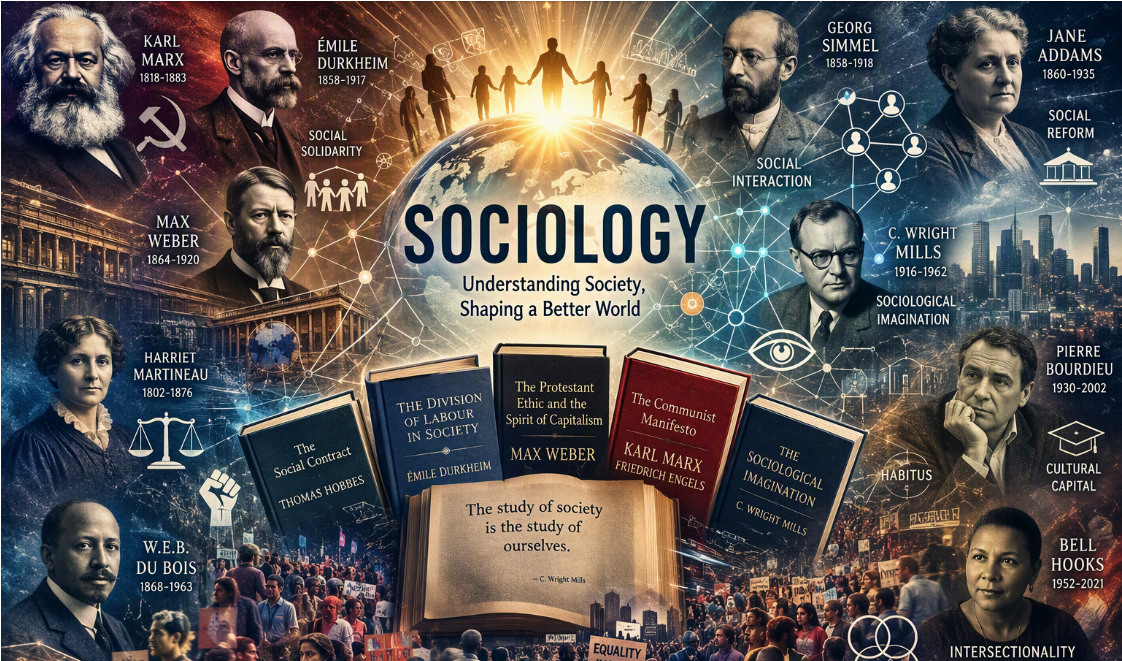
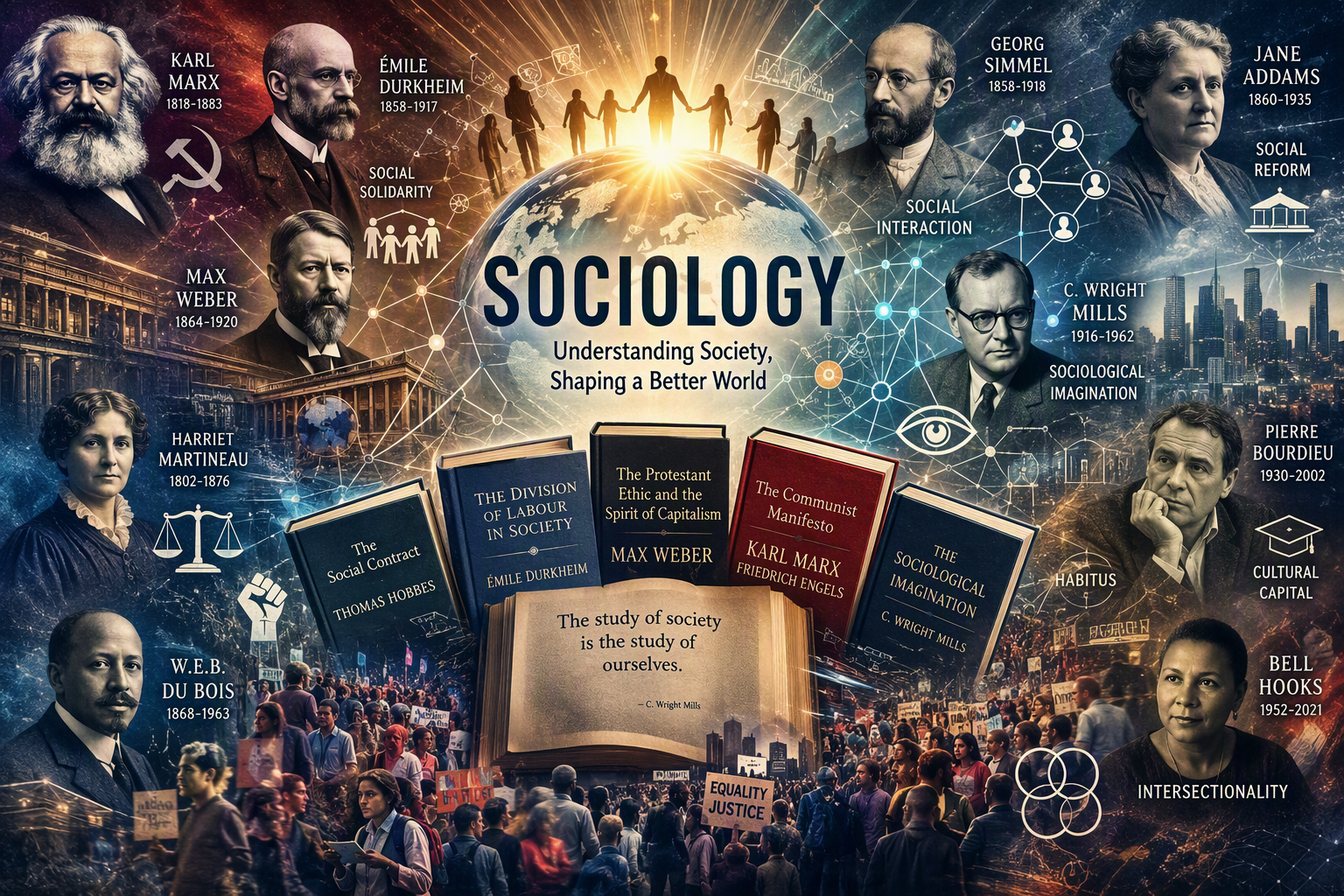
- This guide gives you easy facts about Karl Marx, Emile Durkheim, and Max Weber. These three are the main people you need to know in classical sociology.
- You will read a simple summary of the big ideas like structural functionalism and symbolic interactionism.
- The article talks about how these theories help you understand social change, social behavior, and social order.
- It also gives you tools, such as mind maps, daily practice, and tables to compare the important points.
- You will see how these ideas show up in today’s world. There are cases, current issues, and practice exam questions.
- The guide also shares links for free PDF help and trusted places where you can read more.
Table of Contents
Introduction
If you ever ask, “Who are the main thinkers in the field of sociology, and what do they say?” this guide will help you. The discipline of sociology uses social theories to talk about the social world, social behavior, and social norms. These key names, from the past and those with new ideas, help you see the social world in a clear way. There are also some tips here to help you remember what they say. You will feel more sure when you use their ideas.
Defining Sociological Thinkers and Foundational Theories
Sociological thinkers are people who share ideas about how we see society. What they say helps us know more about social structure, how different groups act, and how people connect to each other. The work they do lets you see the nature of society in a clear and simple way. Their ideas also help you see how the people around you and what happens in your life shape who you are.
Many of these ideas are still important in the sociology of education. They also help people look at inequality. Karl Marx spent a lot of time talking about the means of production. Other people talked more about order, how people act with each other, and what people believe. If you want to know why these thinkers matter, you have to look at what makes someone an important thinker, what their main theories are, and how they do their work.
What Makes a Thinker “Essential” in Sociology
An important thinker in sociology is not just someone many people know. The most important sociologists share ideas that still help us see the social world better. What they write plays a big part in how teachers, students, and researchers understand social institutions. It helps us see how people act and how things can change over time in our world.
You can often tell who is an essential thinker by looking at these three signs:
- Their ideas gave a base that still lasts, like conflict theory or seeing how things are built.
- Their thoughts can still help us look at social issues today and how people live together.
- Their work shaped later thinking, like critical theory and talks that people have now.
Another reason they matter is they help things move forward. A thinker can be important if people keep talking about their ideas. Some people want to make their ideas better. Others may say those ideas are not right. This is why you still hear names from old sociology when people talk about education, religion, inequality, and power. Their ideas still shape and help today’s sociology.
An Overview of Major Sociological Theories
If you want to know the main ideas in sociological theory, there are three ways you often see. Structural functionalism looks at how each part of society helps to keep social order. Conflict theories talk about how people and groups go against each other. They show who has more power and who gets the most from the way things are now.
Symbolic interactionism is about how people talk and act with each other in everyday life. It looks at the things we say and do, the names we use, and the meaning we give to things. This way, we can see how social interaction and social construction help build our ideas of who we are and what we do each day.
| Theory | Main Focus | Simple Use |
|---|---|---|
| Structural functionalism | Stability, institutions, balance | Explains how family, education, and government support social order |
| Conflict theories | Power, inequality, group interests | Examines class, advantage, and struggle |
| Symbolic interactionism | Meaning, labels, interaction | Shows how people act based on shared definitions |
Together, these theories help you look at society in many different ways. They do not give just one answer or point of view.
Methods Used by Influential Sociologists
Sociological theories help us see why people act a certain way with each other. They link different ideas to real proof we can find. The best-known sociologists did not just say what they feel. They watched what happened around them, made comparisons, and used data collection. This is how they found social patterns in many places like communities, schools, workplaces, and even in history. Because of this, sociology has grown. Now, the field is connected to scientific knowledge.
In practice, their methods often involved:
- This is about studying groups, places, and big changes in society as they happen over time.
- It is about looking at different societies or levels of people to see why they do things in the ways they do.
- It connects ideas to things people do in religion, jobs, schools, or government.
These ways are important because they make sociology useful. When you tie a theory to evidence, you can use it to answer questions you have today. If you study things like inequality, how large groups work, or how people talk to each other, method helps you turn big ideas into tools. These tools help you look at and understand these things.
Classical Sociological Thinkers and Their Key Contributions
When people talk about the top thinkers in classical sociology, they often think of Karl Marx, Max Weber, and Emile Durkheim. Each one had their own way to look at how people, power, and rules work in the world. What they wrote is still used today. It helps us look at things like the gap between rich and poor, large groups, and what people feel or think.
Marx looked at the means of production and how they can drive social change. Weber talked about the way authority, bureaucracy, and social status work in a group. Durkheim studied how people stay together and feel united with each other. Auguste Comte helped to build this field of study from the start. The next parts will talk about these classic ideas in simple terms.
Auguste Comte and the Birth of Sociology
Auguste Comte is known as the person who began the discipline of sociology. He is important because he wanted people to study society with structure and scientific knowledge. This was different from just using personal thoughts. Because of the way he looked at it, sociology turned into a real field by itself.
He wanted to know how social order happens. He said you can find out by looking at social life in detail. At that time, this was a big deal because sociology needed a goal. Comte helped show that people can study society in a step-by-step way, just like we do with other things and ideas.
Comte is one of the first people to work in the field of sociology. He is also one of the most important people in this area. He did not just give a single idea or thought. He tried to make sociology a field on its own. The people who came after him used what he started, and each of them moved in their own way with it.
Karl Marx: Conflict and Social Change
Karl Marx is one of the main people to think of when you look at classical sociology. He gave big ideas that help us know more about conflict, inequality, and social change. Marx said that in a capitalist society, the way money and work are set up shapes the whole social structure.
He pays a lot of attention to the means of production. He says that in society, there are two main groups. One group owns the things that are needed to make goods. The other group works and sells their work to get money. This creates an unfair system. It also leads to tension and bad feelings. Conflict theorists keep using the idea of means of production when they talk about class gaps and who gets more from the system.
Marx’s work is still good to use because it connects the study of money with real life. If you look at work conditions, how much wealth people have, or feel that workers are left out, you can use his ideas to explain these things. This is why Marx is still important in theory and helps us study how people live and work.
Max Weber on Authority, Power, and Rationalization
Max Weber is someone you should know about. While Marx spoke a lot about class and money struggles, Max Weber focused on things like authority, social status, how rules are used, and how big groups work together. The ideas he gave us help people see how modern groups and organizations work. He also helps explain why strict systems feel good in some ways, but can also feel like they hold us back.
Weber’s idea of rationalization shows that people now use more rules, numbers, and steps in social life. This is tied to bureaucracy, where power is based on jobs and roles, not just personal connections. His way of thinking helps us see how things are managed in the united states and in India.
He also made the talk about unfairness bigger. Weber did not only focus on class. He showed that things like honor and status are also important in how people be grouped. This makes his work helpful if you want to learn about power, the way people be ranked, and even later talks about the power elite.
Émile Durkheim’s Theoretical Legacy
If you want to read about Emile Durkheim’s theories in a PDF, it helps to know his main ideas first. Emile Durkheim talked a lot about social facts. He also looked at how work is shared between people. He wanted to show the things that help people stay close and feel like one group. His thinking makes it easy to see how social cohesion works among people.
His work is important. He brings together what people do and how the bigger world works. With ideas like the collective conscience, Durkheim showed that society can shape what we feel is right or wrong. He also looked at how we act. In the next parts, you will see his main ideas. We will explain them in a way that is simple and easy to read.
Durkheim’s Theory of Social Facts
Emile Durkheim said we can see why people act the way they do by looking at social facts. These are things that are outside the person, but still change how people act. That means rules, what is normal, what others say we should do, and what people believe are all social facts. All these things guide what people do in a social structure. Emile Durkheim showed it is through these that social behavior takes shape.
This is important because people do not live or act on their own. Social norms shape what people do, what they feel, and how they feel about where they belong. Durkheim said you need to look at these bigger ideas, not just each person’s reason, to know why people get to do what they do. This is what the study of society is about.
His idea helps people see social cohesion better. When everyone has the same rules and values, life seems more stable. If these supports get weak, people feel more confused and stressed. So, social facts are a good way to see how society affects what we all do each day.
Division of Labor and Social Integration
Emile Durkheim is one of the main people in modern sociology. He talked about how work is done by people in a group. He said that when life in a society gets more complex, people get more focused jobs. This change does not always make the group less strong. It can help build new ways that people need and help each other.
That idea can help people feel like they belong to a group. When several roles work well together, people feel connected to their community. Social institutions, like schools, families, and workplaces, help keep these bonds strong. Because of this, Durkheim is still important when we talk about education and how people feel they belong.
His ideas help us when we think about young people. There is a lot of change for them. Not enough support or not knowing what comes next can make people feel alone. Durkheim’s framework shows it is good to have steady places and a shared goal in a world that keeps changing.
Religion and the Collective Conscience
When people talk about the top sociological thinkers, the name Emile Durkheim comes up a lot. He spent much of his time looking at religion. Emile Durkheim did not just think of religion as beliefs. He wanted to know how it works in social life. He showed how religion helps keep a group together.
Durkheim said that religion helps keep the shared ideas and rules in a group. He called this the collective conscience. With religion, people feel they are part of something bigger. Religion brings social integration to the group. It does this when people come together for the same rituals. Using the same symbols and sharing the same feelings helps, too. These things remind everyone that they all belong to the same group.
This idea is still good today because it connects what people believe with the group that they are in. Festivals, ceremonies, and things people do together can help everyone feel close, even if they come from many different places. Durkheim wanted to say something simple and clear: religion is not just a personal belief. It also helps people feel like they belong to their group.
Modern Theories and Influential Contemporary Thinkers
Today, some big traditions in sociological theory are still very popular. For example, symbolic interactionism and structural approaches are still talked about a lot. But, the look of contemporary sociological theory has changed. This is because many thinkers from the late 20th century shared new ideas. These new ways of thinking made people talk more about things like identity, how groups act, and power.
Names like Michel Foucault and Anthony Giddens are often seen in talks today. But old ideas are still important, too. They help us see what people do every day and how large systems work. The next sections will talk about some of the most important new ideas.
Symbolic Interactionism and George Herbert Mead
Symbolic interactionism is a way to understand social behavior. It looks at small moments when people talk or meet with others. This idea does not start by looking at big groups. Instead, it sees how people get meaning from their daily social interaction. With symbolic interactionism, you can see that human behavior can change depending on how people feel about a situation. What we do is not only based on facts but also on what we think and feel in that moment.
George Herbert Mead is linked to this way of thinking. He said that the self grows when people talk with others and connect. This means you find who you are by talking, seeing how people act with you, and using the things people use to show ideas. Thanks to george herbert mead, we see that human awareness comes from being social. It does not come just from inside a person.
This way of looking at things connects to social construction. The names, roles, and what people expect can change how they act. A group makes these ideas together. If people in the group think something is real, that idea can change how all of them act, feel about others, or who they are.
Talcott Parsons and Structural Functionalism
Talcott Parsons is well-known for structural functionalism. He showed that the best way to look at society is as a system with several parts. These parts are called social institutions. A few important ones are the family, schools, and the government.
From this view, every institution helps make social order. When all the parts work together, society stays steady. If they do not, there can be trouble or strain. This way of thinking was very big in academic sociology in the United States.
So if you think about the main ideas and what people say, Parsons is in the functionalist group. He explained how the different parts in our society mix and work as one big social system. You still see this big-picture way of looking at things in the early classes of sociology. This idea helps a lot when you get ready for exams.
Feminist Perspectives in Sociology (Harriet Martineau, Sylvia Walby)
Feminist ideas changed modern sociology in a big way. They made people pay more attention to gender inequality. These ideas showed that a lot of work in this area was about men only. This made experts ask new things like, “Who do we study?” and “Who do we not listen to?” Because of this, people now work in new ways. The field now cares about more experiences and tries to help more people.
Harriet Martineau helped people notice social issues that most did not see before. Sylvia Walby took her work further. She talked about how there is unfairness in society, especially with men and women. Both of them wrote about power, work, family, and public life. Their ideas helped sociology understand these things better, and showed how all of them link to each other.
Their influence matters because today, sociology aims for a more inclusive society. Feminist points of view do not just add women to old ways of thinking. They make people in this field think again about what they believe. They also bring forward experiences that often get missed. These views show how unfair treatment can be seen in places and in people’s day-to-day lives.
Memorizing and Understanding Sociological Theories
Here are some tips that help you remember more about sociological thinkers and social theories. You can start with easy ways to remember little things. Try turning big ideas into clear groups or simple patterns. You will get to understand social theories better if you can link a name, what they think about, and a good example together. Many people like using mind maps and short comparison sheets for this. These tools help a lot.
When you get ready for an exam, you need to do more than just remember facts. You have to understand what they mean, too. When you use comparative tables, you can better see what each thinker said. If you read your notes often, this helps you keep these ideas fresh. When you practice writing answers, you learn how and when to use each thinker’s ideas for questions. The next two sections will show you some good ways to do these things.
Techniques for Remembering Thinkers and Theories
Quick memorization gets easier when you keep things simple and do not change what they mean. You do not have to read the same chapter again and again. Try to connect the thinker, the theory, and an example. This way is good for young people who are getting ready for tests. It helps turn long notes into short hints you can remember.
Try these simple methods:
- Use mind maps to show how one thinker connects to the main themes, some examples, and the keywords.
- Make easy-to-read tables. This can help you compare Marx, Durkheim, and Weber on the same topic.
- Use short study guides. Also, spread out your revision so you go over ideas again from time to time.
Another good way to get better at something is to practice writing answers. Try to make a short reply with one theory. This helps you remember it more than just reading. If you match each thinker to one real-life example, you will find it easier to keep in mind and do well in exams.
Comparative Tables and Mind Maps for Exam Preparation
When you get ready for an exam, it is good to use tables and mind maps. They help you a lot to see each key difference. With the help of these tools, you do not just try to remember every meaning alone. You also start to see social patterns in each theory. This can help you pick the right idea or thinker when you find questions about social change, order, or inequality.
A mind map works well if just one person is thinking about a topic at a time. A table is a good choice when several people are looking at the same issue. If you use both together, you can save time. It also helps make things clear for everyone.
| Topic | Karl Marx | Emile Durkheim | Max Weber |
|---|---|---|---|
| Social order | Shaped by class relations | Maintained by solidarity | Linked to authority and bureaucracy |
| Social change | Driven by conflict | Connected to shifts in integration | Tied to rationalization and organization |
| Key lens | Means of production | Social cohesion | Authority and social status |
This layout helps you read your notes faster. It can make your answers more clear and balanced. This is good when you feel stressed or under a lot of pressure.
Applying Sociological Theories to Everyday Life
You can use sociological theories to see real-world situations with a fresh view. Think of them like tools you can use, not just old words to remember. They help you understand social issues, social behavior, and things that happen in your life each day. This can make the way you read, write, and think much deeper.
For example, one way to look at things can show us why a system stays the same. A different way can help people see hidden gaps or what role social interaction has. Case studies make this clear because they link big ideas to things that really happen. The next parts will show how this plays out in practice.
Using Theory to Analyze Social Issues in India
The easy way to use a theory is to connect that idea to the problem you see. In India, you can use thoughts from old thinkers to look at social issues like unfairness, rules by the government, and stress in the society. This can help your answer move from just saying what happens to seeing why people face these problems.
For example, Marx talks about how city people with a lot can be very different from those who work hard in the countryside. He looks at these big gaps by thinking about money, jobs, and how people in a group treat each other. Weber helps us see how things go in offices, why too many rules can slow things down, and how bosses have more control. Durkheim explains what happens when rules or support fall apart and shows how that can hurt social order and social structure.
This style of teaching and writing became known in the late 20th century. At that time, students started to connect ideas with real-life examples. The most important thing here is that it is easy to read and follow. You pick the thinker whose idea fits the problem. Then, you give a simple example that supports it.
Case Studies: Applying Theory to Current Events
Case studies help you see how theories and things that are happening now connect. They show you how big ideas can explain what is going on in social life. When you practice with a few examples, it is easier to find out which idea will fit a new problem.
You can apply theory like this:
- Use Marx’s idea of alienation to talk about workers in the gig economy and those with insecure jobs. Workers in these jobs often feel they do not belong to their work. They feel cut off from the tasks they do, the other people in the job, and from the final thing they help make. There can be no real control over the job, which makes them feel lost, alone, and left out.
- Use Durkheim’s anomie to look at people’s worry during tough times when the economy is not doing well. When the old ways break or rules are mixed up, people feel out of place. They feel confused and do not know what to value or believe. This can help show why many feel more unhappy and stressed now.
- Use Weber’s bureaucracy to show why some office systems or big groups feel slow and stiff. Many rules, much paper work, and too many steps make people wait a long time. The system feels cold, hard to change, and full of rules that make things tight.
- Use religion and solidarity to show how public festivals help people feel close as a group. When people get together for such events, they feel more united, feel like one group, and feel part of the same thing. This helps make the community feel strong and gives us a greater sense of being together.
These examples show social patterns and not just one thing that happens. They help make writing better because they put the idea, time or place, and proof together. This is the way sociological theory is useful in essays, classrooms, and when people talk with each other.
Essential PDFs and Study Guides for Sociological Thinkers
If you want to know where to get a free PDF on sociological thinkers and their theories, there are many study guides and learning resources out there. These can give you easy-to-read summaries. You can find books, websites, and links for downloads that will be good if you need to prepare for exams. You can read about the main ideas fast, so you do not feel lost with a lot of text.
It is always good to use reliable sources. Try to find materials that show theories in the right way. Look for text that compares thinkers and gives examples of their ideas. Resources about sociology of education, exam help, and how to do data collection will help you more than random notes.
The next parts will talk about online choices and good books for Indian students.
Free PDF Resources Available Online
It is easy to get free help for sociology in the style of a PDF when you look at well-known online sources. You do not have to check random sites. The info collected leads you to course sites, pages that show basic ideas, and open sites that can help with some questions. These places are good for a quick read or when you want to go over what you learned before.
You can begin with:
- You can get e-books and other content from exam sites for the course you take.
- Look for online links where you can read short notes and basic definitions about the important thinkers.
- Some public policy pages show how theory connects with today’s social issues.
- People in groups share their study notes with each other in online learning groups.
Even when the source is free, you have to check if it is clear and if you can trust it. Good study material will tell you what the ideas mean in the right way. It will not mix up what different people say. There will also be some examples in it. When you use good and trusted sources, you save time and stay away from mistakes. This is very helpful when you read over your notes before the exam.
Trusted Books and Documents for Indian Students
For Indian students, it is good to read trusted books, not just short notes. These books have more clear details about sociological thinkers. They also show you how to compare many ideas and help you make strong points. The material here gives you some reliable books. Many students use these books to get ready for sociology.
Useful options include:
- Sociology: Themes and Perspectives by Haralambos and Holborn
- Sociological Theory by George Ritzer
- You will get study guides that help make your course work clear. These are made to help you when you study for exams.
These resources help because they join ideas with understanding. A good book does more than give you names. It will show you what each person said, how those ideas are not the same, and ways you can use them. If you want to get a lot of knowledge and do well in exams, read good books you can trust first. Later, use short guides to review before your tests.
Frequently Asked Questions (FAQ)
Sociological thinkers have changed the way we think about social behavior and the nature of society. People like Karl Marx and Emile Durkheim wrote about how groups act and why they do what they do. Their work on social change, social cohesion, and what makes a society work is still important now.
If you want to read more about these things, there are many good resources out there. A PDF guide is a helpful way to read about the discipline of sociology. It lets you find and understand the main ideas of important thinkers like Max Weber and Herbert Spencer. A guide like this also helps you read about key ideas around social behavior and how people in a group live together.
Which sociological thinkers most influenced modern theory?
Karl Marx, Max Weber, and Emile Durkheim came up with big ideas for sociology. Talcott Parsons made these ideas about structure stronger. Michel Foucault made people see power and places like schools and prisons in new ways. All of them showed us how to think about order, who has more, and who is in charge. They made a big change in theory today.
Where can I find reliable PDFs on sociological thinkers and theories?
You can get free PDF help from top online places, some exam sites, and study guides. For better understanding, read a good book too. The best resources will show you sociological theories in a simple way. They will also connect the right thinkers. These come from trusted schools or known places for learning, not random uploads.
What are the best tips for quickly memorizing sociological theorists?
Use simple ways to help you remember things. Mind maps help you link one thinker to the main ideas. A chart lets you see how several thinkers are the same or different. You can make a short study guide too. Go over what you learn many times. Practice writing your own answers. These steps help you remember better and feel good before the exam.
Conclusion
To sum up, when you learn about the main people in sociology and what they thought, you understand more about how people act and how society works. If you read about names like Comte, Marx, Weber, and Durkheim, you get to know what they did in the past. You also see that their ideas still matter now for the problems you see in the world today. If you are a student or you just want to know more about sociology, you can use things like PDFs and tables as study tools to make learning simple. Take some time to read about each theory. Try to use them as you think about your life and people around you. These ideas can change the way you look at things. If you want to learn even more, you can download our free PDF guide. It shows you in a simple way who these thinkers are and how their ideas help us learn more about human behavior.