Key Highlights
- This guide gives you a short timeline of ancient Indian history to help with your UPSC preparation.
- You will go from the Stone Age to the Indus Valley Civilization in the Indian subcontinent.
- It talks about the Vedic period, big kingdoms, and the rise of the Mauryan Empire.
- You will also look at what came after the Mauryan changes and the Gupta Empire in a simple order.
- The focus is always on what is useful for Prelims, UPSC Mains, and answer writing.
- It will help you look over the timeline of Indian history without any mix-up.
Table of Contents
Introduction
Ancient India can feel big and hard to manage when you start UPSC preparation. The best way is to read ancient history like a timeline, not a mix of facts. When you look at what happened in order, the Stone Age, Indus Valley, Vedic culture, the Mauryan rule, and the Gupta period all start to make more sense and are easier to remember. This guide gives you a clear path to use. If you want to read faster and remember more, studying ancient India in a timeline is a really good idea when you first get going.
Understanding the Importance of Ancient History for UPSC Aspirants
Ancient history is important when you study for the UPSC preparation and the civil services examination. You will find questions about it in General Studies Paper I. It helps with both remembering facts for Prelims and with answer writing for UPSC Mains. A clear timeline can help you connect all the events, rulers, moves in different religions, and changes in areas.
If you find dates hard, try using a time-order way to revise. Put the dynasties and the big events in the right order first. Make short notes on them. Go over old previous year papers during your study. When you know the order, ancient history will feel less loose and out of place in your mind. You can see this in action if you start with how UPSC sets up its syllabus.
How Ancient Indian History is Structured in the UPSC Syllabus
In the latest UPSC syllabus, ancient India is one part of three main history sections. These three are Ancient, Medieval, and Modern. For the exam, ancient India covers the time from prehistory up to the year AD 700. So, it is good to start your revision with the timeline first.
For UPSC Mains GS, it’s good to know the phases instead of just remembering names alone. It all starts with early cultures from prehistory. After that, you get the Indus Valley Civilization, then the Vedic period. Next in line are the Mahajanapadas, followed by the Mauryan Empire, several post-Mauryan kingdoms, and finally, the Gupta Empire. This order helps not only in UPSC Mains GS, but also in optional subjects like History. So, learning about each one—like the Indus Valley, Vedic period, Mauryan Empire, and the Gupta Empire—can be helpful for your studies.
The same setup helps you learn facts, themes, and changes at the same time. You are not just finding out who ruled at what time. You also get to see how things like society, the economy, religion, and power changed as the years went by. That is why you should now look for repeating themes and patterns in this timeline.
Key Themes and Patterns to Focus On
When you read about ancient history, do not see each chapter as its own thing. The UPSC likes it when you can spot patterns. This means you should look at how things like settlement, farming, religion, forming states, and culture changed over time. Doing this will help you make your answer writing better and more clear.
Here are a few ideas that show up again and again in the story of ancient India:
- People in the Indus Valley started to live in cities. They put a lot of thought into how to build and plan those places.
- The Vedic period was a time of big changes in how people lived and how they practiced their religion.
- Kingdoms began to get bigger. Some regions also got more power during this time.
- The Mauryas worked hard to build up their empire.
- The Gupta Empire, or the gupta empire, was a time when there was a lot of new art, ideas, and culture. People also learned many new things during this period.
These topics help you with both direct and detailed questions. If you know the important times and big events in these ways, it gets faster to read again. Now, let’s look at the full order of history you need for the exam.
Chronological Overview of Major Ancient Indian Periods
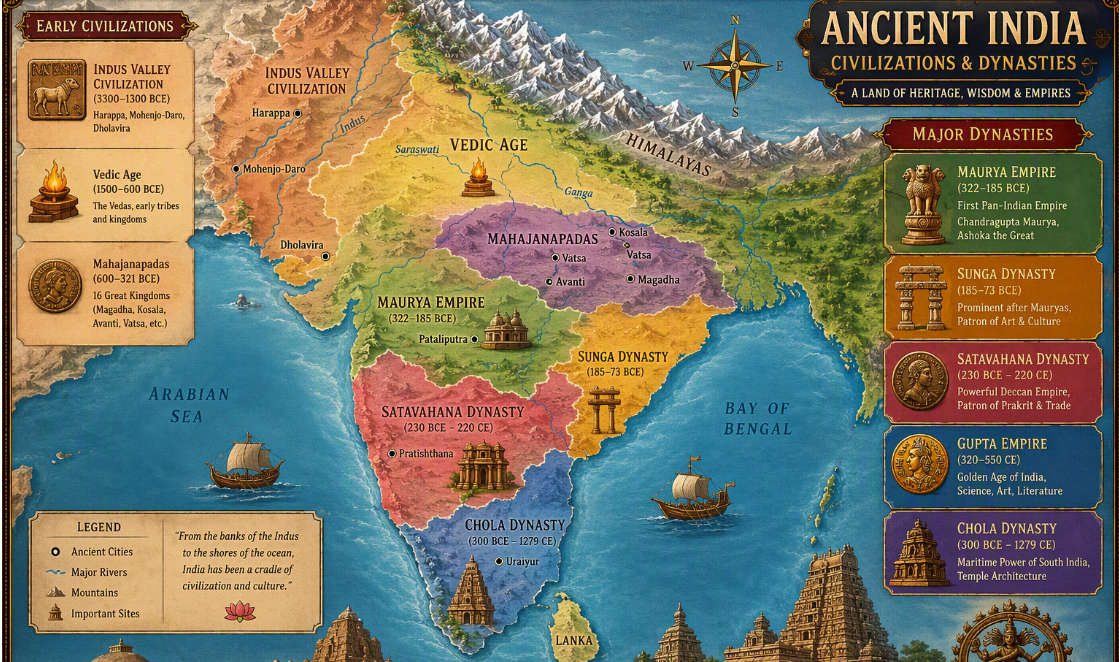
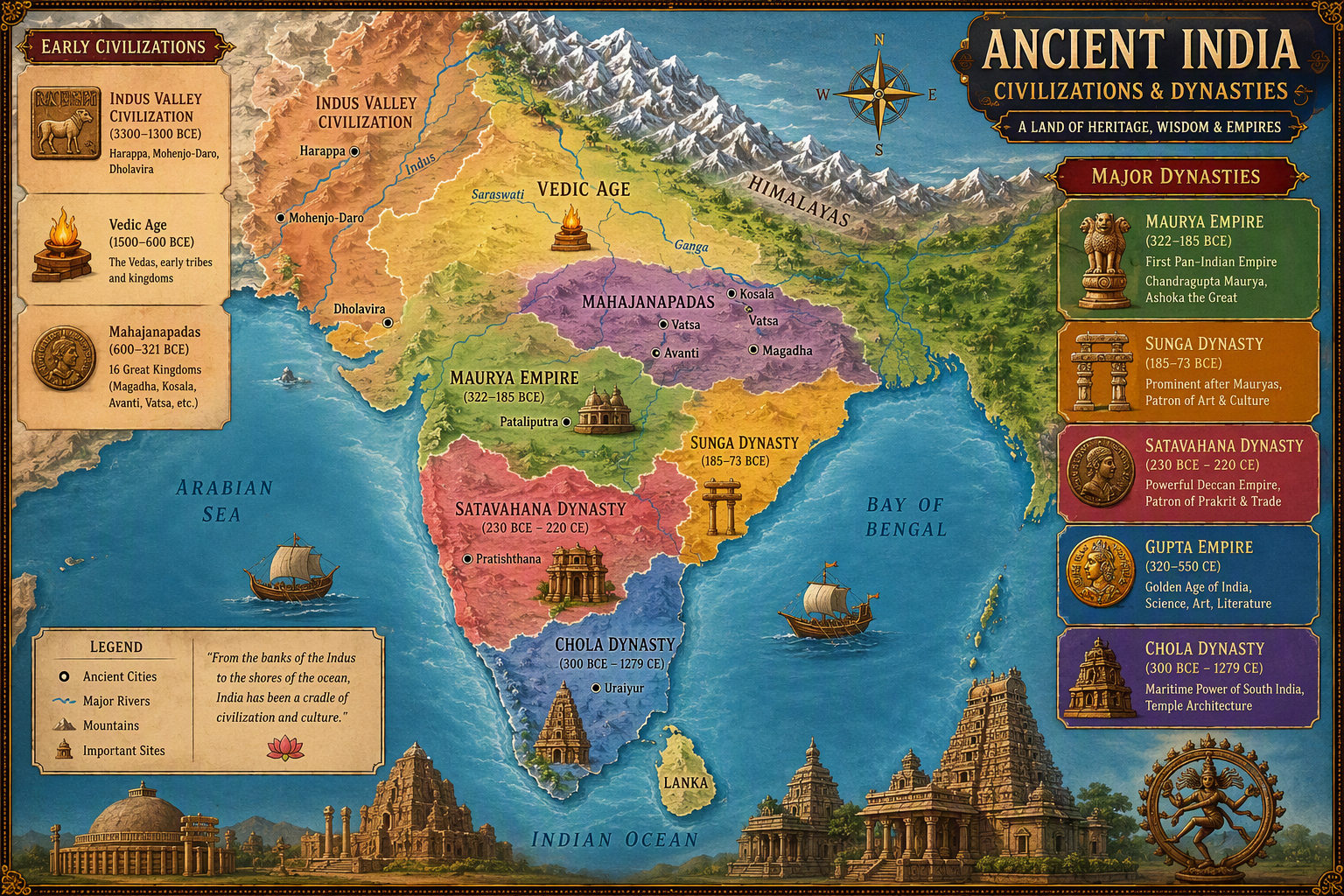
The best way to study ancient history is to follow a simple order of time periods. First, look at prehistoric cultures in the Indian subcontinent. After that, read about the Indus Valley Civilization. Then, learn about the Vedic Age. Next comes the Mahajanapadas. You should be sure to read about the Mauryan Empire, and then learn about the kingdoms that came after the Mauryan Empire. In the end, study the Gupta period. This way will help you understand each time period in the right order.
This order shows you a clear timeline of Indian history and helps you not feel lost when you read about different dynasties or changes in culture. When you know the main flow, it gets easier to fit the small details in the right place. Now, let’s start at the earliest time, where most things we know come from archaeological evidence.
Prehistoric Periods: Stone Age to Chalcolithic Age
The story of ancient India starts with the Stone Age. During this time, people lived very close to nature. They used simple tools and found new ways to live better over time. The palaeolithic period is seen in places like Bhimbetka, the Kurnool Caves, and the Narmada Valley. The use of stone tools and fire is important to this period.
After this, the Mesolithic phase came. People started the domestication of animals during this time. They also began to use microlith tools. Then came the Neolithic age. There was a major shift in how people lived. Agriculture started in this time. The wheel first appeared. People began to settle down and live in one place.
Important neolithic sites are Burzahom, Gufkral, Mehrgarh, Chirand, Mahagara, Hallur, Paiyampalli, Maski, and Daojali Hading.
The chalcolithic period is also called the Copper Age. During this time, people started to use copper with stone tools. Ahar-Banas, Kayatha, Malwa, and Jorwe are some of the key regional cultures from this age. For UPSC, these points are important. They show how people moved from a life of hunting to living in one place and starting early farming.
Indus Valley Civilization: Rise and Fall
The Indus Valley Civilization, also known as the indus valley civilisation, was one of the first big cultures in the indian subcontinent. It grew between about 2700 BC and 1900 BC, but it may have started before that. People know this time for its well-planned cities, buildings made with strong bricks, and the way people built their towns in a neat way.
For UPSC, put your focus on urban planning and daily life in that time. Archaeological evidence tells us the settlements were well planned and people had a strong civic culture. The domestication of animals was also a big part of early life in these areas. Things like beads and other decorative items also help us get to know more about craft work and how people spent their day.
The decline of this time did not be the end for ancient India. Instead, what happened was that the main center for growth moved to the Vedic world and the groups that came later. This change is important. It shows how things moved from the city life of Harappan culture to the way people lived and believed in the Vedic age.
Vedic Age and Later Vedic Phase
The Vedic period is part of the Iron Age and connects to when the Vedas were written. For UPSC, you can break it down into the early Vedic period and the later Vedic period. This makes it easy to see how things changed over time. You will not have to just keep facts in your head without knowing why they matter.
In the early Vedic period, life in society was simple. There was not much political power at that time. Later, during the later Vedic period, people started to settle down in more areas. The structure of society became clearer and had more rules. Political power was now stronger. All of this helped bigger kingdoms and states to form in northern India in the times to come.
When you go back over your notes, try to link the Vedic phase with bigger events happening in the Indian subcontinent. Some places like the Narmada Valley are from a much earlier time. It is good to place these sites right on the timeline, so it does not get confusing. After this, the story starts to show the rise of kingdoms, new religious groups, and how empires begin to get bigger.
Timeline of Prominent Ancient Dynasties and Empires
After you understand the cultural phases in ancient history, the next thing to look at is how dynasties and empires grew. At this stage, the UPSC may ask questions about dates, who the rulers were, and what they did. You need to start with the Mahajanapadas. Then, move to the Mauryas. After them, read about the powers that came after the Mauryas. Last, study the Guptas.
This order helps you sum up the most asked milestones of ancient india. You will not lose track of time while reading this. It also makes it easy to remember how political change happened across different parts. Now, let us start with the time of kingdoms. These kingdoms helped make the way for the first big indian empire.
Mahajanapadas and the Emergence of Kingdoms
The Mahajanapadas were sixteen big kingdoms or rule areas that came after the Vedic time. They were an important step in how the state started in ancient india. For UPSC, know that this time was when big land powers took the place of smaller tribal groups.
Among these Mahajanapadas, Magadha was the strongest. It grew under rulers like Bimbisara and later, the Nanda family. They made the land bigger and set the stage for coming together as one empire. This time was very important in northern India, but there were changes in central India and other places as well.
Another reason this time is important is because religions like Jainism and Buddhism started to grow. Many people in that time were looking for new ways to connect with the spiritual world. The Mahajanapada age was not just about politics. It also changed the way people thought and lived. This is why it is so key for anyone who wants to study ancient history.
The Mauryan Empire and Its Legacy
The Mauryan Empire was the first big power that brought together most of ancient India. Chandragupta Maurya started the Mauryan Empire. It was the start of a large Indian empire with strong rule. For UPSC exams, you have to know the order of rulers: first Chandragupta, then Bindusara, and then Ashoka. Every ruler helped to grow or change the empire in their own way.
Ashoka is the most important Mauryan emperor to study when you prepare for exams. The Kalinga War changed his mind about things. After the war, he started to support peace and Dhamma. His importance is not limited to India. He had a big influence in south asia, and his actions also reached into central asia. He was connected to larger events happening in that time.
| Ruler | Approximate Reign | Main Contribution |
|---|---|---|
| Chandragupta Maurya | 322–298 BCE | Founded the Mauryan Empire and defeated the Nandas and Greeks |
| Bindusara | 298–272 BCE | Extended Mauryan control toward the south |
| Ashoka | 268–232 BCE | After Kalinga, promoted Dhamma and became the best-known Mauryan ruler |
Post-Mauryan Kingdoms and the Gupta Era
After the Mauryan Empire ended, several regional powers began to grow in ancient India. Some of the main ones were the Sungas, Kanvas, Satavahanas, Sakas, and Kushanas. This was an important time because political power spread out. Each region started to grow and change on its own.
The Gupta Empire is often called the golden age of India. During the gupta period, rulers like Samudragupta and Chandragupta II became very well-known. Samudragupta is famous for his military wins. Chandragupta II supported art and science in that time. The gupta empire is important for questions about facts and also for those that make you think more deeply. This is why many people talk about the golden age of india when they discuss the gupta period.
The Gupta era shows how history can stay the same or change. Even after the Guptas lost power, there were new regional powers that took their place. In south India and the Deccan, strong kingdoms like the Pallavas and Chalukyas started to grow. So, the story of the Gupta Empire is not only about one big empire. It also helps you look at the bigger picture of different regional powers across the land.
Conclusion
To sum up, it is important for UPSC students to know the timeline of ancient history, especially if they want to do well in their exams. A clear way of studying, where you focus on things like the main dynasties, big events, and themes, will help you understand and remember more about ancient Indian history. When you read about indian history and learn about the people, keep in mind to use different books and ways of study that suit you best. This will help you feel ready for the exams and also let you feel proud of the rich heritage that made our world what it is today. If you want help with ancient indian history, feel free to get a free consultation from our experts!
Which are the key sources for studying ancient Indian history timeline for UPSC?
Use both literary sources and archaeological evidence to know about the ancient timeline. If you want to revise for exams, you need to look at the official website for the syllabus. Also, check the UPSC Mains topics and practice with previous year papers. This way, you can focus on the facts and what is needed for the exam.
Who are the most significant ancient Indian rulers and what were their main contributions?
In the history of India, Chandragupta Maurya was the one who started the first big Indian empire. Ashoka was the leader who gave the Mauryan Empire its strong moral values. Samudragupta made the empire bigger with military wins. Chandragupta II helped art and science to grow during the time of the Gupta Empire.
These leaders shaped the history of India. The Mauryan Empire and the Gupta Empire are both important in the story of the Indian empire. The Gupta Empire was known for great progress in the arts and science.
What is the best way to remember the chronology of ancient Indian history for UPSC?
The best way to study ancient history is to learn it step by step. You should make short notes with a timeline. Try to group events by time and keep going over your notes. Solve previous year papers often. This helps you remember facts for your UPSC preparation. It also lets you show structured ideas while answer writing.