Key Highlights
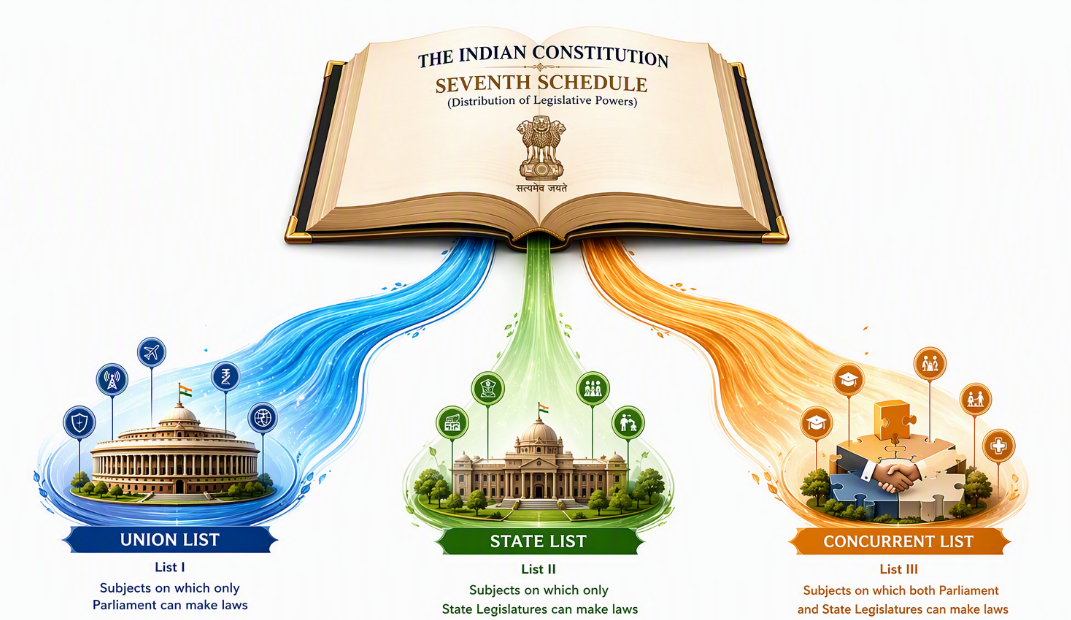
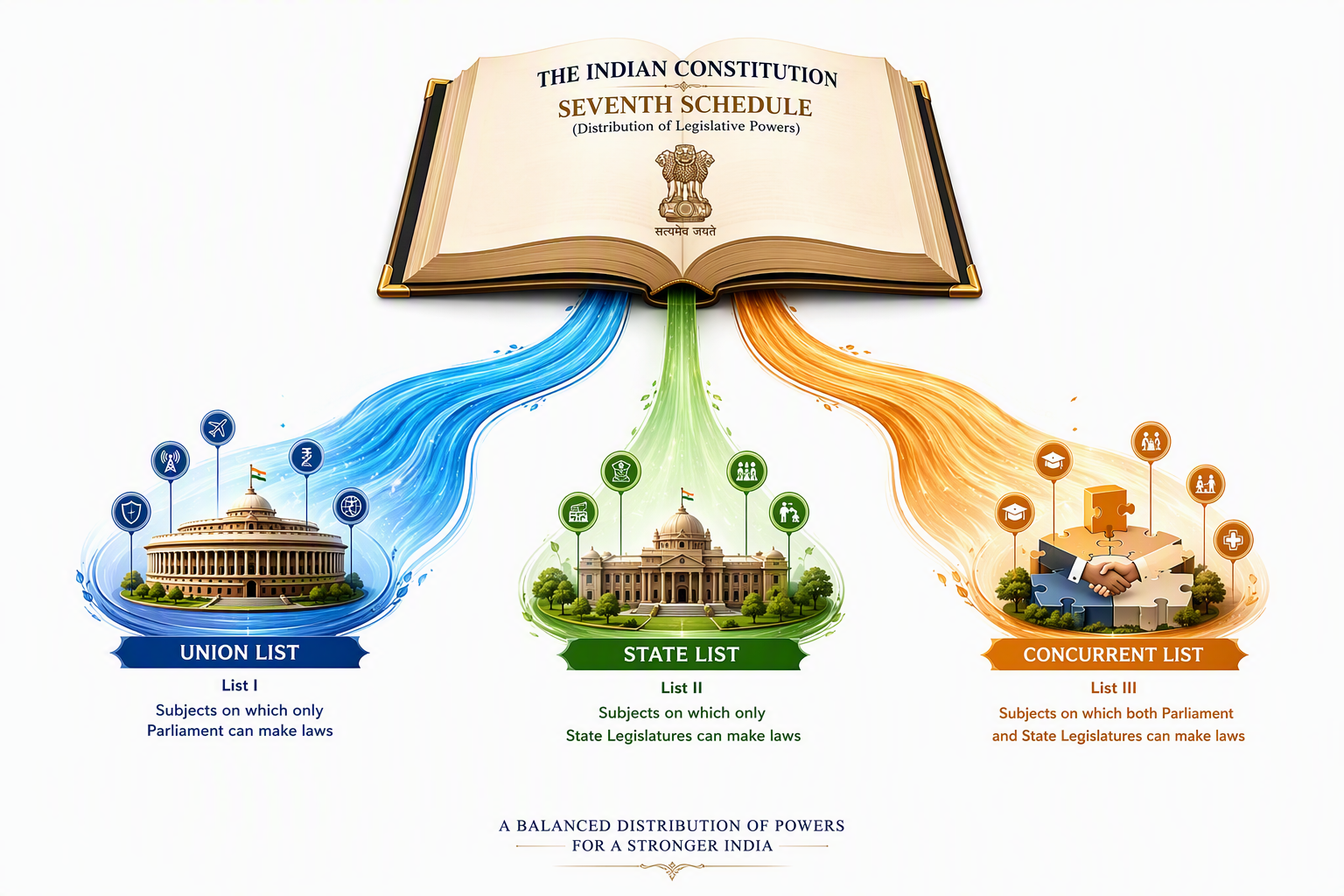
- The 7th schedule of the Indian constitution tells us how power is shared at different levels of the Government of India.
- There are three lists in it: the union list, state list, and concurrent list.
- The union list has topics that are important for all of India. These need one rule for the whole country.
- The state list gives the states their own control on things that only matter for them.
- The concurrent list means both Parliament and the states can make laws on these shared topics.
- For UPSC, the 7th schedule, union list, state list, and concurrent list are key to Indian polity and to how the center and states work together.
Table of Contents
Introduction
The 7th schedule of the indian UPSC is an important part of the constitution of india. It lays out the division of powers between the government of india and the states. In simple words, it shows who gets to make laws about what. This helps keep order in the government of india and stops the union and states from having overlap. In a diverse country like ours, the 7th schedule makes it clear how things should be done. The 7th schedule also comes up a lot in UPSC questions. It helps you understand the way lawmaking power is divided, the balance in a federal system, and how a big, varied country is run by its constitution.
Overview of the 7th Schedule in the Indian Constitution
The 7th schedule of the Indian Constitution is a detailed list. It deals with the distribution of legislative powers in the Constitution of India. The 7th schedule separates legislative subjects into distinct categories. This helps Parliament and state legislatures know their limits. Each group knows what it can do. This way, there is less confusion about who can make laws on different topics.
This setup helps with the division of powers. It also cuts down on constant legal friction. The topic matters for UPSC because you get to see how India runs lawmaking at different levels in the country. To get more from this, you should know its value for the exam and why it was set up in history.
Significance for UPSC Preparation
For UPSC aspirants, the 7th schedule of the Indian Constitution is more than just a topic to remember. The 7th schedule is a main part of what makes Indian politics work. It explains the legislative powers and shows who gets to make the laws. This is important to understand, as it tells us why this sharing of power matters in how the country is run.
The exam often checks if you know about the distribution of legislative powers between Parliament and the states. If you know the three lists well, you will feel more sure when you answer questions on federal structure, center-state relations, and the design of the constitution. Understanding the distribution of legislative powers helps you get these answers right.
This topic is very important because it helps you link static polity with what is happening now. When people talk or argue about things like education, forests, or public order, you can understand where they fit in the constitution. That is why if you want to do well in the UPSC exam, you should know the 7th schedule well. It is a key part for your studies.
Historical Context and Purpose
To understand the schedule well, it helps to know a bit about its history. India is a diverse country, so the people who wrote the constitution had to find a way to balance control from the national government and give some power to the regions to make their own choices.
The constituent assembly set up this system to make federal responsibilities clear. The idea was that some things are important for the whole country, and some are better handled by people closer to where things happen. This way, there would not be any confusion about who should make rules or laws for different areas.
The earlier Government of India Act helped people see why it was important to set clear rules about what subjects belong where. Later, in the Constitution, this idea became more clear and organized. The 7th schedule was made to do more than just set out rules. It was there to help the government of india work better in a big country with many states.
Constitutional Framework behind the 7th Schedule
The main base for the schedule comes from Article 246. It gives legal strength to the division of powers by subject. This article shows who has the power to make laws for each list. Because of this, the Government of India and the states can work in their own areas.
In practice, Article 246 works with the three lists to help Parliament and legislative assemblies know what they can do. It connects the words in the Constitution to the real work of making laws. To see the whole idea, you should read Article 246 by itself. Then, read the other articles that go with it.
Article 246 and Its Relevance
Article 246 is the main rule in the Constitution that gives meaning to the 7th schedule. The 7th schedule has three lists. Article 246 links these lists with lawmaking power. It shows how legislative subjects are split between Parliament and state legislatures.
In this setup, the Government of India handles things that matter to the whole country. The states deal with their own local issues. This clear division of powers helps make things work in an orderly way. It is not left to chance or just what is good for some people in power. The rules make sure that everyone knows who is in charge of what when it comes to national importance.
Its importance is seen when there are fights about who can do what. When this happens, Article 246 of the Constitution helps the court see which group had the power to make rules. This is why the Supreme Court is so important when we want to know how the country’s federal set-up works in real life.
Other Related Articles
While Article 246 is important, it is not the only rule you need to know. The Constitution of India has other sections too. These help show how the legislative powers are used and understood in the country. This helps keep things clear in a system where more than one group shares power.
One key thing to know is that Article 248 gives Parliament the power to make laws on anything not already in the three lists. This is important. There’s always the chance that new issues will come up, and we can’t know about them all right now. When things in the country change, this helps Parliament adjust with new rules.
You should also know that when there is a conflict between a central law and a state law, especially on topics that both cover, the courts use the constitution to solve it. The High Courts and the Supreme Court work to keep things clear for everyone. If you are getting ready for UPSC, understanding how the Supreme Court and High Courts give support when it comes to state law and central law makes your knowledge stronger for this topic.
The Three Lists Explained
The 7th Schedule uses three types of lists, called functional lists, to split up the legislative subjects. These lists show who will deal with what laws. There is the union list, the state list, and the concurrent list. Each of these gives lawmaking power to its own group or authority.
This division of responsibilities makes governance efficiency better and stops the same task from being done twice. The Union takes care of the national things. The states handle what is local. Both work together on shared areas. Now let us see each list one by one.
Union List – Subjects and Scope
The union list includes subjects that are important for the whole country. There should be one law for all these topics in the entire country. Only Parliament can make laws about them. In this way, the central government can control things that have to do with national importance, security, and planning strategies.
The scope is big because each state cannot take care of these things in a different way. Think about national defence, foreign affairs, railways, banking, and atomic energy. These areas must be the same all over the country if things are to run well.
| Feature | Details |
|---|---|
| List Name | Union List |
| Original Entries | 97 |
| Present Entries | 100 |
| Lawmaking Authority | Parliament |
| Nature of Subjects | National importance |
| Examples | National defence, foreign affairs, banking, railways, atomic energy |
State List – Main Subjects Included
The state list has things that matter most to a region. These are problems that can be different in all places. The state governments are able to make laws on these things. This helps give state autonomy and lets local wishes or needs shape policy.
You can see this in things that have to do with day-to-day running of a place. Public order in one state may need a different way than in another state. The same idea works for things like farming, cleaning up towns, and local government.
Some important state list subjects include:
- Public order
- Police
- Public health
- Agriculture
- Local government
This list had 66 entries at first. Now, it has 61 entries. For UPSC, you should know the state list shows India’s federal design. Many matters for the community stay with the states.
Concurrent List – Role and Importance
The concurrent list is where both Parliament and the state governments can make laws. It is good for some subjects that need both levels of government to work on them. This way, the division of powers is not too strict and can be more flexible.
Examples of this are education, forests, trade unions, marriage, adoption, and the protection of wild animals and birds. In these areas, the country has its own rules. But states also need to handle things their own way to fit what is happening where they live.
Its importance has gone up because today’s problems often go beyond one area. Climate change and other big issues can touch the whole country. They are also felt in each state and town. If there is a state law and a central law on the same subject and they are not the same, the central law will usually be the one that gets used. This helps keep things steady for everyone.
Amendments Influencing the 7th Schedule
The 7th Schedule is not the same as it was first made. Over the years, some changes have been made. These changes have shaped how the division of powers works. The biggest change is the 42nd amendment. It made a major shift by taking some entries out of the state list.
These latest amendments are important. They show that the legislative powers can change when the needs of governing change. The next two sections talk about how the 42nd amendment made an impact and what big changes it brought with it.
Impact of the 42nd Amendment Act
The 42nd amendment marked a big change in the way powers are divided under the 7th schedule. It took five subjects from the state list and put them in the concurrent list. This means the Union got more power in those areas of the division of powers.
The subjects that were moved include education, forests, weights and measures, protecting wild animals and birds, and the way justice is managed except for the supreme court and high courts. This was a big change for the system, not just a small update.
Its effect was big for the Government of India and the state governments. On one side, it helped the whole country work better together on major issues. But on the other side, it made people worry that there would be less room for states to handle things their own way. If you study for UPSC, you need to know both which subjects got moved and how this changed the way the government of india and the state governments work together in the country.
Key Changes in Division of Powers
When you look at the big changes, the main thing is that the authority moved from just the states to both the states and others sharing control. This changed the division of powers, but it did not take the states out of the picture. The states are still there.
After the change, the central government started to play a bigger role in areas that used to be only for state governments. Now, these subjects are in the concurrent list. This means both the central government and state governments can make laws about them. But if there is a problem between the two, the central government usually has the upper hand.
This change shows that the way the constitution is made can change when the government needs something new. The latest amendments show that some legislative powers should not stay only with local groups. For UPSC, this helps because it connects changes in the constitution to how things work in practice. It also shows how the center and the states need to work together and keep things balanced.
Division of Powers Between Centre and States
The division of powers is at the heart of center-state ties under the 7th schedule. The 7th schedule sets out the distribution of subjects very clearly. This helps the Constitution avoid fights between Parliament and state groups. But still, there can be times when they do not agree.
These fights often start when one group thinks the other has stepped out of line. It can also happen when a state law clashes with choices made by the Union. That is why it is good to look at how these problems get solved and see some real cases about center-state relations.
Resolution Mechanisms for Disputes
Disputes between the Union and the states are solved by looking at what the Constitution says. The first thing to do is to check which list the subject is a part of. You also need to see if the law was made by the right legislature. This is the key for conflict resolution in the federal setup.
If the issue is about the concurrent list, there is a clear rule. When a central law does not agree with a state law, the central law will usually win. This helps keep things the same in places that both handle.
Courts are big players in this process. High Courts can look at these questions, and the Supreme Court gives the final answer when there is a need. For UPSC, you must remember these disputes do not just get solved by political steps. They are solved by the rules in the Constitution and by the work done by the courts through review.
Examples of Centre-State Relations
Center-state relations get simple when you link the schedule with real problems in the constitution. In most cases, the lists show who can make laws. But when things are not normal, the way power works can change.
For example, the way the Constitution is set up lets the Union do more during special times. This changes how the Government of India and the states work with each other. But state autonomy is still a key part of federal values.
A few useful examples are:
- In normal times, Parliament makes all laws for things in the union list.
- States take care of local issues that are on the state list.
- When there is a national emergency, the union can take on a bigger part than before.
- If president’s rule is in place, the usual work at the state level can change.
These examples show why the schedule is important, not just in theory. The way the schedule is set up changes who has real power in the system.
Provisions and Pointwise Summary for Quick Revision
If you want an easy way to remember the 7th schedule, think of it as a map in the Constitution of India. It shows you who has the power to make laws about each subject. The 7th schedule helps you see how legislative powers are divided. This makes it simple to understand the federal structure.
This pointwise summary is good for you before prelims, mains, or interviews. It turns a wide topic into easy points you can recall. The next two sections talk about the features and exam uses that you should read again and again.
Highlighted Features Relevant for UPSC
For people who are upsc aspirants, it is good to start revision by looking at the structure first. The details can come next. The 7th schedule is not hard to remember. All you have to do is to connect each list with the type of subject it has, and with the group that can make laws on it.
Another good way to get ready is to remember the amendment angle. The questions may ask you not just about state list or concurrent list items, but also about how these lists change over time. You should look out for entries that move from the state list to the concurrent list.
Keep these quick points ready:
- The 7th schedule has three lists.
- It splits the legislative powers between the union and the states.
- The union list is there to deal with things of national importance.
- State list subjects are about matters that are more regional or local.
- Most of the time, when there is a clash on things both can make laws on, the union government will have the final say over the states.
These points help you with a strong way to get ready at the last minute.
Applications in Indian Polity Questions
In Indian polity questions, the schedules can come up in many ways. You may get a question about which list a subject is in. Sometimes, there will be a question to test how well you know federal rules using an example from real life.
For upsc aspirants, it is not enough to just memorize the lists. You need to know how the state legislature and the central government work together when a subject belongs to both of them. It is also important to understand what happens when any legislative subjects get changed by an amendment.
This topic can really help you cut out wrong answers. If you know that public order is there in the state list, and foreign affairs is in the union list, then many questions feel much easier. This is why the 7th schedule is a good area for scoring marks when you prepare for polity.
Frequently Asked Questions (FAQ)
Understanding the 7th Schedule can lead to many questions, especially for UPSC aspirants. A lot of people want to know the role of the Union List, State List, and Concurrent List in how legislative powers are shared. Some ask how the 42nd Amendment has changed state autonomy and local governance. There are also questions about what these lists mean for public health and national defence. If you clear these doubts, you will know the constitutional framework better and see how the division of responsibilities works between the different levels of government.
Why is understanding the 7th Schedule critical for UPSC?
For UPSC aspirants, knowing the 7th schedule is very important. It shows how the division of powers works in the Indian Constitution. You can see which government handles what laws. It helps you know all about legislative powers and how the country is set up to make laws. This is why it comes up a lot in polity questions in both the prelims and mains exams.
Which articles cover the 7th Schedule directly?
Article 246 is the main rule that goes with the 7th schedule in the constitution of india. It links the functional lists to the legislative subjects. The article tells us how the division of powers works between parliament and state legislatures. Article 248 is also key for those things that are not in the schedule and covers residuary matters.
How are disputes resolved between Union and State regarding the 7th Schedule?
Conflict resolution takes place when the supreme court and high courts look at the rules in the constitution. They check if something is on the Union, State, or Concurrent List. If there is a problem between a central law and a state law about something on the concurrent list, the central law usually wins.
Conclusion
To sum up, knowing the 7th schedule of the Indian Constitution is very important if you are getting ready for the UPSC exam. It is the base for how powers are shared between the Centre and the States, and plays a big role in how we run things and make decisions in the country. When you learn about the Union, State, and Concurrent lists, and also look at the changes made over time and the ways to solve problems, you get better at answering questions on Indian polity. The more you know about the 7th schedule, the more sure you feel when giving your exam. This also helps you understand the rules and laws that lead the nation. If you need help or a plan made just for you on the 7th schedule of the Indian constitution or UPSC finals, feel free to ask for a free chat and tips!